The Prehistoric Archaeology Blog is concerned with news reports featuring Prehistoric period archaeology. If you wish to see news reports for general European archaeology, please go to The Archaeology of Europe Weblog.
Wednesday, November 20, 2019
UN HYPOGÉE DU NÉOLITHIQUE À SAINT-MEMMIE (MARNE)
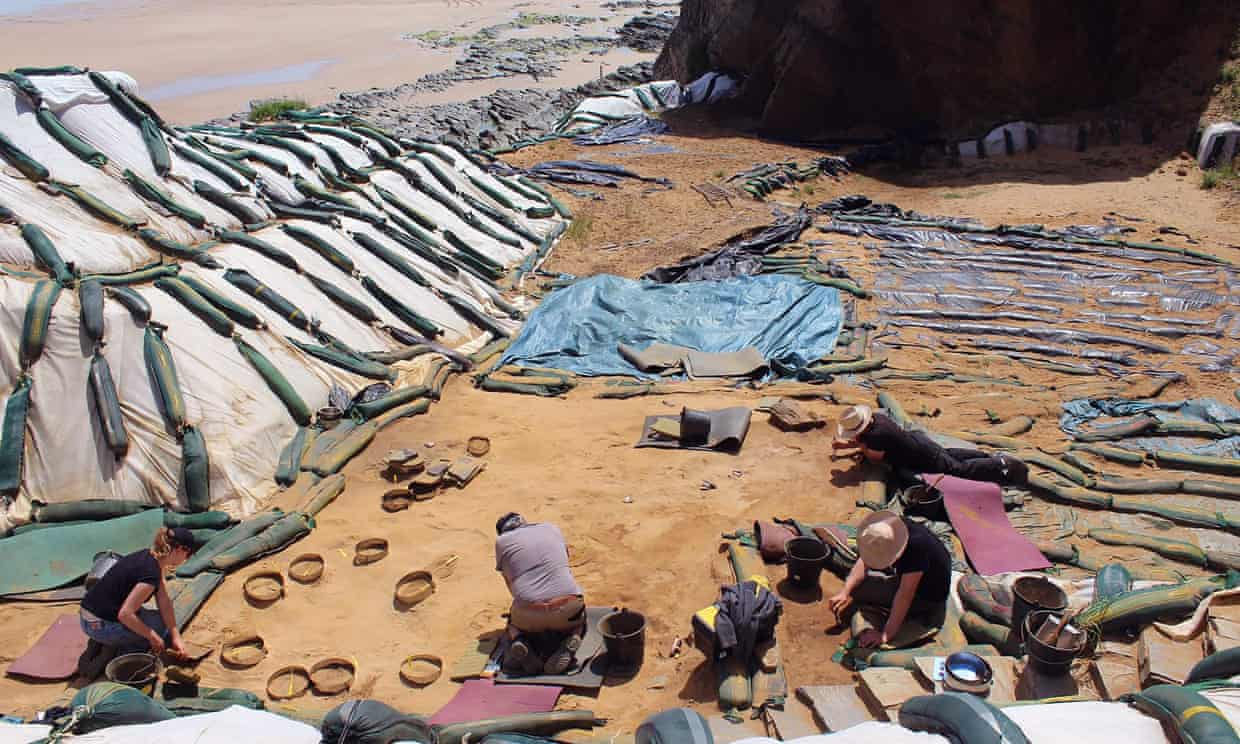
Une équipe d’archéologues de l’Inrap mène une fouille, sur prescription de l’État (Drac grand Est), à Saint-Memmie (Marne), en périphérie de Châlons-en-Champagne, en amont de la création d’un supermarché LIDL. Étendue sur une surface de 5 000 m2, cette fouille a été l'occasion d'une découverte exceptionnelle avec la mise au jour d’un hypogée, datant du Néolithique, vers 3500 à 3000 ans avant notre ère. Les hypogées, monuments funéraires, sont particulièrement représentés dans le département de la Marne : 160 ont été identifiés au fil des siècles, mais la plupart ont été visités et vidés sans étude archéologique. Aujourd’hui, seuls cinq de ces monuments ont été correctement documentés. La fouille en cours à Saint-Memmie, qui bénéficie des dernières méthodes et technologies de l’archéologie préventive, va permettre de renouveler profondément les connaissances sur cette pratique funéraire et l’architecture de ce type de sépulture.
Read the rest of this article...
Tuesday, November 19, 2019
Research shows people made ropes and baskets during the Paleolithic era
Santa Maira cave [Credit: Asociación RUVID]
A research team from the University of Valencia and the CSIC has published a study that demonstrates the use of plant fibres during the Final Palaeolithic era in the Santa Maira caves (Castell de Castells, Alicante).
These are fragments of braided rope and basketwork imprints on clay. The rope has provided the oldest direct dating in Europe for an object made of braided fibres: 12,700 years ago. In the same work, the first evidence on the use of containers made from clay-coated baskets has also been revealed.
The work analyses both the species used to obtain braided ropes, their treatment and preparation, as well as their use to manufacture more complex devices such as baskets and containers. These materials have been dated back about 13,000 years. Ethnological data indicate that these materials have been widely used among historical societies, but we are largely unaware of their use in Prehistory.
Read the rest of this article...
Iron Age DNA sheds light on Finns’ genetic origin
Iron Age samples from Levänluhta, southern Ostrobothnia, trace lineage to Finland's modern Sámi population. Image: Jussi Mankkinen, Yle
They said they were able to reconstruct 103 complete mitochondrial genomes from archaeological bone samples, allowing them to trace maternal lineage. The samples were collected from burial sites across Finland and the Republic of Karelia, Russia.
Scientists found that genes associated with ancient farmer populations were more common in the east, whereas lineages inherited from hunter-gatherers were more prevalent in the west.
Read the rest of this article...
Alpine rock axeheads became social and economic exchange fetishes in the Neolithic
Alpine rock axehead found at Harras, Thuringia, from the Michelsberg Culture
(c. 4300-2800 BCE)
[Credit: Juraj Liptak, State Office for Heritage Management and Archaeology
Saxony-Anhalt]
Axeheads made out of Alpine rocks had strong social and economic symbolic meaning in the Neolithic, given their production and use value. Their resistance to friction and breakage, which permitted intense polishing and a re-elaboration of the rocks, gave these artefacts an elevated exchange value, key to the formation of long-distance exchange networks among communities of Western Europe. Communities who had already begun to set the value of exchange of a product according to the time and effort invested in producing them.
This is what a study led by a research group at the Universitat Autonoma de Barcelona (UAB) indicates in regards to the mechanical and physical parameters characterising the production, circulation and use of a series of rock types used in the manufacturing of sharp-edged polished artefacts in Europe during the Neolithic (5600-2200 BCE).
The objective of the study was to answer a long debated topic: the criteria by which Alpine rocks formed part of an unprecedented pan-European phenomenon made up of long-distance exchange networks, while others were only used locally. Was the choice based on economic, functional or perhaps subjective criteria? Stone axeheads were crucial to the survival and economic reproduction of societies in the Neolithic. Some of the rocks used travelled over 1000 kilometres from their Alpine regions to northern Europe, Andalusia in southern Spain and the Balkans.
Read the rest of this article...
Monday, November 18, 2019
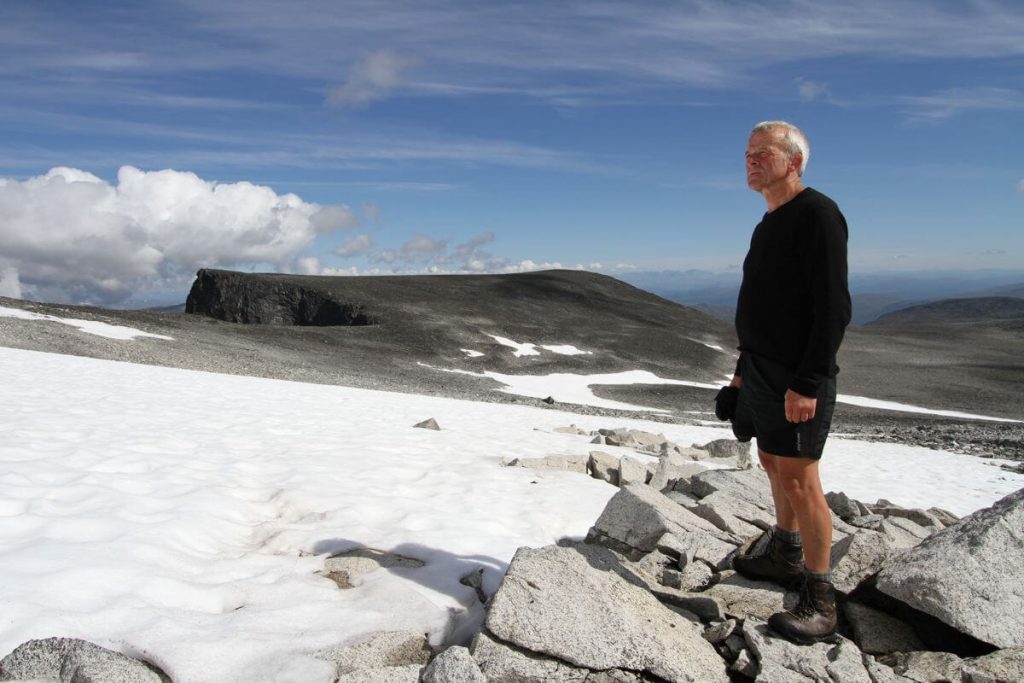
Reidar Marstein – Our Local Hero of Glacier Archaeology
Reidar standing at the edge of one of our ice patches in northeast Jotunheimen.
Photo: Espen Finstad, secretsoftheice.com.
One member of the Secrets of the Ice team is not a professional archaeologist. Reidar Marstein is a hobby archaeologist from Lom. Why is he a core member of the team? Well, there are a number of reasons for that, but the main reason is that without him, glacier archaeology here in Oppland would have looked very different.
In the early 2000’s, Reidar noticed that the ice patches in the northeastern part of the Jotunheimen Mountains were getting smaller. He thought there was a chance that artifacts could emerge from the melting ice. Reidar explains what happened next:
“2006 was a special year for ice patches and glaciers in our high mountains. The summer was warm, and autumn continued with high temperatures into October. We had never witnessed a melt like that. The ice patches and glaciers were smaller than we had ever seen before.
I hiked up to the ice patches every week this autumn. It was my visit on September 17 that became the greatest adventure. I started early in the morning and reached the Langfonne ice patch around 9 am. It was unbelievable how much the ice patch had melted just during the last week. With great excitement, I started my survey around the ice. It had to have been a long time since the last human set foot here.
Sunday, November 17, 2019
EMAS Archaeological Study Tour to Orkney
14 – 23 April 2020
Guide: David Beard MA, FSA, FSA Scot
The 2020 EMAS spring study tour will be to Orkney. We will travel by coach from Baker Street, London stopping overnight at Middlesbrough and Inverness and visiting archaeological sites on the way.
We will be based in Kirkwall, and will visit sites on Orkney Mainland and the islands of Egilsay, Rousay and Wyre. The sites that we will visit include Maes Howe, Skara Brae, Midhowe Broch, the Brough of Birsay, Cubbie Roo’s Castle, the Earl’s Palace at Birsay and Kirkwall Cathedral.
The cost of this study tour will be £1036 per person for people sharing a twin room, and £1305 per person for a single room.
Please note that hotel accommodation is limited and applications must be received by 30 November at the latest.
Click here for a complete itinerary
Archaeologists unearth ancient settlement in SE Turkey
An ancient historical site dating back 11,800 years was unearthed on Thursday in southeastern Turkey.
Now part of the province of Mardin, the area has been home to many different civilizations including the Sumerians, Akkadians, Babylonians, Hittites, Urartians, Romans, Abbasids, Seljuks and Ottomans.
Archeologist Ergul Kodas said his team was excavating the site as part of a project focusing on documenting and rescuing cultural sites located in the Dargecit district, when they came across the 11,800-year-old sewer system and over two dozen architectural artifacts.
A total of 15 restorers and archaeologists as well as 50 workers are currently excavating the area, which was designated a historical and cultural site by Turkish authorities.
Kodas, the head of the excavation team, said the historical site was inhabited for a long period around 9800 B.C. and that there were eight-story historical buildings reaching up to seven meters in height.
He noted that the sewer system was the oldest known in history, saying: "We were only able to unearth a certain portion of the sewer system, and confirmed it was [located] in a public use area."
Read the rest of this article...
3000-year-old sword discovered in north-east Bohemia
Credit: David Tanecek, CTK
A sword dating back to the early Bronze Age has been unearthed in the region of Rychnov nad Kneznou in north-east Bohemia, according to a recent report by the Czech News Agency.
According to the archaeologist Martina Bekova from the Rychnov museum, the weapon has an ornamental engraving and a very sharp blade.
"The bronze sword with its tongue handle is dated around 1200 BC, it belongs to the Lusatian culture. The findings of this culture are numerous in East Bohemia, but this is not true of swords," said Bekova.
"Only five prehistoric swords have been found in the Czech Republic over the last decade," she adds.
Archaeologists are keeping the exact location of the discovery a secret to protect the site.
A search of the area also yielded several rivets which were used to secure the sword handle to the blade, and a bronze spear head from about the same period.
Read the rest of this article...
Caithness Iron Age stone tower to be conserved
Over the years Ousdale Burn Broch has fallen into a poor state of preservation
CAITHNESS BROCH PROJECT
An Iron Age drystone tower damaged by Victorian archaeologists is to be conserved.
The ruins of Ousdale Burn Broch, north of Helmsdale in Caithness, has fallen into further disrepair over the last 120 years.
A wall near the entrance to the broch has collapsed and a tree is growing inside the structure.
Archaeological charity Caithness Broch Project has secured £180,000 of funding towards its conservation.
Read the rest of this article...
Monday, November 11, 2019
Frozen moss reveals fatal final journey of 5,300-year-old ice mummy
Fresh clues have emerged about the final journey of a European glacier mummy shot dead by an arrow before his body was preserved in ice for thousands of years.
The latest study, published Wednesday in the journal Plos One, examined "subfossils" of pieces of vegetation that had frozen on or around the 5,300-year-old mummy, known as Otzi the Iceman.
Otzi's body was frozen in ice until it was discovered by a couple hiking in the North Italian Alps in 1991. Since then, nearly every part of him has been analyzed -- from what he may have sounded like, to the contents in his stomach and how he died. For the past 25 years, his mummified body has been a window into early human history, providing a peek into what life in the Alpine region was like during the Copper Age.
Read the rest of this article...
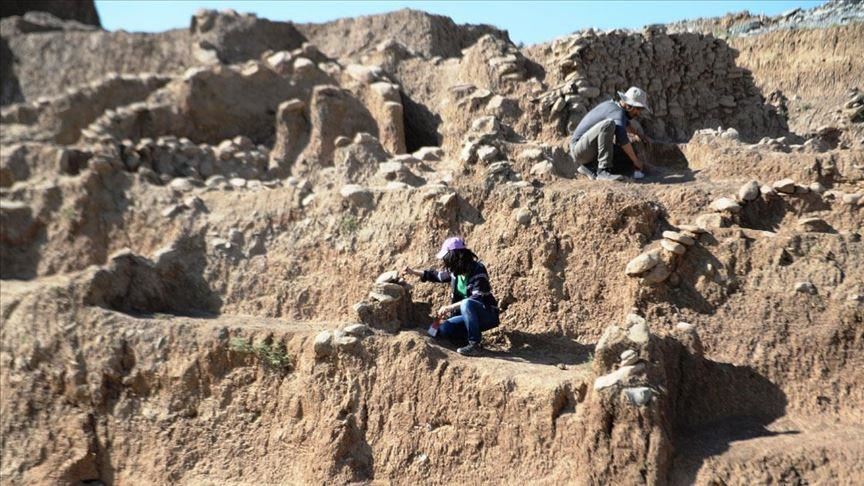
Archaeologists unearth ancient settlement in SE Turkey
Sewer system dating back 11,800 years, over 20 architectural structures found in Mardin province
An ancient historical site dating back 11,800 years was unearthed on Thursday in southeastern Turkey.
Now part of the province of Mardin, the area has been home to many different civilizations including the Sumerians, Akkadians, Babylonians, Hittites, Urartians, Romans, Abbasids, Seljuks and Ottomans.
Archeologist Ergul Kodas said his team was excavating the site as part of a project focusing on documenting and rescuing cultural sites located in the Dargecit district, when they came across the 11,800-year-old sewer system and over two dozen architectural artifacts.
A total of 15 restorers and archaeologists as well as 50 workers are currently excavating the area, which was designated a historical and cultural site by Turkish authorities.
Read the rest of this article...
Archaeologists unearth ancient settlement in SE Turkey
Sewer system dating back 11,800 years, over 20 architectural structures found in Mardin province
An ancient historical site dating back 11,800 years was unearthed on Thursday in southeastern Turkey.
Now part of the province of Mardin, the area has been home to many different civilizations including the Sumerians, Akkadians, Babylonians, Hittites, Urartians, Romans, Abbasids, Seljuks and Ottomans.
Archeologist Ergul Kodas said his team was excavating the site as part of a project focusing on documenting and rescuing cultural sites located in the Dargecit district, when they came across the 11,800-year-old sewer system and over two dozen architectural artifacts.
A total of 15 restorers and archaeologists as well as 50 workers are currently excavating the area, which was designated a historical and cultural site by Turkish authorities.
Read the rest of this article...
New human ancestor discovered in Europe
A male Danuvius guggenmosi probably looked something like this
[Credit: Universitat Tubingen]
IMPORTANTE NÉCROPOLE NÉOLITHIQUE À ENSISHEIM
À Ensisheim (Haut-Rhin), l'Inrap et Archéologie Alsace fouillent des campements de chasseurs-cueilleurs et une importante nécropole néolithique. Les vestiges s’échelonnent de 10 000 à 350 avant notre ère.
De fin août 2019 à mai 2020, les archéologues de l'Inrap et d’Archéologie Alsace réalisent, en groupement, une fouille archéologique sur prescription de l’État, à Ensisheim et Réguisheim (Haut-Rhin). Cette opération déployée sur 9,5 hectares est menée en préalable à la quatrième phase d’aménagement du Parc d'activités de la Plaine d'Alsace porté par la Communauté de communes du Centre Haut-Rhin.
Read the rest of this article...
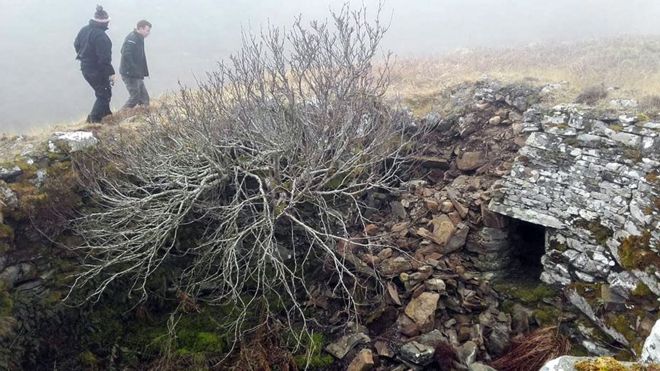
Whale bone DNA gives new clues to Iron Age Orkney life
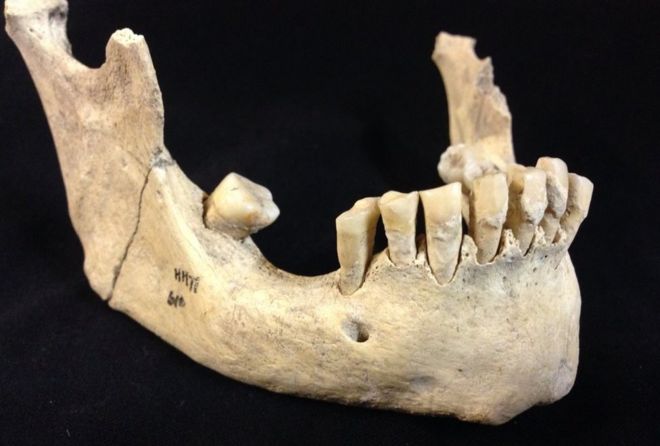
The vessel - made from a fin whale vertebra - contained a human jaw bone and two newborn lambs
UHI ARCHAEOLOGY INSTITUTE
When they first unearthed the container near a broch at South Ronaldsay, archaeologists knew it was a hollowed out whale vertebra.
Dr Martin Carruthers from the UHI archaeology institute at Orkney College says "it was used as a casket, or a vessel.
"And inside of that we found a human jawbone, and two newborn lambs.
"And it was deposited we think in quite a formal manner, just outside the door of the broch at the time it was going out of use."
Even more extraordinarily two sets of antlers from red deer had been jammed into place alongside the backbone, and held in place with a quern stone.
Read the rest of this article...

Sunday, November 3, 2019
Britain's first city discovered as archaeologists say it was home of people who built Stonehenge
Britain's first city discovered as home of people who built Stonehenge
Britain’s first ‘city’ arose near an ancient spring on Salisbury Plain, and its inhabitants probably built Stonehenge, archaeologists believe.
Blick Mead lies just a mile away from the Wiltshire stone circle, and experts have uncovered more than 70,000 stone tools at the site, as well as an intriguing ceremonial platform suggesting the area held ritual importance for prehistoric hunter-gatherers who lived there 10,000 years ago.
Although hunter-gatherer populations rarely settle in one place, Professor David Jacques of the University of Buckingham, believes the site may have been a permanent encampment where at least the children, elderly and sick lived.
“When you look at Stonehenge you think, ‘but where are the people?’” said Prof Jacques. “It makes sense that if you want to find the people who built it, the obvious idea is to look for where the water is.
Read the rest of this article...
The last Neanderthal necklace
A falange of imperial eagle with marks of court from Cave Foradada
[Credit: Antonio Rodriguez-Hidalgo]
The interest in these findings lies in the fact that it is the most modern piece of the kind so far regarding the Neanderthal period and the first one found in the Iberian Peninsula. This circumstance widens the temporary and geographical limits that were estimated for this kind of Neanderthal ornaments. This would be "the last necklace made by the Neanderthals", according to Antonio Rodriguez-Hidalgo.
"Neanderthals used eagle talons as symbolic elements, probably as necklace pendants, from the beginnings of the mid Palaeolithic", notes Antonio Rodriguez-Hidalgo. In particular, what researchers found in Cova Foradada are bone remains from Spanish Imperial Eagle (Aquila Adalberti), from more than 39,000 years ago, with some marks that show these were used to take the talons so as to make pendants.
Read the rest of this article...
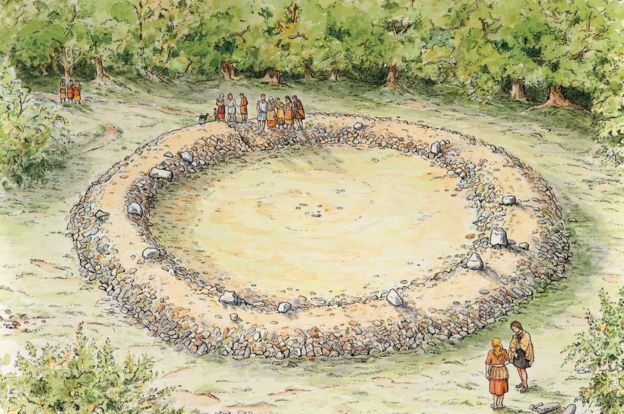
Bronze Age monument discovered in Forest of Dean
Archaeologist Jon Hoyle said nobody knows precisely what ring cairns were used for
ANNE LEAVER
It was identified following a LiDAR (light detection and ranging) survey of the Forest of Dean.
The technique used laser beams fired from an aeroplane to create a 3D record of the land surface, effectively removing the trees from the landscape.
Mr Hoyle said when he studied the data, he spotted an "extremely circular" feature, which he thought initially might be a World War Two gun emplacement.
After visiting the site, at a secret location near the village of Tidenham, he realised it was much older, dating to between 2,500 BC and 1,500 BC.
Read the rest of this article...
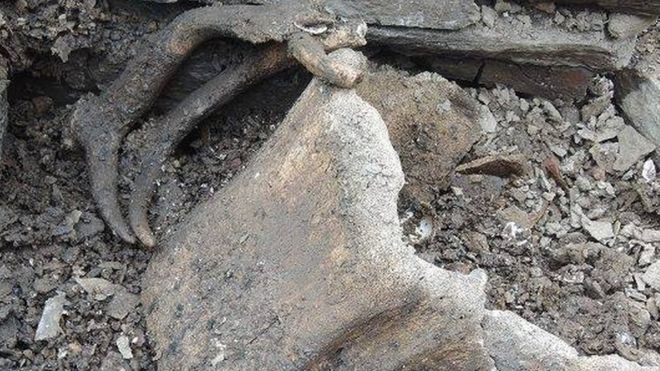
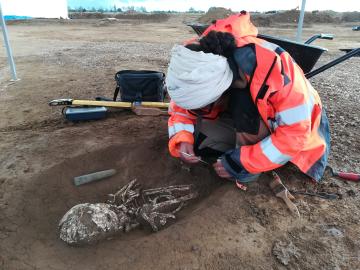
Monday, October 21, 2019
3000-year-old toolkit suggests skilled warriors crossed Europe to fight an epic battle
This collection of bronze artifacts was contained in a pouch or box and lost on a battlefield 3300 years ago, archaeologists say.
THOMAS TERBERGER/UNIVERSITY OF GÖTTINGEN/LOWER SAXONY STATE OFFICE FOR CULTURAL HERITAGE
Bronze Age Europe was a violent place. But only recently have scientists uncovered the scope of the violence, at a 3000-year-old site in northern Germany where thousands of well-armed young men fought with sophisticated weapons in what appears to be an epic battle. Now, a bagful of bronze artifacts and tools found at the bottom of the river in the middle of the battlefield suggests some of these warriors traveled from hundreds of kilometers away to fight. That suggests northern European societies were organized on such a large scale that leaders could call warriors to distant battlefields, long before modern communication systems and roads.
“It’s extremely rare to find a box or pouch [like this],” on an ancient battlefield, says Thomas Terberger, an archaeologist with the Lower Saxony State Office for Cultural Heritage in Hanover, Germany, who describes the find with colleagues in a paper published today in Antiquity. “Somebody lost it there.”
Read the rest of this article...
Havering Hoard: Weapons found on building site to go on show
A group of 453 artefacts are due to go on display at a museum next year
LDRS
Ancient weapons discovered on a building site will go on display at the Museum of London Docklands.
The group of 453 artefacts found in Havering, east London, is the third largest ever discovered in the UK.
It "adds immensely to our understanding of Bronze Age life", Historic England said.
The find, which dates from between 800BC and 900BC, was officially declared treasure by a coroner earlier this year.
The discovery, dubbed the Havering Hoard, was uncovered last September, and will form the centrepiece of a major exhibition from April.
Read the rest of this article...
Scientists find early humans moved through Mediterranean earlier than believed
Map of Greek islands in the Aegean Sea showing Naxos in the center (stock image).
Credit: © lesniewski / Adobe Stock
An international research team led by scientists from McMaster University has unearthed new evidence in Greece proving that the island of Naxos was inhabited by Neanderthals and earlier humans at least 200,000 years ago, tens of thousands of years earlier than previously believed.
The findings, published today in the journal Science Advances, are based on years of excavations and challenge current thinking about human movement in the region -- long thought to have been inaccessible and uninhabitable to anyone but modern humans. The new evidence is leading researchers to reconsider the routes our early ancestors took as they moved out of Africa into Europe and demonstrates their ability to adapt to new environmental challenges.
Read the rest of this article...
Thursday, October 17, 2019
Ungewöhnliche Funde vom bronzezeitlichen Schlachtfeld im Tollensetal
Diese Sammlung von Objekten wurde von einer Tauchergruppe im Fluss Tollense gefunden und ist wahrscheinlich der Besitz eines Kriegers, der vor 3.300 Jahren auf dem Schlachtfeld starb. Foto: Volker Minkus
Ein Forschungsteam unter Leitung der Universität Göttingen, des Landesamtes für Kultur und Denkmalpflege Mecklenburg-Vorpommern und der Universität Greifswald hat im Tollensetal 31 ungewöhnliche Objekte entdeckt. Die Forscherinnen und Forscher vermuten, dass die Funde zum persönlichen Besitz eines bronzezeitlichen Kriegers gehören, der vor 3.300 Jahren auf dem Schlachtfeld starb.
Read the rest of this article...
Wednesday, October 16, 2019
Hundreds of archaeological sites uncovered across NI
Hundreds of important archaeological discoveries have been made at excavations across Northern Ireland during the past four years.
The Department for Communities licensed 800 digs, mainly as a requirement of the planning process where developers are required to record important sites.
It has now made details of significant finds available to the public in a booklet entitled Unearthed.
The sites range from Stone Age farms to 19th Century urban industry.
Read the rest of this article...
Soziale Ungleichheit in bronzezeitlichen Haushalten
Hochrangige und nicht-lokale Frauenbestattung aus Kleinaitingen »Gewerbegebiet Nord«. Der Kopfschmuck und der Bestattungsritus spiegeln die lokalen Traditionen wider, aber die Isotopenwerte zeigen die fremde Herkunft. Diese Bestattung einer Frau ist eine der reichsten bekannten Bestattungen Süddeutschlands. Foto: © ABK Süd
Das archäologisch-naturwissenschaftliche Projekt an der Heidelberger Akademie der Wissenschaften wurde von Philipp Stockhammer von der LMU in München zusammen mit Johannes Krause und Alissa Mittnik vom Max-Planck-Institut für Menschheitsgeschichte in Jena und der Universität Tübingen geleitet. Die Ausgrabungen südlich von Augsburg ermöglichen es den Archäologen, auf bislang ungeahnte Weise tief in die Bronzezeit herein zu zoomen und zu untersuchen, wie sich der Umbruch von der Steinzeit zur Bronzezeit auf die Zusammensetzung der damaligen Haushalte auswirkte. »Reichtum korrelierte entweder mit biologischer Verwandtschaft oder Herkunft aus der Ferne. Die Kernfamilie vererbte ihren Besitz und Status weiter. Aber in jedem Bauernhof haben wir auch arm ausgestattete Personen lokaler Herkunft gefunden«, sagt Philipp Stockhammer, Professor für Prähistorische Archäologie an der LMU und einer der Leiter der Studie. Dieser Befund spricht für eine komplexe Sozialstruktur von Haushalten, wie sie aus dem klassischen Griechenland und Rom bekannt ist. So waren zu römischer Zeit auch die Sklaven Teil der Familie, hatten aber einen anderen sozialen Status. Aber diese Menschen im Lechtal lebten über 1.500 Jahre früher. »Das zeigt erstmals, wie lang die Geschichte sozialer Ungleichheit in Familienstrukturen zurückreicht«, so Stockhammer weiter.
Read the rest of this article...
Thursday, October 10, 2019
1,800-year-old head-shaped balsamarium found in Bulgaria
Dating back about 1,800 years, the brass balsamarium shows the head of a man wearing
a cap made from the skin of a feline [Credit: Daniela Agre]
The skeleton of an ancient sports fan was discovered alongside an 1,800-year-old jar shaped like the head of a wrestler or boxer who may have had his nose broken, archaeologists reported
The "spectacular" balsamarium — a jar used to store liquids such as balm or perfumes — was found in a grave in southeastern Bulgaria (ancient Thrace).
It dates to a time when the Roman Empire controlled Thrace — an ancient area that encompassed parts of Bulgaria, Greece and Turkey.
Israel cave bones: Early humans 'conserved food to eat later'
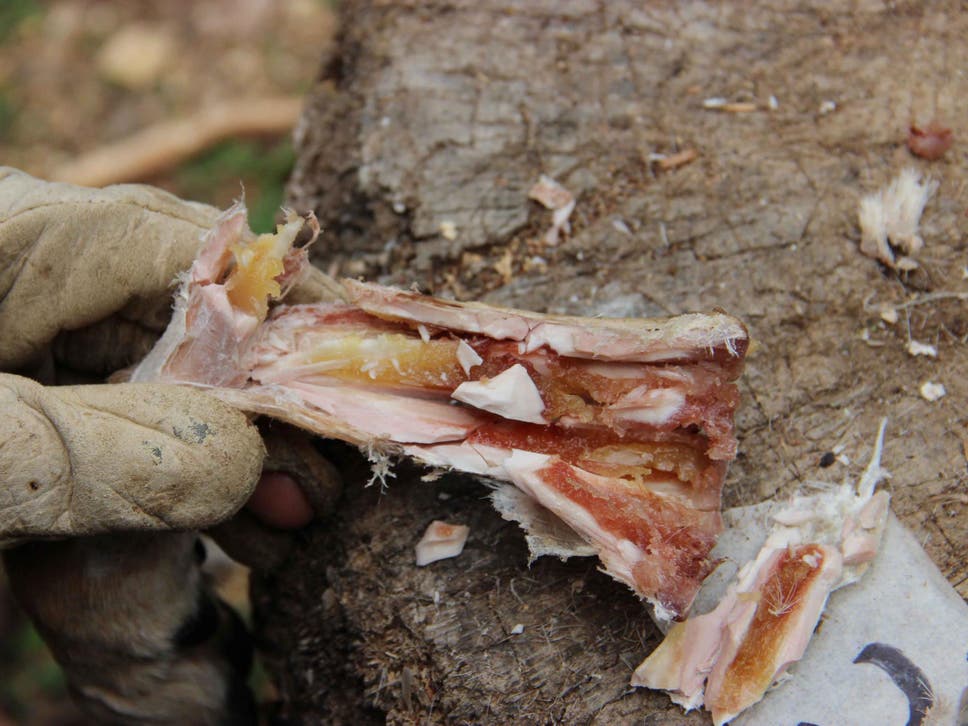
In experiments, researchers removed skin from stored bones to match cut marks
found on bone fragments PA MEDIA
Scientists in Israel say they have found evidence that early humans deliberately stored bones from animals to eat the fatty marrow later.
It is the earliest evidence that humans living between 200,000 and 420,000 years ago had the foresight to anticipate future needs, they say.
Early humans had not previously been thought capable of such dietary planning.
Researchers analysed bone specimens at Qesem cave near Tel Aviv.
They identified cut marks on most of the bone surfaces - consistent with preservation and delayed consumption.
The researchers suggest the marks came about because the early humans had to make greater effort to remove skin which had dried on bones which had been kept longer.
Read the rest of this article...
L’ENVIRONNEMENT DE NÉANDERTAL ET DE HOMO SAPIENS À ITTENHEIM
Une équipe d’archéologues de l’Inrap a mené une opération archéologique à Ittenheim (Bas-Rhin), sur prescription de l’État. Elle permet d’accéder à des vestiges très anciens, dont deux dents de lait d'un mammouth, datant du Paléolithique, soit entre 22 000 et 115 000 ans avant notre ère. Il est très rare d’étudier des vestiges de cette période qui correspond entre autres à celle de l’homme de Néandertal.
Read the rest of this article...
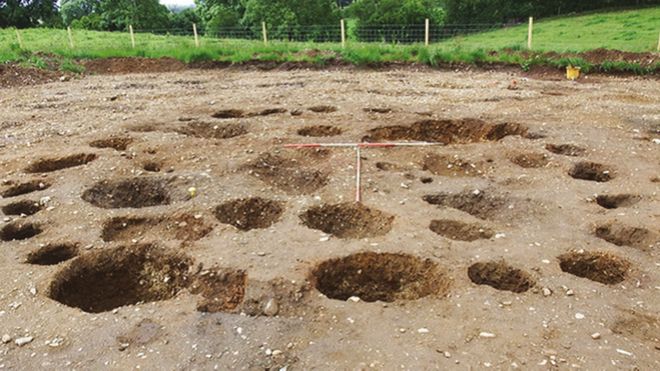
Climate change endangers Scotland's archaeological treasures
FILE PHOTO: Neolithic Buildings are seen at Skara Brae in the Orkney Islands, Scotland Britain September 25, 2019. REUTERS/George Sargent
Evidence has been found of human habitation there going back 8,500 years. Some buildings on the islands date to the Iron Age, Viking rule and medieval times.
But around 1,000 sites are situated on the coastline and are under threat.
One such site is the Iron Age building South Howe Broch on the island of Rousay. Dating from between 600-400AD, the sea has taken much of the site’s western area. Now the broch wall itself is falling into the sea.
Read the rest of this article...
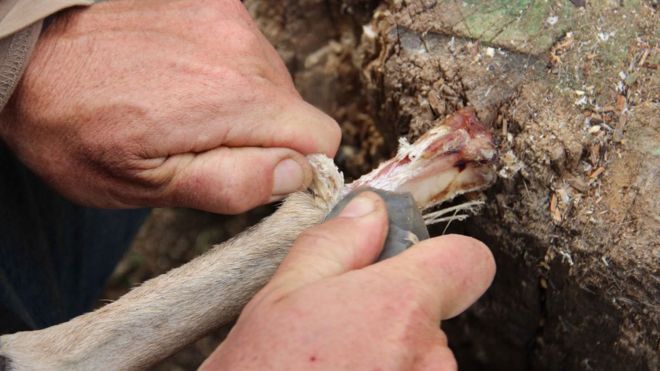
Early humans stored bone marrow like tins of soup 400,000 years ago
The earliest evidence of delayed food consumption:
pictured is bone marrow after six weeks
( AFTAU )
Previously, scientists thought Paleolithic people lived a hand-to-mouth existence but this research shows they were sophisticated enough to preserve meat using bones like we use modern-day cans.
The study shows this was happening between 420,000 and 200,000 years ago in Qesem cave near what is now Tel Aviv. It is the earliest evidence of delayed consumption of food in the world, according to the study published in Science Advances.
“The bones were used as ‘cans’ that preserved the bone marrow for a long period until it was time to take off the dry skin, shatter the bone and eat the marrow,” said Professor Ran Barkai from Tel Aviv University, who was involved in the research.
Read the rest of this article...
Thursday, October 3, 2019
Ancient asteroid apocalypse destroyed early human civilisations, scientists claim
A map showing the ‘platinum spikes’ found across the world
A cataclysmic asteroid impact caused a global disaster which destroyed early human proto-civilisations in Africa and America, researchers have claimed.
In a study published in a respected journal, scientists presented evidence which indicates Earth was struck by an asteroid 12,800 years ago.
This caused a worldwide catastrophe which plunged animal species into extinction and may have caused the abrupt demise of the mysterious Clovis people, although this hypothesis is controversial.
The Clovis was a prehistoric society that lived in North America but abruptly disappeared.
Now a team from the University of the Witwatersrand in Johannesburg have uncovered evidence of a gigantic impact which preceded a period of massive climate change, spelling doom for the Clovis and potentially other early societies around the world
Read the rest of this article...
Archives, Possible Throne Room Discovered in Ancient Palace on Crete
Source: Ministry of Culture
The Greek Ministry of Culture announced on Thursday that a new storage room for valuables in Zominthos Palace, on the plateau of Mount Psiloritis on Crete, was discovered at the sprawling site during this year’s excavation season.
Supporting evidence for the Palace room being used as a type of archive includes its location and other circumstantial evidence.
Besides the multitude of vessels found throughout the site, discoveries included a hallway with pillars, leading to what could possibly be a throne room. The remains of a seat were found in that room, which was ostensibly used in earlier periods as well, from 1900 BC to Mycenaean times, ca. 1400 BC.
Read the rest of this article...
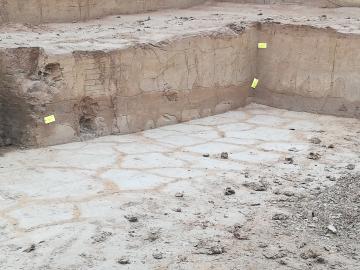
Zentralismus in den ältesten vorstädtischen Siedlungen Europas
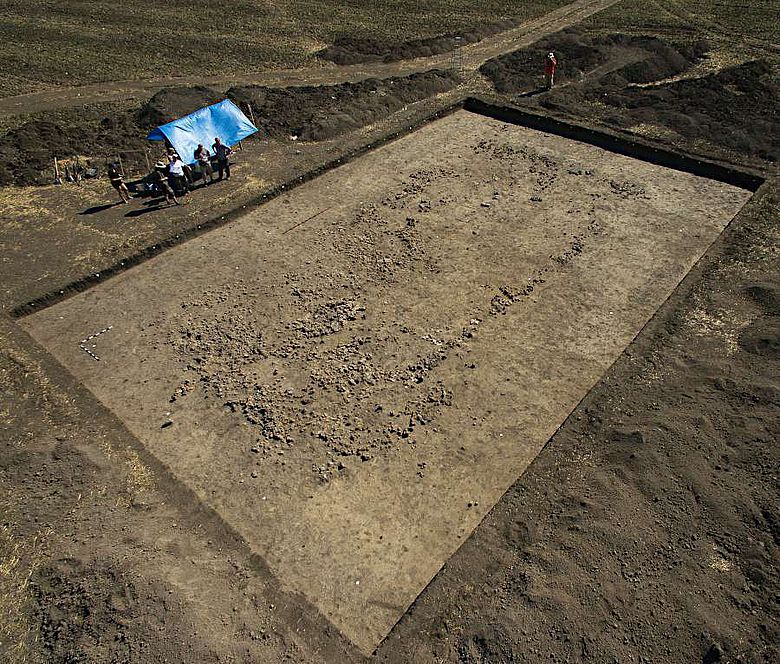
Kupferzeitliches Versammlungshaus nach der Freilegung: In einem offenen Hof und einem angrenzenden, überdachten Gebäudeteil fanden eine Vielzahl unterschiedlicher integrativer Aktivitäten statt. (© SFB 1266)
Ein ukrainisch-deutsches Forschungsteam sieht in undemokratischen Entscheidungsstrukturen und der Bündelung von Macht die vermutliche Ursache für den Zusammenbruch der ältesten vorstädtischen Großsiedlungen Europas um 3.700 vor Christus.
Zwischen 5000 und 2700 vor Christus breitete sich in Osteuropa auf dem heutigen Gebiet der Ukraine, Moldawiens und Rumäniens die sogenannte Tripolye-Kultur aus und schuf die größten bekannten Siedlungen dieser Zeit in Europa: sogenannte Megasiedlungen mit bis zu 15.000 Einwohnern, die sich über Flächen von bis zu 340 Hektar erstreckten.
Staatliche Strukturen waren zu dieser Zeit unbekannt und so wirft die Größe dieser Siedlungen viele Fragen bezüglich ihrer gesellschaftlichen Organisation auf: Wie liefen Entscheidungsprozesse ab? Gab es gesellschaftliche Unterschiede, demokratische Prozesse, Führer? Insbesondere bewegt die Wissenschaft aber die Frage, warum die Siedlungen nach nur wenigen hundert Jahren wieder verschwanden.
Read the rest of this article...
Sunday, September 29, 2019
Did a common childhood illness take down the Neanderthals?
MAGE: THIS ILLUSTRATION SHOWS THE STRUCTURE OF THE EUSTACHIAN TUBE IN NEANDERTHAL MAN AND IT'S SIMILARITY TO THE HUMAN INFANT.
BROOKLYN, NY - It is one of the great unsolved mysteries of anthropology. What killed off the Neanderthals, and why did Homo sapiens thrive even as Neanderthals withered to extinction? Was it some sort of plague specific only to Neanderthals? Was there some sort of cataclysmic event in their homelands of Eurasia that lead to their disappearance?
A new study from a team of physical anthropologists and head & neck anatomists suggests a less dramatic but equally deadly cause.
Published online by the journal, The Anatomical Record, the study, "Reconstructing the Neanderthal Eustachian Tube: New Insights on Disease Susceptibility, Fitness Cost, and Extinction"1 suggests that the real culprit in the demise of the Neanderthals was not some exotic pathogen.
Read the rest of this article...
Saturday, September 28, 2019
Somerset human remains 'as old as Cheddar Man'
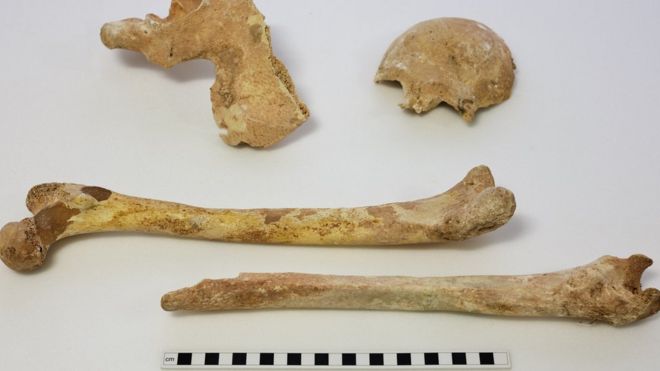
The human remains were found to be as old as Britain's oldest complete skeleton, the Cheddar Man
SOUTH WEST HERITAGE TRUST
Two boxes of human remains rediscovered after 55 years have been found to be as old as the Cheddar Man - Britain's oldest complete skeleton.
The bones were discovered in a cave in Cannington Park Quarry near Bridgwater, Somerset, in the 1960s.
Soon after they "disappeared", and were recently found at Somerset Heritage Centre near Taunton, Cotswold Archaeology said.
Radiocarbon dating has shown them to be more than 9,000 years old.
Read the rest of this article...
Thursday, September 26, 2019
Historic find suggests bottle-feeding not a modern phenomenon
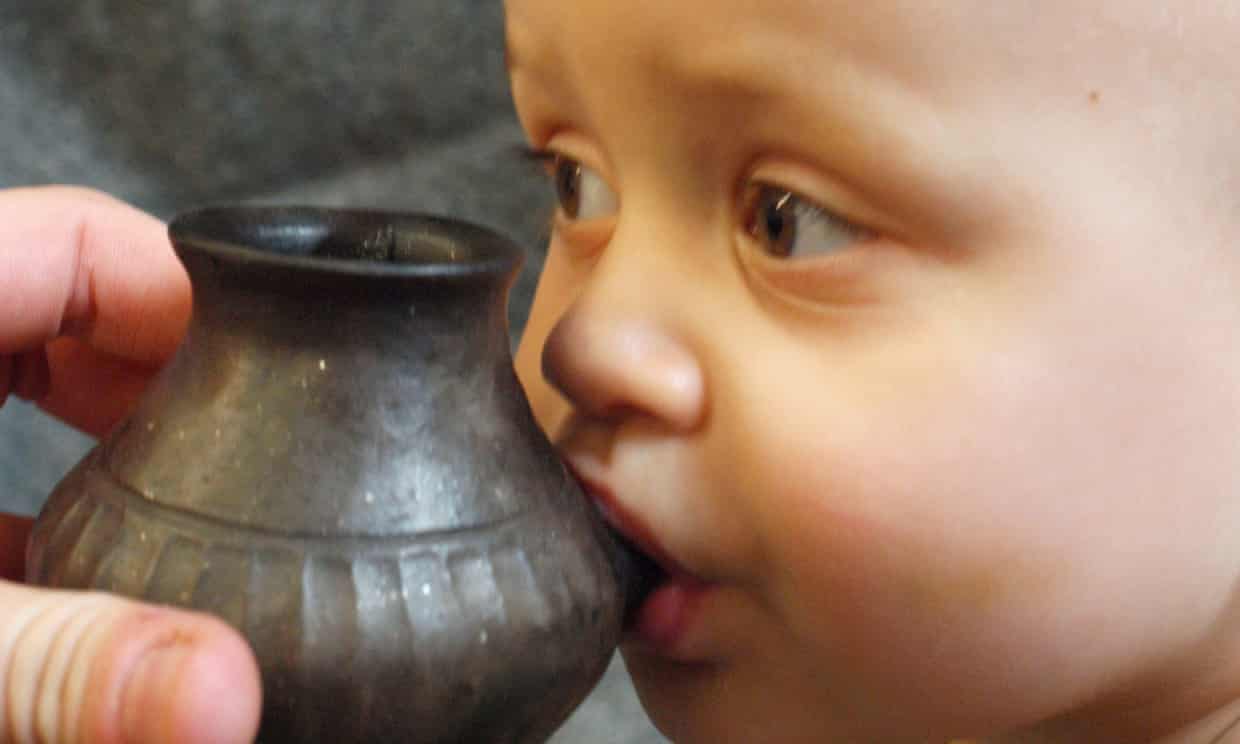
A reconstruction of a baby being fed using a vessel.
Photograph: Helena Seidl da Fonseca/PA
Babies from prehistoric cultures were fed animal milk in small ceramic pots, according to a study that suggests bottle-feeding is not a modern phenomenon.
The drinking vessels, which were excavated from children’s graves in Bavaria, date to between 450 and 1,200BC. They have teat-shaped spouts, appear designed to be easily held by an older baby or toddler and one is shaped as an imaginary animal, suggesting it may have doubled as a toy.
Julie Dunne, a chemist at the University of Bristol and lead author, said: “These very small, evocative, vessels give us valuable information on how and what babies were fed thousands of years ago, providing a real connection to mothers and infants in the past.”
Read the rest of this article...
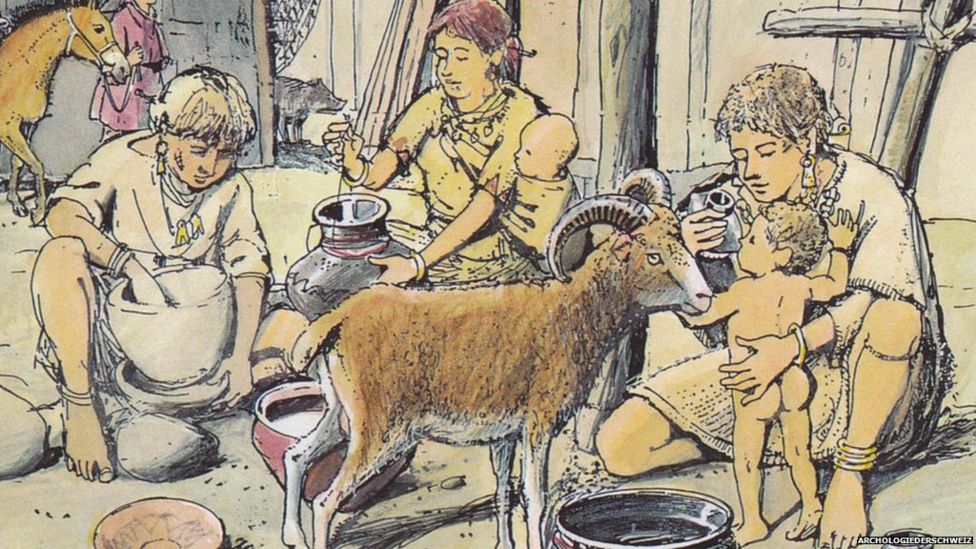
Prehistoric babies fed animal milk in bottles
Prehistoric family scene ARCHOLOGIEDERSCHWEIZ
Prehistoric babies were bottle-fed with animal milk more than 3,000 years ago, according to new evidence.
Archaeologists found traces of animal fats inside ancient clay vessels, giving a rare insight into the diets of Bronze and Iron Age infants.
The discovery suggests milk was given to infants to supplement breast feeding and could have contributed to a baby boom.
The type of milk is unknown, but goats or cows are likely suspects.
This is the first direct evidence for how prehistoric infants were fed, said Dr Julie Dunne of the University of Bristol, adding that the practice could have boosted fertility.
Read the rest of this article...
Wednesday, September 25, 2019
Neanderthal footprints found in France offer snapshot of their lives
The excavation site of the footprint layer in Le Rozel, France.
Photograph: Dominique Cliquet/AFP/Getty Images
Scientists find 257 prints that were preserved in wind-driven sand 80,000 years ago
Scientists have found hundreds of perfectly preserved footprints, providing evidence that Neanderthals walked the Normandy coast in France.
The prints suggest a group of 10-13 individuals, mostly children and adolescents, were on the shoreline 80,000 years ago.
Neanderthals, the closest evolutionary cousins to present-day humans and primates, have long been thought to have lived in social groups, but details have been hard to establish.
The 257 footprints discovered at Le Rozel in western France give a snapshot of how Neanderthals lived and suggest they may have been taller than previously thought.
Read the rest of this article...
Giving birth two million years ago was 'relatively easy'
Human childbirth can be a long, painful, drawn-out process, needing assistance
and sometimes taking days. GETTY IMAGES
Human childbirth can be a long, painful, drawn-out process, needing assistance and sometimes taking days.
So why do close living relatives like chimps have an easier labour, giving birth in hours and on their own?
In an attempt to answer this evolutionary question, scientists have been looking at how ancient members of the human family tree gave birth.
Human-like relatives two million years ago had it "pretty easy", according to birth reconstruction in a fossil.
For Australopithecus sediba, which lived 1.95 million years ago in South Africa, we see "a relatively easy birth process", says study researcher Dr Natalie Laudicina.
"The foetal head and shoulder breadth have ample space to pass through even the tightest dimensions of the maternal birth canal," she says.
Read the rest of this article...
Monday, September 16, 2019
Earliest direct evidence of milk consumption
The evidence comes from dental plaque from Neolithic remains
SOPHY CHARLTON / DORSET COUNTY MUSEUM
The team identified milk protein entombed in calcified dental plaque (calculus) on the teeth of prehistoric farmers from Britain.
It shows that humans were consuming dairy products as early as 6,000 years ago - despite being lactose intolerant.
This could suggest they processed the raw milk into cheese, yoghurt or some other fermented product.
This would have reduced its lactose content, making it more palatable.
The team members scraped samples of plaque off the teeth, separated the different components within it and analysed them using mass spectrometry.
They detected a milk protein called beta-lactoglobulin (BLG) in the tartar of seven individuals spanning early to middle Neolithic times.
Read the rest of this article...
Wednesday, August 14, 2019
Ancient Tombs Unearthed in Nemea, Greece Shed Light on Mycenaean Civilization
Aerial view of the road and the chamber of the two tombs in the eastern part of the Mycenaean cemetery at Aidonia, along with the tombs from the old excavation.
Source: Ephorate of Antiquities of Corinth
The Greek Ministry of Culture announced on Sunday that archaeologists have discovered two ancient, unlooted chamber tombs dating from the Late Mycenaean period, (1400 – 1200 BC), near Nemea in the Peloponnesian Peninsula.
The newly-found tombs at the Aidonia burial site include five full burials and the skeletons of fourteen individuals whose remains had been transferred there from other tombs.
The finds will shed more light on the Mycenaean civilization, the Greek Culture Ministry announced.
Both chamber tombs provided an array clay pots and figurines to the discoverers, as well as other small objects.
Read the rest of this article...
Subscribe to:
Posts (Atom)