The Prehistoric Archaeology Blog is concerned with news reports featuring Prehistoric period archaeology. If you wish to see news reports for general European archaeology, please go to The Archaeology of Europe Weblog.
Monday, April 23, 2018
Neolithic Surgeons May Have Practiced on Animals
PARIS, FRANCE—Paleontologists Alain Froment and Fernando Ramirez Rozzi of the French National Center for Scientific Research suggest a hole in a cow skull uncovered at the Neolithic site of Champ-Durand in southwestern France could be evidence of a surgical procedure. According to a Gizmodo report, their analysis of the hole found no trace of fracturing or splintering, indicating it was not caused by goring from another cow, or a puncture from a powerful blow with a stone tool.
Read the rest of this article...
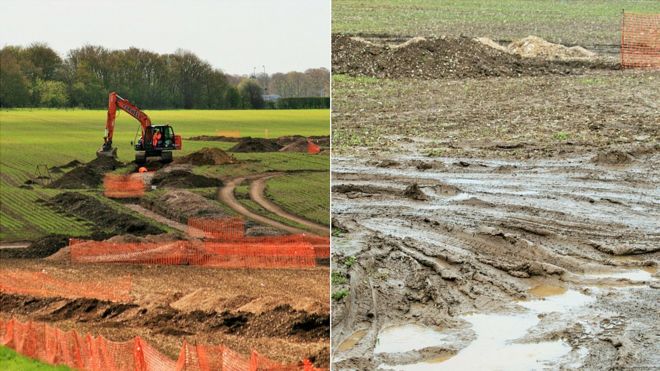
Stonehenge archaeology 'under threat' from Highways England diggers
Stonehenge Alliance said using heavy machinery on wet ground could "devastate any fragile archaeological deposits"
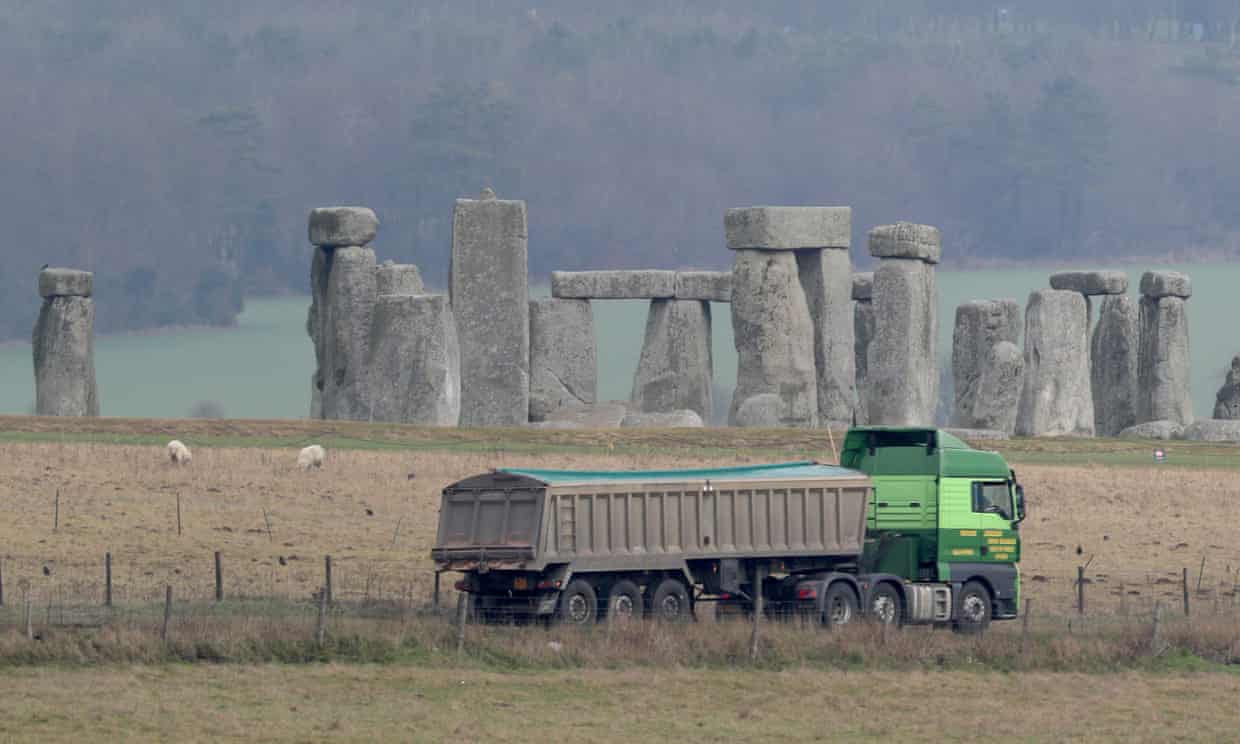
Heavy diggers being used by Highways England near Stonehenge are threatening its "fragile archaeology", campaigners have warned.
The agency has been surveying the proposed site of a controversial tunnel near the monument since January.
Stonehenge Alliance said archaeological evidence may be lost due to heavy machinery being used on wet ground.
Highways England said the claims were "alarmist and untrue" and "due care" was being "exercised at all times".
Plans for 1.8-mile (2.9km) underground dual carriageway as part of a £1.6bn upgrade of the A303, were unveiled by the government in January.
But Dr Kate Fielden, from Stonehenge Alliance - a campaign group which includes archaeologists and environmental campaigners - said what Highways England were doing in the area "beggars belief".
Read the rest of this article...
DES OCCUPATIONS DU NÉOLITHIQUE À L’ÂGE DU FER SUR LE CONTOURNEMENT OUEST DE STRASBOURG
Une équipe d’archéologues de l’Inrap mène actuellement une fouille archéologique à Berstett (Bas-Rhin), sur prescription de l’Etat (Drac Grand Est), en amont de la construction de l’autoroute du Contournement Ouest de Strasbourg portée par le Groupe Vinci Autoroutes. Les archéologues mettent principalement au jour des vestiges des périodes du Néolithique jusqu’à l’âge du Fer.
Read the rest of this article...
Thursday, April 19, 2018
Raunds henge 'discovered' by Warth Park building work
An archaeological site thought to be 4,000 years old has been fully unearthed by work to extend an industrial estate.
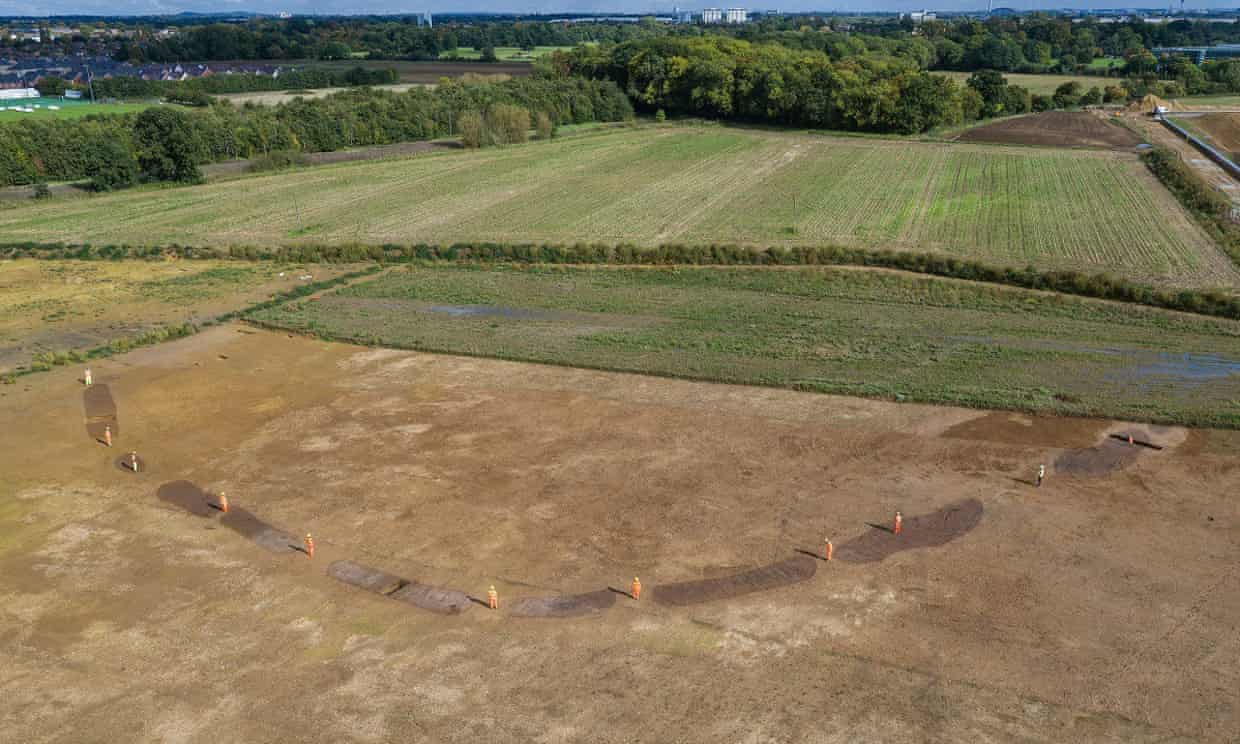
Builders have uncovered the henge, which is 100m (330ft) in diameter, at Warth Park in Raunds, Northamptonshire.
An aerial photo showing the scale of the Neolithic monument first emerged on Twitter on Tuesday, but was deleted.
However, archaeologists say that site, known as Cotton Henge, has previously been investigated twice before.
Oxford Archaeology East, working on behalf of developer Roxhill, said the henge was first identified by aerial photography in the 1970s.
They added that it was likely to date from the late Neolithic period (circa 3000BC -2500BC) and forms part of a larger group of ceremonial landscape features located and excavated as part of the Raunds Area Project.
Read the rest of this article...
The nineteenth century doctor who practiced neolithic trepanation
Human skull illustrating different methods of trephination owned by Dr. T. Wilson Parry, skull of Guanche, Canary Islands, 1871-1930 (approx). Credit: Science Museum, London. CC BY
Using images from the Science Museum and Wellcome Collection we explore the neolithic practice of trepanation
Archaeologists might not be able to agree on the reason why our ancestors made holes in their skulls, but what they can agree on is that humans on every continent have done it at some point in history, suggesting the seemingly-bizarre practice developed independently across multiple civilizations.
To date, thousands of skulls with trepanation holes have been unearthed at archaeological sites around the world.
Read the rest of this article...
Skull and mandible
Bronze Age skull and mandible of an adult male recovered from Rathlin Island, Co. Antrim.
The skull and mandible were both modelled 360 using AgiSoft PhotoScan before being assembled in Blender. Outputs included animations and the SketchFab model as educational aids for our osteoarchaeology students.
Created by Dr Siobhán McDermott, Centre for Archaeological Fieldwork, QUB. #ActualLivingTechnician.
Read the rest of this article...
Tuesday, April 17, 2018
Bronze age pot uncovered in Cornwall field
A tenant farmer on the National Trust land where the pot was found had suggested the archaeology team should investigate his field
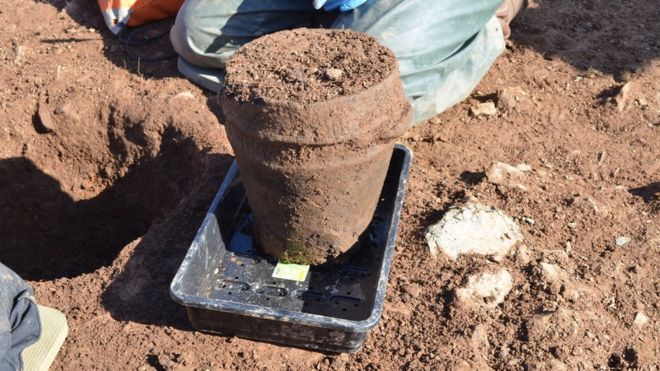
An intact earthenware pot thought to date back to the Bronze Age has been unearthed in a field in Cornwall.
The pot, which is 12in (30cm) high, is about 4,000 years old and thought to contain human remains.
It was found just below the surface, along with other Bronze Age artefacts like pottery and flint tools, at Hendersick Barrow near Looe.
Lead archaeologist Dr Catherine Frieman said: "It's almost a miracle that a plough has never hit it."
The project is part of the Southeast Kernow Archaeological Survey, with input from the Australian National University (ANU).
Read the rest of this article...
Tuesday, March 27, 2018
Skilled female potters travelled around the Baltic nearly 5000 years ago
These are Neolithic Corded ware pottery recovered in Southern Finland
[Credit: Elisabeth Holmqvist-Sipilä]
Was it the fine pottery itself, or the artisans who made it, that moved around the Baltic Sea region during the Corded Ware Culture of late Neolithic period? Are the archaeological artefacts found in Finland imported goods or were they made out of Finnish clay by artisans who had mastered the new technology? These are the questions researchers are trying to answer in the most extensive original study of archaeological ceramics ever undertaken in the Nordic countries.
Researchers mapped the arrival routes of pottery and people representing the Corded Ware Culture complex (c. 2900-2300 BCE) into the Nordic countries by identifying the areas where the pottery was made.
Corded Ware pottery was very different from earlier Stone Age pottery. It represented a new technology and style, and as a new innovation, used crushed ceramics -- or broken pottery -- mixed in with the clay.
Ramsey Island: New survey finds 'Bronze Age' site
Ramsey Island is owned and managed by the RSPB
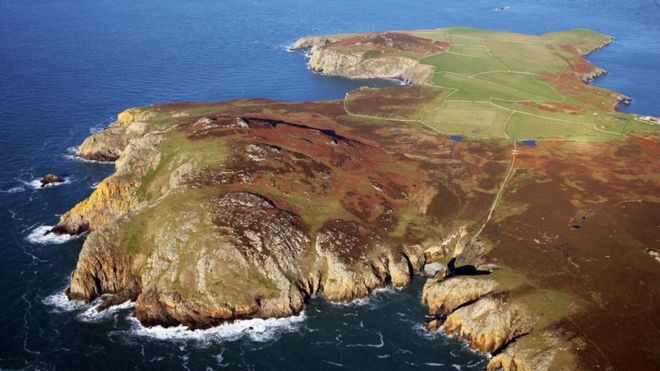
New archaeological sites on a small island off the coast of west Wales have been discovered.
The laser scan of Ramsey Island uncovered a "hidden" landscape thought to date back to the Bronze Age.
The survey, taken from the air, has also seen a detailed 3D model of the two mile-long beauty spot made for the first time.
Experts say the data could also be used to see if climate change affects the environment on the island.
Royal Commission archaeologist Dan Hunt described the findings as "incredible".
He added: "It has presented us with a stunning view of the island in enormous detail."
The archaeologists sorting out Orkney's Neolithic bones
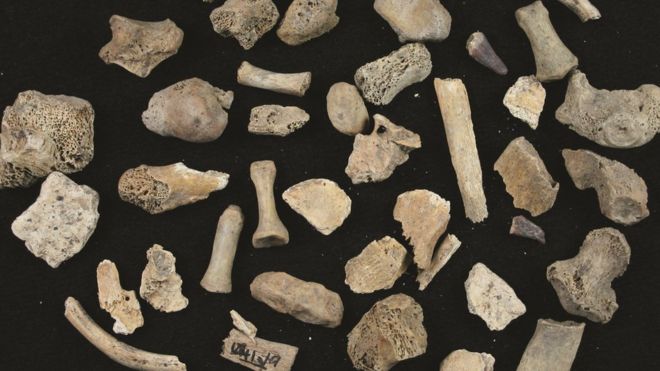
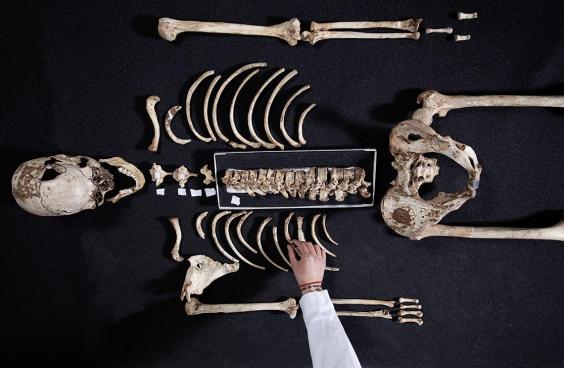
Archaeologists excavating Neolithic tombs in Orkney are used to finding jumbled collections of bones
A new study could potentially transform our understanding of the way Neolithic people dealt with their dead.
Archaeologists excavating Neolithic tombs in Orkney are used to finding jumbled collections of bones that seem unconnected.
Now, work by Dr Rebecca Crozier, from the University of Aberdeen, suggests whole bodies were placed in the chambered structures.
She said they could have been dismembered after being buried.
She told BBC Radio Orkney: "What we're trying to do is look at all the bones and try and understand why they are in the mess that we finding them in.
Read the rest of this article...
Monday, March 19, 2018
Site of huge Iron Age feast celebration found on Orkney
Windwick Bay at South Ronaldsay, close to the site of the massive cliff top feast held more than 1,700 years ago. PIC: www.geography.co.uk
Archaeologists have identified the site of a huge Iron Age feast on Orkney where more than 10,000 animals were cooked and eaten in a vast cliff top celebration.
Tests have shown that horses, cattle, red deer and otters were on the menu at the gathering above Windwick Bay, South Ronaldsay, more than 1,700 years ago.
Archaeologists from the University of the Highlands and Islands have been working at The Cairns for several years.
A large number of jewellery fragments and tools have already been discovered at the site, where the remains of an Iron Age broch and metalworking site can be found, with recent radiocarbon tests carried out at a midden - or rubbish tip - nearby.
Read the rest of this article...
Utrecht’s history goes back 11,000 years, archaeologists say
The history of Utrecht begins at least 8,000 years earlier than was previously thought, local broadcaster RTV Utrecht reported this week.
The discovery was made when archaeologists were digging at the site of the Prinses Máxima Centrum for children with cancer ahead of its expansion.
The dig yielded traces of human habitation and objects from the early Stone Age, with some indications that Utrecht started as far back as 11,000 BC.
‘There have been prehistoric finds in Leidsche Rijn and Hoograven, particularly from the Bronze Age and the Iron Age. But this discovery means the history of Utrecht started 8,000 years earlier than the history books tell us,’ Utrecht alderman Kees Geldof told the broadcaster.
Not only were older indications of a human presence found at the site but the dig also showed evidence that the site had been inhabited without interruption throughout the Stone Age.
Read the rest of this article...
Thursday, March 1, 2018
15,000-year-old artefacts discovered along Scotland's Aberdeen bypass
Artefacts and structures found during archaeological excavations on the Aberdeen Western Peripheral Route/Balmedie to Tipperty (AWPR/B-T) project are shedding light on land use and settlement in the north east over the past 15,000 years, including Mesolithic pits, Roman bread ovens, prehistoric roundhouses and a cremation complex.
Since the archaeological excavations were completed, specialists have been analysing the artefacts and samples recovered from the various sites and will be detailing the results in a new limited edition book due to be published later this year.
Keith Brown, Cabinet Secretary for Economy, Jobs and Fair Work said: “When complete, the AWPR will help to reduce congestion, cut journey times, improve safety and lower pollution in Aberdeen City Centre, as well as enable local authorities to develop public transport solutions."
Read the rest of this article...
A beaker from the Chalcolithic period; a fluted carinated bowl from early Neolithic times;
impressed ware from the middle Neolithic
[Credit: Transport Scotland]
Keith Brown, Cabinet Secretary for Economy, Jobs and Fair Work said: “When complete, the AWPR will help to reduce congestion, cut journey times, improve safety and lower pollution in Aberdeen City Centre, as well as enable local authorities to develop public transport solutions."
Monday, February 26, 2018
Britain's prehistoric catastrophe revealed
Ancient Britons may have been nearly wiped out by bubonic plague brought by newcomers to the island
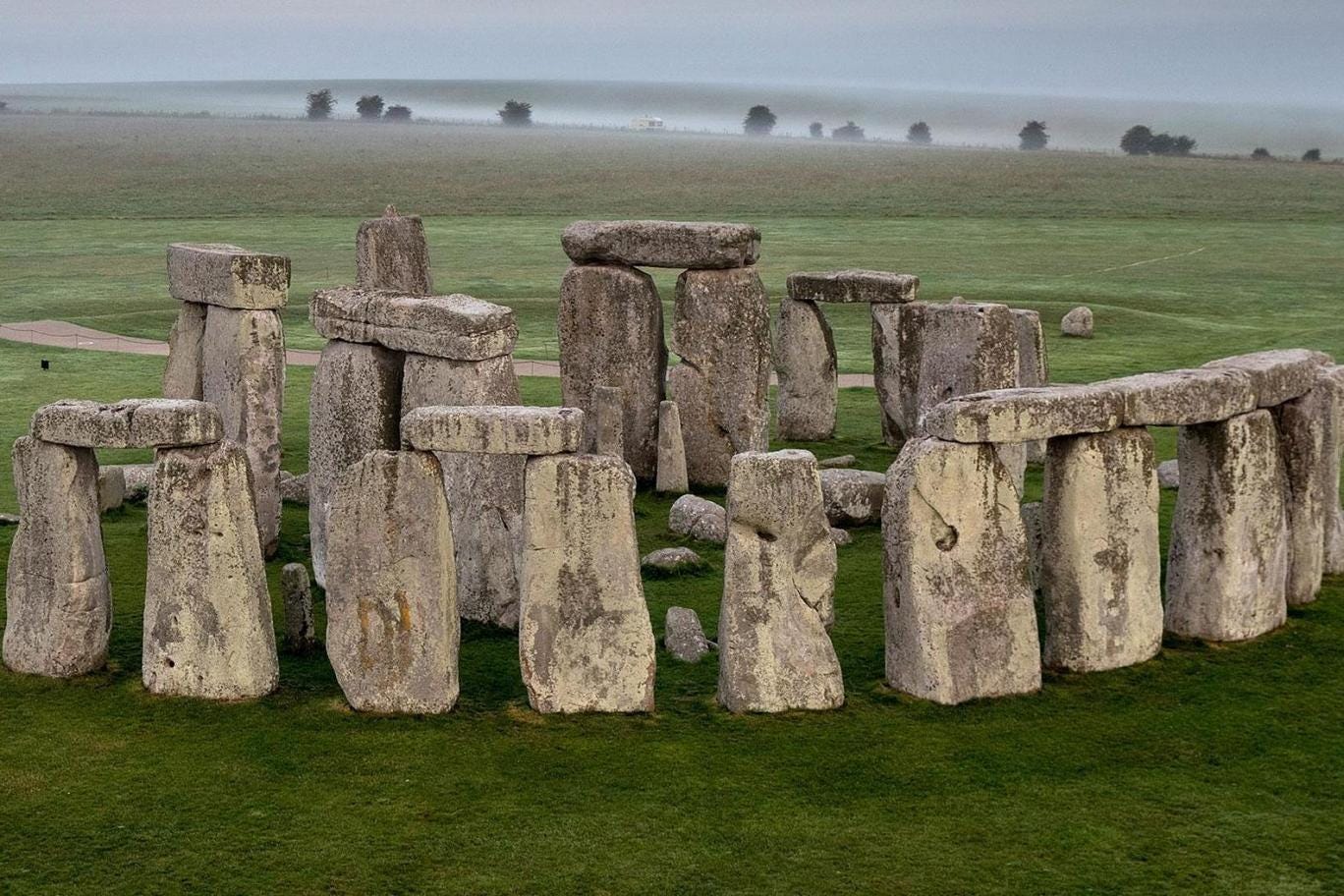
The builders of Stonehenge are thought to be the last of Britain's neolithic people Getty
Extraordinary new genetic evidence is revealing how Britain experienced a mysterious almost total change in its population in just a few centuries after the construction of Stonehenge.
It suggests that some sort of social, economic or epidemiological catastrophe unfolded.
The great 20-30 tonne stones of Stonehenge were erected by Neolithic farmers whose ancestors had lived in Britain for at least the previous 1,500 years – and new genetic research on 51 skeletons from all over Neolithic Britain has now revealed that during the whole of the Neolithic era, the country was inhabited mainly by olive-skinned, dark-haired Mediterranean-looking people.
Read the rest of this article...
The Archaeology of Wealth Inequality
Researchers trace the income gap back more than 11,000 years
When the last of the volcanic ash from Mount Vesuvius settled over Pompeii in A.D. 79, it preserved a detailed portrait of life in the grand Roman city, from bristling military outposts to ingenious aqueducts. Now researchers say the eruption nearly 2,000 years ago also captured clues to one of today’s most pressing social problems.
Analyzing dwellings in Pompeii and 62 other archaeological sites dating back 11,200 years, a team of experts has ranked the distribution of wealth in those communities. Bottom line: economic disparities increased over the centuries and technology played a role. The findings add to our knowledge of history’s haves and have-nots, an urgent concern as the gulf between the 1 percent of ultra-rich and the rest of us continues to grow.
“We wanted to be able to look at the ancient world as a whole and draw connections to today,” says Michael E. Smith, an archaeologist at Arizona State University, who took part in the study. The research is being published this month in Ten Thousand Years of Inequality, a book edited by Smith and Timothy Kohler of Washington State University.
Read the rest of this article...
Ancient Britons 'replaced' by newcomers
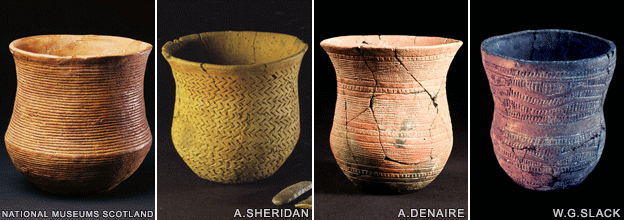
Beaker pottery starts to appear in Britain around 4,500 years ago
The ancient population of Britain was almost completely replaced by newcomers about 4,500 years ago, a study shows.
The findings mean modern Britons trace just a small fraction of their ancestry to the people who built Stonehenge.
The astonishing result comes from analysis of DNA extracted from 400 ancient remains across Europe.
The mammoth study, published in Nature, suggests the newcomers, known as Beaker people, replaced 90% of the British gene pool in a few hundred years.
Read the rest of this article...
13,500-year-old carved bison bone fished from the bottom of the North Sea
he carved bison bone was fished out of the North Sea in 2005 and dates to the last Ice Age
[Credit: Rijksmuseum van Oudheden]
Late Ice Age hunter gatherers roamed the area that became the North Sea but very little evidence of their presence has been found. But sometimes the sea floor yields treasures that shed light on the period. This is a confirmation, the article says, of ‘the importance of continental shelves as archaeological archives’.
In 2005 a Dutch fishing vessel caught a bison bone in its nets on the border of the Dutch part of the continental shelf. The bone, which had a distinctive zigzag pattern carved in it, ended up in the hands of a collector who, the NRC writes, ‘had good contacts with fishermen’ and agreed to let experts at the Leiden archaeological museum take a look at it.
Carbon isotope analysis showed the bone to be 13,500 years old and part of a culture that decorated animal bones with zigzag and herringbone motives. Only three other similarly carved objects have been discovered so far: a horse’s jaw in Wales, deer antlers in Northern France and moose antlers in Poland.
Read the rest of this article...
The Guardian view on Neanderthals: we were not alone
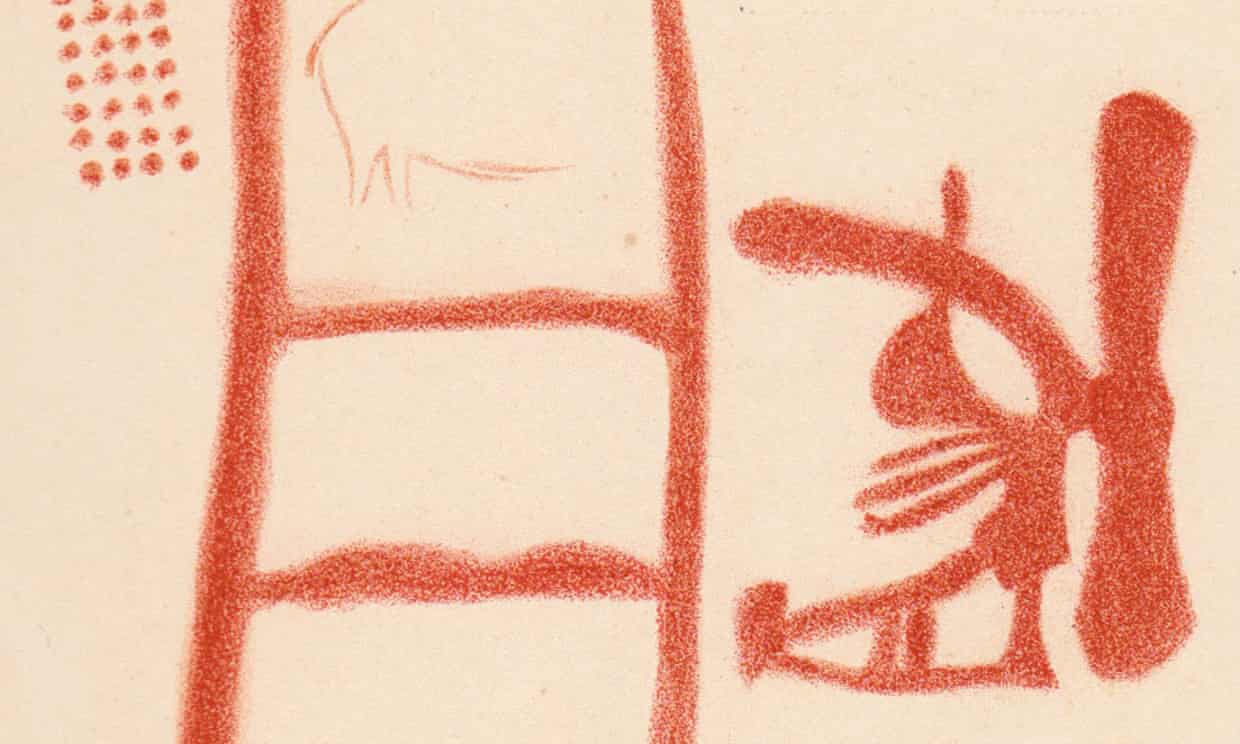
Drawing of Panel 78 in La Pasiega by Breuil et al (1913). The red scalariform (ladder) symbol has a minimum age of 64,000 years but it is unclear if the animals and other symbols were painted later. Photograph: Breuil et al
The three human subspecies known to have hybridised to produce the present human population of the planet, Neanderthals, Homo sapiens and Denisovans, last had a common ancestor more than half a million years ago. Until now it has been assumed that the only branch of her descendants to think symbolically was us, Homo sapiens. In fact, until the development of sequencing techniques sensitive enough to work on ancient DNA, it was thought that the other two species had died out entirely, rather than leaving portions of their genome in European and Melanesian populations respectively. But the discovery, reported last week, of palaeolithic art at four sites in Spain that dates from the time when the peninsula was occupied only by Neanderthals, shows that they worked with symbols of stone and paint.
We have no idea what these markings mean. That is in the nature of symbolism, and indeed of language: the meaning of a sound, or a marking on the wall, is given by the community that uses it; it can’t be read by outsiders. We already know that Neanderthals were anatomically equipped for speech; their use of painted symbols suggests that they could make audible symbols and not just visible ones.
Read the rest of this article...
Neanderthals – not modern humans – were first artists on Earth, experts claim
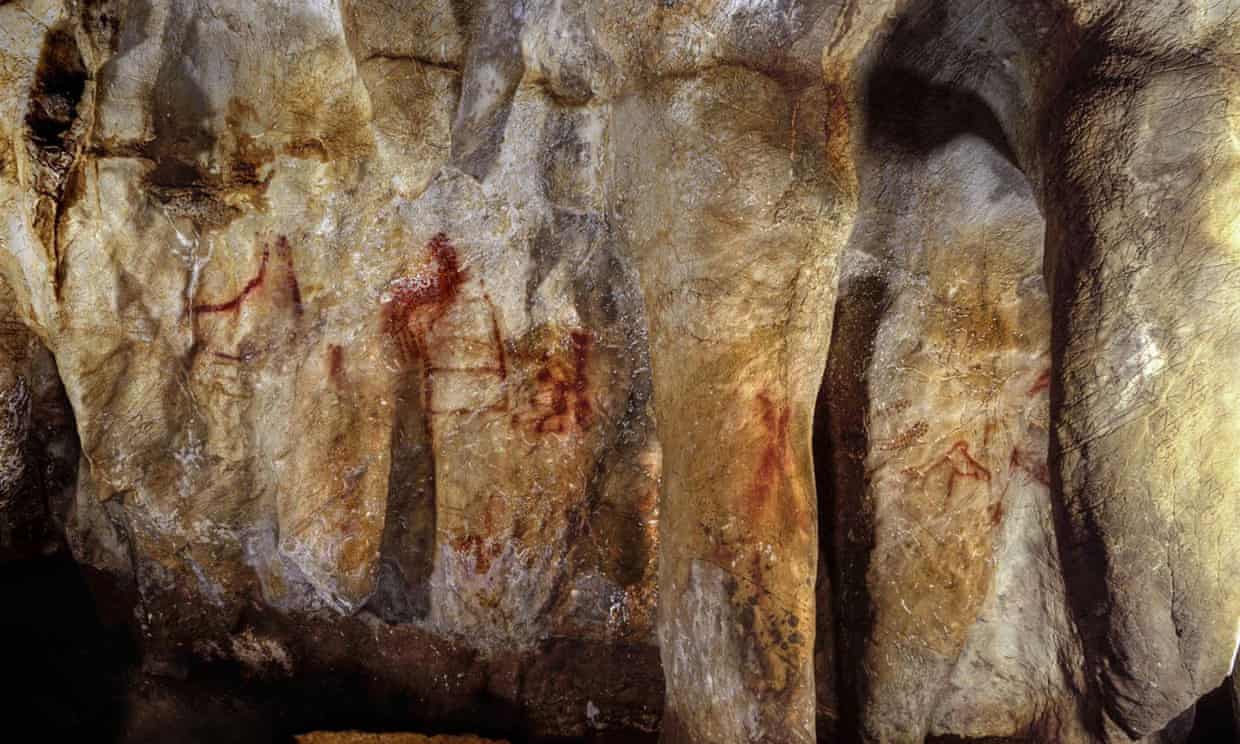
Paintings on a section of the La Pasiega cave wall, including a ladder shape composed of red horizontal and vertical lines. Photograph: P. Saura/PA
More than 65,000 years ago, a Neanderthal reached out and made strokes in red ochre on the wall of a cave, and in doing so, became the first known artist on Earth, scientists claim.
The discovery overturns the widely-held belief that modern humans are the only species to have expressed themselves through works of art.
In caves separated by hundreds of miles, Neanderthals daubed, drew and spat paint on walls producing artworks, the researchers say, tens of thousands of years before modern humans reached the sites.
Read the rest of this article...
A rare Neanderthal hand axe found in a long lost cave in Wales
Image courtesy National Museum Cardiff
Elizabeth Walker, Palaeolithic & Mesolithic Archaeologist and Head of Collections at National Museum Cardiff, talks about a Neanderthal hand axe, which dates back to c. 60,000-35,000 BC
This hand axe was found during excavations at Coygan Cave, near Laugharne, Carmarthenshire, in advance of the cave’s destruction by quarrying in the 1960s. It is of a form typically made by a Neanderthal and was left at the cave with another similar tool sometime between 60,000 and 35,000 years ago.
Findings like this hint that Neanderthals may have lived in the Carmarthenshire area, but we have no evidence of their physical remains. The two axes we have were found near the wall of the cave, and it’s been suggested they were deliberately cached by their owners, who intended to return to the cave to use them on a future visit.
Read the rest of this article...
Wednesday, February 14, 2018
Northumberland Bronze Age skeleton: Whose bones are these?
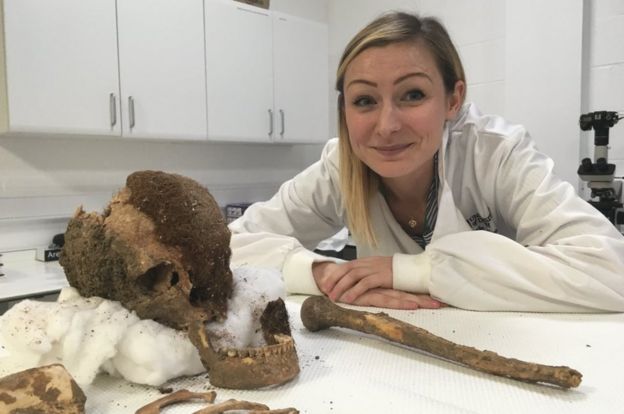
Sanita Nezirovic has been investigating the Bronze Age remains
Forensic scientists have been analysing Bronze Age bones found in a field - but how do they work out who the person was?
In September 2017, a farmer near Rock, Northumberland, preparing his field for drainage discovered a burial cist - or stone coffin - containing a skeleton and a jug.
Sanita Nezirovic, a lecturer in forensic science at the University of Derby, was tasked with finding out whose bones they were.
She has looked at the remains of hundreds of people, dating from the Bronze Age to modern times.
In each case she creates a "presumptive profile", detailing facts such as the person's sex, age and height.
Read the rest of this article...
Bizarre 'Spider Stones' Found at Site of Neolithic Sun-Worshipers
Two of the 5,000-year-old "spider stones" unearthed on the Danish island on Bornholm.
Credit: Bornholm Museum
Strangely marked stones and other artifacts unearthed on the island of Bornholm in Denmark have raised new mysteries about a Neolithic sun-worshipping religion centered there about 5,000 years ago.
The new finds include "spider stones," inscribed with pattern like a spider's web, and a piece of copper from a time when the metal could not be made by the island's Stone Age inhabitants, say the researchers.
The handful of newfound spider stones look a little like hundreds of inscribed "sun stones" or "solar stones" — solsten in Danish — found since the 1990s amid the remains of an earthen-walled Neolithic enclosure, about 650 feet (200 m) across, at the Vasagard archaeological site on Bornholm in the Baltic Sea, between the southern tip of Sweden and the coast of Poland.
Read the rest of this article...
8,000-Year-Old Heads on Stakes Found in Mysterious Underwater Grave
None of the human skulls had jaw bones. There was one human jaw bone at the site, but it wasn't associated with any of the skulls.
The discovery of a burial containing 8,000-year-old battered human skulls, including two that still have pointed wooden stakes through them, has left archaeologists baffled, according to a new study from Sweden.
It's hard to make heads or tails of the finding: During the Stone Age, the grave would have sat at the bottom of a small lake, meaning that the skulls would have been placed underwater. Moreover, of the remains of at least 11 adults placed on top of the grave, only one had a jawbone, the researchers said.
Neanderthals' lack of drawing ability may relate to hunting techniques
Replica of drawing of lions painted in the Chauvet Cave. Art in the cave has been identified
as created by early modern humans [Credit: UC Davis]
Neanderthals had large brains and made complex tools but never demonstrated the ability to draw recognizable images, unlike early modern humans who created vivid renderings of animals and other figures on rocks and cave walls. That artistic gap may be due to differences in the way they hunted, suggests a University of California, Davis, expert on predator-prey relations and their impacts on the evolution of behaviour.
Neanderthals used thrusting spears to bring down tamer prey in Eurasia, while Homo sapiens, or modern humans, spent hundreds of thousands of years spear-hunting wary and dangerous game on the open grasslands of Africa.
Richard Coss, a professor emeritus of psychology, says the hand-eye coordination involved in both hunting with throwing spears and drawing representational art could be one factor explaining why modern humans became smarter than Neanderthals.
Major Neolithic ceremonial enclosure uncovered at Windsor
An aerial view of the site of the Neolithic causewayed enclosure
[Credit: Wessex Archaeology]
A major 5,500 year old Neolithic ceremonial gathering place known as a causewayed enclosure has been partially uncovered within sight of Windsor Castle in Berkshire. The discovery was made at Riding Court Farm, near Datchet as part of CEMEX UK’s archaeological programme on the quarrying site, which is monitored on behalf of the local planning authority by Berkshire Archaeology.
Defined by encircling bank and ditch segments with gap entrances, such sites represent some of the earliest known acts of monument building in Britain. Around 80 monuments have been identified across Britain, and others are known on the Continent. The Riding Court causewayed enclosure may have been seasonally occupied, a place where communities gathered to undertake ceremonial feasting, exchange of goods, the marking of festivals and social obligations. Imported objects found in other enclosures suggest trade and exchange of exotic objects (stone axes and pottery), while evidence of feasting and human burials are known from other sites.
One feature is the deliberate consumption and wasting of meat and the exposure of human remains including the placing of skulls in the base of ditches. There are signs that pots were deliberately smashed perhaps as festivities came to a close.
Read the rest of this article...
Mystery of 8,000-Year-Old Impaled Human Heads Has Researchers Stumped
Archaeologists have never before encountered this grisly phenomenon in Mesolithic Scandinavia, and they're hard-pressed to explain it.
In 2009, a new railway bridging southern Sweden's Motala Ström River was slated for construction. But then, archaeologists began turning up artifacts there that were thousands of years old. Over the next few years, animal bones, tools made from antlers, wooden stakes, and bits of human skull were found in the bog's lime sediment.
The remains belonged to Mesolithic hunter-gatherers, a group that existed around 8,000 years ago between the Old and New Stone Ages. These societies have been known to show respect for the bodily integrity of their dead—that is, until now. (Related: "Mysterious Graves Discovered at Ancient European Cemetery")
In 2011, Fredrik Hallgren of the Cultural Heritage Foundation led an archaeological project on the Kanaljorden excavation site near the Motala Ström River. When the team began excavating the site, they uncovered the first known instance of Mesolithic hunter-gatherers mounting human skulls on stakes. (Related: "Archaeologists Discover New Mass Grave From Notorious Shipwreck")
Read the rest of this article...
Impaled Mesolithic Skull
found on the bottom of a shallow lake in Kanaljorden #Sweden
ca. 7,000 years old
In 2009, a new railway bridging southern Sweden's Motala Ström River was slated for construction. But then, archaeologists began turning up artifacts there that were thousands of years old. Over the next few years, animal bones, tools made from antlers, wooden stakes, and bits of human skull were found in the bog's lime sediment.
The remains belonged to Mesolithic hunter-gatherers, a group that existed around 8,000 years ago between the Old and New Stone Ages. These societies have been known to show respect for the bodily integrity of their dead—that is, until now. (Related: "Mysterious Graves Discovered at Ancient European Cemetery")
In 2011, Fredrik Hallgren of the Cultural Heritage Foundation led an archaeological project on the Kanaljorden excavation site near the Motala Ström River. When the team began excavating the site, they uncovered the first known instance of Mesolithic hunter-gatherers mounting human skulls on stakes. (Related: "Archaeologists Discover New Mass Grave From Notorious Shipwreck")
Read the rest of this article...
Thursday, February 8, 2018
Discovery of Windsor neolithic monument excites archaeologists
Scientists expect to uncover entire circuit of causewayed enclosure at Berkshire quarry
A neolithic monument has been discovered less than two miles from Windsor Castle. Dating from 5,500 years ago, it is one of the earliest known examples of monument-building in Britain.
A ceremonial gathering place known as a causewayed enclosure has been revealed with the discovery of a series of encircling ditches, artificial boundaries with gap entrances, at a vast site in Berkshire.
Archaeologists have found extensive quantities of animal bones as well as decorated pottery sherds, and evidence that pots were deliberately smashed, perhaps as festivities came to a boisterous close. Other finds include finely worked, leaf-shaped flint arrowheads, serrated blades, stone axes and grinding stones.
Read the rest of this article...
An aerial view of the site of the Neolithic causewayed enclosure.
Photograph: Wessex Archaeology
A neolithic monument has been discovered less than two miles from Windsor Castle. Dating from 5,500 years ago, it is one of the earliest known examples of monument-building in Britain.
A ceremonial gathering place known as a causewayed enclosure has been revealed with the discovery of a series of encircling ditches, artificial boundaries with gap entrances, at a vast site in Berkshire.
Archaeologists have found extensive quantities of animal bones as well as decorated pottery sherds, and evidence that pots were deliberately smashed, perhaps as festivities came to a boisterous close. Other finds include finely worked, leaf-shaped flint arrowheads, serrated blades, stone axes and grinding stones.
Housebuilder uncovers Iron Age chamber on Lewis
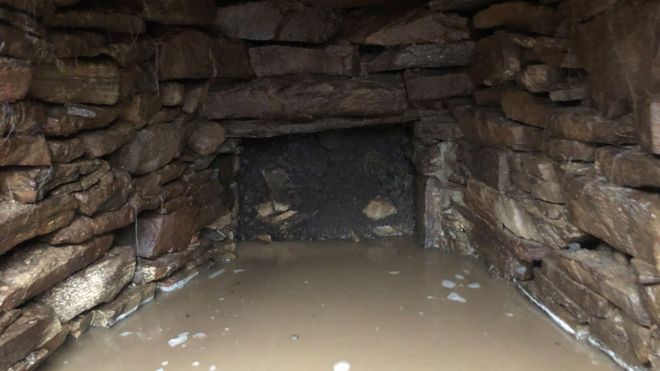
A 2,000-year-old underground chamber has been uncovered during work to build a house on the Isle of Lewis.
The Iron Age soutterrain was revealed during the digging of the foundations for the property in Ness.
Local archaeologists, husband and wife team Chris and Rachel Barrowman, are recording the soutterrain.
Mr Barrowman said theories on the purpose of the stone-lined, flat stone-roofed structures included storing food.
Read the rest of this article...
Stonehenge A303 tunnel plans will 'protect and enhance' monument
This is the proposed western approach to the new Longbarrow junction
Initial designs for the scheme have been unveiled for the first time as a major public consultation starts.
Highways England said the design would "restore the tranquil environment and setting of the monument".
Opponents have said the tunnel could destroy archaeological treasures and scar the landscape irreparably.
Read the rest of this article...
Wednesday, February 7, 2018
Cheddar Man: First modern Briton had 'dark to black' skin, DNA research reveals
The first modern Briton had “dark to black” skin, groundbreaking new analysis of his 10,000-year-old remains has revealed.
Britain’s oldest complete skeleton, known as Cheddar Man, was unearthed more than a century ago in Gough’s Cave in Somerset.
But an unprecedented examination of his DNA, along with a facial reconstruction of the fossil, shows the young man would have had a darker complexion than previously thought, along with blue eyes and dark, curly hair.
Previous reconstructions of Cheddar Man, which were not based on DNA data, depicted him with a lighter skin tone.
Yet research by evolution and DNA specialists at the Natural History Museum and University College London suggests the pigmentation associated with northern European ancestry is a more recent development.
Read the rest of this article...
Could these be the oldest Neandertal tools made with fire?
These 171,000-year-old digging sticks may have been made by Neandertals.
In the spring of 2012, while digging a hole for a thermal pool, construction workers in Grosseto, Italy, hit scientific pay dirt: layers of stratified soil and rock filled with prehistoric bones and artifacts close to 171,000 years old. Excavating the pool would have to wait. With further digging, the researchers found tantalizing evidence of early fire use—nearly 60 partially burned digging sticks made mostly of boxwood. The most likely creators of the sticks were Neandertals, who are known to have lived in Europe at that time. If our extinct cousins did indeed craft the sticks, they represent the earliest use of fire for toolmaking among Neandertals.
Neandertals evolved in Europe perhaps as early as 400,000 years ago, but it’s unclear when they began to regularly use fire. Until now, the earliest evidence of Neandertals controlling fire dates to the late Middle Pleistocene, about 130,000 years ago. And because wood decomposes easier and faster than materials like bone and stone, it’s unusual to find prehistoric wooden artifacts. The oldest wooden weapons discovered so far are spears in Schöningen, Germany. They are thought to have been made by Homo heidelbergensis or Neandertals some 300,000 years ago.
Read the rest of this article...
First modern Britons had 'dark to black' skin, Cheddar Man DNA analysis reveals
The genome of Cheddar Man, who lived 10,000 years ago, suggests that he had blue eyes, dark skin and dark curly hair
The first modern Britons, who lived about 10,000 years ago, had “dark to black” skin, a groundbreaking DNA analysis of Britain’s oldest complete skeleton has revealed.
The fossil, known as Cheddar Man, was unearthed more than a century ago in Gough’s Cave in Somerset. Intense speculation has built up around Cheddar Man’s origins and appearance because he lived shortly after the first settlers crossed from continental Europe to Britain at the end of the last ice age. People of white British ancestry alive today are descendants of this population.
It was initially assumed that Cheddar Man had pale skin and fair hair, but his DNA paints a different picture, strongly suggesting he had blue eyes, a very dark brown to black complexion and dark curly hair.
The discovery shows that the genes for lighter skin became widespread in European populations far later than originally thought – and that skin colour was not always a proxy for geographic origin in the way it is often seen to be today.
Tom Booth, an archaeologist at the Natural History Museum who worked on the project, said: “It really shows up that these imaginary racial categories that we have are really very modern constructions, or very recent constructions, that really are not applicable to the past at all.”
Read the rest of this article...
Tuesday, February 6, 2018
Genome erzählen die Bevölkerungsgeschichte Nordeuropas
Schädel, der im Rahmen dieser Studie untersucht wurde. Fundort: Ölsund, Hälsingland, Schweden, datiert auf etwa 2,300 v. Chr., im Reinraumlabor für die Analyse alter DNA des Max-Planck-Instituts für Menschheitsgeschichte. (© Alissa Mittnik)
Ein internationales Forschungsteam unter Leitung des Max-Planck-Instituts für Menschheitsgeschichte in Jena, hat das Erbgut von 38 Nordeuropäern aus der Zeit von etwa 7.500 bis 500 vor Christus analysiert. Die Studie, die jetzt in Nature Communications erschien, zeigt, dass Skandinavien ursprünglich über eine südliche und eine nördliche Route besiedelt wurde und dass die Landwirtschaft in Nordeuropa wahrscheinlich durch einwandernde Bauern und Weidehirten rund 2000 Jahre später als in Mitteleuropa eingeführt wurde.
Read the rest of this article...
Monday, February 5, 2018
New tunnel bypassing Stonehenge could destroy traces of human life dating back to the Ice Age, experts warn
Hoof prints dating back 8,000 years could be destroyed by road plans at ‘precious‘ site, archaeologist says
A new tunnel bypassing Stonehenge could destroy a “unique” site where traces of humans living as far back as the last Ice Age have been preserved, experts have warned.
Hoof prints of wild cattle known as aurochs were recently discovered at excavations a mile and a half from the famous stone circle in Wiltshire, University of Buckingham archaeologist David Jacques said.
The 6,000-year-old marks, preserved in what appears to be a ritualistic manner, are the latest finds of a decade-long dig at Blick Mead, which Prof Jacques said form a "national archive of British history".
However, the proposed tunnel and a flyover close to Blick Mead, which could be built under Government-backed roadwork plans to ease congestion on the A303, could irrevocably damage the site, he warned.
Opponents of the plan fear it could harm the rich archaeological landscape.
Read the rest of this article...
The Government has backed road works to ease traffic congestion near Stonehenge Getty
A new tunnel bypassing Stonehenge could destroy a “unique” site where traces of humans living as far back as the last Ice Age have been preserved, experts have warned.
Hoof prints of wild cattle known as aurochs were recently discovered at excavations a mile and a half from the famous stone circle in Wiltshire, University of Buckingham archaeologist David Jacques said.
The 6,000-year-old marks, preserved in what appears to be a ritualistic manner, are the latest finds of a decade-long dig at Blick Mead, which Prof Jacques said form a "national archive of British history".
However, the proposed tunnel and a flyover close to Blick Mead, which could be built under Government-backed roadwork plans to ease congestion on the A303, could irrevocably damage the site, he warned.
Opponents of the plan fear it could harm the rich archaeological landscape.
Read the rest of this article...
Stonehenge tunnel could destroy 'unique library' of early history
Plans for A303 could spell loss of Blick Mead site, where humans may have lived since the Ice Age
The construction of a tunnel past Stonehenge could spell the loss of a unique site that can trace the presence of people back to the last Ice Age, experts have said.
Perfectly preserved hoofprints of wild cattle known as aurochs have recently been found at excavations a mile and a half from the Wiltshire stone circle, David Jacques, and archaeologist at the University of Buckingham, said.
The 6,000-year-old prints, preserved in what appears to be a ritualistic way, are the latest in a wealth of finds made during a decade-long dig at Blick Mead, which Jacques said amounted a “national archive of British history”.
The tunnel, and a flyover close to the Blick Mead excavations which could also form part of the roadworks to improve the A303, could irrevocably damage the site, he said.
The government has backed plans to build a tunnel to house the A303 as it passes Stonehenge as part of measures to ease congestion and improve the setting of the neolithic site.
Read the rest of this article...
The construction of a tunnel past Stonehenge could spell the loss of a unique site that can trace the presence of people back to the last Ice Age, experts have said.
Perfectly preserved hoofprints of wild cattle known as aurochs have recently been found at excavations a mile and a half from the Wiltshire stone circle, David Jacques, and archaeologist at the University of Buckingham, said.
The 6,000-year-old prints, preserved in what appears to be a ritualistic way, are the latest in a wealth of finds made during a decade-long dig at Blick Mead, which Jacques said amounted a “national archive of British history”.
The tunnel, and a flyover close to the Blick Mead excavations which could also form part of the roadworks to improve the A303, could irrevocably damage the site, he said.
The government has backed plans to build a tunnel to house the A303 as it passes Stonehenge as part of measures to ease congestion and improve the setting of the neolithic site.
Read the rest of this article...
Sunday, February 4, 2018
Scandinavians shaped by several waves of immigration
Directly following the last ice age, people from the western parts of what is now Norway were a population that had substantially different genetics from the people living in the area corresponding to present-day Sweden.
"We were surprised that the results showed such marked dissimilarities," says associate professor and archaeologist Birgitte Skar at the Norwegian University of Science and Technology's (NTNU) University Museum. Skar is responsible for the museum's Stone Age and Bronze Age collections.
Scandinavia was one of the last parts of Europe to become habitable when the glaciers released their icy grip more than 10,000 years ago. The ocean's resources and the coastal archipelago attracted marine hunter-gatherers of yore to the region.
Swedish and Norwegian researchers have collaborated on analysing the DNA in 9500-year-old bone samples from the southern and western Norwegian coast and from the Swedish islands of Gotland and Stora Karlsö. This period corresponds to the Mesolithic Stone Age.
Read the rest of this article...
Anne-Marian Snaaijer, a PhD candidate at the Norwegian University of Science and Technology works in Trondheim's Archive Centre at Dora. The collection trays hold lots of bone discoveries
[Credit: Åge Hojem, NTNU University Museum]
"We were surprised that the results showed such marked dissimilarities," says associate professor and archaeologist Birgitte Skar at the Norwegian University of Science and Technology's (NTNU) University Museum. Skar is responsible for the museum's Stone Age and Bronze Age collections.
Scandinavia was one of the last parts of Europe to become habitable when the glaciers released their icy grip more than 10,000 years ago. The ocean's resources and the coastal archipelago attracted marine hunter-gatherers of yore to the region.
Swedish and Norwegian researchers have collaborated on analysing the DNA in 9500-year-old bone samples from the southern and western Norwegian coast and from the Swedish islands of Gotland and Stora Karlsö. This period corresponds to the Mesolithic Stone Age.
Read the rest of this article...
Melting Glaciers Could Reveal How Our Ancestors Dealt With Changing Climates
While some archaeologists dig with trowels and shovels, others use a warming planet to their advantage.
Archaeologist holding a c. 1400-year-old arrow, lost reindeer hunting in the high mountains of Oppland, Norway, during the Late Antique Little Ice Age.
PHOTOGRAPH BYJULIAN MARTINSEN, SECRETS OF THE ICE OPPLAND COUNTY COUNCIL
When Lars Pilø, co-director of the Glacier Archaeology Program at Oppland County Council, noticed Norway was experiencing a particularly warm autumn in 2006, the archaeologist turned to the mountains. If climate change was thawing glacial ice, what did that mean for the artifacts that were emerging from the melt? So, starting officially in 2011, Pilø and an international team took to Norway's icy Jotunheimen and Oppland mountains to see what ancient objects they could rescue from the snowmelt.
Over the years, the archaeologists uncovered thousands of artifacts, some of which date back 6,000 years. Since the ice acts like a giant freezer and preserves the objects, the finds look like they could have been uncovered yesterday. (Read: "Alaska's Thaw Reveals—And Threatens—A Culture's Artifacts")
"The moment these artifacts melt out of the ice, they're immediately vulnerable to the elements," says James H. Barrett, a University of Cambridge environmental archaeologist.
The glacier archaeologists detailed their findings in a Royal Society Open Science paper published January 24. Pilø and Barrett are authors on the paper.
Read the rest of this article...
Friday, February 2, 2018
Archaeologists may have found architects' camp for Stonehenge
A team of archaeologists believe they may have discovered a spot where some of the architects of Stonehenge gathered and camped.
The team have been investigating a causewayed enclosure – these are thought to be ancient meeting places or centres of trade – on army land at Larkhill close to Stonehenge.
They found an alignment of posts that matches the orientation of the circle at Stonehenge, leading to the theory that Larkhill could have been some sort of blueprint for the temple.
Si Cleggett, of Wessex Archaeology, conceded it was possible to suggest that any evidence of prehistoric settlement could be connected to the creation of Stonehenge.
But he argued that the proximity of Larkhill – a relatively short walk from the stone circle – and the coincidence of the alignment of the nine posts gave weight to the idea that the people who created and visited the enclosure could have had a hand in the conceptualisation of Stonehenge.
Read the rest of this article...
Subscribe to:
Posts (Atom)