The Prehistoric Archaeology Blog is concerned with news reports featuring Prehistoric period archaeology. If you wish to see news reports for general European archaeology, please go to The Archaeology of Europe Weblog.
Monday, July 29, 2019
Slovakia/Thousands of years old traces of human presence found in Tatra cave
Source: Prof. Paweł Valde-Nowak
Researchers including Polish archaeologists discovered 14-15 thousand years old traces of human presence in the Hučava Cave in the Belianske Tatras. These are stone blades used by hunters. Until now, no prehistoric items have been found in any of the Tatra caves.
The discovery was made in July by a Slovak-Polish archaeological expedition. The Hučava Cave (Hučivá diera) is located in the Belianske Tatras in Slovakia, on the slopes of Kobylí Vrch, at 937 m a.s.l. Excavations are being carried out both at the entrance and in the cavern chamber.
"We have discovered dozens of stone blades that have survived completely or in fragments, originally embedded on poles (that have not survived until our time). We recovered some of the blades from the remnants of a hearth" - says Prof. Paweł Valde-Nowak from the Institute of Archaeology of the Jagiellonian University in Kraków. Valde-Nowak leads the research project together with Dr. Marian Sojak from the Institute of Archaeology of the Slovak Academy of Sciences in Nitra.
Read the rest of this article...
10,000-year-old engraved 'pebble' found near Rome said to be earliest known lunar calendar
The 10,000-year-old pebble which is believed to be the oldest lunar calendar in the world
[Credit: Sapienza Universita di Roma]
[Credit: Sapienza Universita di Roma]
The oldest known lunar calendar may be an engraved pebble dating back to the Upper Palaeolithic found in Velletri, in the Alban Hills, south of Rome. The news has been announced by Flavio Altamura, a researcher at the Department of Antiquities of Sapienza University, who analyzed this enigmatic object in collaboration with the Superintendency for Archaeology, Fine Arts and Landscape in the Rome Metropolitan Area, the Province of Viterbo and Southern Etruria. The results of this study have been published in the Journal of Archaeological Science: Reports.
"The study reveals," explains Flavio Altamura, "that the notches were made over time using more than one kind of sharp cutting stone tool, as if they had been used for counting and calculating, or to store some kind of information over a period of time.”
Read the rest of this article...
Sunday, July 28, 2019
Finds from Celtic grave found in Zurich analyzed
Reconstruction of the grave with tree coffin [Credit: Amt für Städtebau, City of Zurich]
The tree coffin burial of a Celtic woman, which was discovered in March 2017 during construction work on the Kern school building, was examined by the Archaeology City of Zurich in an interdisciplinary evaluation. The bones and the unusual burial objects were carefully documented, salvaged, preserved and evaluated. Thus the grave can be assigned to the Late Iron Age around 200 BC. Of the artefacts that have been found, a string of glass beads in particular is unique in its form: it is fastened between two fibulae (clasps) and fitted with precious glass and amber beads.
The now completed interdisciplinary evaluation of the archaeology department of the city of Zurich paints a fairly accurate picture of the deceased. The examination of the skeleton and especially the teeth shows, among other things, that she died at the age of about 40, did little physical work during her lifetime and probably ate a relatively large amount of starchy or sweetened food.
Seltene Brandgräber aus der Steinzeit bei Wedringen
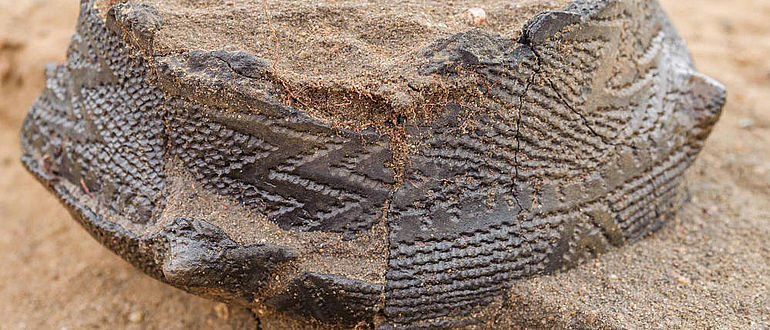
Im Zuge des Neubaus der Ortsumfahrung bei Wedringen, Ortsteil von Haldensleben, Ldkr. Börde, führt das Landesamt für Denkmalpflege und Archäologie Sachsen-Anhalt (LDA) derzeit archäologische Ausgrabungen durch. Auf dem aktuellen Abschnitt der Grabungsfläche wurden seltene Brandgräber der Rössener Kultur (ca. 6600–6450 vor heute) entdeckt. Die etwa 25 Grabgruben sind an der dunklen, aschigen Verfüllung gut in dem sie umgebenden Boden erkennbar. Als Beigaben in den Gräbern sind reich verzierte Gefäße sowie Beile und Äxte aus Felsgestein zu finden. Im näheren Umfeld der Brandbestattungen und ohne erkennbaren Befundzusammenhang deponierte Keramikgefäße lassen an ein noch nicht näher zu definierendes Ritual während der Bestattungszeremonie denken.
Read the rest of this article...
Rare relics of an Iron Age warrior who fought the Romans
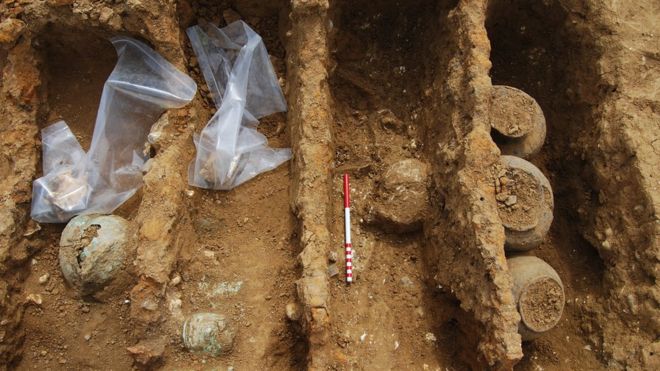
The helmet and crest of the Iron Age warrior. Photo Allan HutchingsPhotography
As the Novium in Chichester prepares to display the late Iron Age Bersted Warrior and his possessions in January 2020, we talk to archaeologist James Kenny about one of the most spectacular warrior burials ever found in Britain
When archaeologists arrived to investigate a grave discovery on the site of a new housing development near Chichester in West Sussex, they had little idea what was awaiting them.
A large scale archaeological excavation had been taking place ahead of the development in 2008 at North Bersted, and when the grave was uncovered Chichester District Council’s archaeologist, James Kenny, was one of the first people to view it.
Read the rest of this article...
Iron Age warrior's remains to go on show in Chichester
The grave contained "significant" artefacts
Chichester District Council
The remains of an Iron Age warrior and his possessions - hailed as a "spectacular discovery" by archaeologists - are to go on display.
Weaponry and other artefacts were found alongside the ancient fighter during excavations at a site near Chichester, West Sussex.
It is thought the grave belonged to someone of high status.
The man, who may have fought alongside a Roman king, will be the centre-piece of an exhibition at a city museum.
A team from Thames Valley Archaeological Services found the grave on land at North Bersted, near Bognor Regis, in 2008.
Read the rest of this article...
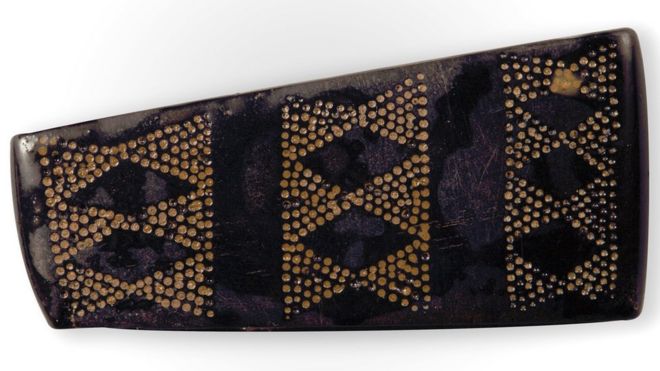
Grave of 'real-life Asterix' who fought Caesar found amid trove of weapons and possessions in West Sussex
'Unique find': the artefacts have been carefully studied for the last decade CREDIT: PA
The grave of a real-life Asterix containing what is believed to be an ancient Gallic warrior who came to Britain and fought Julius Caesar has been discovered, archaeologists have announced.
The unique and highly-elaborate resting place was found on a West Sussex building site.
The Iron Age warrior, buried with his glamorous and ornate head-dress, is thought to have been a refugee French Gallic fighter who fled Julius Caesar's legionnaires as they swept across continental Europe in about 50BC.
Archaeologists have described the discovery, which will go on display at Chichester's Novium Museum in January 2020, as "the most elaborately equipped warrior grave ever found in England".
Read the rest of this article...
Tuesday, July 23, 2019
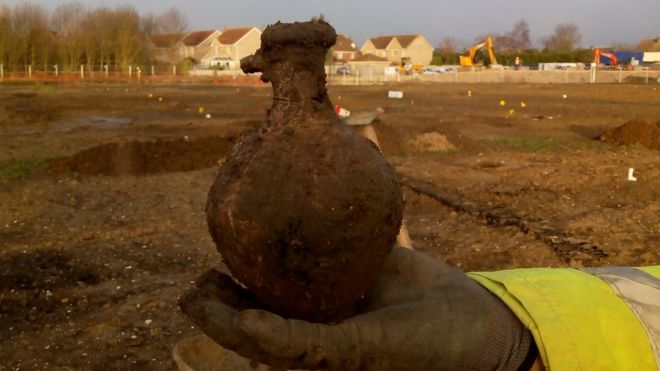
Isle of Man Round Mounds: 'Spectacular' 4,000-year-old jet necklace found
Sand on the beads from the burial site will be removed as part of the conservation process
MNH
MNH
A 4,000-year-old necklace has been uncovered during an archaeological dig on the Isle of Man.
The piece of jewellery, found in the west of the island, is made up of 122 "intricately" decorated jet beads each measuring between 1cm and 5cm.
Thought to have originated in Whitby, North Yorkshire it is the first of its kind to be found on the Isle of Man.
When fully assembled, the necklace was crescent-shaped and made from multiple strings.
Read the rest of this article...
'Important' Iron Age settlement found at Warboys dig
Roman finds include this jug and human remains, including six skeletons
Oxford Archaeology East
Iron Age roundhouses, Roman burials and Saxon pottery have been discovered in a "hugely important and hitherto unknown settlement".
The seven month-long dig in Warboys in Cambridgeshire also uncovered "a rare example" of "early Saxon occupation mingled with the latest Roman remains".
Archaeologist Stephen Macaulay said: "We almost never find actual physical evidence of this."
The settlement reverted to agricultural use after the 7th Century.
"What makes this site really significant is we have evidence of early Saxon occupation mingled with the latest Roman remains," said Mr Macaulay, deputy regional manager for Oxford Archaeology East.
Read the rest of this article...
Friday, July 19, 2019
Stone tool changes may show how Mesolithic hunter-gatherers responded to changing climate
Reconstruction of a Mesolithic camp-site with a hunter in the front ready to fire an arrow
mounted with stone microliths [Credit: Ulco Glimmerveen]
As a result of warming occurring at a rate of ca. 1.5 to 2°C per century, hunter-gatherers in Europe during the Mesolithic era (approximately 11,000-6,000 years ago) experienced significant environmental changes, very similar to the ones we face today: rising sea levels, increased drought, plant and animal migrations and wildfires. Here, Crombé examined microliths, small stone arrowheads/barbs used in hunting, to see how their design and usage by Mesolithic hunter-gatherers shifted in conjunction with climatic and environmental changes.
Building on archaeological research from the last two decades, Crombé used Bayesian modelling to reveal potential correlations between 228 radiocarbon dates specific to Mesolithic sites along the southern North Sea basin and the different types and shapes of microliths (triangles, crescents, leaf-shaped and mistletoe-shaped microliths, trapezes, etc.) found at these sites.
Thursday, July 18, 2019
Archaeology Anthropology Palaeontology Evolution Exhibitions Natural Heritage Astronomy Out of Africa and into an archaic human melting pot
A map showing where the ancestors of modern humans appear to have met and mixed
with archaic hominins [Credit: University of Adelaide]
Genetic analysis has revealed that the ancestors of modern humans interbred with at least five different archaic human groups as they moved out of Africa and across Eurasia.
While two of the archaic groups are currently known - the Neanderthals and their sister group the Denisovans from Asia ¬- the others remain unnamed and have only been detected as traces of DNA surviving in different modern populations. Island Southeast Asia appears to have been a particular hotbed of diversity.
Published in the Proceedings of the National Academy of Sciences, researchers from the University of Adelaide's Australian Centre for Ancient DNA (ACAD) have mapped the location of past "mixing events" (analysed from existing scientific literature) by contrasting the levels of archaic ancestry in the genomes of present-day populations around the world.
Read the rest of this article...
Maternal secrets of our earliest ancestors unlocked
Australopithecus africanus impression by Jose Garcia and Renaud Joannes-Boyau, Southern Cross University
[Credit: Jose Garcia and Renaud Joannes-Boyau, Southern Cross University]
[Credit: Jose Garcia and Renaud Joannes-Boyau, Southern Cross University]
Analysis of more than two-million-year-old teeth from Australopithecus africanus fossils found in South Africa have revealed that infants were breastfed continuously from birth to about one year of age. Nursing appears to continue in a cyclical pattern in the early years for infants; seasonal changes and food shortages caused the mother to supplement gathered foods with breastmilk. An international research team led by Dr Renaud Joannes-Boyau of Southern Cross University, and by Dr Luca Fiorenza and Dr Justin W. Adams from Monash University, published the details of their research into the species in the journal Nature.
"For the first time, we gained new insight into the way our ancestors raised their young, and how mothers had to supplement solid food intake with breastmilk when resources were scarce," said geochemist Dr Joannes-Boyau from the Geoarchaeology and Archaeometry Research Group (GARG) at Southern Cross University.
"These finds suggest for the first time the existence of a long-lasting mother-infant bond in Australopithecus. This makes us to rethink on the social organisations among our earliest ancestors," said Dr Fiorenza, who is an expert in the evolution of human diet at the Monash Biomedicine Discovery Institute (BDI)
Read the rest of this article...
Stonehenge may have been built using pig fat
Fat residues on shards of pottery found at
Durrington Walls, near Stonehenge, have long been assumed to be
connected with feeding the many hundreds of people that came from across
Britain to help construct the ancient monument.
But, new analysis by archaeologists at Newcastle University, UK, suggests that because the fragments came from dishes that would have been the size and shape of buckets, not cooking or serving dishes, they could have been used for the collection and storage of tallow—a form of animal fat.
Dr. Lisa-Marie Shillito, Senior Lecturer in
Landscape Archaeology, Newcastle University, said: "I was interested in
the exceptional level of preservation and high quantities of lipids—or
fatty residues—we recovered from the pottery. I wanted to know more
about why we see these high quantities of pig fat in pottery, when the
animal bones that have been excavated at the site show that many of the
pigs were 'spit roasted' rather than chopped up as you would expect if
they were being
Read the rest of this article...
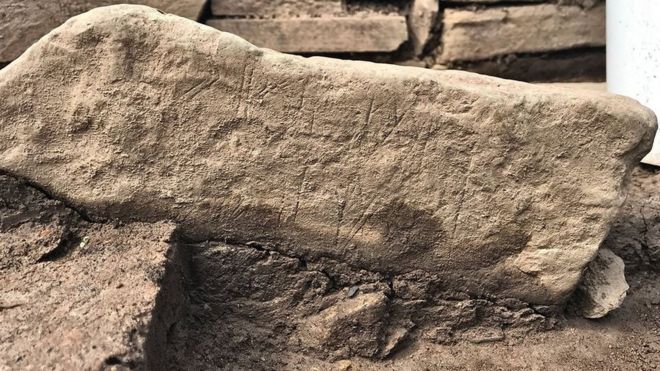
'Stunning' decorated Neolithic stone discovered in Orkney
The decorated stone was discovered on Monday
Ness of Brodgar
Ness of Brodgar
Archaeologists have uncovered what they describe as a "stunning example" of Neolithic decorate stone in Orkney.
The notch-marked slab was discovered at Ness of Brodgar, the location of a well-preserved and sophisticated complex of stone buildings.
The site was built and occupied by people more than 5,000 years ago.
Archaeological excavations began at Ness of Brodgar more than 15 years ago and the site covers an area of about six acres (2.5 ha).
The decorated stone was found on Monday, followed by further discoveries of smaller carved stones during the rest of the week
Read the rest of this article...
Thursday, July 11, 2019
A
reconstruction of Apidima 2, which was shown to be a Neanderthal skull.
A far older skull fragment, Apidima 1, was also assumed to be
Neanderthal, but scientists now say it belonged to a modern human.
CreditCreditKaterina Harvati, Eberhard Karls University of Tübingen
The bone, found in a cave, is the oldest modern human fossil ever discovered in Europe. It hints that humans began leaving Africa far earlier than once thought.
A skull fragment found in the roof of a cave in southern Greece is the oldest fossil of Homo sapiens ever discovered in Europe, scientists reported on Wednesday.
Until now, the earliest remains of modern humans found on the Continent were less than 45,000 years old. The skull bone is more than four times as old, dating back over 210,000 years, researchers reported in the journal Nature.
The finding is likely to reshape the story of how humans spread into Europe, and may revise theories about the history of our species.
Read the rest of this article...
Wednesday, July 10, 2019
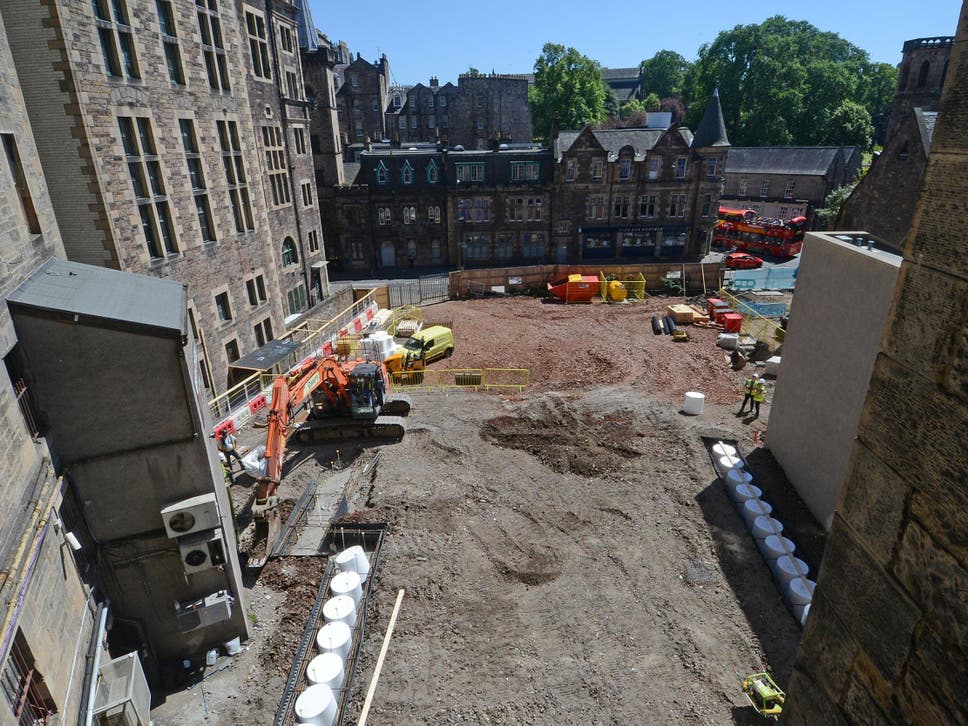
Cannonballs, skulls and jewellery: Archaeologists discover 'Bronze Age relics' in Edinburgh city centre, delaying Richard Branson’s new hotel
Building
of first Virgin Hotel in Britain has been delayed for a year after
archaeologists at the Edinburgh site unearthed artefacts dating back
1,000 years ( Jon Savage /SWNS )
The opening of Sir Richard Branson‘s first Virgin Hotel in Britain has been delayed by a year after archaeologists at the site unearthed artefacts dating back 1,000 years.
The excavation in Edinburgh has lasted more than a year, three times longer than expected, due to the range of objects and material discovered from the 10th century.
Experts say the remains of buildings found predate Edinburgh Castle and the creation of the town burgh by David I by around 200 years.
The work has also unearthed ditches and walls marking the original boundary of the city and some of the discoveries could date as far back as the Bronze Age.
Read the rest of this article...
The first Europeans weren’t who you might think
Genetic tests of ancient settlers' remains show that Europe is a melting pot of bloodlines from Africa, the Middle East, and today's Russia.
The idea that there were once “pure” populations of ancestral Europeans, there since the days of woolly mammoths, has inspired ideologues since well before the Nazis. It has long nourished white racism, and in recent years it has stoked fears about the impact of immigrants: fears that have threatened to rip apart the European Union and roiled politics in the United States.
Now scientists are delivering new answers to the question of who Europeans really are and where they came from. Their findings suggest that the continent has been a melting pot since the Ice Age. Europeans living today, in whatever country, are a varying mix of ancient bloodlines hailing from Africa, the Middle East, and the Russian steppe.
The evidence comes from archaeological artifacts, from the analysis of ancient teeth and bones, and from linguistics. But above all it comes from the new field of paleogenetics. During the past decade it has become possible to sequence the entire genome of humans who lived tens of millennia ago. Technical advances in just the past few years have made it cheap and efficient to do so; a well-preserved bit of skeleton can now be sequenced for around $500.
The result has been an explosion of new information that is transforming archaeology. In 2018 alone, the genomes of more than a thousand prehistoric humans were determined, mostly from bones dug up years ago and preserved in museums and archaeological labs. In the process any notion of European genetic purity has been swept away on a tide of powdered bone.
Read the rest of this article...
Thursday, July 4, 2019
Late Iron Age chariot pieces found in Pembrokeshire
Archaeologists discovered bronze artefacts, the iron tyres of the chariot wheels and an iron sword
MUSEUM WALES
Archaeologists have discovered more artefacts at the first Celtic chariot burial site to be found in southern Britain.
Two iron tyres and a sword from the chariot were retrieved during an excavation in Pembrokeshire.
The exact site remains a secret and follows the discovery of decorative objects by a metal detector enthusiast on the same land in February 2018.
National Museum Wales is conserving the chariot pieces.
Archaeologists had suspected they would uncover more beneath the farmland where metal detectorist Mike Smith found a number of objects associated with a chariot.
Following an initial investigation in June 2018 by archaeologists from National Museum Wales and Dyfed Archaeological Trust, a dig was carried out in March and April, funded by National Museum Wales, Cadw and the National Lottery Heritage Fund.
Read the rest of this article...
Ancient Humans Dietary Habits Reflected In Bonobo Aquatic Greens Diet
Bonobos have been spotted doing something interesting in the Congo basin. They are scouring the swamp in search of aquatic herbs that are packed with iodine, a nutrient that is very important for advancing the growth of higher cognitive abilities. That could help scientists understand the nutritional needs and practices of ancient humans. The Bonobo consumption of food rich in iodine is the first-ever recorded by a species other than humans.
“Our results have implications for our understanding of the immigration of prehistoric human populations into the Congo basin,” Dr. Gottfried Hohmann, the lead author of the study comments.
“Bonobos as a species can be expected to have similar iodine requirements to humans, so our study offers—for the first time—a possible answer on how pre-industrial human migrants may have survived in the Congo basin without artificial supplementation of iodine,” the researcher added.
Read the rest of this article...
Monday, June 17, 2019
Britain’s Atlantis: Evidence of Stone Age human activity found beneath North Sea
Archaeologists have found evidence of ancient human activity on Britain’s very own “Atlantis”.
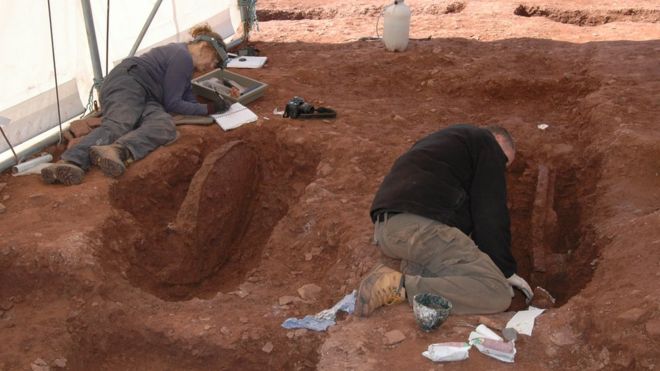
Scientists investigating a drowned Stone Age landscape at the bottom of the North Sea have discovered two potential prehistoric settlement sites on the banks of a long-vanished ancient river.
It is the first time that an archaeological expedition has ever found such evidence far offshore under the huge body of water.
In the past, prehistoric artefacts have on occasions been trawled up by fishermen and found by oil exploration teams – but the seabed contexts they came from were never archaeologically assessed.
This time, the discoveries are part of a systematic archaeological survey.
Read the rest of this article...
Scientists investigating a drowned Stone Age landscape at the bottom of the North Sea have discovered two potential prehistoric settlement sites on the banks of a long-vanished ancient river.
It is the first time that an archaeological expedition has ever found such evidence far offshore under the huge body of water.
In the past, prehistoric artefacts have on occasions been trawled up by fishermen and found by oil exploration teams – but the seabed contexts they came from were never archaeologically assessed.
This time, the discoveries are part of a systematic archaeological survey.
Read the rest of this article...
Anglesey archaeology: Bronze Age cairn dig at Bryn Celli Ddu
Bryn Celli Ddu burial chamber is aligned to the sun and is lit during the summer solstice
AERIAL-CAM
An excavation is under way on the site of a suspected 4,500-year-old burial cairn that lies next to one of Wales' most important prehistoric monuments.
Experts are hoping to learn more about it and its relationship to Bryn Celli Ddu burial chamber at Anglesey.
The 5,000-year-old "passage tomb" is aligned to coincide with the rising sun on the summer solstice.
Dr Ffion Reynolds said the cairn showed the site remained a "special location" centuries after the chamber was built.
Read the rest of this article...
Sunday, June 16, 2019
Archaeologists uncover megalithic monument thought to be unlike any found in Ireland to date
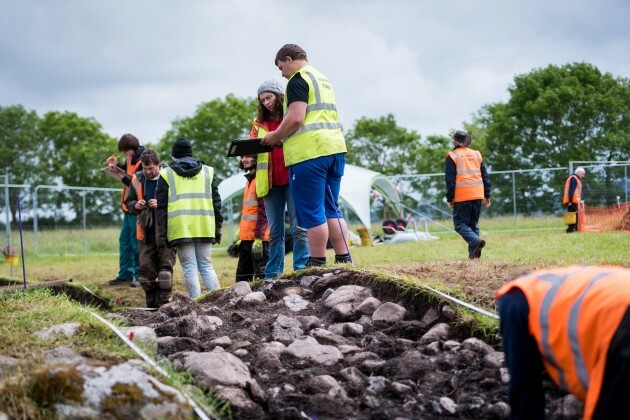
IT Sligo Archaeology students Jazmin Scally Koulak and Eugene Anderson sieving the soil at Carrowmore excavation
AN ARCHAEOLOGICAL EXCAVATION in Co Sligo has uncovered a megalithic monument thought to be unlike any found in Ireland to date.
Several prehistoric tools made from a hard stone called chert were discovered and are thought to have been used for activities such as working animal hides, cutting and preparing food, basket food, basket working and bone working.
The discovery was made by a team of archaeologists from IT Sligo during a two-week excavation of a prehistoric monument in the heart of the Carrowmore megalithic complex in Co Sligo.
Carrowmore in the largest cemetery of megalithic tombs in Ireland, with 5,500-year-old passage tombs dating from 3,600 BC.
Read the rest of this article...
Thursday, June 13, 2019
Artificial islands older than Stonehenge stump scientists
A diver holds a Neolithic (ca. 3,500 B.C) Ustan vessel found near a crannog (artificial island)
in Loch Arnish, Scotland. PHOTOGRAPH BY C. MURRAY
When it comes to studying Neolithic Britain (4,000-2,500 B.C.), a bit of archaeological mystery is to be expected. Since Neolithic farmers existed long before written language made its way to the British Isles, the only records of their lives are the things they left behind. And while they did leave us a lot of monuments that took, well, monumental effort to build—think Stonehenge or the stone circles of Orkney—the cultural practices and deeper intentions behind these sites are largely unknown.
Now it looks like there may potentially be a whole new type of Neolithic monument for archaeologists to scratch their heads over: crannogs.
Artificial islands commonly known as crannogs dot hundreds of Scottish and Irish lakes and waterways. Until now, researchers thought most were built when people in the Iron Age (800-43 B.C.) created stone causeways and dwellings in the middle of bodies of water. But a new paper published today in the journal Antiquity suggests that at least some of Scotland’s nearly 600 crannogs are much, much older—nearly three thousand years older—putting them firmly in the Neolithic era. What’s more, the artifacts that help push back the date of the crannogs into the far deeper past may also point to a kind of behavior not previously suspected in this prehistoric period.
Read the rest of this article...
Friday, June 7, 2019
DNA from 31,000-year-old milk teeth leads to discovery of new Ice Age population of big game hunters
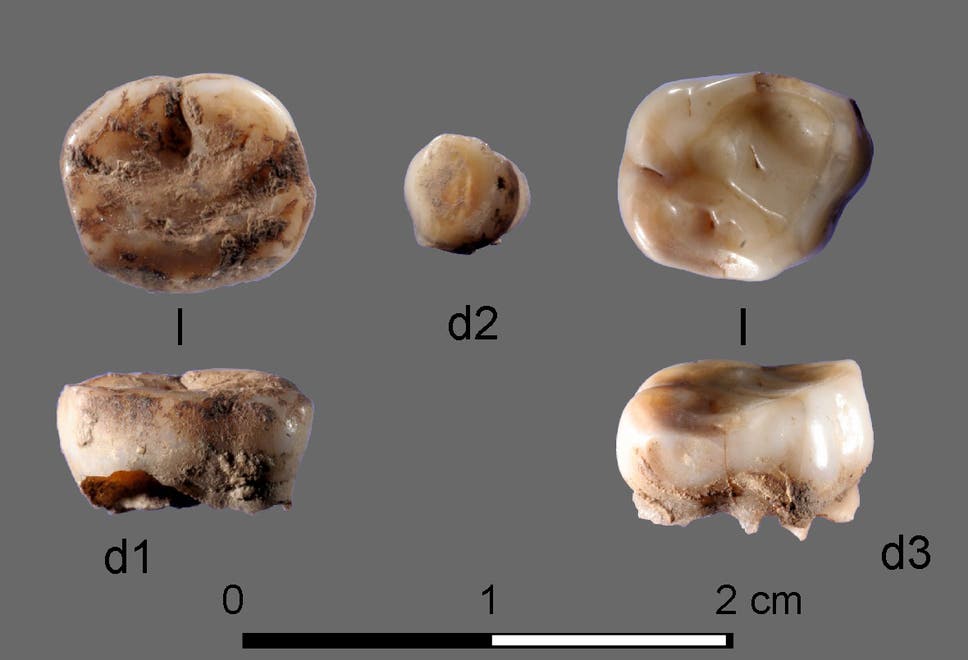
The DNA was recovered from the only human remains discovered during the era – two tiny milk teeth ( Russian Academy of Sciences )
A new Ice Age population of big game hunters that lived in the depths of Siberia has been discovered using DNA taken from 31,000-year-old human milk teeth.
Named the ‘Ancient North Siberians’ the hardy population would have hunted lions, wolves, woolly mammoths and bison, according to a study led by Cambridge University.
The find was one aspect of new research into the genetic composition of Native Americans who in part descended from these Siberian hunters.
The existence of this fierce population, who first evolved 38,000 years ago, forms “a significant part of human history”, according to lead researcher Professor Eske Willerslev.
He told The Independent: “These humans had adapted to an extremely harsh environment in terms of temperatures – it’s a part of the world that is almost completely dark all winter. There are basically no trees and they were living alongside lions, wolves, bison and rhinos.
Read the rest of this article...
Thursday, June 6, 2019
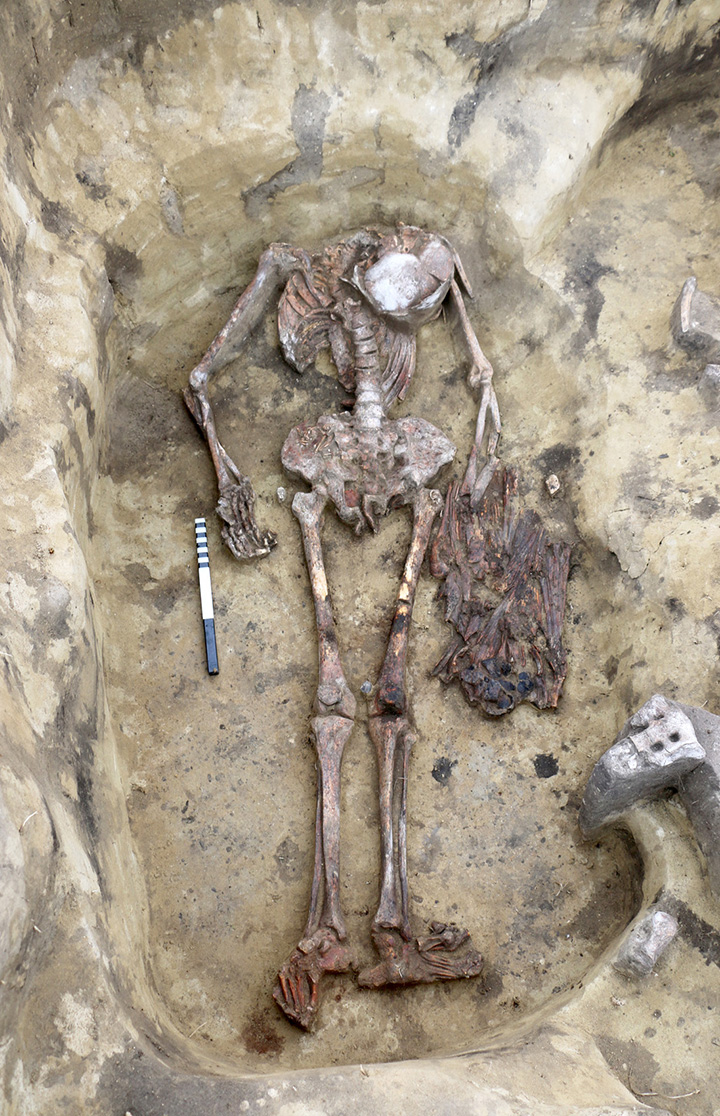
Prehistoric stone engraved with horses found in France
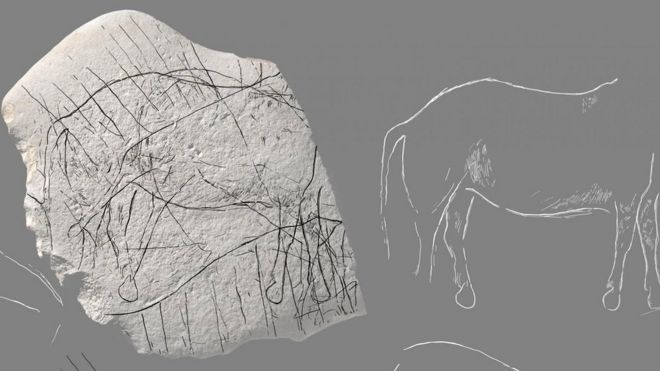
A generated image of the prehistoric sandstone plate and its engraving
DENIS GLIKSMAN/INRAP
A stone believed to be about 12,000 years old and engraved with what appears to be a horse and other animals has been discovered in France.
The prehistoric find by archaeologists excavating a site in the south-western Angoulême district, north of Bordeaux, has been described as "exceptional".
Markings appear on both sides of the sandstone, the National Archaeological Research Institute (Inrap) said.
It was found during work at an "ancient hunting site" near Angoulême station.
The Palaeolithic stone plate, which is said to be about 25cm long, 18cm wide and 3cm thick, "combines geometric and figurative motifs", Inrap said.
Read the rest of this article...
Wednesday, June 5, 2019
Africa’s first herders spread pastoralism by mating with foragers
INHERITING HERDING Ancient DNA indicates that early African herders started mating with hunter-gatherers more than 5,000 years ago. Here, modern herders in Tanzania watch over their goats.
Ancient sheep, goat and cattle herders made Africa their home by hooking up with the continent’s native hunter-gatherers, a study suggests.
DNA analysis shows that African herders and foragers mated with each other in two phases, says a team led by archaeologist Mary Prendergast of Saint Louis University in Madrid. After entering northeastern Africa from the Middle East around 8,000 years ago, herders swapped DNA with native foragers between roughly 6,000 and 5,000 years ago. Herders possessing some forager heritage then trekked about halfway down the continent and mated with eastern African foragers around 4,000 years ago, the scientists report online May 30 in Science.
Present-day herders, such as the Dinka in South Sudan, still live in eastern Africa. But how pastoralism spread into the region has been a mystery. In particular, it has been difficult to tell whether ancient African hunter-gatherers mated with early herders or simply adopted their livestock practices. The new study supports an emerging view from ancient DNA studies that human cultural evolution has often featured mating across groups with different traditions and lifestyles.
Read the rest of this article...
Monday, June 3, 2019
The Birdman of Siberia: sensational finds in the heart of Russia puzzle scientists
Two unique burials of the Odinov culture (early Bronze) were unearthed last year at the Ust-Tartas site in Novosibirsk region.
Inside one of them researches found several dozen long beaks and skulls of large birds assembled into something looking like a collar, a head dress, or armour.
‘Nothing of this kind was ever found as part of Odinov culture in all of Western Siberia’ said researcher Lilia Kobeleva from Novosibirsk Institute of Archeology and Ethnography.
‘Why do we think this was a part of clothing? The beaks were assembled at the back of the skull, along the neck, as if it was a collar that protected the owner when he lived here.’
Read the rest of this article...
17 amphorae from the 3rd century BC discovered off Cannes
Credit: Marc Langleur
A campaign of underwater archaeological excavations has uncovered 17 amphorae dating from the 3rd century BC at a depth of twenty metres, not far from the Lérins islands off the Bay of Cannes.
According to Anne Joncheray, archaeologist and director of the Saint-Raphaël Museum of Archaeology, the 2,300-year-old amphorae are remarkably well-preserved and were likely used to transport locally produced wine to the Greek trading posts of the Mediterranean.
Read the rest of this article...
Sunday, June 2, 2019
Whipworm eggs found in 8000-year-old human coprolites. Andrew Masterson reports.
Archaeologists carefully excavating the neolithic village.
SCOTT HADDOW
Researchers picking though 8000-year-old human faeces have identified the earliest evidence of intestinal parasite infection in the mainland Near East.
A team led by archaeologist Piers Mitchell of Cambridge University in the UK travelled to the well preserve remains of a prehistoric village called Çatalhöyük, in southern Anatolia.
The site was occupied from about 7500 to 5700 BCE, and is today a UNESCO World Heritage Site.
Apart from the extraordinarily good state of its survival, the village is of key interest because it was occupied around the period that populations in the region shifted from foraging to farming.
The change in both diet and lifestyle – particularly the emergence of permanent settlements – introduces the question of whether such a shift in living conditions also brought about a consequent change in disease profiles.
Monday, May 27, 2019
LATE BRONZE AGE SETTLEMENT DISCOVERED IN NORTHWEST BULGARIA IN TURKISH STREAM GAS PIPELINE RESCUE DIGS
A settlement originally dating back to the Late Bronze Age, which was also subsequently inhabited in the Thracian and Roman Antiquity, and the Middle Age, has been discovered by archaeologists near Rasovo in Northwest Bulgaria during rescue excavation on the projected route of the Turkish Stream natural gas transit pipeline.
A total of three archaeological sites have been found along the route of the proposed extension of the Turkish Stream gas pipeline (dubbed Turkish Stream – Northwest) that would potentially be transporting natural gas from Russian via the Black Sea, Turkey, and Bulgaria into Central Europe.
One of the three newly discovered sites is the settlement from the very end of the Bronze Age dating back to ca. 1,200 BC near today’s town of Rasovo, Medkovets Municipality, Montana District, in Northwest Bulgaria.
Because of the fact it was also inhabited during later historical periods, however, the archaeologists have described it as a “multilayer settlement".
Read the rest of this article...

Roadworks uncover Bronze Age urn burial site in Saxony-Anhalt, Germany
Credit: ct-press
More than 100 cremation burials dating to around 800 BC have been found here, reports chief archaeologist Susanne Friederich, head of the department for the preservation of archaeological monuments at the State Office for Archaeology and Monument Conservation.
"The place obviously served as a 'cemetery' for several villages, whose remains were also found nearby", she said
"The deceased were burned on pyres. Their relatives placed their ashes and bone remains in urns, together with anything which had not been destroyed by fire, such as bronze clasps or jewellery made of metal," excavation leader Anette Schubert explains.
NOUVELLE FOUILLE DE LA TOMBE DE LA « DAME DE VIX »
Le site de Vix en Côte-d’Or est avant tout célèbre pour la tombe de « la Dame de Vix », dont la fouille, menée en 1953, a révélé un mobilier d’une incroyable richesse. Hormis la sépulture, le vaste monument funéraire qui l’abritait n’a jamais été réellement fouillé. D’août à novembre 2019, il fera l’objet, d’une importante fouille sous la direction de l’Inrap (Bastien Dubuis), en partenariat avec le Laboratoire ARTEHIS (CNRS/Université de Bourgogne) et avec le soutien de la DRAC Bourgogne-Franche-Comté et de la Communauté de Communes du Pays Châtillonnais. Les nouvelles approches et méthodes de l’archéologie devraient permettre une contextualisation et une compréhension plus fine de cette tombe emblématique du phénomène princier celtique.
Read the rest of this article...
Sunday, May 26, 2019
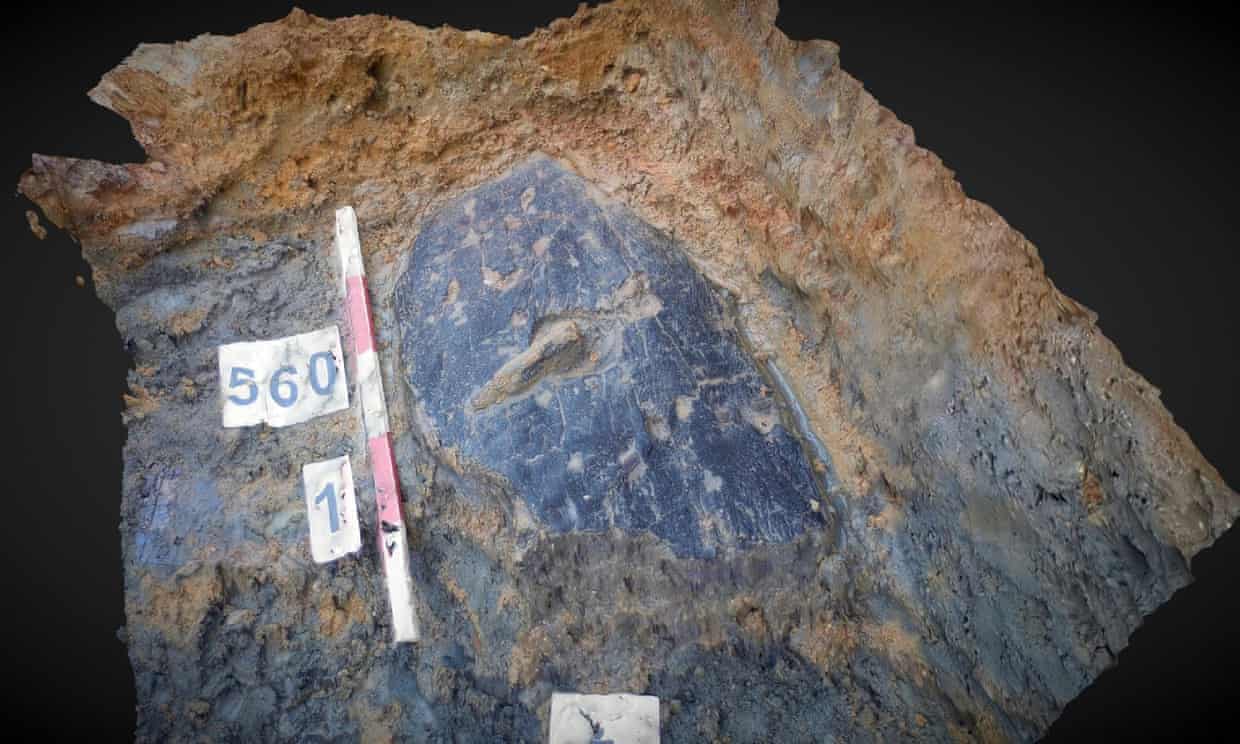
'Phenomenal' 2,300-year-old bark shield found in Leicestershire
The shield is made from green bark that has been stiffened with internal wooden laths.
An “astonishing and unparalleled” 2,300-year-old shield made of tree bark has been discovered in Leicestershire, the only example of its kind ever found in Europe.
Archaeologists say the discovery of the shield, made between 395 and 250BC, has completely overturned assumptions about the weapons used in the iron age, sparking breathless reactions among experts of the period.
“This is an absolutely phenomenal object, one of the most marvellous, internationally important finds that I have encountered in my career,” said Julia Farley, curator of British and European iron age collections at the British Museum.
“So often it is gold which grabs the headlines, but this bark shield is much rarer.”
Read the rest of this article...
Wednesday, May 22, 2019
New data platform illuminates history of humans' environmental impact
Animal bones on display.
Credit: © DedMityay / Adobe Stock
The human environmental footprint is not only deep, but old.
Ancient traces of this footprint can be found in animal bones, shells, scales and antlers at archaeological sites. Together, these specimens tell the millennia-long story of how humans have hunted, domesticated and transported animals, altered landscapes and responded to environmental changes such as shifting temperatures and sea levels.
Now, that story is available digitally through a new open-access data platform known as ZooArchNet, which links records of animals across biological and archaeological databases.
Making these specimen records accessible digitally helps provide a long-term perspective on current biodiversity crises, such as animal extinction and habitat loss, and could lead to more informed conservation policies, said Michelle LeFebvre, postdoctoral associate at the Florida Museum of Natural History and lead author of a study introducing ZooArchNet.
Read the rest of this article...
Sunday, May 19, 2019
Analysis of the Palaeolithic diet shows no social divisions in food consumption
Credit: University of Granada
The study of the human diet in Palaeolithic times is currently among the research areas generating the greatest advances in knowledge. Analysis of the Palaeolithic diet is conducted mainly on the basis of stable isotopes of carbon and nitrogen, which are present in the collagen of human bones. These isotopes indicate the types of food consumed by the individual in the years leading up to their death.
Researchers from the University of Granada (UGR) have analyzed the diets of past peoples from samples in the anthropological collections of the Megalithic necropolises of Panoria (Darro, Granada) and El Barranquete (Nijar, Almeria). They find that although Megalithic communities did vary their eating habits over time, there were no relevant social differences, either in the type of food or in the proportion of proteins consumed.
Read the rest of this article...
Friday, May 17, 2019
Chewing gums reveal the oldest Scandinavian human DNA
Masticate being examined
[Credit: Natalija Kashuba/Stockholm University]
[Credit: Natalija Kashuba/Stockholm University]
The first humans who settled in Scandinavia more than 10,000 years ago left their DNA behind in ancient chewing gums, which are masticated lumps made from birch bark pitch. This is shown in a new study conducted at Stockholm University and published in Communications Biology.
Ancient chewing gums are as of now an alternative source for human DNA and possibly a good proxy for human bones in archaeogenetic studies. The investigated pieces come from Huseby-Klev, an early Mesolithic hunter-fisher site on the Swedish west coast. The sites excavation was done in the early 1990's, but at this time it was not possible to analyse ancient human DNA at all, let alone from non-human tissue. The masticates were made out of birch bark tar and used as glue in tool production and other types of technology during the Stone Age.
Read the rest of this article...
Fossil teeth push the human-Neandertal split back to about 1 million years ago
CROWNING ROOTS An analysis of hominid tooth evolution, including specimens from Spanish Neandertals (top row), pushes back the age of a common Neandertal-human ancestor to more than 800,000 years ago. The bottom row shows Homo sapiens teeth.
People and Neandertals separated from a common ancestor more than 800,000 years ago — much earlier than many researchers had thought.
That conclusion, published online May 15 in Science Advances, stems from an analysis of early fossilized Neandertal teeth found at a Spanish site called Sima de los Huesos. During hominid evolution, tooth crowns changed in size and shape at a steady rate, says Aida Gómez-Robles, a paleoanthropologist at University College London. The Neandertal teeth, which date to around 430,000 years ago, could have evolved their distinctive shapes at a pace typical of other hominids only if Neandertals originated between 800,000 and 1.2 million years ago, she finds.
Gómez-Robles’ study indicates that, if a common ancestor of present-day humans and Neandertals existed after around 1 million years ago, “there wasn’t enough time for Neandertal teeth to change at the rate [teeth] do in other parts of the human family tree” in order to end up looking like the Spanish finds, says palaeoanthropologist Bernard Wood of George Washington University in Washington, D.C.
Read the rest of this article...
Bronze Age Caernarfon bypass find 'could be canoe'
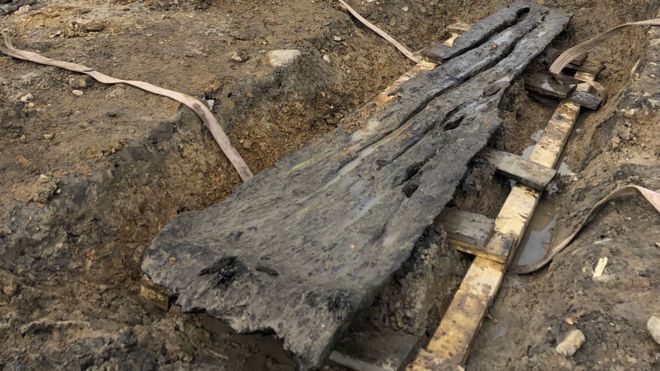
If proven to be a canoe the timber would be a "rare find", according to experts
WELSH GOVERNMENT
Work on a bypass in Gwynedd has revealed the site of a Bronze Age mound which could contain an ancient canoe.
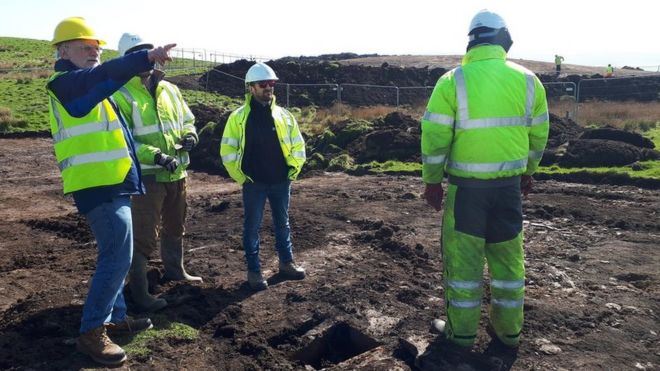
Archaeological excavation on the site of the Caernarfon-Bontnewydd bypass uncovered three troughs underneath a burnt mound dating back about 3,500 years.
Experts think one of the troughs may have been originally used as a dug-out canoe hollowed from an oak tree.
It would be the first prehistoric canoe ever found in north Wales if proven.
The timber has now been lifted from its discovery site and is being examined in more detail.
Bronze age burial uncovered at Orkney sub station site
The cist archaeologists have uncovered lies on top of a glacial mound
ORCA ARCHAEOLOGY
The stone lined box capped with a large flat stone was unearthed at Finstown, ahead of construction work by SSEN Transmission.
The pit - known as a cist - appears to be empty, though it would once have contained bones or cremated remains.
It's thought the burial dates back around 3,500 years.
The team from ORCA Archaeology based at Orkney College are exploring and recording the features and history of the site on behalf of the power firm.
Read the rest of this article...
Thursday, April 11, 2019
Stone Circles Ringed House That May Have Belonged to the Neolithic 'One Percent'
The Avebury henge consists of at least two stone circles enclosed within a larger stone circle.
Credit: Kevin Standage/Shutterstock
The massive and ancient stone circles around Stonehenge and Avebury in southern England may have all started with the commemoration of a single Neolithic house that probably belonged to an elite family, archaeologists now say.
Using ground-penetrating radar, the researchers found that the monumental stone circles of Avebury, about 25 miles (40 kilometers) north of Stonehenge, were centered on an early Neolithic habitation, with the concentric stone circles and large earthen embankment being built around it probably centuries later.
They say the Neolithic house at Avebury was built sometime after 3700 B.C. — but centuries before the creation of the larger rings of stone at Avebury and the megalithic monument at Stonehenge, which research shows were built after 3000 B.C.
Read the rest of this article...
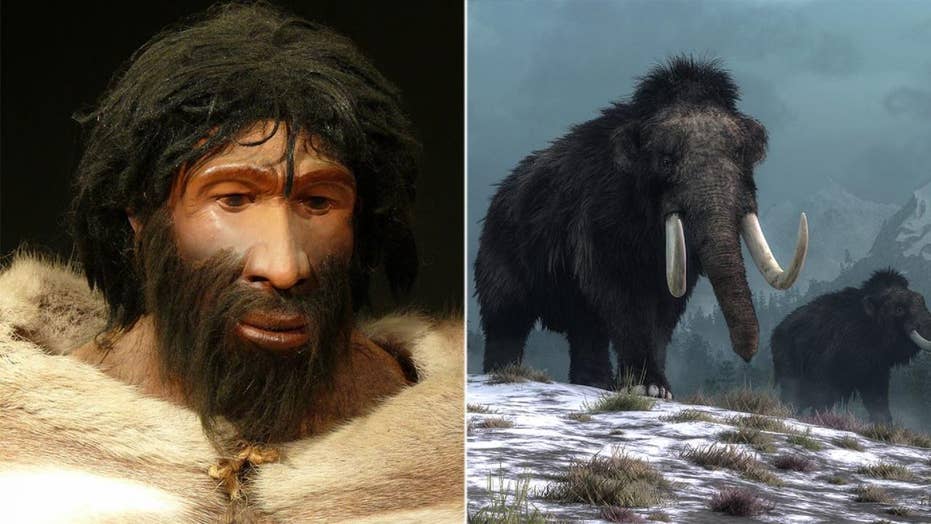
Woolly mammoth mystery solved? Study reveals shocking details about prehistoric creature
A new study suggests that woolly mammoths and mankind's ancestors, the Neanderthals, may have shared genetic traits.
Extinct for thousands of years, the woolly mammoth continues to fascinate humanity, as the prospect of eventually reviving the species is pondered among the scientific community. Now, a new study suggests that the giant creatures and mankind's ancestors, the Neanderthals, may have shared genetic traits.
The study, published by researchers at Tel Aviv University, suggests that because of their shared geography, mammoths and Neanderthals likely had similar molecular characteristics that allowed them to adapt to their harsh environmental surroundings.
"Neanderthals and mammoths lived together in Europe during the Ice Age. The evidence suggests that Neanderthals hunted and ate mammoths for tens of thousands of years and were actually physically dependent on calories extracted from mammoths for their successful adaptation," said professor Ran Barkai in a statement.
Read the rest of this article...
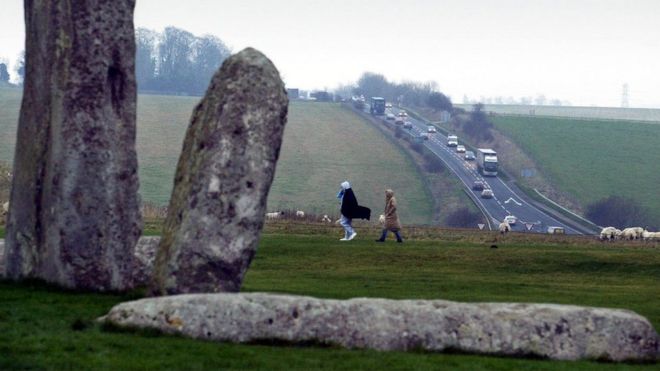
Stonehenge tunnel: Row over building clause in deeds
Campaigners say the deeds prevent work close to the stones
Plans for a controversial road tunnel near Stonehenge could be blocked because of conditions in the ancient monument's deeds.
The government wants to build a 1.9 mile (3km) tunnel past the Neolithic stone circle.
But when the monument was gifted to the nation by Sir Cecil Chubb in 1918 its deeds contained conditions.
Highways England said it believed the proposed tunnel did not fall within the covenant's boundary.
The issue was raised during a Planning Inspectorate preliminary meeting into the application to build the tunnel past the stones.
Read the rest of this article...
Subscribe to:
Posts (Atom)