The Prehistoric Archaeology Blog is concerned with news reports featuring Prehistoric period archaeology. If you wish to see news reports for general European archaeology, please go to The Archaeology of Europe Weblog.
Monday, April 4, 2016
Ancient theatre of Larissa opens to public
One of the largest ancient Greek theatres, the ancient theatre of Larissa dated back to the 3rd century BC, has opened its doors to the public.
Ancient theatre of Larissa opens to public According to the Larissa Antiquities Ephorate decision, the ancient theatre will be open for visitors every day from 10.00-13.00 as of April 1 with free entrance.
Visitors to the site will have access to the area of the orchestra and the stage, but the seats and the other areas of the theatre will not be accessible, since restoration works are still in progress.
Read the rest of this article...
Friday, April 1, 2016
DNA sheds light on ancient Greek maritime trade
Analysing
ancient DNA is a powerful method for classical studies, helping
modern-day scientists understand more about life thousands of years ago.
These new techniques can reveal the original contents of ceramic
archaeological artefacts. DNA sheds light on ancient Greek maritime
trade
"By my rough, conservative estimate there are at least three-quarters of a million ancient shipwrecks undiscovered in the Mediterranean alone. Shipwrecks are packets of information that help us understand ancient civilisations," Brendan Foley, an archaeologist at the Woods Hole Oceanographic Institution in Massachusetts, told IBTimes UK.
Read the rest of this article...
Archaeologists
excavating the Antikythera shipwreck expedition in 2015 created a
high-resolution, 3D map of the site using stereo cameras [Credit:
Brendan Foley]
"By my rough, conservative estimate there are at least three-quarters of a million ancient shipwrecks undiscovered in the Mediterranean alone. Shipwrecks are packets of information that help us understand ancient civilisations," Brendan Foley, an archaeologist at the Woods Hole Oceanographic Institution in Massachusetts, told IBTimes UK.
Read the rest of this article...
Inscribed stele uncovered at Etruscan temple
Archaeologists in Italy have discovered what may be a rare sacred text in the Etruscan language that is likely to yield rich details about Etruscan worship of a god or goddess.
Inscribed
stele uncovered at Etruscan temple The Etruscan stele was embedded in
the foundations of a monumental temple where it had been for more than
2,500 years [Credit: Mugello Valley Project]
The lengthy text is inscribed on a large 6th century BCE sandstone slab that was uncovered from an Etruscan temple.
A new religious artifact is rare. Most Etruscan discoveries typically have been grave and funeral objects.
“This is probably going to be a sacred text, and will be remarkable for telling us about the early belief system of a lost culture that is fundamental to western traditions,” said archaeologist Gregory Warden, co-director and principal investigator of the Mugello Valley Archaeological Project, which made the discovery.
Read the rest of this article...
Sunday, March 20, 2016
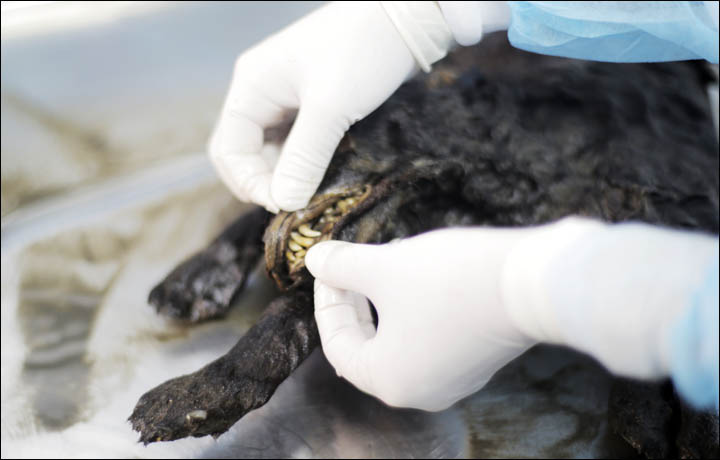
Ancient puppy's brain is 'well preserved'... as dog bares its teeth after 12,400 years
Scientists revealed today that they have found the first-ever well preserved brain of a Pleistocene canid. Our exclusive video and pictures show the autopsy on a carcass of a suspected pet puppy found mummified close to what are believed to be signs of human activity in the Ust-Yansky district of the Sakha Republic - also known as Yakutia - on a steep bank of the River Syalakh.
Present at the examination of the remains in regional capital Yakutsk was Hwang Woo-suk, the pioneering South Korean professor who is actively involved in seeking to clone woolly mammoths and other extinct creatures. The ancient dog is now added to the list of animals he wants to bring back to life.
Read the rest of this article...
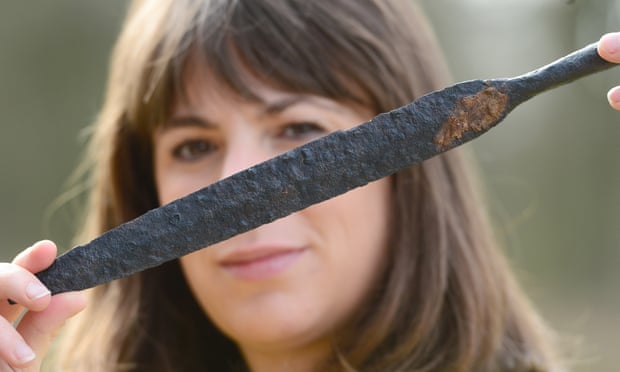
Warrior king uncovered at east Yorkshire iron age settlement
The well-preserved remains were unearthed at a 2,500-year-old site in Pocklington, described as being of international significance
A spear head found at Pocklington. Photograph: Anna Gowthorpe/PA
A warrior king buried almost 2,500 years ago has been discovered in an iron-age settlement unearthed at the foot of the Yorkshire Wolds. The remains of the burial ground is being hailed as one of the largest and most significant iron age finds of recent times.
In 2014 a housing developer stumbled upon the fossil site in the small market town of Pocklington in east Yorkshire, a find that is said to be of extreme “national and international significance”.
One of the most exciting discoveries was the “remarkably” well-preserved remains of a youthful warrior. Found in the cemetery and dated to 800BC he had been ritually speared to “release his spirit” and lay in the ground next to his sword.
Read the rest of this article...
35,000-year-old carving of bird found in SW France
In advance of the construction of the eastern Bergerac bypass route (Dordogne), the preventive excavation realized by Inrap at the open-air doline site of Cantalouette revealed prehistoric occupations from the Middle Paleolithic and Neolithic periods. Iluminada Ortega and Laurence Bourguignon of Inrap, along with their Spanish colleagues, have announced in the Journal of Archaeological Science Reports, the discovery of an Aurignacian art object, 35,000 – 31,000 years old. This object, depicting a bird, contributes to our knowledge of the origins of figurative art. 35,000-year-old carving of bird found in SW France
The
bird engraving was found at the Aurignacian open-air site, Cantalouette
II (Dordogne, France) [Credit: © Iluminada Ortega, Joseba
Rios-Garaizar, Diego Garate Maidagan, Juan Arizaga, Laurence
Bourguignon. Denis Gliksman, Inrap]
This depiction is very distinct and probably unique in the Aurignacian period, during which Modern Humans arrived in western Europe. It is exceptional in its degree of naturalism, the nature of its support—the cortex (limestone coating) of a flint flake—and the engraving technique used. This “sunk relief” technique was identified through microscopic and 3D analyses realized at Cenieh (Burgos, Spain).
Read the rest of this article...
Tuesday, March 15, 2016
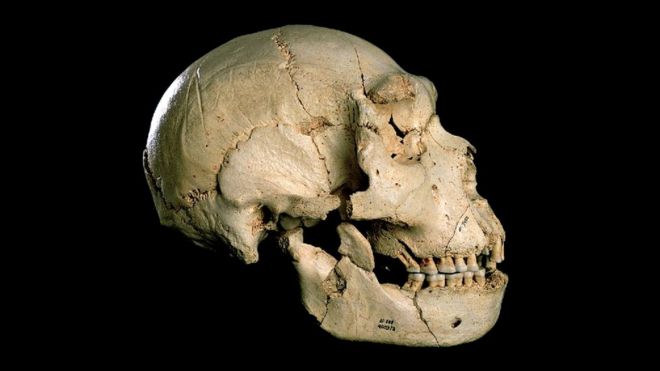
Ancient DNA identifies 'early Neanderthals'
The relationship of the Pit specimens to other ancient species has been the subject of debate
The oldest "nuclear DNA" from a human has identified some early representatives of the Neanderthal lineage.
They are about 400,000 years old, but their relationships to Neanderthals and other ancient relatives has been hotly debated.
DNA analysis confirms that they lie on the evolutionary line to Neanderthals.
The results are published in the journal Nature.
Read the rest of this article...
Archaeological dig planned as metal detectorist discovers untouched Bronze Age burial mound
Copper-alloy socketed chisel and fragment of a copper alloy dagger, found by metal detectorists at the site of the previously unknown Barrow, and dating to the Middle to Late Bronze Age
© Stuart Noon
Dig Ventures is planning its next crowd-funded archaeological dig following a major Bronze Barrow discovery by an amateur archaeologist
An untouched Bronze Age burial mound is a rare thing in the archaeological landscape of Britain, but in a sleepy corner of the North West a metal detectorist’s chance discovery is about to trigger a major dig that archaeologists hope will uncover more secrets of our pre-historic ancestors.
Archaeology crowdfunding platform, DigVentures, has launched a campaign to excavate the rare unexplored Bronze Age barrow in what will be the first scientific excavation of an undisturbed burial mound from the period in the region in over 50 years.
NEANDERTHALS: 20 PERCENT VEGETARIAN
The collagen from the Neanderthals’ bones offers clues to their diet. © Bocherens
Scientists from the Senckenberg Center for Human Evolution and Palaeoenvironment (HEP) in Tübingen have studied the Neanderthals’ diet. Based on the isotope composition in the collagen from the prehistoric humans’ bones, they were able to show that, while the Neanderthals’ diet consisted primarily of large plant eaters such at mammoths and rhinoceroses, it also included vegetarian food. The associated studies were recently published in the scientific journals “Journal of Human Evolution” and “Quaternary International.”
The paleo-diet is one of the new trends among nutrition-conscious people – but what exactly did the meal plan of our extinct ancestors include? “We have taken a detailed look at the Neanderthals’ diet,” explains Professor Dr. Hervé Bocherens of the Senckenberg Center for Human Evolution and Palaeoenvironment at the University of Tübingen, and he continues, “In the process, we were able to determine that the extinct relatives of today’s humans primarily fed on large herbivorous mammals such as mammoths and woolly rhinoceroses.”
Read the rest of this article...
Sunday, March 6, 2016
31 intact burials unearthed at large Mycenaean cemetery
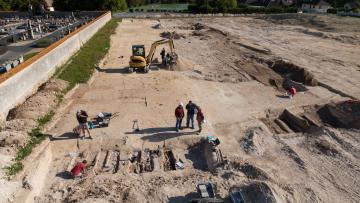
An extensive Mycenaean cemetery with 31 undisturbed burials containing numerous items of jewellery and several different types of ceramic vases, including 12 ornate Mycenaean drinking cups or kylikes, has been unearthed by Greek archaeologists at the Loggas site near Elati in Kozani (Macedonia), a short distance from ancient Aiani. 31 intact burials unearthed in large Mycenaean cemetery
View of the excavation of the Mycenaean cemetery near Elati, Macedonia
[Credit: Georgia Karamitrou-Mentesidi via Ethnos]
"The Mycenaean presence in Upper Macedonia is now well established by the discovery of several settlement types throughout the region", says archaeologist Georgia Karamitrou-Mentesidi.
Read the rest of this article...
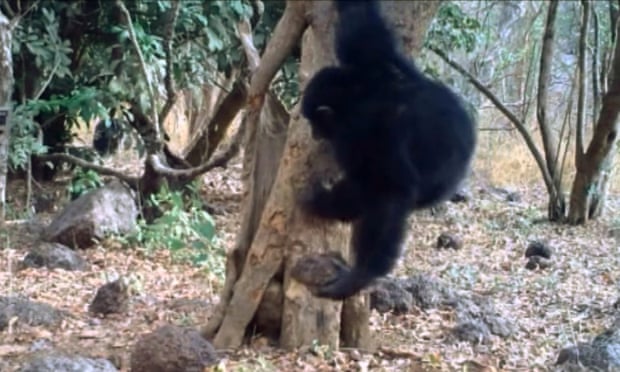
The images of chimps thrilled me: do they show evidence of spirituality in the wild?
A ritual with rocks observed in a study in Guinea has profound implications for our relationship with the animal kingdom
A young chimp collects rocks in a hollow tree trunk. Photograph: Kühl
A fter more than half a century of scientists studying chimpanzees in the wild, it was easy to think there were no surprises left. But there it was, right before our eyes – a new behaviour in our biological next of kin. We were a group of six on a field mission in the Republic of Guinea, investigating all aspects of a previously unstudied chimp community. These chimps didn’t enjoy the comforts of a protected area, but instead eked out their existence in what little habitat was left between expanding farms and villages.
The day of the discovery began as any other, struggling through the thorny African savannah while swatting away the sweat bees thirsty for our perspiration. We were surveying the area, looking for signs of chimps. We came to a stop at a clearing in the bush. I was relieved. It gave me a chance to untangle the thorns caught in my hair. But why had we stopped?
Read the rest of this article...
Friday, March 4, 2016
Travailler aux champs : la panoplie agricole antique de Saint-Clément
Les archéologues de l’Inrap ont découvert une panoplie d’outils agricoles du IIIe siècle, dans la cave incendiée d’une ferme antique à Saint-Clément (Yonne). Fouillé à l’automne 2015, sur prescription de l’État (Drac Bourgogne), dans le cadre de l’aménagement d’un lotissement par Brennus habitat, le site a livré d’intéressants vestiges de l’âge du Bronze et une partie de villa antique dont est issu cet important lot de mobilier métallique. Ce corpus unique livre quantité de renseignements sur l’organisation et le fonctionnement des fermes gallo-romaines.
Read the rest of this article...
Stone-throwing chimps leave scientists stumped by ‘sacred shrine
Chimpanzees in the savannah of Guinea and the forests of Liberia have been captured picking up stones and throwing them at a tree as well as placing them gently at the base
Chimpanzees in Guinea and the forests
of Liberia have been observed picking up stones and throwing them at a
tree as well as placing them gently at the base - behaviour that
appeared to serve no purpose and could be evidence of "ritualistic
behaviour" in animals.
"What we saw on this camera was exhilarating – a large male chimp
approaches our mystery tree and pauses for a second. He then quickly
glances around, grabs a huge rock and flings it full force at the tree
trunk," said Laura Kehoe, PhD researcher at Humboldt University of Berlin.
Read the rest of this article...
Thursday, March 3, 2016
Neanderthals collected manganese dioxide to make fire
Manganese dioxide is abundant in nature, and owing to their colour, these oxides have been used as pigments since the Stone Age. Some of the cave paintings in Lascaux, France, for example, were produced with manganese-based pigments. In a series of compositional analyses, scientists from Leiden University and Delft University of Technology conclude that Neanderthals at Pech-de-l'Azé I in South Western France had a strikingly different use for this mineral 50,000 years ago.
During excavations at several Neanderthal sites in France large numbers of small black 'blocs' where found. The usual interpretation is that these chunks of 'manganese oxides' were used for their colouring properties in body decoration, potentially even for symbolic expression. However Neanderthals habitually used fire and if they needed black material for decoration, soot and charcoal were readily available, whereas manganese oxides would have necessitated a considerably higher investment in both time and energy to obtain.
Read the rest of this article...
Why Did Ancient Europeans Just Disappear 14,500 Years Ago?
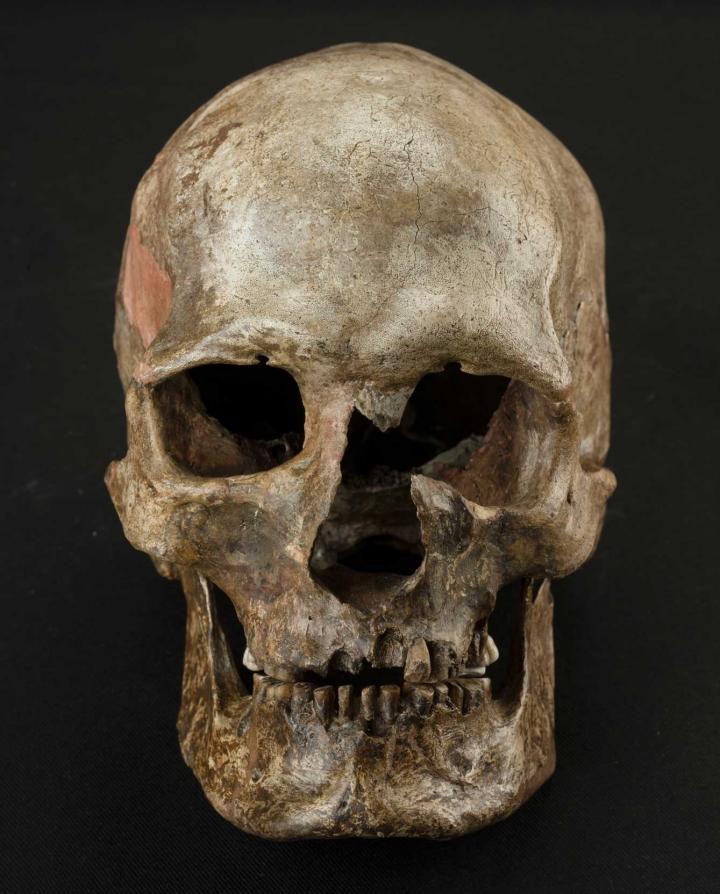
The skull of a man who lived between 36,200 and 38,700 years ago in Kostenki in western Russia
Some of Europe's earliest inhabitants mysteriously vanished toward the end of the last ice age and were largely replaced by others, a new genetic analysis finds.
The finds come from an analysis of dozens of ancient fossil remains collected across Europe.
The genetic turnover was likely the result of a rapidly changing climate, which the earlier inhabitants of Europe couldn't adapt to quickly enough, said the study's co-author, Cosimo Posth, an archaeogenetics doctoral candidate at the University of Tübingen in Germany. [Top 10 Mysteries of the First Humans]
The temperature change around that time was "enormous compared to the climactic changes that are happening in our century," Posth told Live Science. "You have to imagine that also the environment changed pretty drastically."
Read the rest of this article...
More "Polish pyramids" - new discoveries of archaeologists
More than a dozen hitherto unknown monumental megalithic tombs, have been discovered near Dolice (Western Pomerania) by archaeologists from Szczecin. They are so-called Kujawy tombs, often referred to as "Polish pyramids" because of their monumental character.
These ground structures were built in the shape of an elongated triangle and surrounded with huge stone blocks. The width of the base ranged from 6 to 15 meters and length reached 150 m. The structures reached a height of 3 m. The mounds usually contained single burials. Tombs were erected by the Funnel Beaker Culture community from the fifth to the third millennium BC According to archaeologists, people buried in these tombs were associated with the elders of the tribe and clan.
Read the rest of this article...
Wednesday, March 2, 2016
Le cimetière allemand de Boult-sur-Suippe
Une équipe de l’Inrap vient de fouiller un cimetière militaire allemand de la Grande Guerre. Ces recherches se sont déroulées en amont de la construction d’un lotissement par la société Immocoop et sur prescription de l’État (Drac Champagne-Ardenne). Environ 530 tombes et plus d’un millier d’objets personnels et militaires ont été mis au jour. Cette recherche d’ampleur permet notamment d’étudier la prise en charge des défunts et des blessés, du champ de bataille à la nécropole, et pour certains de les identifier.
Un cimetière de fortune
Durant les combats, dès 1916, les soldats ont été enterrés dans ce cimetière de fortune. Entre 1925 et 1927, période où les terres sont restituées aux agriculteurs pour relancer l’économie, une partie des sépultures est exhumée en urgence. Aujourd’hui, les archéologues mettent en évidence que les corps ont été partiellement prélevés, certains oubliés.L’étude portera sur le recrutement des soldats (âge, stature), leur état sanitaire, leurs provenances géographiques, les causes de leur décès, la chirurgie de guerre, la logistique militaire. Déjà figurent des recrues trop jeunes pour avoir eu l’âge légal de s’enrôler.
Read the rest of this article...
Glanzstück der Bronzezeit oder Fälschung?
Eine Tagung zur Goldscheibe von Moordorf
Der bronzezeitliche Goldschmuck aus dem bayrischen Bernstorf steht wegen der extrem hohen Reinheit des Metalls im Verdacht, gefälscht zu sein. In diesen Verdacht ist die gleichfalls bronzezeitliche Goldscheibe aus Moordorf (Ostfriesland) im Landesmuseum Hannover geraten, deren außergewöhnlich hoher Goldgehalt ebenso als Hinweis auf eine mögliche Fälschung gedeutet wird.
Read the rest of this article...
Sunday, February 28, 2016
World famous ancient Siberian Venus figurines 'are NOT Venuses after all'
Close microscopic inspection reveals them as being far from idealised female forms.
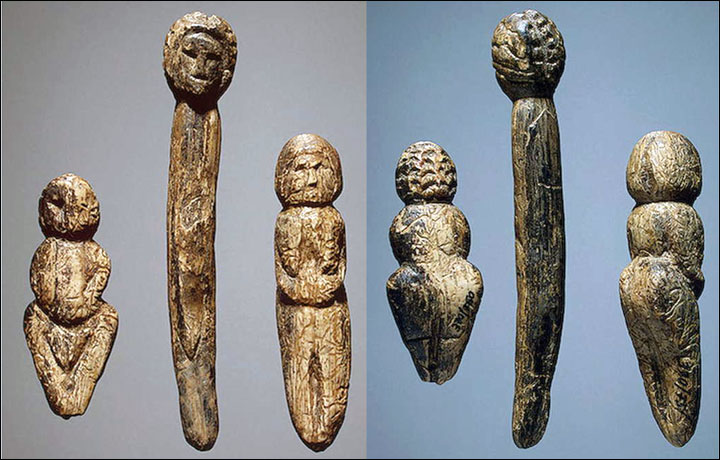
Picture: Hermitage Museum
New groundbreaking research shows that a celebrated collection of prehistoric Venus figurines are - in fact - a fashion show of ordinary people of all ages from some 20,000 years ago.
Close microscopic inspection reveals them as being far from idealised female forms. Rather, many are male, and others are children, the new research shows.
It's true that in the past some of the woolly mammoth tusk carvings were known to be clothed. Notably, these were called alluringly Venus in Furs figurines. They were dressed for protection from the Siberian winter, and are possibly the oldest known images anywhere in the world of sewn fur clothing. Yet even deep in Soviet times, the figurines were hailed for their feminine features, and seen as the idealised female form.
Read the rest of this article...
Engraved Mesolithic pendant unearthed in the UK
An 11,000 year old engraved shale pendant discovered by archaeologists during excavations at the Early Mesolithic site at Star Carr in North Yorkshire is unique in the UK, according to new research.
The
sacred prehistoric stone pendant, discovered by archaeologists in
Yorkshire. It was probably worn by a shaman carrying out hunting-related
rituals
[Credit: Harry Robson , University of York]
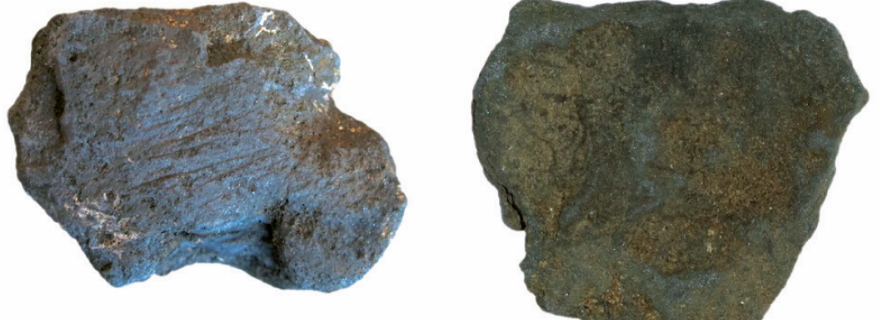
The artwork on the tiny fragile pendant, uncovered by a research team from the Universities of York, Manchester and Chester, is the earliest known Mesolithic art in Britain. Crafted from a single piece of shale, the subtriangular three-millimetre thick artefact measuring 31mm by 35mm contains a series of lines which archaeologists believe may represent a tree, a map, a leaf or even tally marks.
Engraved motifs on Mesolithic pendants are extremely rare and no other engraved pendants made of shale are known in Europe.
Read the rest of this article...
Monday, February 22, 2016
Neanderthals mated with modern humans much earlier than previously thought, study finds
COLD SPRING HARBOR LABORATORY—Cold Spring Harbor, NY - Using several different methods of DNA analysis, an international research team has found what they consider to be strong evidence of an interbreeding event between Neanderthals and modern humans that occurred tens of thousands of years earlier than any other such event previously documented.
Today in Nature the team publishes evidence* of interbreeding that occurred an estimated 100,000 years ago. More specifically the scientists provide the first genetic evidence of a scenario in which early modern humans left the African continent and mixed with archaic (now-extinct) members of the human family prior to the migration "out of Africa" of the ancestors of present-day non-Africans, less than 65,000 years ago.
Read the rest of this article...
Friday, February 19, 2016
Remains Found of 7,000-Year-Old Man Buried Upright
The young man was buried in a vertical pit in a 8,500-year-old cemetery, one of the oldest ever found in Europe.
A Mesolithic site in Germany has revealed the 7,000-year-old remains of a young man buried there in a strange upright position.
The unique burial was found near the village of Groß Fredenwalde, on top of a rocky hill in northeastern Germany, about 50 miles north of Berlin.
Read the rest of this article...
Bronze Age wheel at 'British Pompeii' Must Farm an 'unprecedented find'
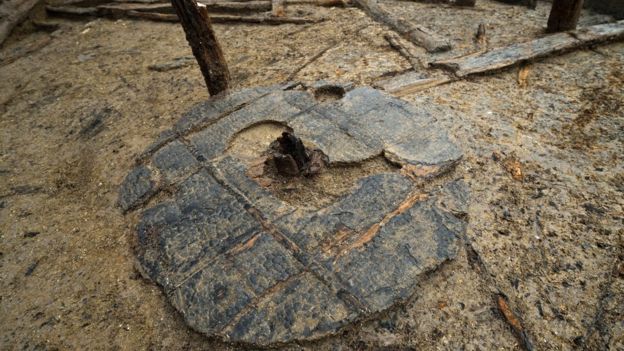
A complete Bronze Age wheel believed to be the largest and earliest of its kind found in the UK has been unearthed.
Archaeologists have described the find - made close to the country's "best-preserved Bronze Age dwellings" - as "unprecedented".
Still containing its hub, the 3ft-diameter (one metre) wooden wheel dates from about 1,100 to 800 BC.
The wheel was found close to the largest of one of the roundhouses found at the settlement last month.
Read the rest of this article...
Perfectly preserved bronze age wheel unearthed in Cambridgeshire
The largest and most perfectly preserved bronze age wheel ever discovered in the UK, made of oak planks almost 3,000 years ago, has emerged from a site in Cambridgeshire dubbed a Fenland Pompeii.
“This site is one continuing surprise, but if you had asked me, a perfectly preserved wheel is the last thing I would have expected to find,” said the site director, Mark Knight, from the Cambridge university archaeology unit. “On this site objects never seen anywhere else tend to turn up in multiples, so it’s certainly not impossible we’ll go on to find another even better wheel.”
Archaeologists are carefully excavating the wheel, which was found still attached to its hub and scorched by fire that destroyed the settlement built on stilts over a tributary of the river Nene.
Read the rest of this article...
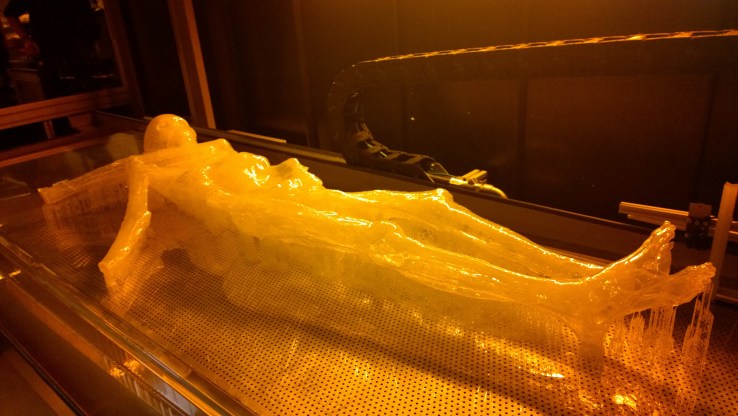
Scientists Can Now 3D Print Otzi The Mummified Ice Man
Otzi, for those not up on their 5,300-year-old mummified men, died and was frozen in the Alps near Hauslabjoch on the border between Austria and Italy. His body is one of the best preserved human mummies in Europe and now he’s getting a 3D-printed makeover.
Researchers and engineers have worked together with 3D-printing firm Materialise to perfectly scan Otzi. This allows researchers to 3D print his tortured frame over and over again and, in an interesting episode of Nova, an artist will create a perfect replica of the mummy for study by researchers and potential museum-goers. Otzi, for his part, his hanging out in a climate-controlled vault in Italy so he doesn’t degenerate.
Read the rest of this article...
Monday, February 15, 2016
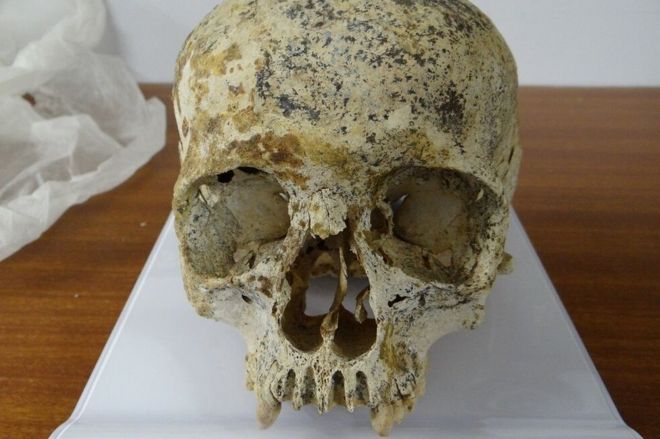
Effort to unlock secrets of 3,700-year-old woman 'Ava'
A skull and other remains were found at a Middle Bronze Age burial site almost 30 years ago
An archaeologist hopes to gain new insights into the life of a young woman who died more than 3,700 years ago.
Unusually, she was buried in a pit dug into solid rock and her skull is an abnormal shape which some suggest was done deliberately using bindings.
Maya Hoole believes advances in technology could reveal more about the remains known as "Ava".
Read the rest of this article...
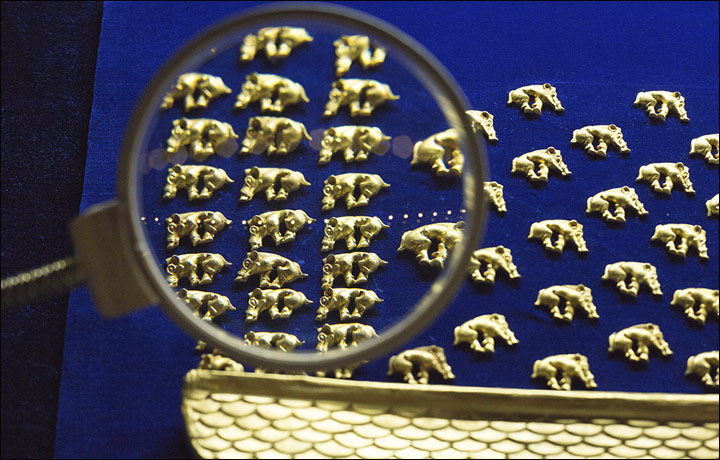
FOCUS ON TUVA: Stunning treasures - and macabre slaughter - in Siberia's Valley of the Kings
In
all, some 9,300 decorative gold pieces were found here, not including
the 'uncountable golden beads'. Picture: Vera Salnitskaya
The royal tomb known as Arzhan 2 in the modern-day Republic of Tuva - to many, the most mysterious region in all Russia - is some 2,600 years old but its valuables match any trove from any era anywhere in the world.
Here inside a mound 80 metres wide was buried a warrior tsar with a sway that plainly reached over a vast territory of mountains and steppes, and whose magnificent possessions indicated close contacts with other civilisations.
Forget the notion of barbaric Siberian nomadic tribes in this epoch: well, don't quite forget. These ancient warriors used the skulls of their vanquished foes as drinking cups, according to no less an authority than Greek historian Herodotus.
And this queen or concubine was almost certainly sacrificed to that she could be buried beside the dead ruler. And yet, as the pictures show, their exceptional artwork predates the influence of the Greeks, and displays a high degree of sophistication.
Read the rest of this article...
Mysterious Graves Discovered at Ancient European Cemetery
This
six-month-old baby is one of the oldest infant skeletons found in
Europe. It was buried 8,400 years ago by hunter-gatherers near Berlin.
One of the oldest cemeteries in Europe has recently been discovered,
with graves dating back almost 8,500 years. Two of the most intriguing
finds are the skeleton of a six-month-old child and a mysterious upright
burial of a man in his early 20s.
The German cemetery, called Gross Fredenwalde after a nearby village,
belongs to a time known as the Mesolithic, when Europe was populated by
hunter-gatherers. At a press conference Thursday morning in Berlin,
excavators announced that nine skeletons have been uncovered on the
hilltop burial site so far, five of them children younger than 6 years
old. And the researchers found ample evidence that more graves remain
unexcavated.
“It’s rare for the Mesolithic to find multiple graves in one place,”
says forensic anthropologist Bettina Jungklaus, who excavated one of the
bodies. “They were mobile people, ranging over the landscape.”
Read the rest of this article...
Saturday, February 13, 2016
Bronze Age burial near Stonehenge discovered by badger
A Bronze Age cremation burial has been discovered near Stonehenge after being accidentally dug up by a badger.
Experts believe the burial may have been that of an archer or a person who made archery equipment.
The artefacts date back to 2,200-2,000BC, senior archaeologist Richard Osgood, of the MOD, said.
Read the rest of this article...
9,200-year-old settlement discovered in Sweden
The discovery of the world's oldest storage of fermented fish in southern Sweden could rewrite the Nordic prehistory with findings indicating a far more complex society than previously thought. The unique discovery by osteologist Adam Boethius from Lund University was made when excavating a 9,200 year-old settlement at what was once a lake in Blekinge, Sweden. 9,200-year-old settlement discovered in Sweden
Excavation team in Blekinge, Sweden [Credit: Lund University]
"Our findings of large-scale fish fermentation, a traditional way of preserving fish, indicate that not only was this area settled at that time, it was also able to support a large community," says Adam Boethius, whose findings are now being published in the Journal of Archaeological Science.
The discovery is also an indication that Nordic societies were far more developed 9,200 years ago than what was previously believed. The findings are important as it is usually argued that people in the north lived relatively mobile lives, while people in the Levant -- a large area in the Middle East -- became settled and began to farm and raise cattle much earlier.
Read the rest of this article...
Freilegung des "Herren von Boilstädt" abgeschlossen
Das Highlight der Ausgrabungen im Zuge von Bauarbeiten zur Ortsumfahrung Gotha-Sundhausen in den Jahren 2012 und 2013 waren zwei frühmittelalterliche Bestattungen, die im Block geborgen wurden. Die Freilegung der beiden Bestattungen und die Restaurierung der Funde sind nun abgeschlossen und wurden heute der Öffentlichkeit präsentiert.
Anlässlich der Bauarbeiten zur Ortsumfahrung Gotha-Sundhausen wurden von August 2012 bis November 2013 archäologische Ausgrabungen durch das Thüringische Landesamt für Denkmalpflege und Archäologie (TLDA) nötig. Bei einer Trassenlänge von rund 3 km wurden insgesamt 2,5 ha ausgegraben. Es konnten dabei Befunde unterschiedlicher Zeitstellung dokumentiert werden, darunter eine Siedlung der jungsteinzeitlichen sog. Linearbandkeramik (ab 5500 v. Chr.), eine Siedlung der frühen Bronzezeit (um 2000 v. Chr.), Grabhügel der späten Bronzezeit (ca. 1000 v. Chr.) sowie Siedlungspuren und Bestattungen aus der Eisenzeit (ca. 500 v. Chr.) bis ins frühe Mittelalter.
Read the rest of this article...
Friday, February 5, 2016
Legal bid fails to rebury remains of 2,500 year old tattooed 'ice princess'
After archeologists dug up the ancient mummy - preserved in permafrost - natural disasters were unleashed in Siberia, court told.
A
mannequin - an exact replica - is displayed in the museum but on
'special occasions' VIPs would be 'provided the opportunities to see the
real mummy'. Picture: Autotravel.ru
An appeal will be launched after a court this week rejected a demand by the the leader of the Teles ethnic group in the Altai Mountains to order the reburial of the world famous tattooed remains of 'Princess Ukok', dug from her tomb in 1993 by leading Russian archeologists.
A court in Gorno-Altaisk rejected his lawsuit, allowing the relic to remain in the care of the National Museum in the city, capital of the Altai Republic.
Read the rest of this article...
DNA evidence uncovers major upheaval in Europe near end of last Ice Age
A photograph of les Closeaux at Rueil-Malmaison, Paris Basin, France. Credit: L. Lang
DNA evidence lifted from the ancient bones and teeth of people who lived in Europe from the Late Pleistocene to the early Holocene—spanning almost 30,000 years of European prehistory—has offered some surprises, according to researchers who report their findings in the Cell Press journal Current Biology on Feb. 4, 2016. Perhaps most notably, the evidence shows a major shift in the population around 14,500 years ago, during a period of severe climatic instability.
"We uncovered a completely unknown chapter of human history: a major population turnover in Europe at the end of the last Ice Age," says leading author Johannes Krause of the Max Planck Institute for the Science of Human History in Germany.
Read the rest of this article...
Humans evolved by sharing technology and culture
Blombos Cave in South Africa has given us vast knowledge about our early ancestors. In 2015, four open access articles, with research finds from Blombos as a starting point, have been published in the journal PLOS ONE.
Humans evolved by sharing technology and culture This image shows Blombos Cave, South Africa [Credit: University of Bergen]
"We are looking mainly at the part of South Africa where Blombos Cave is situated. We sought to find out how groups moved across the landscape and how they interacted," says Christopher S. Henshilwood, Professor at the University of Bergen (UiB) and University of the Witwatersrand and one of the authors of the articles.
Read the rest of this article...
Europe’s First Modern Humans May Have Been Replaced
TÜBINGEN, GERMANY—A new genetic study suggests that some 50,000 years ago, all non-Africans dispersed rapidly from a single population, and that around 14,500 years ago, there was a major turnover of the population in Europe. Researchers reconstructed the mitochondrial genomes of 35 hunter-gatherers who lived in Italy, Germany, Belgium, France, the Czech Republic, and Romania between 35,000 and 7,000 years ago.
The mitochondrial DNA of three of these individuals, who lived in what is now Belgium and France more than 25,000 years ago, belonged to haplogroup M. Haplogroup M is now very common in Asian, Australasian, and Native American populations, but had not been found in Europe, leading to the argument for multiple migrations. “When the Last Glacial Maximum began around 25,000 years ago, hunter-gatherer populations retreated south to a number of putative refugia, and the consequent genetic bottleneck probably resulted in the loss of this haplogroup,” Cosimo Posth of the University of Tübingen said in a press release.
Read the rest of this article...
Thursday, February 4, 2016
Headteacher mocked on Twitter for claiming evolution is not a fact
Richard Dawkins weighs in on social media debate after Christina Wilkinson said there was ‘more evidence that Bible is true’
Christina
Wilkinson, who runs a Church of England school, sparked a social media
row with her remarks. Photograph: St Andrew’s C of E primary
A primary school headteacher has been mocked on Twitter after claiming that evolution was “a theory” and there was “more evidence that the Bible is true”.
Christina Wilkinson, of St Andrew’s Church of England school in Oswaldtwistle, Lancashire, made the remarks in a tweet responding to London headteacher Tom Sherrington, who urged teachers to stick to science when teaching the origins of life.
Wilkinson wrote: “Evolution is not a fact. That’s why it’s called a theory! There’s more evidence that the Bible is true.”
Read the rest of this article...
Kilnwood, Vicarage Hill
This report has been reproduced by TimeTeign to help enhance our understanding of the early occupation and history of Kingsteignton during the early/late Bronze Age and into the Roman occupation around this hill-site. The report itself was made in relation to the construction of forty (40) dwellings on the Kilnwood estate, on Vicarage Hill, Kingsteignton, Devon, has been approved and passed by Steve Reed, at Devon County Council.
The site is situated to the southeast of the historic core of Kingsteignton within an area that was covered by the former mediaeval field systems. Remnants of these survived as parts of the existing field system and as previously-recorded lynchets to east and southeast of the site.
Read the rest of this article...
Bärenkult und Schamanenzauber
Bärenkult und Schamanenzauber: Rituale Früher Jäger
5.12.2015 - 28.3.2016
Archäologische Museum Frankfurt
Warum hat man Bären feierlich bestattet?
Weshalb tanzten Schamanen mit einem Hirschgeweih auf dem Kopf?
In welchen Zauberwelten weilten sie bei ihren Séancen?
Und wozu dienten Äxte und Stäbe, die wie Köpfe von Elchkühen gestaltet waren?
Bärenzeremoniell, Hirschtanz sowie Ren- und Elchkult waren religiös-schamanische Rituale zahlreicher indigener Jägervölker im Norden Skandinaviens und Sibiriens. Mit Faszination und Abscheu begegneten Geistliche und Reisende des 17. und 18. Jahrhunderts diesen Praktiken. Sie verdammten sie als „erschröcklichen Abgötterej vnnd verehrung der Teuffel". Dahinter stand jedoch eine urtümliche Vorstellungswelt und Religiosität, die in der Lebensform archaischer Jäger-Fischer-Sammler-Kulturen wurzelte.
Staunen erweckt jedoch nicht nur die weite Verbreitung dieser Kulte über die gesamte zirkumpolare Zone, sondern noch mehr ihr unergründliches Alter. Denn die Verehrung von Bären und Geweihträgern, verbunden mit schamanischen Ritualen, ist schon für die Altsteinzeit überliefert, dem Auftreten des modernen Menschen in Europa vor etwa 40 000 Jahren und noch darüber hinaus. In den religiösen Phänomenen neuzeitlicher Ethnien der nördlichen Hemisphäre werden somit Züge einer menschlichen „Urreligion" sichtbar.
Read the rest of this article...
Tuesday, February 2, 2016
Turtle soup, perchance? Prehistoric humans had a penchant for tortoises
New discovery at excavation of Qesem Cave reveals tortoises played a supplementary role in the diets of early humans 400,000 years ago
Grilled, boiled or salted? Turtles, or tortoises, are rarely consumed today, but a select few cultures, primarily those in East Asia, still consider turtle soup, made from the flesh of the turtle, a delicacy.
According to a new discovery at Qesem Cave near Tel Aviv, the site of many major findings from the late Lower Paleolithic period, they are not alone in their penchant for tortoise. Tel Aviv University researchers, in collaboration with scholars from Spain and Germany, have uncovered evidence of turtle specimens at the 400,000-year-old site, indicating that early man enjoyed eating turtles in addition to large game and vegetal material.
Study suggests how modern humans drove Neanderthals to extinction
A study* published in the Proceedings of the National Academy of Sciences (PNAS) suggests how Neanderthals could have been driven to extinction by competition with modern humans. Archaeologists have hypothesized that competition between Neanderthals and modern humans led to the former’s extinction because modern humans had a more advanced culture than Neanderthals, giving modern humans a competitive edge. Marcus Feldman and colleagues tested the plausibility of this hypothesis using a model of interspecies competition that incorporates differences in the competing species’ levels of cultural development.
Read the rest of this article...
ARCHAEOLOGISTS LONG UNDERESTIMATED EARLY HOMININS
Hominins of the Lower Paleolithic are much more like modern humans than was previously thought. By 300,000 years ago, Homo heidelbergensis in Schöningen used highly sophisticated weapons and tools. The hominins at Schöningen lived in social groups that practiced coordinated group hunting, a division of labor, and were able to communication about the past, present and future. These are cultural traits that archaeologists typically attribute to modern humans. The excavations in the open-cast coal mine in Schöningen running from 1994 until today show that we have long underestimated the cultural capacities of Homo heidelbergensis. Schöningen is a key site for documenting both a high resolution record of past climatic change and how hominins lived in northern Europe during the Ice Age. Since 2008 Professor Nicholas Conard and Dr. Jordi Serangeli of the University of Tübingen have led the excavations with a major international research team in close cooperation with the Cultural Heritage Office of Lower Saxony.
Read the rest of this article...
Subscribe to:
Posts (Atom)