The Prehistoric Archaeology Blog is concerned with news reports featuring Prehistoric period archaeology. If you wish to see news reports for general European archaeology, please go to The Archaeology of Europe Weblog.
Friday, January 15, 2016
New discoveries concerning Ötzi's genetic history
EUROPEAN ACADEMY OF BOZEN/BOLZANO (EURAC)—A study was published last week on the DNA of Helicobacter pylori, the pathogen extracted from the stomach of Ötzi, the ice mummy who has provided valuable information on the life of Homo Sapiens. New research at the European Academy of Bolzano/Bozen (EURAC) further clarifies the genetic history of the man who lived in the Eastern Alps over 5,300 years ago. In 2012 a complete analysis of the Y chromosome (transmitted from fathers to their sons) showed that Ötzi's paternal genetic line is still present in modern-day populations. In contrast, studies of mitochondrial DNA (transmitted solely via the mother to her offspring) left many questions still open.
Read the rest of this article...
Intact horse skeleton discovered in ancient cemetery in southern coastal Athens
A burial site containing an unusually well preserved skeleton of a horse, intact even down to the hooves, was among the finds discovered during landscaping works around the Stavros Niarchos Foundation Cultural Centre in the Faliro Delta, a prime tract of land in southern coastal Athens and previously hosted the country's only pari-mutuel horse track. The find was presented to the Central Archaeological Council during a session held on Tuesday, with members stressing its importance.
"In the Faliro necropolis we have found four complete horse graves, as well as parts of other skeletons, therefore, it is not something rare for the area. What is rare and surprised us was the degree of preservation of the specific skeleton, which even has its hooves. For zoo-archaeologists or a university, this find could be an excellent opportunity for a study. Having such a large number of skeletons - four is quite a number - such a study could reach a number of conclusions on the breeds and the evolution of the species. From this point of view, this find is very important," the top archaeologist Stella Chrysoulaki explained.
Read the rest of this article...
NEW DISCOVERIES CONCERNING ÖTZI’S GENETIC HISTORY
The Iceman’s maternal genetic line originated in the Alps and is now extinct.
A study was published last week on the DNA of Helicobacter pylori, the pathogen extracted from the stomach of Ötzi, the ice mummy who has provided valuable information on the life of Homo Sapiens; new research at the European Academy of Bolzano/Bozen (EURAC) further clarifies the genetic history of man who lived in the Eastern Alps over 5,300 years ago. In 2012 a complete analysis of the Y chromosome (transmitted from fathers to their sons) showed that Ötzi’s paternal genetic line is still present in modern-day populations. In contrast, studies of mitochondrial DNA (transmitted solely via the mother to her offspring) left many questions still open. To clarify whether the genetic maternal line of the Iceman, who lived in the eastern Alps over 5,300 years ago, has left its mark in current populations, researchers at the European Academy of Bolzano/Bozen (EURAC) have now compared his mitochondrial DNA with 1,077 modern samples.
Read the rest of this article...
The Ancient Greek Drinking Party
a lecture by Michael Duigan
Friday, 12 February 2016
7:00 pm
Activity Space 1, Clore Learning Centre
Museum of London, London Wall
EC2Y 5HN
FREE TO EMAS MEMBERS £3:00 NON-MEMBERS
Go to the EMAS Website...
Thursday, January 14, 2016
Apulian burial rituals prove you can take it with you
Death is inevitable, but what death shows us about the social behaviors of the living is not. And recent University of Cincinnati research examining the ancient bereavement practices from the the Central Apulian region in pre-Roman Italy helps shed light on economic and social mobility, military service and even drinking customs in a culture that left no written history.
Red-figure hydria with grave scene: Women offering fillets to the deceased. Apulian Greek 450-300 BCE, terracotta [Credit: archaeology.wiki]
For instance, by focusing on the logistics of burials, treatment of deceased bodies and grave contents dating from about 525-200 BC, UC Classics doctoral student Bice Peruzzi found indication of strong social stratification and hierarchy. She also found indications of the commonality of military service since men's tombs of the era routinely contained metal weaponry lying across or near the skeletal remains.
Read the rest of this article...
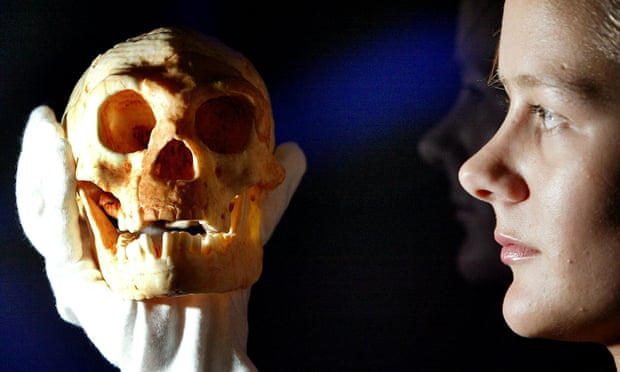
Sulawesi find: 118,000-year-old stone tools point to 'archaic group of humans'
Discovery of 311 implements on Indonesian island suggest modern humans settling there 60,000 years ago would have met an ‘isolated human lineage’
A model of a skull from a species of Hobbit-sized humans called Homo floresiensis, which was found in a cave on the Indonesian island of Flores. Scientists now believe they may have had relatives on other islands.
Photograph: Stephen Hird/Reuters/Corbis
The diminutive prehistoric human species dubbed the “Hobbit” that inhabited the Indonesian island of Flores long before the arrival of Homo sapiens apparently had company on other islands.
Stone tools that are at least 118,000 years old have been discovered on the island of Sulawesi, indicating a human presence, scientists said on Wednesday. No fossils of these individuals were found in conjunction with the tools at the site called Talepu, leaving the toolmakers’ identity a mystery.
Read the rest of this article...
Bronze Age stilt houses unearthed in Cambridgeshire
Large circular wooden houses built on stilts collapsed in a dramatic fire 3,000 years ago and plunged into a river, preserving their contents in astonishing detail. Archaeologists say the excavations have revealed the best-preserved Bronze Age dwellings ever found in Britain.
Archaeologists at Must Farm have uncovered the charred wooden roof structure of a 3,000 year old round house [Credit: Cambridge Archaeological Unit]
Archaeologists have revealed exceptionally well-preserved Bronze Age dwellings during an excavation at Must Farm quarry in the East Anglian fens that is providing an extraordinary insight into domestic life 3,000 years ago. The settlement, dating to the end of the Bronze Age (1200-800 BC), would have been home to several families who lived in a number of wooden houses on stilts above water.
Read the rest of this article...
Dog domestication may have increased harmful genetic changes, UCLA biologists report
The domestication of dogs may have inadvertently caused harmful genetic changes, a UCLA-led study suggests.
Domesticating dogs from gray wolves more than 15,000 years ago involved artificial selection and inbreeding, but the effects of these processes on dog genomes have been little-studied.
UCLA researchers analyzed the complete genome sequences of 19 wolves; 25 wild dogs from 10 different countries; and 46 domesticated dogs from 34 different breeds. They found that domestication may have led to a rise in the number of harmful genetic changes in dogs, likely as a result of temporary reductions in population size known as bottlenecks.
“Population bottlenecks tied to domestication, rather than recent inbreeding, likely led to an increased frequency of deleterious genetic variations in dogs,” said Kirk Lohmueller, senior author of the research and assistant professor of ecology and evolutionary biology in the UCLA College.
Wednesday, January 13, 2016
Bronze Age houses: What the finds tell us
At a quarry in Cambridgeshire, archaeologists say they have discovered Britain's "Pompeii - a number of well-preserved dwellings dating back to the Bronze Age. The artefacts found there reveal new details about the period between 2500 and 2000BC and those who lived through it.
One of the finds at Must Farm quarry in Cambridgeshire were pots with meals still inside. According to Selina Davenport, an archaeologist who helped uncover the Bronze Age dwellings, the find suggests that the pots were being used to make pottage.
"Think porridge and add a few extra herby things, and if you were lucky you might have had honey to dollop in the middle. It isn't a great meal, and if someone put a bowl in front of you, you wouldn't light up," says Chris Gosden, Professor of European Archaeology at the University of Oxford.
Read the rest of this article...
Bronze Age village found near ancient Roman city
A 3,500-year-old settlement has been unearthed near an ancient Roman city in northeast Italy.
The Roman city of Aquileia, in Friuli Venezia Giulia, is one of Italy's 51 world heritage sites but the discovery of a Bronze Age village just outside the city has cast new light on the area's human history, Corriere della Sera reported.
The village was found next to an ancient Roman canal, known as the Canale Anfora, by a team of archaeologists from the University of Udine.
From 200BC until 400AD Aquileia – today home to just 3,500 inhabitants – was one of the biggest and most important market towns in Europe, with a population of some 100,000.
Read the rest of this article...
Dorset's oldest settlement 'could fall into sea'
Parts of what is believed to be Dorset's oldest human settlement could be lost to coastal erosion, archaeologists have warned.
Excavations were carried out in 2009, metres from the cliff edge at Doghouse Hill
[Credit: Paul Baker]
Hunter-gatherers lived on Doghouse Hill near Seatown up to 10,000 years ago. The settlement was on land a mile inland, but erosion means it is now on a cliff edge which has crumbled further during the winter storms. Archaeology writer Paul Baker said there was an "imminent danger" of landslips.
The National Trust, which owns Golden Cap Estate, led excavations in 2009 that unearthed a stone hearth, fire pit and pot shards from Bronze Age periods (2,500 to 1,000BC) and other relics from the Mesolithic Age (10,000 to 4,000BC) when Dorset was inhabited by hunter-gathers living off the land.
Read the rest of this article...
Behind the Myth of King Midas
What was behind the legendary story of King Midas and his golden touch?
That is the question to be answered—not with chests full of gold, but with a spectacular array of 150 objects, including more than 120 specially-loaned ancient artifacts from four museums in the Republic of Turkey, keys to telling the true story of a very real and powerful ruler of the Phrygian kingdom. The Golden Age of King Midas is an exclusive, world premiere exhibition developed by the Penn Museum, 3260 South Street in Philadelphia, in partnership with the Republic of Turkey. A special Opening Celebration on Saturday, February 13 kicks off the exhibition, which runs through November 27, 2016.
Read the rest of this article...
What History Gives, the Sea Steals
On a North Sea shore in Scotland, a group of archaeologists struggles to dig in a storm. The wind is so fierce it threatens to blow them over, and bursts of hail and near-horizontal rain send them periodically scurrying for shelter. They’re battling water on more than one front: waves surge up the beach, threatening to inundate the worksite. Sometime after an expensive camera sails off a tripod and breaks, they abandon their dig.
Undaunted, the crew of professional and volunteer archaeologists returns a few months later to finish work at the site, a coastal farm called Meur. The structures they’re excavating have survived for thousands of years. But a strong storm uncovered the site in the first place, and the next storm could drag it into the ocean for good. In Scotland, as on coastlines around the world, climate change is both helping to reveal new archaeological sites and threatening to destroy them. Researchers and citizen scientists are racing time to collect the stories of these vanishing sites.
Read the rest of this article...
Britain's Pompeii? Well, we can dream
You may snort at the fact that a bronze-age village has been compared to the most famous Roman site in the world. But what we lack in grandeur we make up for in romanticism
They’re calling it Britain’s Pompeii, after the well-preserved Roman town in the heart of Italy. There, temple columns stand tall against the sky and it’s easy to squint and imagine that the crowds milling around are wearing togas and buying tickets to see someone get eaten by a lion.
Britain’s Pompeii isn’t a Roman ruin, it’s a bronze-age one. But you still might be expecting something dramatic; standing stones, maybe, or a burial labyrinth. Actually, it’s quite a lot of wood, in a sort of bog. It looks like a wet weekend in East Anglia. It is.
To be fair, it’s an extraordinary find and will shed new light on the way humans lived on these islands a thousand years before the birth of Christ. There are wooden pots, glass beads and preserved textiles showing fibres woven by hand in patterns that would be familiar to us today. Archaeologists are right to be excited. Comparing it to Pompeii is a way of getting across how important they think it is. It may revolutionise our understanding of British bronze-age culture, the way the excavations in the shadow of Vesuvius did with Roman life.
Read the rest of this article...
Tuesday, January 12, 2016
Ancient burial rituals prove you can take it with you ... and what you take says a lot
Research on ancient burial tombs unlocks the mysteries of pre-Roman social status and cultural change, including urbanization, militarism and even likely shifts in drinking patterns.
This image shows a 4th century assemblages with fine Greek vases, banquet implements and metal weapons.
Death is inevitable, but what death shows us about the social behaviors of the living is not.
And recent University of Cincinnati research examining the ancient bereavement practices from the the Central Apulian region in pre-Roman Italy helps shed light on economic and social mobility, military service and even drinking customs in a culture that left no written history.
For instance, by focusing on the logistics of burials, treatment of deceased bodies and grave contents dating from about 525-200 BC, UC Classics doctoral student Bice Peruzzi found indication of strong social stratification and hierarchy. She also found indications of the commonality of military service since men's tombs of the era routinely contained metal weaponry lying across or near the skeletal remains.
Bronze age dig in Whittlesey uncovers very rare 3,000 year glimpse into the past
A unique treasure trove of historical artefacts thousands of years old has been discovered near Whittlesey.
Two Bronze Age round houses, dating back to around 1290 BC were discovered in Must Farm Quarry, off Funthams Lane.
The 3,000 year old houses, which were built on stilts were destroyed by a fire and collapsed into a river - which preserved the bowls, tools and even timber in clay.
Now archaeologists have been able to learn more about how our ancestors lived.
A £1.1 million project to excavate the site, funded by government heritage agency Historic England, and quarry-owners Forterra, has been launched.
Mark Knight, site director of the excavation, said: “We are, effectively, for the first time in British history about to go inside a Bronze Age roundhouse.
Read the rest of this article...
How blue and green clays kill bacteria
Since prehistoric times, clays have been used by people for medicinal purposes. Whether by eating it, soaking in a mud bath, or using it to stop bleeding from wounds, clay has long been part of keeping humans healthy. Certain clays have also been found with germ-killing abilities, but how these work has remained unclear.
A new discovery by Arizona State University scientists shows exactly how two specific metallic elements in the right kinds of clay can kill troublesome bacteria that infect humans and animals.
"We think of this mechanism like the Trojan horse attack in ancient Greece," said Lynda Williams, a clay-mineral scientist at ASU's School of Earth and Space Exploration (SESE). "Two elements in the clay work in tandem to kill bacteria."
Read the rest of this article...
New Labor-Saving Software Developed for Archaeologists
TRONDHEIM, NORWAY—New software has been developed by PRESIOUS, a project funded by the European Union, to help archaeologists work economically and efficiently. “We set out to address some of the challenges that archaeologists face in their everyday work,” project coordinator Theoharis Theoharis of the Norwegian University of Science and Technology said in a press release from the European Commission Community Research and Development Information Service. The first tool simulates how a stone object will erode under certain conditions. The second allows archaeologists to find possible fits for fragmented objects. The third uses symmetry to predict how artifacts with missing pieces might have looked. “But in order to develop these technologies, we had to address a key bottleneck—the expense and labor-intensive nature of digitization,”
Read the rest of this article...
Bronze Age houses uncovered in Cambridgeshire are Britain's 'Pompeii'
Archaeologists have uncovered Britain's "Pompeii" after discovering the "best-preserved Bronze Age dwellings ever found" in the country.
The circular wooden houses, built on stilts, form part of a settlement at Must Farm quarry, in Cambridgeshire, and date to about 1000-800 BC.
A fire destroyed the posts, causing the houses to fall into a river where silt helped preserve the contents.
Pots with meals still inside have been found at the site.
Read the rest of this article...
Monumental Ditched Enclosures in Neolithic Europe
As part of the 'outreach' activities of a University of Southampton research project that Dr. Víctor Jiménez Jáimez has been developing the last two years, he has created a new website centred upon monumental ditched enclosures in Neolithic Europe. The visual language and the structure and form of the content have been designed for educational purposes. It's aimed at the general public, but it could also be a useful resource for Archaeology students and even researchers. It is completely non-profit.
You can find the site at:
Saturday, January 9, 2016
Ötzi the iceman reveals secrets of European migration
Stomach contents of a frozen 5,300 year old corpse discovered in the Alps by tourists 24 years ago has shed new light on the origins of European man
Ötzi the iceman's stomach contents sheds light on European prehistoric migration Photo: Getty
Ötzi the iceman has fascinated scientists since his frozen 5,300-year-old corpse was discovered by Alpine hikers in 1991.
Now, three and a half years after discovering that Ötzi was murdered, experts have now found discovered was suffering from a nasty stomach bug.
It is this bug which has shed fascinating new light on the migration patterns of prehistoric man, showing that Europe’s first farmers are most likely to have come from the Middle East.
Read the rest of this article...
Neanderthal genes 'boosted our immunity'
We may owe our ability to fight disease to our extinct relatives - the Neanderthals and Denisovans.
According to a pair of scientific studies, key genes in the immune system come from our ancient "cousins".
The findings, which appear in The American Journal of Human Genetics, suggest we have Neanderthals to thank for being able to fight off pathogens.
But interbreeding may have had a downside, as the same genes may have made us more prone to allergies.
Modern-day people can trace their ancestry to a small population that emerged from Africa about 60,000 years ago.
As the African humans spread out across the world, they came into contact with other ancient humans based in Europe and Western Asia.
Genetic evidence suggests that these different "tribes" interbred, with part of the genome of Neanderthals still present in humans alive today.
Read the rest of this article...
Knossos flourished after collapse of Bronze Age
Recent fieldwork at the ancient city of Knossos on the Greek island of Crete finds that during the early Iron Age (1100 to 600 BC), the city was rich in imports and was nearly three times larger than what was believed from earlier excavations.
The North Portico at the Minoan palace of Knossos [Credit: Bernard Gagnon/WikiCommons]
The discovery suggests that not only did this spectacular site in the Greek Bronze Age (between 3500 and 1100 BC) recover from the collapse of the socio-political system around 1200 BC, but also rapidly grew and thrived as a cosmopolitan hub of the Aegean and Mediterranean regions. Antonis Kotsonas, a University of Cincinnati assistant professor of classics, will highlight his field research with the Knossos Urban Landscape Project at the 117th annual meeting of the Archaeological Institute of America and Society for Classical Studies. The meeting takes place Jan. 7-10, 2016 in San Francisco.
Read the rest of this article...
Tuesday, December 22, 2015
Stonehenge tunnel survey reveals new sites, and mysteries
Archaeologists are mapping the area before road is replaced and teasing secrets from the ancient landscape
Some 3,400 years before the roaring torrent of the A303 road sliced theStonehenge landscape in half, some people cut a beautiful pit a metre deep into the chalk with no tools except picks made of red deer antlers.
They may have had primitive tools, but there was nothing primitive about their skills: the bottom of the pit was so neatly levelled that you could balance a beaker of mead on it without spilling a drop.
As druids and tourists head towards Stonehenge for the winter solstice, which falls this year on 22 December, when the midwinter sun should set framed perfectly by the giant stones, Historic England archaeologists are hard at work teasing ancient secrets out of the landscape.
Read the rest of this article...

Wednesday, December 16, 2015
Dog has been man's best friend for 33,000 years, DNA study finds
First domesticated dogs came about 33,000 years ago and migrated to Europe from south east Asia, rather than descending from domesticated European wolves 10,000 years ago as had previously been thought
Man's best friend came about after generations of wolves scavenged alongside humans more than 33,000 years ago in south east Asia, according to new research.
Dogs became self-domesticated as they slowly evolved from wolves who joined humans in the hunt, according to the first study of dog genomes.
And it shows that the first domesticated dogs came about 33,000 years ago and migrated to Europe, rather than descending from domesticated European wolves 10,000 years ago as had previously been thought.
Scientists have long puzzled over how man's best friend came into existence but there is conflicting evidence on when and where wild wolves were first tamed.
Tuesday, December 15, 2015
Stonehenge was moved by glaciers - not our prehistoric ancestors
The famous rocks of Stonehenge were not dragged by pagans but moved by glaciers, according to a team of Welsh academics.
Previously, a team of experts from University College London (UCL) claimed to have resolved the archaeological enigma, confirming that the stones were excavated and transported from two sites in Pembrokeshire by our prehistoric ancestors.
The team of archaeologists and geologists said Carn Goedog and Craig Rhos-y-felin, both in the Preseli Hills, had definitely been quarried for the mysterious stones.
They believe that between 4,000 and 5,000 years ago, rocks were taken from the Welsh mountain range by people and dragged away to where they currently stand, in Wiltshire.
But in a recent conflicting report, scientists have refuted UCL’s findings.
Monday, December 14, 2015
Millet: The missing link in prehistoric humans' transition from hunter-gatherer to farmer
Professor Martin Jones is pictured with millet in north China.
New research shows a cereal familiar today as birdseed was carried across Eurasia by ancient shepherds and herders laying the foundation, in combination with the new crops they encountered, of 'multi-crop' agriculture and the rise of settled societies. Archaeologists say 'forgotten' millet has a role to play in modern crop diversity and today's food security debate.
The domestication of the small-seeded cereal millet in North China around 10,000 years ago created the perfect crop to bridge the gap between nomadic hunter-gathering and organised agriculture in Neolithic Eurasia, and may offer solutions to modern food security, according to new research.
Studies show early human hunters more advanced than previously thought
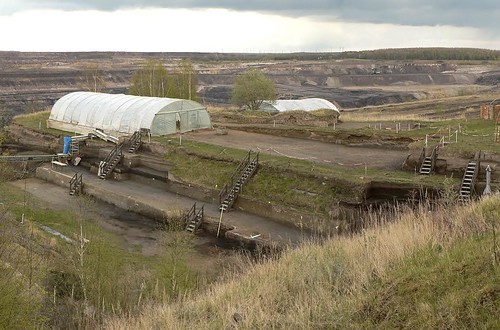
The Schöningen excavation site. Tangelnfoto, Wikimedia Commons
The Paleolithic site of Schöningen in north-central Germany is best known for the earliest known, completely preserved wooden spears (at least 10 recovered) by archaeologists under the direction of Dr. Hartmut Thieme between 1994 and 1998 at an open-cast lignite mine. Deposited in organic sediments on an ancient lakeshore, they were found in combination with the remains of about 16,000 animal bones, including 20 to 25 butchered wild horses, whose bones featured numerous butchery marks, including one pelvis that still had a spear protruding from it. The finds are considered evidence that early humans were active hunters with specialized tool kits as early as 300,000 or more years ago.
Now, a series of detailed study reports on the Schöningen findings have been published online in the Journal of Human Evolution. Altogether, they present a picture of groups of prehistoric hunters who sojourned at sites in the Schöningen area about 300,000+ years ago and hunted and processed mammalian species such as wild horse and red deer using tools/weapons made of wood, stone and bone. The findings have changed the long-accepted paradigm of a more primitive early human hunting culture during this time period that featured primarily stone tools and weapons and a somewhat more limited subsistence strategy.
Read the rest of this article...
6,000-year-old skeletons in French pit came from victims of violence
CIRCLE OF DEATH A circular pit excavated in France (left) contains the remains of eight people probably killed in a violent attack around 6,000 years ago. Seven severed left arms lay at the bottom of the pit. A diagram of the pit discoveries denotes bones of each individual in different colors.
A gruesome discovery in eastern France casts new light on violent conflicts that took lives — and sometimes just limbs — around 6,000 years ago.
Excavations of a 2-meter-deep circular pit in Bergheim revealed seven human skeletons plus a skull section from an infant strewn atop the remains of seven human arms, say anthropologist Fanny Chenal of Antea Archéologie in Habsheim, France, and her colleagues.
Two men, one woman and four children were killed, probably in a raid or other violent encounter, the researchers report in the December Antiquity. Their bodies were piled in a pit that already contained a collection of left arms hacked off by axes or other sharp implements. Scattered hand bones at the bottom of the pit suggest that hands from the severed limbs had been deliberately cut into pieces.
Unique Neolithic sculpture found at Czech site
Archaeologists in the east Moravian town of Přerov have discovered a unique statuette which they believe dates back to the early Neolithic period. The richly ornamented torso has been hidden under ground for over seven thousand years ago.
The richly engraved torso of a Neolithic figurine was found at an archaeological site in the Czech Republic [Credit: Zdeněk Schenk]
The valuable finding was discovered during initial excavations of an archaeological site near Lipník nad Bečvou, a small town on the edge of the Moravian Gate valley. It is a torso of a body, or what the archaeologists call an anthropomorphic sculpture, richly engraved with geometric ornaments. It is about 76 millimetres tall and its head and arms have been broken off.
According to the head of the archaeological research at the site Zdeněk Schenk, the statuette must be at least seven thousand years old, since it was found on the site of an early Neolithic settlement:
Read the rest of this article...
Dans les pas des mammouths de Montereau-sur-le-Jard (Seine-et-Marne)
Avant la construction, par Snecma, d’un nouveau bâtiment sur le site de Villaroche, à Montereau-sur-le-Jard (Seine-et-Marne), la Drac Île-de-France (service régional de l’Archéologie) a prescrit des recherches archéologiques menées par l’Inrap.
Le diagnostic, préalable à la fouille, a montré une répartition des vestiges archéologiques sur une surface de 3 000 m². Seuls les
1 800 m² menacés par les travaux d’aménagement ont donné lieu à une fouille, de juin à juillet 2015.
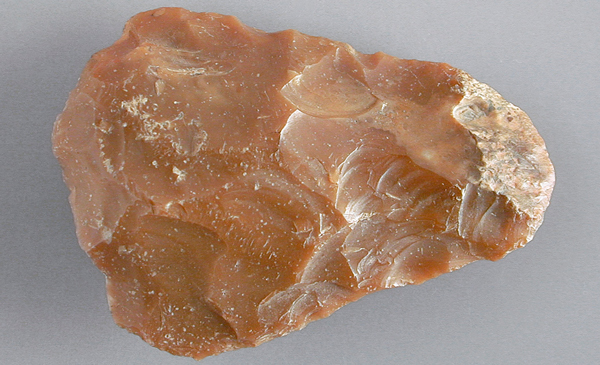
Les recherches ont démontré que le site a été occupé à plusieurs reprises au Paléolithique moyen (entre - 300 000 et - 40 000 avant notre ère). De nombreux outils en silex associés à des restes de mammouths datés de la dernière glaciation (autour de 100 000 ans avant notre ère) ont été mis au jour. Ces découvertes sont d’autant plus inédites qu’elles sont faites en contexte de plateau. Elles éclairent de façon singulière les comportements de subsistance des groupes humains à cette période.
Read the rest of this article...
Wednesday, December 2, 2015
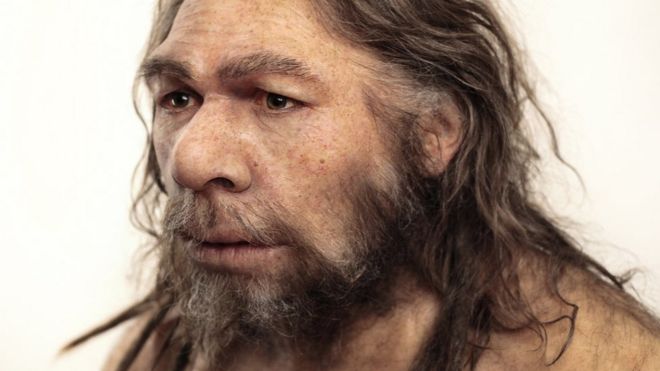
Did our ancient ancestors 'kill the cat'?
The European sabre-toothed cat was about the size of a modern tiger or lion
Our ancient human cousins may have fought off big cats with spears, according to archaeological evidence.
The sabre-toothed cat lived alongside early humans, and may have been a fearsome enemy, say scientists.
Several feline teeth - and a chunk of arm bone - were uncovered at a site in Germany known for the oldest discovery of human spears.
The 300,000-year-old animal fossils are described as "spectacular".
The sabre-toothed cat - once known as the sabre-toothed tiger - lived from about 55.8 million to 11,700 years ago.
Read the rest of this article...
Secrets unearthed at Boodie Cave: humankind just got a little older
Boodie Cave on Barrow Island is yielding an ancient secret of global significance: resourceful, well-fed humans were living in its limestone chambers more than 50,000 years ago, several thousand years earlier than archaeologists had estimated.
UWA researcher and PhD student Kane Ditchfield excavating Boodie Cave, on Barrow Island off Western Australia [Credit: Ingrid Ward]
The startling evidence has been unearthed in surgically excavated pits on Barrow, Western Australia’s second largest island, 50km off the Pilbara coast.
Thousands of tiny artefacts lie in sediment dated to 50,000 years old in an Oxford University laboratory, where 200 single sand grains were measured by optically stimulated luminescence.
Read the rest of this article...
Rice basket study rethinks roots of human culture
Although teaching is useful, it is not essential for cultural progress.
Image courtesy of Shutterstock
A new study from the University of Exeter has found that teaching is not essential for people to learn to make effective tools.
The results counter established views about how human tools and technologies come to improve from generation to generation and point to an explanation for the extraordinary success of humans as a species. The study reveals that although teaching is useful, it is not essential for cultural progress because people can use reasoning and reverse engineering of existing items to work out how to make tools.
The capacity to improve the efficacy of tools and technologies from generation to generation, known as cumulative culture, is unique to humans and has driven our ecological success. It has enabled us to inhabit the coldest and most remote regions on Earth and even have a permanent base in space. The way in which our cumulative culture has boomed compared to other species however remains a mystery.
Read the rest of this article...
Human nature’s dark side helped us spread across the world
New research by an archaeologist at the University of York suggests that betrayals of trust were the missing link in understanding the rapid spread of our own species around the world.
Dr Penny Spikins, of the University’s Department of Archaeology, says that the speed and character of human dispersals changed significantly around 100,000 years ago.
Before then, movement of archaic humans were slow and largely governed by environmental events due to population increases or ecological changes. Afterwards populations spread with remarkable speed and across major environmental barriers.
Read the rest of this article...
Thursday, November 26, 2015
Gold jewellery unearthed at prehistoric site in Bulgaria
As gold jewellery goes, it could be considered to be quite modest, but a 6,600 year old pendant discovered at the site of one of Europe's oldest prehistoric towns may be the world's oldest bling.
The newly found gold jewel from the Solnitsata prehistoric town near Bulgaria’s Provadiya
[Credit: Cherno More News Agency]
[Credit: Cherno More News Agency]
The tiny two-gram pendant was discovered during excavations at the archaeological site of Solnitsata in the Varna region of Bulgaria.
Archaeologists believe the area may have been part of an advanced prehistoric society that was among the first to work out how to process and produce gold goods.
The necropolis at Solnitsata, which means 'Salt Pit', is situated just to the north of the Bulgarian city of Provadia.
Read the rest of this article...

Paleolithic elephant butchering site found in Greece
Excavation with some of the elephant bones exposed.
Credit: Greek Ministry of Culture
A new Lower Paleolithic elephant butchering site, Marathousa 1, has been discovered in Megalopolis, Greece, by a joint team of researchers from the Ephorate of Paleoanthropology and Speleology (Greek Ministry of Culture) and the Paleoanthropology group, University of Tübingen.
Marathousa 1 is located in an open-cast coal mine, on what was once the shore of a shallow lake. It has yielded stratified stone artifacts in association with a nearly complete skeleton of Elephas antiquus, as well as the exceptionally well-preserved remains of fauna (rodents, birds, amphibians, reptiles, mollusks and insects) and plants (wood, seeds, fruit). The association of lithic artifacts with the elephant remains, as well as the discovery of cutmarks on elephant bones, indicate that Marathousa 1 is an elephant butchering site.
Tuesday, November 24, 2015
Genetic history of Europeans revealed
A study of ancient DNA has shed new light on European genetic history.
It confirms that farming spread across Europe due to the influx of ancient people from what is now eastern Turkey.
Many modern Europeans owe their taller stature to these early farmers - and a later influx of Bronze Age "horsemen" - say international researchers.
In the study, researchers mapped the genes of 273 ancient people who lived in West Europe and Asia from about 8,500 to 2,500 years ago.
Of these, 26 were part of a population that gave rise to Europe's first farmers.
Prof Ron Pinhasi of the School of Archaeology at University College Dublin, a lead researcher on the study, said: "We now have the first clear evidence that agriculture in Europe started with the first farmers coming from what is now Turkey.
Read the rest of this article...
Subscribe to:
Posts (Atom)