Sunday, September 29, 2019

Did a common childhood illness take down the Neanderthals?

MAGE: THIS ILLUSTRATION SHOWS THE STRUCTURE OF THE EUSTACHIAN TUBE IN NEANDERTHAL MAN AND IT'S SIMILARITY TO THE HUMAN INFANT.

BROOKLYN, NY - It is one of the great unsolved mysteries of anthropology. What killed off the Neanderthals, and why did Homo sapiens thrive even as Neanderthals withered to extinction? Was it some sort of plague specific only to Neanderthals? Was there some sort of cataclysmic event in their homelands of Eurasia that lead to their disappearance?

A new study from a team of physical anthropologists and head & neck anatomists suggests a less dramatic but equally deadly cause.

Published online by the journal, The Anatomical Record, the study, "Reconstructing the Neanderthal Eustachian Tube: New Insights on Disease Susceptibility, Fitness Cost, and Extinction"1 suggests that the real culprit in the demise of the Neanderthals was not some exotic pathogen.

Read the rest of this article...

Saturday, September 28, 2019

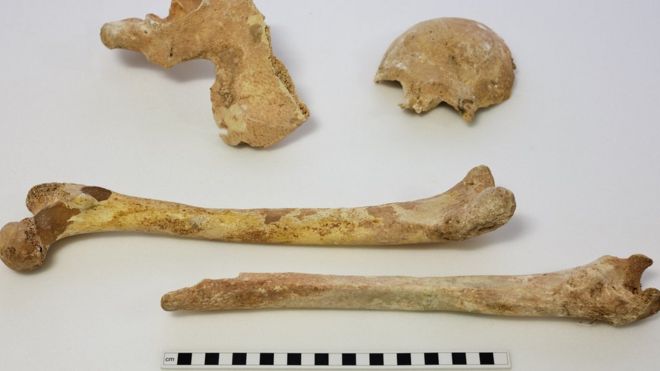
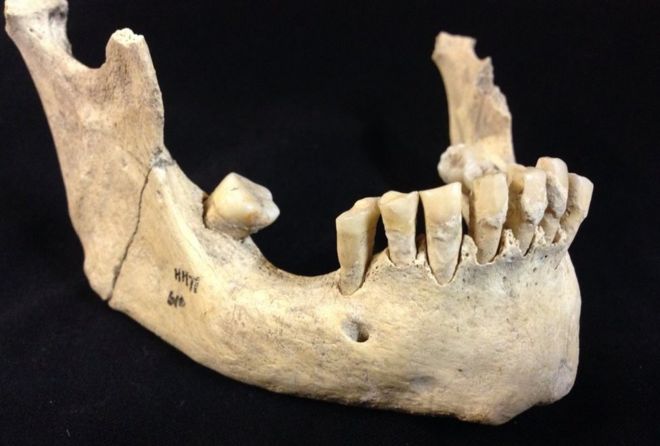
Somerset human remains 'as old as Cheddar Man'

The human remains were found to be as old as Britain's oldest complete skeleton, the Cheddar Man
SOUTH WEST HERITAGE TRUST

Two boxes of human remains rediscovered after 55 years have been found to be as old as the Cheddar Man - Britain's oldest complete skeleton.

The bones were discovered in a cave in Cannington Park Quarry near Bridgwater, Somerset, in the 1960s.

Soon after they "disappeared", and were recently found at Somerset Heritage Centre near Taunton, Cotswold Archaeology said.

Radiocarbon dating has shown them to be more than 9,000 years old.

Read the rest of this article...
Thursday, September 26, 2019

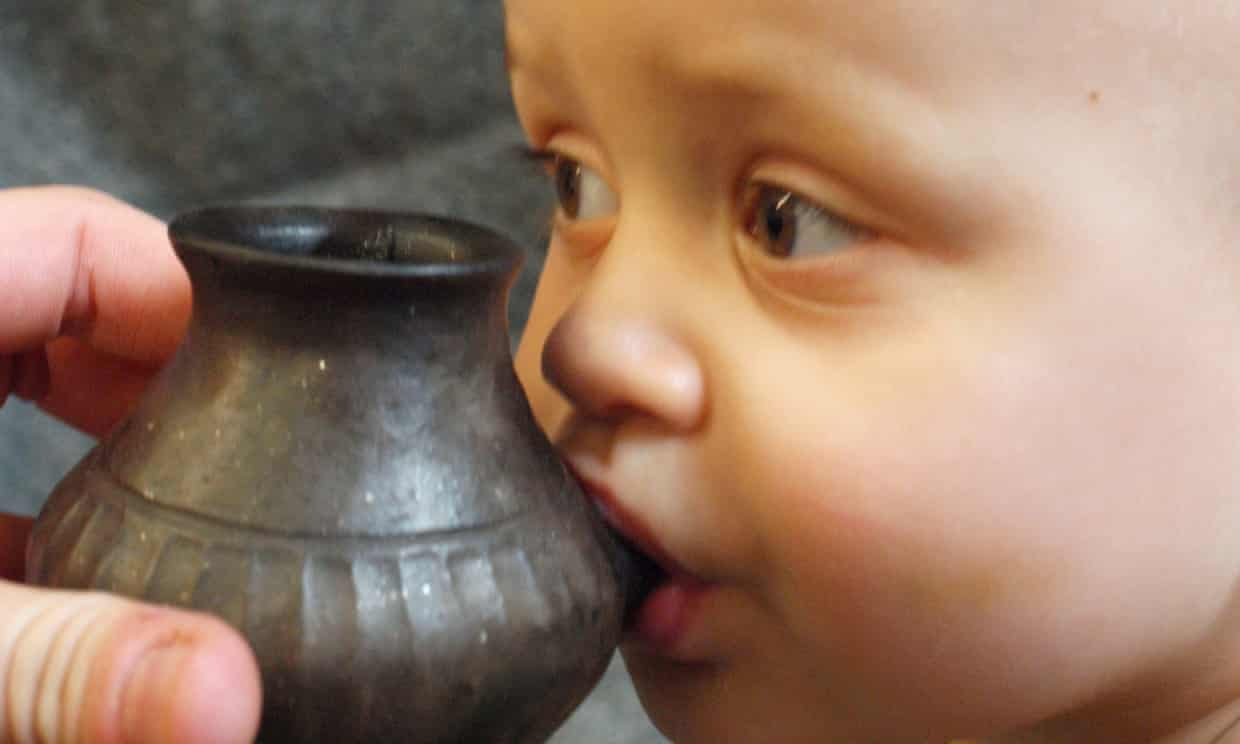
Historic find suggests bottle-feeding not a modern phenomenon

A reconstruction of a baby being fed using a vessel. 
Photograph: Helena Seidl da Fonseca/PA

Babies from prehistoric cultures were fed animal milk in small ceramic pots, according to a study that suggests bottle-feeding is not a modern phenomenon.

The drinking vessels, which were excavated from children’s graves in Bavaria, date to between 450 and 1,200BC. They have teat-shaped spouts, appear designed to be easily held by an older baby or toddler and one is shaped as an imaginary animal, suggesting it may have doubled as a toy.

Julie Dunne, a chemist at the University of Bristol and lead author, said: “These very small, evocative, vessels give us valuable information on how and what babies were fed thousands of years ago, providing a real connection to mothers and infants in the past.”

Read the rest of this article...
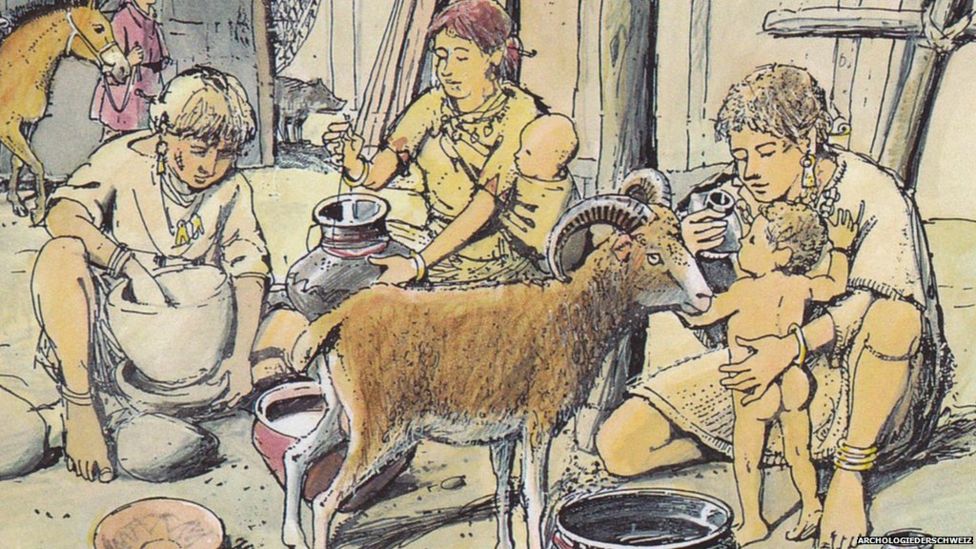
Prehistoric babies fed animal milk in bottles

Prehistoric family scene ARCHOLOGIEDERSCHWEIZ

Prehistoric babies were bottle-fed with animal milk more than 3,000 years ago, according to new evidence.

Archaeologists found traces of animal fats inside ancient clay vessels, giving a rare insight into the diets of Bronze and Iron Age infants.

The discovery suggests milk was given to infants to supplement breast feeding and could have contributed to a baby boom.

The type of milk is unknown, but goats or cows are likely suspects.

This is the first direct evidence for how prehistoric infants were fed, said Dr Julie Dunne of the University of Bristol, adding that the practice could have boosted fertility.

Read the rest of this article...

Wednesday, September 25, 2019

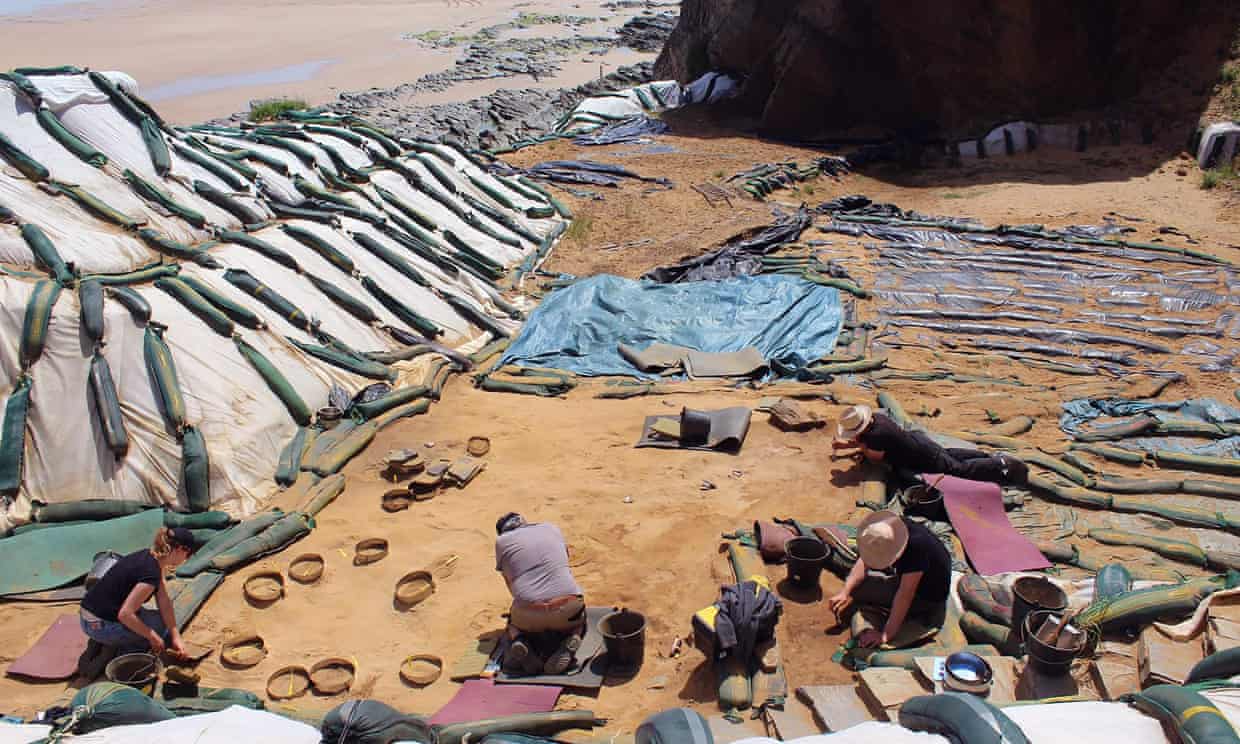
Neanderthal footprints found in France offer snapshot of their lives

The excavation site of the footprint layer in Le Rozel, France. 
Photograph: Dominique Cliquet/AFP/Getty Images

Scientists find 257 prints that were preserved in wind-driven sand 80,000 years ago

Scientists have found hundreds of perfectly preserved footprints, providing evidence that Neanderthals walked the Normandy coast in France.

The prints suggest a group of 10-13 individuals, mostly children and adolescents, were on the shoreline 80,000 years ago.

Neanderthals, the closest evolutionary cousins to present-day humans and primates, have long been thought to have lived in social groups, but details have been hard to establish.

The 257 footprints discovered at Le Rozel in western France give a snapshot of how Neanderthals lived and suggest they may have been taller than previously thought.

Read the rest of this article...

Giving birth two million years ago was 'relatively easy'

Human childbirth can be a long, painful, drawn-out process, needing assistance 
and sometimes taking days. GETTY IMAGES

Human childbirth can be a long, painful, drawn-out process, needing assistance and sometimes taking days.

So why do close living relatives like chimps have an easier labour, giving birth in hours and on their own?

In an attempt to answer this evolutionary question, scientists have been looking at how ancient members of the human family tree gave birth.

Human-like relatives two million years ago had it "pretty easy", according to birth reconstruction in a fossil.

For Australopithecus sediba, which lived 1.95 million years ago in South Africa, we see "a relatively easy birth process", says study researcher Dr Natalie Laudicina.

"The foetal head and shoulder breadth have ample space to pass through even the tightest dimensions of the maternal birth canal," she says.

Read the rest of this article...

Monday, September 16, 2019

Earliest direct evidence of milk consumption

The evidence comes from dental plaque from Neolithic remains
SOPHY CHARLTON / DORSET COUNTY MUSEUM

Scientists have discovered the earliest direct evidence of milk consumption by humans.

The team identified milk protein entombed in calcified dental plaque (calculus) on the teeth of prehistoric farmers from Britain.

It shows that humans were consuming dairy products as early as 6,000 years ago - despite being lactose intolerant.

This could suggest they processed the raw milk into cheese, yoghurt or some other fermented product.

This would have reduced its lactose content, making it more palatable.

The team members scraped samples of plaque off the teeth, separated the different components within it and analysed them using mass spectrometry.

They detected a milk protein called beta-lactoglobulin (BLG) in the tartar of seven individuals spanning early to middle Neolithic times.

Read the rest of this article...
Wednesday, August 14, 2019

Ancient Tombs Unearthed in Nemea, Greece Shed Light on Mycenaean Civilization

Aerial view of the road and the chamber of the two tombs in the eastern part of the Mycenaean cemetery at Aidonia, along with the tombs from the old excavation.
Source: Ephorate of Antiquities of Corinth

The Greek Ministry of Culture announced on Sunday that archaeologists have discovered two ancient, unlooted chamber tombs dating from the Late Mycenaean period, (1400 – 1200 BC), near Nemea in the Peloponnesian Peninsula.

The newly-found tombs at the Aidonia burial site include five full burials and the skeletons of fourteen individuals whose remains had been transferred there from other tombs.

The finds will shed more light on the Mycenaean civilization, the Greek Culture Ministry announced.

Both chamber tombs provided an array clay pots and figurines to the discoverers, as well as other small objects.

Read the rest of this article...

Monday, August 12, 2019

Archaeology Dig to start at Iron Age site in Caithness

Aerial view of the Swartigill site. Photo: Bobby Friel @Takethehighview

The University of the Highlands and Islands Archaeology Institute, in partnership with the Yarrows Heritage Trust, are preparing for a fourth season of excavation at the Burn of Swartigill in Thrumster, Caithness, Scotland.

Previous seasons of excavation at the site have uncovered a complex of Iron Age structures, which are providing an important window into Iron Age society away from the monumental architecture of the Brochs.

This season the team led by Rick Barton from ORCA Archaeology hope to continue to reveal the extent of some of these structures so that they can better understand just how complex the site is. We will also be aiming to recover more information about what life was like for the Iron Age people who lived there two thousand years ago. Analysis of the precious remnants of people’s day to day lives will not only help us to understand the environment and economy of the site at the Burn of Swartigill, but also potentially that of Iron Age Scotland in a much broader context.

Read the rest of this article...

Sunday, August 11, 2019

Ancient Greek skull found in Turkey shows evidence of neurosurgery performed 2,200 years ago

Credit: AA

Archaeologists carrying out excavations at the ancient Greek city of Euromus dating to the 5th century BC, in the area now occupied by Turkey found a skull with marks indicating that neurosurgery existed 2,200 years ago.

The Anadolu News Agency reports that the skull was found in a burial chamber during new excavations led by Turkish archaeologist Abuzer Kizil found that brain surgery was performed on one of the skulls belonging to an adult male.

“We believe this surgery was performed due to a headache or a problem that had to do with the skull,” Kizil said.

Read the rest of this article...

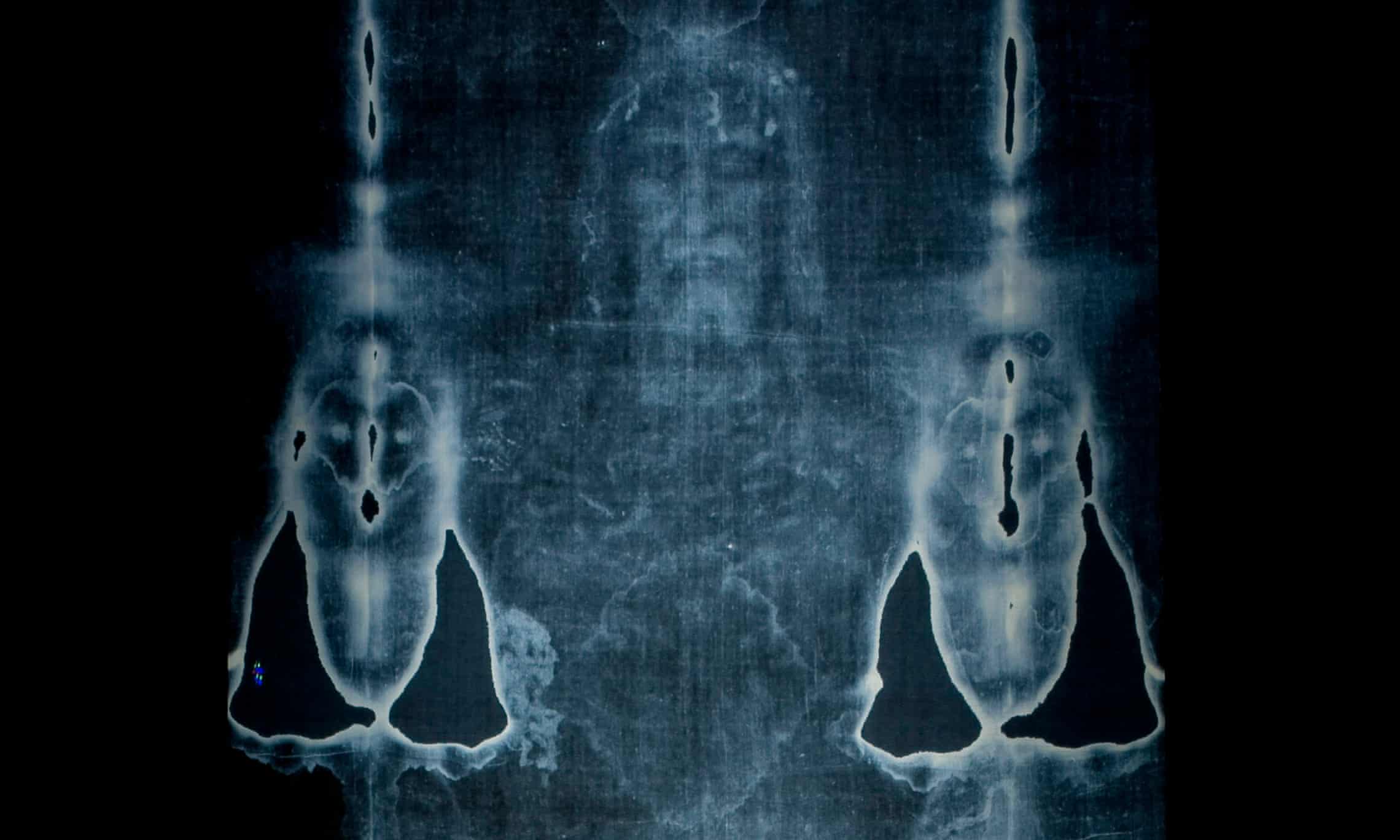
‘Perhaps the most important isotope’: how carbon-14 revolutionised science

A photographic reproduction of the Turin shroud. 
Photograph: Jorge Guerrero/AFP/Getty Images

The discovery that carbon atoms act as a marker of time of death transformed everything from biochemistry to oceanography – but the breakthrough nearly didn’t happen

Martin Kamen had worked for three days and three nights without sleep. The US chemist was finishing off a project in which he and a colleague, Sam Ruben, had bombarded a piece of graphite with subatomic particles. The aim of their work was to create new forms of carbon, ones that might have practical uses.

Exhausted, Kamen staggered out of his laboratory at Berkeley in California, having finished off the project in the early hours of 27 February 1940. He desperately needed a break. Rumpled, red eyed and with a three-day growth of beard, he looked a mess.

And that was unfortunate. Berkeley police were then searching for an escaped convict who had just committed several murders. So when they saw the unkempt Kamen they promptly picked him up, bundled him into the back of their patrol car and interrogated him as a suspected killer.

Thus one of most revolutionary pieces of research undertaken in the past century was nearly terminated at birth when one of its lead scientists was accused of murder. It was only when witnesses made it clear that Kamen was not the man the police were after that he was released and allowed to go back to the University of California Radiation Laboratory to look at the lump of graphite that he and Ruben had been irradiating.

Read the rest of this article...

Thursday, August 8, 2019

Archaeologists discover almost 40 new monuments close to Newgrange

The site of one of the newly discovered monuments found near Newgrange. 
Credit: University College Dublin

A team from University College Dublin have unearth almost 40 previously unknown monuments close to Newgrange, including a "spectacular" monument that aligns with the Winter Solstice sunrise.

The findings likely range from the Neolithic period (4000 BC), through the Bronze Age (2500 BC), and the early Middle Ages.

The monument aligned with the Winter Solstice sunrise is believed to be around 200—300 years newer than the Stone Age passage tomb at Newgrange, dated around 3200 BC, and was discovered in a field just metres from the famous site.

Dr. Steve Davis and a team from the UCD School of Archaeology used a large-scale geophysical imaging system to reveal the new monuments as a part of a joint project with the Romano-Germanic Commission.

"These methods have in the last few years changed our understanding of the Brú na Bóinne landscape beyond all recognition," Dr. Davis said.

Read the rest of this article...

Monday, August 5, 2019

Archaeologists find rare Stone Age graves in Germany


Archaeologists have discovered 25 rare Stone Age graves in the district of Borde, north of the city of Magdeburg in eastern Germany, according to project director Susanne Friederich of the Ludwig-Maximilian University in Munich.

Friederich said the 6,500-year-old find near Wedringen is a cremation cemetery of the so-called Central European Rossen culture.

This is a peculiarity, since in this culture the dead were normally buried in the earth. "They are not tombs with urns, but the holes of the tombs have a size that corresponds to the burials of entire bodies," said Friederich.

Instead of a complete skeleton, the archaeologists found only fragments of cremated corpses. The dead were burned with their personal belongings. This was evidenced by stone axes cracked by the effect of heat

Read the rest of this article...

The road to Scandinavia's bronze age: Trade routes, metal provenance, and mixing


The geographic origins of the metals in Scandinavian mixed-metal artifacts reveal a crucial dependency on British and continental European trading sources during the beginnings of the Nordic Bronze Age, according to a study published July 24, 2019 in the open-access journal PLOS ONE by Heide W. Nørgaard from Aarhus University, Denmark, and colleagues.

2000-1700BC marks the earliest Nordic Bronze Age, when the use and availability of metal--specifically tin and copper, which when alloyed together creates bronze--increased drastically in Scandinavia. The authors performed isotope and trace-element analyses on 210 Bronze Age artifact samples, predominantly axeheads, originally collected in Denmark and representing almost 50% of all known existing Danish metal objects from this period.

Read the rest of this article...

Bronze Age children’s cemetery uncovered near Kilcreggan

Sandra Kelly was uncovering a stone coffin yesterday

Archaeologists have uncovered a series of graves dating back over 3,000 years at a site on the Rosneath Peninsula.

They found six graves so far, as well as pottery and a bead.

The team from the North Clyde Archaeological Society have worked on remains from three periods on the site at Portkil near Kilcreggan – military installations and roads from before World War One, a lime kiln from the late 18th or early 19th century and a series of Bronze Age burials and artefacts.

They have been working since November and are currently uncovering a stone coffin.

The society’s vice chair Tam Ward said it was relatively commonplace to find individual graves from the Bronze Age, but the number and combination at Portkil was unusual.

Read the rest of this article...

Thursday, August 1, 2019

Standing stones uncovered near important archaeological site

This view of the site shows the alignment of the standing stones that have been found.
(SBMA-ARIA SA.)

Six aligned standing stones have been discovered on a building site in Sion, southwest Switzerland, in what local authorities call an important archaeological find.   

“This discovery is of prime importance to help us understand social rituals at the end of the Neolithic period (around 2,500BC) in central Europe,” says a press releaseexternal link from canton Valais’s buildings, monuments and archaeology department.   

The find was made by chance during work for a new residential building in the Petit-Chasseur quarter of the cantonal capital Sion. This is the same area where, in the 1960s, several dolmens (collective tombs) and some 30 standing stones were found.  

Three of the recently found standing stones are engraved with markings. The biggest find is a stone weighing nearly two tonnes bearing a representation of a male figure wearing geometrically patterned clothing and with a sun-like motif around his face.   

Read the rest of this article...
Monday, July 29, 2019

Slovakia/Thousands of years old traces of human presence found in Tatra cave


Source: Prof. Paweł Valde-Nowak

Researchers including Polish archaeologists discovered 14-15 thousand years old traces of human presence in the Hučava Cave in the Belianske Tatras. These are stone blades used by hunters. Until now, no prehistoric items have been found in any of the Tatra caves.

The discovery was made in July by a Slovak-Polish archaeological expedition. The Hučava Cave (Hučivá diera) is located in the Belianske Tatras in Slovakia, on the slopes of Kobylí Vrch, at 937 m a.s.l. Excavations are being carried out both at the entrance and in the cavern chamber.

"We have discovered dozens of stone blades that have survived completely or in fragments, originally embedded on poles (that have not survived until our time). We recovered some of the blades from the remnants of a hearth" - says Prof. Paweł Valde-Nowak from the Institute of Archaeology of the Jagiellonian University in Kraków. Valde-Nowak leads the research project together with Dr. Marian Sojak from the Institute of Archaeology of the Slovak Academy of Sciences in Nitra.


Read the rest of this article...

10,000-year-old engraved 'pebble' found near Rome said to be earliest known lunar calendar

The 10,000-year-old pebble which is believed to be the oldest lunar calendar in the world
[Credit: Sapienza Universita di Roma]

The oldest known lunar calendar may be an engraved pebble dating back to the Upper Palaeolithic found in Velletri, in the Alban Hills, south of Rome. The news has been announced by Flavio Altamura, a researcher at the Department of Antiquities of Sapienza University, who analyzed this enigmatic object in collaboration with the Superintendency for Archaeology, Fine Arts and Landscape in the Rome Metropolitan Area, the Province of Viterbo and Southern Etruria. The results of this study have been published in the Journal of Archaeological Science: Reports.

"The study reveals," explains Flavio Altamura, "that the notches were made over time using more than one kind of sharp cutting stone tool, as if they had been used for counting and calculating, or to store some kind of information over a period of time.”

Read the rest of this article...

Sunday, July 28, 2019

Finds from Celtic grave found in Zurich analyzed

Reconstruction of the grave with tree coffin [Credit: Amt für Städtebau, City of Zurich]

The tree coffin burial of a Celtic woman, which was discovered in March 2017 during construction work on the Kern school building, was examined by the Archaeology City of Zurich in an interdisciplinary evaluation. The bones and the unusual burial objects were carefully documented, salvaged, preserved and evaluated. Thus the grave can be assigned to the Late Iron Age around 200 BC. Of the artefacts that have been found, a string of glass beads in particular is unique in its form: it is fastened between two fibulae (clasps) and fitted with precious glass and amber beads.

The now completed interdisciplinary evaluation of the archaeology department of the city of Zurich paints a fairly accurate picture of the deceased. The examination of the skeleton and especially the teeth shows, among other things, that she died at the age of about 40, did little physical work during her lifetime and probably ate a relatively large amount of starchy or sweetened food.

Read the rest of this article...

Seltene Brandgräber aus der Steinzeit bei Wedringen


Im Zuge des Neubaus der Ortsumfahrung bei Wedringen, Ortsteil von Haldensleben, Ldkr. Börde, führt das Landesamt für Denkmalpflege und Archäologie Sachsen-Anhalt (LDA) derzeit archäologische Ausgrabungen durch. Auf dem aktuellen Abschnitt der Grabungsfläche wurden seltene Brandgräber der Rössener Kultur (ca. 6600–6450 vor heute) entdeckt. Die etwa 25 Grabgruben sind an der dunklen, aschigen Verfüllung gut in dem sie umgebenden Boden erkennbar. Als Beigaben in den Gräbern sind reich verzierte Gefäße sowie Beile und Äxte aus Felsgestein zu finden. Im näheren Umfeld der Brandbestattungen und ohne erkennbaren Befundzusammenhang deponierte Keramikgefäße lassen an ein noch nicht näher zu definierendes Ritual während der Bestattungszeremonie denken.

Read the rest of this article...