Monday, August 20, 2012

Annual dig at Gibraltar's Gorham’s Cave


The annual expert exploration of Gorham’s Cave is well under way, but the access to the potential World Heritage Site is an arduous daily trek for the volunteers, as it was for the local media when they were invited to see what was happening down there. 

No less than 350 steep and broken steps, with a rickety handrail, have to be negotiated, followed by about 100 metres across the rockiest beach imaginable – a ragged mix of boulders, smaller rocks, and fossilised sand, with no clear path through, which now cover the former Governor’s Beach, the rubble having been thrown there during tunnel excavations in the last thirty years 

Our Gibraltar Museum guide, Dr Geraldine Finlayson, told the half-heat-stricken press corps that we were lucky, as the volunteer archaeologists not only have to make the journey twice a day, but they also carry their food, water, equipment, and petrol for the generators down with them, and then lug sacks of samples back up. No wonder they opt to spend their lunch break down there in the shade of the cave’s massive entrance. In fact, all food is eaten outside to avoid contamination of the cave floor.

Sunday, August 19, 2012

Henge found on North Downs from satellite images


Circular earthworks dating back to the stone age have been discovered on the North Downs in Kent.

The henge was found after satellite images were studied by archaeologists.

The circle is about 50m across and archaeologists said bones discovered in the area suggest it was a religious site.

Read the rest of this article...

Study casts doubt on human-Neanderthal interbreeding theory


Cambridge scientists claim DNA overlap between Neanderthals and modern humans is a remnant of a common ancestor

When scientists discovered a few years ago that modern humans shared swaths of DNA with long-extinct Neanderthals, their best explanation was that at some point the two species must have interbred.

Now a study by scientists at the University of Cambridge has questioned this conclusion, hypothesising instead that the DNA overlap is a remnant of a common ancestor of both Neanderthals and modern humans.

When the genetic sequence of Homo neanderthalensis was published in 2010, one of the headline findings was that most people outside Africa could trace up to 4% of their DNA to Neanderthals. This was widely interpreted as an indication of interbreeding between Neanderthals and early Homo sapiens just as the latter were leaving Africa. The two species would have lived in the same regions around modern-day Europe, until Neanderthals died out about 30,000 years ago.

Monmouth site is Bronze Age - archaeologist in row with minister


A MAN who is leading a dig at a site in Monmouth says he's found evidence to dispute claims by a minister who claimed remains there were not Bronze Age.

Steve Clarke of Monmouth Archaeology says latest scientific results from the Parc Glyndwr site shows the area was teeming with prehistoric activity, especially during the bronze ages.

Mr Clarke claims the development refutes comments by heritage minister Huw Lewis that what had been found at the Rockfield Road site was from a later period.

Read the rest of this article...

Friday, August 10, 2012

Neolithic Man: The First Lumberjack?


A polished axe from the PPNB period. American Friends of Tel Aviv University

Transition from hunting to agricultural society parallels development of woodworking tools, TAU research reveals

During the Neolithic Age (approximately 10000–6000 BCE), early man evolved from hunter-gatherer to farmer and agriculturalist, living in larger, permanent settlements with a variety of domesticated animals and plant life. This transition brought about significant changes in terms of the economy, architecture, man’s relationship to the environment, and more.

Now Dr. Ran Barkai of Tel Aviv University‘s Department of Archaeology and Ancient Near Eastern Civilizations has shed new light on this milestone in human evolution, demonstrating a direct connection between the development of an agricultural society and the development of woodworking tools.

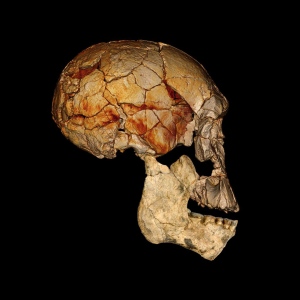
Fossils point to a big family for human ancestors


An upper skull found in 1972 and a newly discovered lower jaw are both thought to belong to the enigmatic hominin species Homo rudolfensis.

Fossilized skulls show that at least three distinct species belonging to the genus Homo existed between 1.7 million and 2 million years ago, settling a long-standing debate in palaeoanthropology.

A study published this week in Nature1 focuses on Homo rudolfensis, a hominin with a relatively flat face, which was first identified from a single large skull in 1972. Several other big-skulled fossils have been attributed to the species since then, but none has included both a face and a lower jaw. This has been problematic: in palaeoanthropology, faces and jaws function like fingerprints for identifying a specimen as a particular species (which is indicated by the second word in a Linnaean title, such as 'rudolfensis'), as opposed to the broader grouping of genus (the first word, as in'Homo').

Without complete skulls, it has been difficult to reach a consensus on whether specimens attributed to H. rudolfensis are genuinely members of a distinct species, or actually belong to other Homo species that lived around the same time, such as Homo habilis or Homo erectus. Understanding how many different Homo species there were, and whether they lived concurrently, would help to determine whether the history of the human lineage saw fierce competition between multiple hominins, or a steady succession from one species to another.

Neue Zweige im Stammbaum des Menschen


Zwei weitere Frühmenschen-Arten in Kenia gefunden


Montage des neu entdeckten Unterkiefer KNM-ER 60000 mit dem Schädel KNM-ER 1470; man nimmt an, dass beide zur selben Art gehören. © Foto: Fred Spoor

Neue Fossilien, die im Osten des Turkana-Sees in Kenia entdeckt wurden, bestätigen nun, dass dort vor zwei Millionen Jahren neben unserem direkten Vorfahren Homo erectus zwei weitere Arten der Gattung Homo lebten.

Die Funde - ein Gesichtsschädel, ein bemerkenswert vollständiger Unterkiefer und der Teil eines zweiten Unterkiefers - werden in der renommierten Fachzeitschrift Nature am 9. August 2012 beschrieben. Ausgegraben wurden die Fossilien zwischen 2007 und 2009 im Rahmen des von Meave und Louise Leakey geleiteten Koobi Fora Forschungsprojekts (Koobi Fora Research Project, KFRP). Fred Spoor, KFRP-Mitglied und Wissenschaftler der Abteilung Humanevolution am Max-Planck-Institut für evolutionäre Anthropologie koordinierte die wissenschaftlichen Untersuchungen der Fossilien. Zahlreiche Analysen wurden in Leipzig durchgeführt, darunter auch die virtuelle Rekonstruktion der neuen Funde mittels modernster Computertechnologie. 

Monday, August 6, 2012

Volcanic cryptotephra gives clues to Neanderthal demise

Invisible to the human eye, cryptotephra is a fine volcanic glass that is blasted out of erupting volcanoes along with ash. It leaves behind a hidden layer, in the earth, which has now been detected, giving clues about why the Neanderthals died out.

About 40,000 years ago, a layer of cryptotephra particles carpeted a huge area of Central and Eastern Europe after a massive volcanic eruption in Italy called the Campanian Ignimbrite (CI). This eruption, and the resulting environmental and climatic disruption, has been suggested as a factor in the extinction of the Neanderthals.

Interaction with us, modern humans, is one of the other possibilities. Neanderthals, who were our closest relatives, had been living in Europe for hundreds of thousands of years. But all physical evidence of them disappears after about 30,000 years ago. Early modern humans were known to have arrived in Europe at least 35,000 years ago, having originated in Africa, but precise dates, and the length of time they overlapped with the last Neanderthals, are unclear.

Soldiers uncover 27 ancient bodies on Salisbury Plain


All the burials at the mound, which was under attack from burrowing badgers, were excavated by soldiers from The Rifles

Soldiers have unearthed 27 bodies during an archaeological dig on Salisbury Plain.

Troops from The Rifles, injured in Afghanistan, were excavating the 6th Century burial site at Barrow Clump, as part of a programme of rehabilitation.

The bodies, including Anglo-Saxon warriors, had been buried with a range of personal possessions.
Rifleman Mike Kelly said: "As a modern day warrior, unearthing the remains... fills me with overwhelming respect."

Sunday, August 5, 2012

Silchester Iron Age finds reveal secrets of pre-Roman Britain


By the gap in a hedge bordering the entrance off a muddy lane in Hampshire, the young diggers on one of the most fascinating archaeological sites in Britain have made a herb garden: four small square plots. The sudden blast of sunshine after months of heavy rain has brought everything into bloom, and there’s a heady scent of curry plant and dill, marigold and mint.

Many of the plant seeds are familiar from Roman sites across Britain, as the invaders brought the flavours and the medical remedies of the Mediterranean to their wind-blasted and sodden new territory, but there is something extraordinary about the seeds from the abandoned Iron Age and Roman town of Silchester.

The excavation run every summer by Dr Amanda Clarke and Professor Michael Fulford of the archaeology department at Reading University, using hundreds of volunteer students, amateurs and professionals, now in its 15th season, is rewriting British history.

The banal seeds are astonishing because many came from a level dating to a century before the Romans. More evidence is emerging every day, and it is clear that from around 50BC the Iron Age Atrebates tribe, whose name survived in the Latin Calleva Atrebatum, the wooded place of the Atrebates, enjoyed a lifestyle that would have been completely familiar to the Romans when they arrived in AD43.

Wednesday, August 1, 2012

Brewing Stone Age beer


Jørn Kragtorp (left) and Manfred Heun brew beer from the primitive wheat known as einkorn. Here they are adding a malt of einkorn, ready to start the brewing process. (Photo: Asle Rønning)

Beer enthusiasts are using a barn in Norway’s Akershus County to brew a special ale which has scientific pretensions and roots back to the dawn of human culture.

The beer is made from einkorn wheat, a single-grain species that has followed humankind since we first started tilling the soil, but which has been neglected for the last 2,500 years.

“This is fun − really thrilling. It’s hard to say whether this has ever been tried before in Norway,” says Jørn Kragtorp.

He started brewing as a hobby four years ago. He represents the fourth generation on the family farm of Nedre Kragtorp in Aurskog-Høland, Akershus County.

Later Stone Age got earlier start in South Africa than thought


New research led by CU-Boulder on South Africa's Border Cave shows the Later Stone Age emerged more than 20,000 years than previously thought [Credit: Courtesy Paola Villa, University of Colorado] 

The Later Stone Age emerged in South Africa more than 20,000 years earlier than previously believed -- about the same time humans were migrating from Africa to the European continent, says a new international study led by the University of Colorado Boulder. 

The study shows the onset of the Later Stone Age in South Africa likely began some 44,000 to 42,000 years ago, said Paola Villa, a curator at the University of Colorado Museum of Natural History and lead study author.  The new dates are based on the use of precisely calibrated radiocarbon dates linked to organic artifacts found at Border Cave in the Lebombo Mountains on the border of South Africa and Swaziland containing evidence of hominid occupation going back 200,000 years. 

The Later Stone Age is synonymous to many archaeologists with the Upper Paleolithic Period, when modern humans moved from Africa into Europe roughly 45,000 years ago and spread rapidly, displacing and eventually driving Neanderthals to extinction. The timing of the technological innovations and changes in the Later Stone Age in South Africa are comparable to that of the Upper Paleolithic, said Villa.

Giant Neo-Hittite sculpture unearthed in Turkey


Side view of the Suppiluliuma statue [Credit: Jennifer Jackson]

A beautiful and colossal human sculpture is one of the latest cultural treasures unearthed by an international team at the Tayinat Archaeological Project (TAP) excavation site in southeastern Turkey. A large semi-circular column base, ornately decorated on one side, was also discovered. Both pieces are from a monumental gate complex that provided access to the upper citadel of Kunulua, capital of the Neo-Hittite Kingdom of Patina (ca. 1000-738 BC). 

"These newly discovered Tayinat sculptures are the product of a vibrant local Neo-Hittite sculptural tradition," said Professor Tim Harrison, the Tayinat Project director and professor of Near Eastern Archaeology in the University of Toronto's Department of Near and Middle Eastern Civilizations. "They provide a vivid glimpse into the innovative character and sophistication of the Iron Age cultures that emerged in the eastern Mediterranean following the collapse of the great imperial powers of the Bronze Age at the end of the second millennium BC."

Sunday, July 29, 2012

17,500-Year-Old Ceramic Figures Unearthed in Croatia


36 ceramics artifacts found at the archaeological site of Vela Spila, Croatia (Rebecca Farbstein / PLoS ONE)

An international team of archaeologists has uncovered the first evidence of ceramic figurative art in late Upper Paleolithic Europe – from about 17,500 years ago, thousands of years before pottery was commonly used.

The evidence of a community of prehistoric artists and craftspeople who ‘invented’ ceramics during the last Ice Age has been found at the archaeological site of Vela Spila, Croatia.

The finds consist of 36 fragments, most of them apparently the broken-off remnants of modeled animals, and come from the site on the Adriatic coast. The archaeologists believe that they were the products of an artistic culture which sprang up in the region about 17,500 years ago. Their ceramic art flourished for about 2,500 years, but then disappeared.

Friday, July 27, 2012

Archaeologists uncover Palaeolithic ceramic art


Leg and torso from the model of a four-legged animal, possibly a deer or horse. This is one of 36 ceramic items recovered from Vela Spila, Croatia. Credit: Rebecca Farbstein

Evidence of a community of prehistoric artists and craftspeople who “invented” ceramics during the last Ice Age – thousands of years before pottery became commonplace – has been found in modern-day Croatia.

The finds consist of 36 fragments, most of them apparently the broken-off remnants of modelled animals, and come from a site called Vela Spila on the Adriatic coast. Archaeologists believe that they were the products of an artistic culture which sprang up in the region about 17,500 years ago. Their ceramic art flourished for about 2,500 years, but then disappeared. 

The study, which is published in the journal PLoS ONE, adds to a rapidly-changing set of views about when humans first developed the ability to make ceramics and pottery. Most histories of the technology begin with the more settled cultures of the Neolithic era, which began about 10,000 years ago.
Leg and torso from the model of a four-legged animal, possibly a deer or horse. This is one of 36 ceramic items recovered from Vela Spila, Croatia. Credit: Rebecca Farbstein

Read more at: http://phys.org/news/2012-07-archaeologists-uncover-palaeolithic-ceramic-art.html#jCp

Thursday, July 26, 2012

6,500 year old hunting trophy found in eastern Croatia


Archaeologists in Bapska, eastern Croatia have stumbled across 6,500 year old deer antlers. The hunting trophy was found hanging on the wall of prehistoric house along with valuable items of jewellery, writes website dalje.com.

"We have the oldest deer hunting trophy in Croatia," said Marcel Buric, the head researcher at the Department of Prehistoric Archaeology of the Faculty of Philosophy in Zagreb.

According to Buric, local hunters from Bapska have estimated that the deer, where the antlers trophy has come from, would have weighed between 220 and 250 kilograms and would have been extremely strong due to its 12 antlers.

Tuesday, July 24, 2012

Archaeologists to dig at Bronze Age site near Peterborough


Archaeologists are hoping to find clues about an ancient timber structure at Flag Fen Credit: ITV Central
Archaeologists are to dig at a Bronze Age site near Peterborough for the first time in 10 years. 

They are hoping to find clues about an ancient timber structure at Flag Fen. 

In previous digs they found the UK's oldest wheel and gold rings more than 3,500 years old.

News Science Archaeology House of the Telephus Relief: raising the roof on Roman real estate


Buried by Vesuvius nearly 2,000 years ago, archaeologists at Herculaneum have excavated and carried out the first-ever full reconstruction of the timber roof of a Roman villa

 With several dozen rooms, the House of the Telephus Relief was 'top-level Roman real estate'. Photograph: Art Archive/Alamy

For almost two millennia, the piles of wood lay undisturbed and largely intact under layers of hardened volcanic material. Now, after three years of painstaking work, archaeologists at Herculaneum have not only excavated and preserved the pieces, but worked out how they fitted together, achieving the first-ever full reconstruction of the timberwork of a Roman roof.

With several dozen rooms, the House of the Telephus Relief was "top-level Roman real estate", said Andrew Wallace-Hadrill, the director of the Herculaneum Conservation Project (HCP). It was more of a palace or mansion, thought to have been built for Marcus Nonius Balbus, the Roman governor of Crete and part of modern-day Libya, whose ostentatious tomb was found nearby.

The most lavishly decorated part of the immense residence was a three-storey tower. On the top floor was a nine-metre high dining room with a coloured marble floor and walls, a suspended ceiling and a wrap-around terrace. It offered the owners and their dinner guests a heart-stopping view across the silver-blue Bay of Naples to the islands of Ischia and Capri.

Sunday, July 22, 2012

Neanderthals Self-Medicated?

Tartar remains on teeth reveal traces of herbs, veggies, study says.

 Neanderthals may have been gatherers and hunters (file picture of a model of a Neanderthal woman).

A cave in northern Spain that previously yielded evidence of Neanderthals as brain-eating cannibals now suggests the prehistoric humans ate their greens and used herbal remedies.

A new study of skeletal remains from El Sidrón cave site in Asturias (map) detected chemical and food traces on the teeth of five Neanderthals. (Take a Neanderthal quiz in National Geographic magazine.)

Tartar samples from the 50,000-year-old teeth revealed microscopic plant starch granules, which had cracks indicating the plants had been roasted first. Further chemical analysis revealed compounds associated with wood smoke.

Friday, July 20, 2012

Neanderthals' macho image may be wrong


Neanderthals have traditionally been seen as a race of macho hunters but in reality they spent much of their time carrying out domestic chores, a study has found. 

The primitive men, who became extinct about 30,000 years ago after human ancestors arrived in Europe from Africa, were presumed to have spent most of their time hunting prey. 
But a new study suggests that their daily lives were in fact much more mundane, with tedious tasks like processing animal skins to make clothing accounting for several hours of each day.