Saturday, February 16, 2013

EMAS Easter Study Tour to Yorkshire


There are still a few places available on the Easter archaeological study tour to Yorkshire.

The Study Tour is organized by EMAS, the University of London Extra-Mural Archaeological Society, and is open to any one.

You can find further details here...

Friday, February 15, 2013

Swiss dolmen reveals rituals of the Neolithic


The dolmen during the early stages of excavation with the massive capstone in situ. (Source: ADB)

Asensational archaeological discovery has been made in the region of  Bern, Switzerland, consisting of a communal dolmen grave dating back to over 5,000 years, containing 30 bodies and Neolithic artefacts. It represents the first intact burial chamber to be found north of the Alps.


Unexpected discovery

In October 2011, specialists from the Archaeological Service of the Canton of Bern began investigation of the large granite slab weighing in at 7 tonnes. The glacial erratic measured 3 metres long, 2 metres wide and was nearly 1 metre thick – what they did not realise at first was that it still covered a grave belonging to a Neolithic community.

The site was originally found when a farmer decided to try and remove the glacial boulder that he had to mow around when cutting grass in his field.

The boulder is from the last glacial maximum – some 20,000 years ago – and used by the early farmers during the 4th millennium BCE for burial purposes.


Read the rest of this article...

Didcot dig: A glimpse of 9,000 years of village life


The archaeological trenches can still be seen at the site where the builders are now working


When archaeologists began digging the fields in 2010 they knew it was a site of historical interest, but even they were surprised by the wealth of ancient finds their trowels unveiled.

Back in 1995, a hoard of 400 Roman coins was discovered west of Didcot in Oxfordshire, indicating the land had been lived on for centuries.

As plans progressed for 3,300 new homes, schools and shops on the 180-hectare site, archaeologists were called in to investigate.

It has taken them nearly three years to excavate 30 hectares, but they now know people have been living in Didcot for about 9,000 years - since the end of the last ice age.


Read the rest of this article...

Battered Skulls Reveal Violence Among Stone Age Women


Skulls from a forensic anthropology lab.
CREDIT: David Hunt, North Carolina State University                                             


  Stone Age farmers lived through routine violence, and women weren't spared from its toll, a new study finds.

The analysis discovered that up to 1 in 6 skulls exhumed in Scandinavia from the late Stone Age — between about 6,000 and 3,700 years ago — had nasty head injuries. And contrary to findings from mass gravesites of the period, women were equally likely to be victims of deadly blows, according to the study published in the February issue of the American Journal of Physical Anthropology.

Linda Fibiger, an archaeologist at the University of Edinburgh in Scotland, and her colleagues focused on the late Stone Age, when European hunter-gatherers had transitioned into farming or herding animals.


Read the rest of this article...

Friday, February 8, 2013

Early Humans in Southeast Europe Were of a Different Sort, Say Researchers


Newly conducted dating of a human mandible fossil discovered in 2008 in the Mala Balanica cave in southern Serbia has revealed that the human species to which it belonged featured a morphology (form and structure) that significantly departed from the pattern of features of early humans who inhabited what is today Western Europe during the same time period.
Considered a remain from what is now suggested to be the oldest hominin (human-related) species found in the Balkans of Eastern Europe, its age is now placed between 397,000 and 525,000 years old based on the application of electron spin resonance (ESR), uranium series isotoptic analysis and infrared/post infrared luminescence dating. These cutting-edge dating techniques are thought, used in combination in this instance, to provide a highly reliable date range for the fossil found. The new testing and study* was conducted by an international team of researchers that included William Jack Rink of McMaster University, Canada, Dušan Mihailović, University of Belgrade, Serbia, and Mirjana Roksandic, University of Winnipeg, Canada. Mihailović and Roksandic were both involved in the initial discovery of the ancient mandible (scientifically labeled "BH-1") in 2008. The new date range corresponds to a time when a human species called Homo heidelbergensis was present in Western Europe and an early stage in Neanderthal evolution. Homo heidelbergensis is suggested by many scientists to be a possible progenitor to Neanderthals or humans, or possibly a common ancestor.

Read the rest of this article...

Prehistoric rock art found in Scottish Highlands


One of the 28 stones on Swordale Hill which bear Bronze Age cupmarks [Credit: STV News]

An archaeologist has uncovered the biggest collection of ancient rock art in the Highlands. Douglas Scott, 64, of Tain, Ross-shire, discovered a circle of 28 carved rocks which date back 5000 years while combing a 200-metre hillside farm in Evanton.

Mr Scott reckons the stones, which have cup-marked shapes cut into them, represent one of the biggest collections of ancient rock art ever found in Scotland. He revealed he only visited the site, on Swordale Hill, Evanton, after one of his close friends died.

Mr Scott said: "I was first invited up the hill over 25 years ago by a friend of mine who was an archaeologist called Bob Gourlay.


Read the rest of this article...

Wednesday, February 6, 2013

Ice Age Art at the British Museum: 'Not even Leonardo surpassed this'


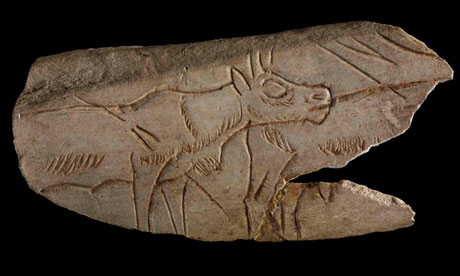
Human bodies in this show are overwhelmingly abstract, while animals are portrayed with gobsmacking accuracy … an image of a reindeer, carved into a reindeer bone, from Ice Age Art at the British Museum in London


I am looking at women with floppy breasts, massive hips and eyeless faces. Their bodies are deeply alien – disturbing in their total lack of what the modern world sees as desirable. Nearby, the British Museum has installed two nudes by Matisse, in one of many attempts in this exhibition to draw parallels between the earliest art and that of our own era. But this comparison just adds to the unease. To put it in language no archaeologist is likely to use: the curves of a Matisse woman are sexy; the bulges and blanknesses of these nudes, carved from ivory in central Europe 30,000 years ago, are not.
Then something catches my eye: a sculpture of a bison, created 21,000 years ago. It's so real, so alive, I can almost hear it snort and stamp. It has the same magical presence, the same thrilling realism, as cave paintings I've seen, also dating back to the ice age: images of mammoths, horses, bison. So why did the same artists choose to depict humans with such bizarre abstraction? It is one of the mysteries that make this show so eerie and thought-provoking.

Read the rest of this article...

Tuesday, February 5, 2013

Neanderthal extinction earlier than thought


Neanderthals may have become extinct in Europe some ten thousand years earlier than scientists currently think, a new radiocarbon dating study suggests.
Over the past 20 years, it has become widely accepted that the Iberian peninsula - modern day Spain and Portugal - served as a kind of refuge for the last remaining Neanderthals, who survived there five or ten thousand years longer than they did elsewhere in Europe.
Much of the evidence for this hypothesis came from radiocarbon dating of material found in caves associated with Neanderthal fossils or the particular kinds of stone tools, known to archaeologists as Mousterian, which are closely associated with the species.
North of the Ebro valley which crosses northern Spain, scientists previously found that evidence of Neanderthals disappeared around 42,000 years ago when anatomically modern humans arrived. South of that valley, it appeared, Neanderthals survived until 36,000 years ago with little evidence of modern humans.

Read the rest of this article...

Neanderthals 'unlikely to have interbred with human ancestors'


A model of a Neanderthal man from a museum in Mettmann, Germany. Traces of neanderthal DNA can be found in humans today. Photograph: Jochen Tack/Alamy


A new finding has cast doubt on the theory that ancestors of modern humans interbred with Neanderthals over thousands of years. Scientists have re-dated fossil bones from two sites in southern Spain and discovered they are much older than previously thought.
According to the new evidence, it is unlikely Neanderthals and modern humans ever lived together in the region. Researchers now think the Neanderthals had long gone before the arrival of the first Homo sapiens.
Since the 1990s experts have believed the last Neanderthals sought refuge in the Spanish peninsula and died out around 30,000 years ago. That would have provided easily enough time for the Neanderthals to mix their DNA with that of modern humans, who are believed to have colonised Spain more than 10,000 years earlier.

Read the rest of this article...

Australians shed new light on Neanderthals


A reconstructed Neanderthal skeleton, right, with a modern human skeleton. Photo: AP

Australian scientists have re-dated a collection of Neanderthal bones from southern Europe and found they are about 10,000 years older than first thought.

The new evidence means many of the region's Neanderthal specimens may be much older than previous studies suggest, and casts doubt on the date archaeologists believe the human subspecies became extinct.

Since the early 1990s several research groups have claimed to have radio-carbon dated some of the youngest Neanderthal bones, several just 32,000 years old, in a region known as Iberia, modern Spain and Portugal.
But the leader of the new research, Rachel Wood, said many archaeologists were not convinced of the specimens' ages.


Read the rest of this article...

Monday, February 4, 2013

Iron Age skull found at Scottish golf course


Police were called to this spot at Musselburgh Links Golf Course, on the race course where bones have been found [Credit: East Lothian News]

A skull unearthed during maintenance work at Musselburgh’s world famous Old Links is believed to be that of a young Iron Age woman.

Police were called to the historic nine-hole golf course last Tuesday after council workers dug up human remains while repairing a bunker at the fourth green, close to Mrs Forman’s pub.

The police investigation was halted after initial forensic tests confirmed that the skull had not been buried recently.

Subsequent tests by East Lothian Council’s archaeology officers showed the find to date back more than 2,000 years.


Read the rest of this article...

Saturday, February 2, 2013

Ice Age Lion Man is world’s earliest figurative sculpture


40,000 years old: Lion Man sculpture. Photo: Thomas Stephan, © Ulmer Museum


Work carved from mammoth ivory has been redated and 1,000 new fragments discovered—but it won’t make it to British Museum show
The star exhibit initially promised for the British Museum’s “Ice Age Art” show will not be coming—but for a good reason. New pieces of Ulm’s Lion Man sculpture have been discovered and it has been found to be much older than originally thought, at around 40,000 years. This makes it the world’s earliest figurative sculpture. At the London exhibition, which opens on 7 February, a replica from the Ulm Museum will instead go on display.

The story of the discovery of the Lion Man goes back to August 1939, when fragments of mammoth ivory were excavated at the back of the Stadel Cave in the Swabian Alps, south-west Germany. This was a few days before the outbreak of the Second World War. When it was eventually reassembled in 1970, it was regarded as a standing bear or big cat, but with human characteristics.


Read the rest of this article...

Thursday, January 31, 2013

Snail shells yield ancient climate clues


An old wives' tale that snails can be a sign of changing weather should not be dismissed out of hand, European researchers say, as they may give climate clues.


Snails climbing a plant or post supposedly means rain is coming, the tale goes, but a study led by the University of York in Britain goes one better: It shows snails can provide a wealth of information about the prevailing weather conditions thousands of years ago.

Analysis of the chemistry of snail shells recovered from Mediterranean caves, and dating back as far as 9,000 years, shows the western Mediterranean was not the hot dry place it is now but warmer, wetter and stickier, a university release reported Wednesday.

Archaeological sites around the Mediterranean basin from the time when the first farmers arrived in Italy and Spain contain an abundance of land snail shell remains, the researchers said.


Read the rest of this article...
Harvard Uses 3-D Printing to Replicate Ancient Statue


Joseph Greene, (right) Assistant Director, Semitic Museum and Adam Aja, Assistant Curator of Collections, Semitic Museum discuss the creation of a digital 3-d model of a lion statue dating to the Nuzi period inside the Semitic Museum at Harvard University.

3-D printing may be the wave of the future, but the technique—which is shaking up how architects, scientists, arms manufacturers and countless others go about their trade—will also now redeem the past.

Our story begins some 3,300 years ago, when a rampaging army ransacked the town of Nuzi whose ruins now lie southwest of the modern day Iraqi city of Kirkuk. The conquerors—the Assyrians, one of the more bullying empires of Mesopotamian antiquity—overran the town’s defenses, burned down its buildings, slaughtered or enslaved its inhabitants and looted its temples. What was not plundered was left, in many instances, smashed, tossed down wells and discarded in the smoldering wreck of the city. And there it lay for millennia until a team of archaeologists spearheaded by a number of American universities excavated the site in 1930 and unearthed its broken treasures.

Among the finds at Yorghan Tepe (the modern day name for the site where Nuzi once stood) were a set of lions thought to have flanked an installation of a statue of the goddess Ishtar. These and other objects were, under the colonial administration of the time, divided between local authorities and foreign archaeologists. The remains of one lion—fragments of its hindquarters and front paws—were claimed by Harvard’s Semitic Museum, while another more intact one made its way to the University of Pennsylvania. A decade ago, the two lions were reunited when Penn allowed their statue to be sent to the Semitic Museum on loan; it’s believed the lions were once mirror images of each other (their tails move in opposite directions).


Read the rest of this article...
Wednesday, January 30, 2013

Delancey Park Neolithic grave protection plan submitted


A Neolithic grave in Guernsey could be half-buried in soil and grassed-over to preserve it.
Guernsey Museums and Art Galleries has asked for planning permission to conduct the work in Delancey Park and put up an information sign.
States Archaeologist Dr Philip de Jersey said covering part of the stones would hopefully protect them.
He said: "People have lit fires in between them so they crack... there's been graffiti... we want to stop that."
The grave was discovered and excavated in 1919, 1932 and in the summers from 2009-2011.

Read the rest of this article...

Tuesday, January 29, 2013

Oldest stone hand axes unearthed


Scientists have unearthed more than 350 ancient tools in Konso, Ethiopia that were used by humans' ancient ancestors. The tools, which span roughly 1 million years of evolution, show a gradual progression to more refined shaping.


Scientists have unearthed and dated some of the oldest stone hand axes on Earth. The ancient tools, unearthed in Ethiopia in the last two decades, date to 1.75 million years ago.

The tools roughly coincided with the emergence of an ancient human ancestor called Homo erectus, and fossilized H. erectus remains were also found at the same site, said study author Yonas Beyene, an archaeologist at the Association for Research and Conservation of Culture in Ethiopia. Collectively, the finding suggests an ancient tool-making technique may have arisen with the evolution of the new species.

"This discovery shows that the technology began with the appearance of Homo erectus," Beyene told LiveScience. "We think it might be related to the change of species."


Read the rest of this article...

Ancient grave with gold wreath found in Thessaloniki


One of the eight gold wreaths which came to light during the Thessaloniki subway works
[Source: ΑΠΕ-ΜΠΕ]

Excavation work during construction of a new subway network in Greece's second largest city has discovered an ancient wreath made of gold that was buried with a woman some 2,300 years ago.

Archaeologists say Friday's find in Thessaloniki occurred on the site of an ancient cemetery in the west of the northern port city.

A total 23,000 ancient and medieval artifacts have been found during archaeological excavations connected with the construction since 2006.


Read the rest of this article...

Monday, January 28, 2013

Meet the Hobbit


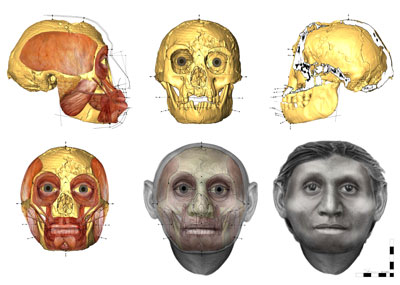
Modern humans can now look their recently discovered relative, Homo floresiensis, in the face thanks to a new reconstruction unveiled at an archaeological conference in Australia.

This species of early human was first identified in 2003 when researchers led by Professor Mike Morwood and Thomas Sutikna found the remains of nine individuals in Liang Bua, a large limestone cave on the remote island of Flores, Indonesia (CWA 22).

Among these was the almost-complete skeleton of a 30-year-old woman, popularly known as ‘Hobbit’ because of her short stature and large feet, whose appearance has now been recreated by Dr Susan Hayes, an anthropologist at the University of Wollongong who specialises in facial approximation. Referring to CT scans and the remains themselves, Dr Hayes digitally rebuilt the woman’s anatomy layer by layer.


Read the rest of this article...

Research Team Investigates Demise of Neanderthals in Spain


La Roca dels Bous, a Paleolithic site located near the southeastern Pyrenees of Spain, has been cited by archaeologists as a key location with Neanderthal-related remains that may shed light on the changes that may have contributed to the demise of the Neanderthals in Europe. Now, a team led by Dr. Rafael Mora of the University Autonomous of Barcelona will be returning to the site in 2013 to excavate and explore lithic assemblages, fossil bone, and other remains that may date as far back as 50,000 BP. The excavations may help research efforts focused on constructing a better understanding of the factors that may have contributed to the decline and eventual disappearance of humanity's most closely related extinct human species. 

The project, part of the European project POCTEFA, combines the efforts of the University Autonomous of Barcelona, ArchaeoBarcelona and resources from three countries -- France, Spain and Andorra -- and will employ innovative digital technology for collecting, organizing and storing data, in part through hand-held tablet devices. In this way a large body of information can be more efficiently and accurately collected and then more easily used for analysis and reporting of finds. The results should also provide a valuable reference for further study by researchers and students worldwide.  "It is the first archaeological site in Spain that has been turned into a museum exhibition with digital technology", reports the team leadership. "Using an iPad you can take an interactive tour through videos, photos and 3D applications. Furthermore, the exact location of the findings is mapped via laser triangulation to provide an unparalleled experience."[1]


Read the rest of this article...

Sunday, January 27, 2013

Pre-Roman decapitated skeleton unearthed in UK


The skeleton found on the old allotment land at Soham [Credit: Cambridge News]

Archaeologists have unearthed decapitated human remains beneath former allotment land in Soham.

Experts from the Hertford-based firm Archaeological Solutions are currently excavating a Roman settlement on land off Fordham Road, before 96 homes are built on the site.

Among the wealth of artefacts found are a number of human burials thought to predate the Roman settlement, including one where the person was decapitated before being put in the ground.


Andrew Peachey, a specialist in prehistoric and Roman pottery at the company, said: “Prior to the Roman settlement, the margins of the Fen and island [of Ely] were heavily exploited by prehistoric settlers, including one who appears to have been decapitated before being placed in a crouched burial in a circular pit. 

Read the rest of this article...

Thursday, January 24, 2013

New Dates for the Bronze Age


When I was an undergrad in 1990 we were taught that all six periods of the Scandinavian Bronze Age were 200 (or in one case 300) years long. The most recent radiocarbon work shows that they all had different lengths and were more likely 130-280 years long. And the periods with the most abundant metalwork finds, II and V, are the two shortest. So their previously known status as metal-rich eras looks even more pronounced now, and the intervening periods look even poorer.

Per I. 1700-1500 cal BC (200 yrs)
Per. II. 1500-1330 (170 yrs)
Per. III. 1330-1100 (230 yrs)
Per. IV. 1100-950/20 (165 yrs)
Per. V. 950/20-800 (130 yrs)
Per. VI. 800-530/20 (275 yrs)

Each of these periods translates to a list of artefact and monument types that are commonly found together. Their relative ordering through time has been known since the 1880s. Current work looks at the absolute dates at which these typological laundry lists were current. It uses a new technology, radiocarbon dating of cremated bone, and new applications of Bayesian statistics, which allow us to constrain the uncertainty of the radiocarbon results using stratigraphical observations. The latter means that if we know that grave B was later than grave A because one sat on top of the other, then we can tell the software to disregard parts of the probability distributions that gainsay this observation.


Neanderthal cloning chatter highlights scientific illiteracy


Harvard geneticist George Church speaks to Reuters reporters about cloning during an interview in Boston, Massachusetts January 23, 2013.
Credit: Reuters/Jessica Rinaldi


After spending the weekend reading blog posts claiming that he was seeking an "extremely adventurous female human" to bear a cloned Neanderthal baby - which was news to him - Harvard geneticist George Church said it may be time for society to give some thought to scientific literacy.
Church became the subject of dozens of posts and tabloid newspaper articles calling him a "mad scientist" after giving an interview to the German magazine Der Spiegel.
 
In the interview, Church discussed the technical challenges scientists would face if they tried to clone a Neanderthal, though neither he nor the Der Spiegel article, which was presented as a question and answer exchange, said he intended to do so.

Dog evolved 'on the waste dump'


Wolves that coped best with cereals in their diet may be part of the story of domestication

Anyone who owns a dog knows that it will rummage around in the kitchen bin looking for food, given half a chance.

But this annoying behaviour may have a more profound undercurrent than we realise, according to scientists.

A new study of dog genetics reveals numerous genes involved in starch metabolism, compared with wolves.
It backs an idea that some dogs emerged from wolves that were able to scavenge and digest the food waste of early farmers, the team tells Nature journal.

No-one knows precisely when or how our ancestors became so intimately connected with dogs, but the archaeological evidence indicates it was many thousands of years ago. 


Wednesday, January 23, 2013

UK dig discovers 9,000-year-old remains

Archaeologists have proved for the first time that people started living in the Didcot area as early as 9,000 years ago.

Oxford Archaeology has been excavating land at Great Western Park, where more than 3,300 homes are being built, to detail the site’s history.

The two-and-a-half-year dig has uncovered the remains of a Roman villa, and early Bronze Age arrowheads which will now go on display.

Rob Masefield – director of archaeology at RPS Planning, which is managing the investigation – said one of the most important discoveries was hundreds of flints dating back over 9,000 years to the Mesolithic period.

Read the rest of the article...


Tuesday, January 22, 2013

Have a Neanderthal baby and save humanity

The life of a Neanderthal family, as depicted by the Neanderthal Museum in Krapina, Croatia. Photograph: Nikola Solic/Reuters

This is a once-in-a-lifetime opportunity – simply rent your womb out to Prof George Church, Harvard, and a Nobel prize is yours

If you're a young, single and adventurous female human and wondering what to do with the womb you have just lying around inside you collecting dust, an opportunity has arisen. You can bear a Neanderthal baby.

This is a once in an aeon chance to have your very own bundle of fur; a little Ug Jnr with your eyes and smile but the back hair of its great-great-great-great-great (etc) grandfather.

Prof George Church of Harvard Medical School believes that he can reconstruct Neanderthal DNA, and is seeking a volunteer have the "neo-Neanderthal" embryo implanted into her uterus. Church believes that a new race of human could be beneficial if we end up facing an apocalypse at some point, so the lending of your womb could potentially save humanity. Or at the very least produce a subspecies that would be good at heavy lifting and killing the DNA-reconstructed mammoths we will inevitably recreate as well.

Read the rest of this article...

Wednesday, January 16, 2013

Mesolithic people adapted their environment in Severn Estuary

Mesolithic footprint from Goldcliff. Image: Reading University

New and exciting evidence has been found at a threatened archaeological site on the Severn Estuary that seems to show Mesolithic  people knew how to adapt their environment to suit their needs.

Encouraging specific plants

Researchers from the University of Reading found 7500 year-old worked flint tools, bones, charcoal and hazelnut shells while working at Goldcliff, near Newport, south Wales, in September 2012.

Charcoal remains discovered on the site suggest these people used fire to encourage the growth of particular plants, such as hazelnuts, crab apples and raspberries. This evidence may indicate that Mesolithic people were deliberately manipulating the environment to increase their resources, thousands of years before farming began.

Read the rest of this article...

War was central to Europe’s first civilisation - contrary to popular belief

Dr Barry Molloy

Research from the University of Sheffield has discovered that the ancient civilisation of Crete, known as Minoan, had strong martial traditions, contradicting the commonly held view of Minoans as a peace-loving people.
 
The research, carried out by Dr Barry Molloy of the University of Sheffield’s Department of Archaeology, investigated the Bronze Age people of Crete, known by many as the Minoans, who created the very first complex urban civilisation in Europe.

“Their world was uncovered just over a century ago, and was deemed to be a largely peaceful society,” explained Molloy. “In time, many took this to be a paradigm of a society that was devoid of war, where warriors and violence were shunned and played no significant role.

“That utopian view has not survived into modern scholarship, but it remains in the background unchallenged and still crops up in modern texts and popular culture with surprising frequency.

“Having worked on excavation and other projects in Crete for many years, it triggered my curiosity about how such a complex society, controlling resources and trading with mighty powers like Egypt, could evolve in an egalitarian or cooperative context. Can we really be that positive about human nature? As I looked for evidence for violence, warriors or war, it quickly became obvious that it could be found in a surprisingly wide range of places.”

Read the rest of this article...
Storms expose iron age skeleton

2,000 years old human remaions were exposed by the storms - Photos: Shetland Amenity Trust

SHETLAND’S pre-Christmas storms have revealed remains of an iron age building and a human skeleton believed to be 2,000 years old.
 
Archaeologists said a structure was briefly exposed at Channerwick before being buried again by a rockfall over the festive period.

Before it disappeared from view, police officers and archaeologists were able to investigate the site and take a bone sample for radiocarbon dating.

Shetland Amenity Trust assistant archaeologist Chris Dyer said: “The skeleton, initially reported by a local resident, looked as if it were contemporary with the Iron Age remains.

“The original burial now lies under several tons of fallen bank and the Iron Age structures have also disappeared from view.”

County archaeologist Val Turner added that during the investigation she and freelance colleague Samantha Dennis discovered evidence of at least one, and possibly two other burials.

Read the rest of this article...

Tuesday, January 15, 2013

Indians inhabited Australia 4 000 years ago, study shows


New research shows ancient Indians migrated to Australia and mixed with Aborigines 4 000 years ago, bringing the dingo's ancestor with them.

The research re-evaluated the continent's long isolation before European settlement.

The vast southern continent was thought to have been cut off from other populations until Europeans landed at the end of the 1700s, but the latest genetic and archaeological evidence throws that theory out.

Researchers at the Max Planck Institute for Evolutionary Anthropology in Leipzig, Germany, reported "evidence of substantial gene flow between Indian populations and Australia about 4 000 years ago".

Read the rest of this article...

Monday, January 14, 2013

Ancient poop tells story of how urbanisation changed the intestine

Image by: Gallo Images/Thinkstock

Research by US scientists into the composition of dried human faeces from archeological sites shows that the increasingly urban and cosmopolitan way of modern life has led to dramatic changes in the make-up of human intestinal flora.

Raul Tito and his colleagues from the University of Oklahoma analysed the microbial composition of coprolite samples (faeces retrieved from archaeological contexts) from three locations in the Americas.

The sites were chosen because they provided a broad range of environmental conditions.

The samples taken from Hinds Cave in the southwestern United States were the oldest, at around 8,000 years, while those recovered from Rio Zape in northern Mexico were 1,400 years old.

The samples taken from naturally preserved mummies in Caserones in northern Chile were 1,600 years old.

Read the rest of this article...

Neolithic remains discovered in Istanbul


A team of Turkish archeologists has unearthed ruins of a Neolithic settlement dating back over eight millennia in Pendik district in Istanbul.

The relics were uncovered during the construction process of a project in Istanbul’s Marmaray railway.

The findings include ancient houses, skeletons, cemeteries and various tools such as spoons, needles and axes that indicate a history of 8,500-year-old settlement at the area.

Most of the found skeletons were buried in a fetal position, where the arms are embracing the lower limbs.

As thousands of mussel shells were discovered in the area, the experts suggest that the residents of the ancient village must have consumed large amounts of mussels.

Read the rest of this article...

Clay pot fragments reveal early start to cheese-making, a marker for civilization

The presence of milk byproducts found in clay fragments from central Europe provides compelling evidence that farmers used the perforated pots to separate cheese curds from whey, said Bogucki, whose early theory was substantiated by recent research in Europe. Credit: Mélanie Salque

Read more at: http://phys.org/news/2013-01-clay-pot-fragments-reveal-early.html#jCp
The presence of milk byproducts found in clay fragments from central Europe provides compelling evidence that farmers used the perforated pots to separate cheese curds from whey, said Bogucki, whose early theory was substantiated by recent research in Europe. Credit: Mélanie Salque

Read more at: http://phys.org/news/2013-01-clay-pot-fragments-reveal-early.html#jCp
The presence of milk byproducts found in clay fragments from central Europe provides compelling evidence that farmers used the perforated pots to separate cheese curds from whey, said Bogucki, whose early theory was substantiated by recent research in Europe. Credit: Mélanie Salque

While working as director of studies at one of Princeton University's residential colleges in the 1980s, Bogucki theorized that the development of cheese-making in Europe—a critical indicator of an agricultural revolution—occurred thousands of years earlier than scientists generally believed. His insight, based on a study of perforated potsherds that Bogucki helped recover from dig sites in Poland, promised to change the scientific understanding of how ancient Western civilization developed. 

Bogucki published his theory in a 1984 article in the Oxford Journal of Archaeology. Although his detective work was extensive, it was impossible to prove the bits of pottery were the remains of a cheese maker, rather than some other type of strainer. 

There the matter lay, until researchers at the University of Bristol used a new type of test to measure ancient molecular remnants embedded within the pottery.

Read the rest of this article...

Sunday, January 13, 2013

Neolithic remains unearthed in Istanbul


Workers helping to upgrade Istanbul’s Marmaray railway project have discovered the priceless ruins of a Neolithic settlement dating back well over eight millennia in the city’s Pendik district.

The 8,500-year-old foundations of ancient houses, cemeteries and various tools such as spoons, needles and axes were found during the construction process of the Gebze-Haydarpaşa section of the Marmaray. The Istanbul Archaeology Museum is currently leading a dig to shed light on the district’s past inhabitants.
Culture and Tourism Provincial Manager Ahmet Emre Bilgili said discovering the ancient history of Istanbul, which dates back thousands of years, was a cause for great joy, adding that a new museum was required for the discoveries belonging to the Neolithic period.

Read the rest of this article...

Ancient Olympia to get a facelift

A further 50-70 m of the Gymnasium at Olympia are expected to be revealed [Credit: To Vima]

The face of global symbol and most sacred place of ancient Greece, Ancient Olympia, is changing, after the decisions made by the Central Archaeological Council (KAS) about the excavations in the area and the approval of proposed studies.  

The project which was unanimously approved by the members of KAS is structured in three parts:

  • Unearthing and enhancement of the East Arcade of the Gymnasium (new entrance and facilities for audience services).
  • Conservation of the retaining wall of the Treasuries.
  • Conservation of the excavation slopes at the Sanctuary of Demetra Chamyne.
Read the rest of this article...

Friday, January 11, 2013

Silbury Hill trespassers causing 'spectacular' damage

Floodwater surrounding Silbury Hill is nothing to worry about, says English Heritage 
[Credit: BBC]

Trespassers on a rain-soaked monument in Wiltshire are causing "spectacular" damage, an archaeologist has warned.

Heavy rain has led to standing water around Silbury Hill in Avebury and very soft ground which is being eroded by people climbing the monument.

Jim Leary, an archaeologist for English Heritage, said that illegal climbers on the sodden hill were "leaving some really rather hideous scars".

The hill dates back to 2400 BC and is the largest man-made mound in Europe.

Mr Leary said access to the mound had been prohibited for a number of decades and people should not be attempting to climb it.

"They are going up and it is very wet and they are eroding the side of the hill," he added.


Read the rest of this article...

Stone Age hunters liked their carbs


The Stone Age hunter’s food contained large amounts of protein from fish, lean mean, herbs and coarse vegetables and has formed the basis of one of today’s hottest health trends: the paleo diet.

The modern version of the Stone Age diet excludes foods rich in carbohydrates. This exclusion of carbs is based on the idea that Stone Age hunters didn’t have access to bread, rice or pasta.

But is it true that Stone Age hunters and gatherers didn’t eat any carbohydrates at all?

Sabine Karg, an external lecturer at Copenhagen University’s Saxo Institute, specialises in archaeobotany. She says that Stone Age hunters, unlike many followers of the modern Stone Age diet, joyfully munched away at carbs when the opportunity presented itself.

Read the rest of this article...

Ancient floor not seen for 10,000 years


AN ANCIENT floor which has not seen the light of day for 10,000 years has been uncovered at the Ayia Varvara-Asprokremmos site, the antiquities department said yesterday.

The department said new finds during the latest excavations had redefined the understanding of the kind of human occupation that existed at the Neolithic site in the Nicosia district, which has been radio-carbon dated to between c. 8,800-8,600 BC.


The excavations took place in November 2012 and were run by Dr Carole McCartney on behalf of the University of Cyprus working in partnership with Cornell University and the University of Toronto.
According to an announcement, the floor which “was exposed for the first time in 10,000 years” exhibited a dished form, raised above the central area providing a rough bench that ran along the circumference of the interior wall.


Read the rest of this article...

Prehistoric clay figurines unearthed in Greece


Archaeologists from the University of Southampton studying a Neolithic archaeological site in central Greece have helped unearth over 300 clay figurines, one of the highest density for such finds in south-eastern Europe.

The Southampton team, working in collaboration with the Greek Archaeological Service and the British School at Athens, is studying the site of Koutroulou Magoula near the Greek village of Neo Monastiri, around 160 miles from Athens.

Koutroulou Magoula was occupied during the Middle Neolithic period (c. 5800 - 5300 BC) by a community of a few hundred people who made architecturally sophisticated houses from stone and mud-bricks. The figurines were found all over the site, with some located on wall foundations. It's believed the purpose of figurines was not only as aesthetic art, but also to convey and reflect ideas about a community's culture, society and identity.


Read the rest of this article...