Monday, October 12, 2015

Digitising Yorkshire's savannah past


Ancient bones from a North Yorkshire cave, including the remains of rhinos, bears and hyenas, are to go on display in a "virtual museum" more than a century after they were excavated.
Some of the bones, found in Victoria Cave in the dales, date back more than one hundred thousand years.
At that time, such beasts were common in northern England.
A team of archaeologists from the organisation DigVentures has set out digitise the site's unique collection.
The cave was discovered in 1837 when a man noticed his dog disappear through an opening in the hill, and reappear through another.

Read the rest of this article...

Friday, October 9, 2015

First ancient African genome solves migration mystery


An ancient African genome has been sequenced for the first time.
Researchers extracted DNA from a 4,500-year-old skull that was discovered in the highlands of Ethiopia.
A comparison with genetic material from today's Africans reveals how our ancient ancestors mixed and moved around the continents.
The findings, published in the journal Science, suggests that about 3,000 years ago there was a huge wave of migration from Eurasia into Africa.
This has left a genetic legacy, and the scientists believe up to 25% of the DNA of modern Africans can be traced back to this event.
"Every single population for which we have data in Africa has a sizeable component of Eurasian ancestry," said Dr Andrea Manica, from the University of Cambridge, who carried out the research.

Read the rest of this article...

Saturday, October 3, 2015

Mummification was common in Bronze Age Britain


Ancient Britons may have intentionally mummified some of their dead during the Bronze Age, according to archaeologists at the University of Sheffield. 


Bronze Age skeleton from Neat's Court excavation, on Isle of Sheppey, Kent  
[Credit: Geoff Morley]

The study, published in the Antiquity Journal, is the first to provide indications that mummification may have been a wide-spread funerary practise in Britain. 

Working with colleagues from the University of Manchester and University College London, Dr Tom Booth analysed skeletons at several Bronze Age burial sites across the UK. The team from the University of Sheffield’s Department of Archaeology found that the remains of some ancient Britons are consistent with a prehistoric mummy from northern Yemen and a partially mummified body recovered from a sphagnum peat bog in County Roscommon, Ireland.

Read the rest of this article...

ARCHAEOLOGISTS UNCOVER BRONZE AGE ‘SAUNA HOUSE’ IN ORKNEY


Archaeologists in Orkney have uncovered the remains of over 30 buildings dating from around 4000 BC to 1000 BC, together with field systems, middens and cemeteries. The find includes a very rare Bronze Age building which experts believed could have been a sauna or steam house, which may have been built for ritual purposes. 

EASE Archaeology recently made the exciting discovery on the periphery of the prehistoric Links of Noltland, on the island of Westray in Orkney, next to where the famous ‘Westray Wife’ was found in 2009, which is believed to be the earliest depiction of a human face in Britain. 

The work is being funded by Historic Scotland, who are this week merging with the Royal Commission on Ancient and Historic Monuments of Scotland (RCAHMS) to form a new heritage body called Historic Environment Scotland. 

Work has been carried out at the Links of Noltland for several years now but the most recent discovery, and one of the most remarkable to date, is that of an almost complete and remarkably well-preserved, very rare Bronze Age building which experts believe had a very specialised function and was used by select groups for activities such as rites of passage or spiritual ceremonies.  It’s also possible that the building could have been used as a sweat house or sauna, for a number of activities ranging from basic healing and cleansing, or as a place where women could come to give birth, the sick and elderly could come to die, or where bodies were taken before burial.


Read the rest of this article...

Monday, September 21, 2015

5,000-Year-Old Throne Found in Turkey


The remains of a 5,000-year-old adobe basament of a possible “throne” have been unearthed during excavations in Turkey, revealing the origins of the secularization of power and one of the first evidence of the birth of the state system.
Discovered in Aslantepe in the eastern Turkish province of Malatya, the structure consists of an adobe platform, raised by three steps above the floor, on top of which burnt wooden pieces were found.
“The burnt wooden fragments are likely the remains of a chair or throne,” excavation director Marcella Frangipane of La Sapienza University in Rome, told Discovery News.
Read the rest of this article...

Steinzeitliche Miniaturräder aus Holz


Kinderspielzeug, Anschauungsmaterial für Wagenbauer oder rituelle Gegenstände?
Im Olzreuter Ried bei Bad Schussenried in Oberschwaben fanden Archäologen des des Landesamts für Denkmalpflege im Regierungspräsidium Stuttgart zwei gut erhaltene hölzerne Miniaturräder aus dem 3. Jahrtausend v.Chr. Die Funde zeigen, dass in der Jungsteinzeit zwei unterschiedliche Konstruktionsprinzipien für Fuhrwerke bekannt waren.
Read the rest of this article...

Monday, September 14, 2015

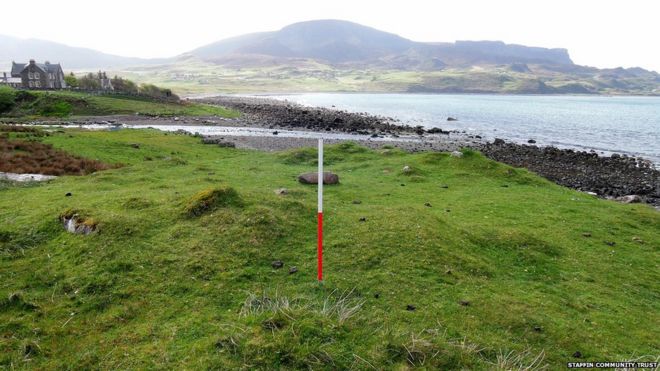
Mesolithic site on Skye to be investigated

Archaeologists have described the site as having "huge potential"

Excavations of a Mesolithic site on Skye could give new insights into the lives of some of the island's earliest residents.
Archaeologists believe the location above Staffin Bay has the remains of a house that could be 8,000 years old.
Mesolithic flints have previously been found in an area of eroded grazing land near the site.
Archaeologists will work with Staffin Community Trust and volunteers in making small excavations.
Read the rest of this article...

Neolithic skeleton reveals early history of rickets


Rickets has been identified in a Neolithic skeleton from the Scottish island of Tiree, making it the earliest case of the disease in the UK, according to research announced at the British Science Festival in Bradford.
This is particularly surprising as the disease – caused by Vitamin D deficiency linked to lack of sunlight – is more commonly associated with the urban slums of Victorian Britain than with rural, farming communities, as existed in Neolithic Scotland. The nature of the grave itself – a simple burial rather than a chambered tomb – has raised questions as to how the woman, physically deformed by the disease, may have been treated by her community.
Professor Ian Armit from the University of Bradford explains: “The earliest case of rickets in Britain until now dated from the Roman period, but this discovery takes it back more than 3,000 years. There have been a few possible cases in other parts of the world that are around the same time, but none as clear cut as this. While we can’t say for certain that this is the earliest case in the world, it is definitely very unusual.
Read the rest of this article...

DNA from Neandertal relative may shake up human family tree

FOSSIL SKULLS AND CHIMPANZEE/J.-J. HUBLIN; BONOBO/ROYAL MUSEUM FOR CENTRAL AFRICA, TERVUREN, BELGIUM

In a remarkable technical feat, researchers have sequenced DNA from fossils in Spain that are about 300,000 to 400,000 years old and have found an ancestor—or close relative—of Neandertals. The nuclear DNA, which is the oldest ever sequenced from a member of the human family, may push back the date for the origins of the distinct ancestors of Neandertals and modern humans, according to a presentation here yesterday at the fifth annual meeting of the European Society for the study of human evolution.

Ever since researchers first discovered thousands of bones and teeth from 28 individuals in the mid-1990s from Sima de los Huesos (“pit of bones”), a cave in the Atapuerca Mountains of Spain, they had noted that the fossils looked a lot like primitive Neandertals. The Sima people, who lived before Neandertals, were thought to have emerged in Europe. Yet their teeth, jaws, and large nasal cavities were among the traits that closely resembled those of Neandertals, according to a team led by paleontologist Juan-Luis Arsuaga of the Complutense University of Madrid. As a result, his team classified the fossils as members of Homo heidelbergensis, a species that lived about 600,000 to 250,000 years ago in Europe, Africa, and Asia. Many researchers have thought H. heidelbergensis gave rise to Neandertals and perhaps also to our species, H. sapiens, in the past 400,000 years or so.

Read the rest of this article...

Scientists identify a new ancient ancestor


An international team of scientists, including one from the University of Colorado Denver and another from the University of Colorado Anschutz Medical Campus in Aurora, announced the discovery of a new species of hominin, a small creature with a tiny brain that opens the door to a new way of thinking about our ancient ancestors. 


This photo provided by National Geographic from their October 2015 issue shows  a composite skeleton of Homo naledi surrounded by some of the hundreds of  other fossil elements recovered from the Rising Star cave in South Africa,  photographed at the Evolutionary Studies Institute of the University of  the Witwatersrand in Johannesburg, South Africa  [Credit: Robert Clark/National Geographic, Lee Berger/ University of the Witwatersrand via AP] 

The discovery of 15 individuals, consisting of 1,550 bones, represents the largest fossil hominin find on the African continent. 

“We found adults and children in the cave who are members of genus Homo but very different from modern humans,” said CU Denver Associate Professor of Anthropology Charles Musiba, PhD, who took part in a press conference Thursday near the discovery inside the Rising Star Cave in the Cradle of Humankind World Heritage Site outside Johannesburg, South Africa. “They are very petite and have the brain size of chimpanzees. The only thing similar we know of are the so-called ‘hobbits’ of Flores Island in Indonesia.”

Read the rest of this article...

Friday, July 31, 2015

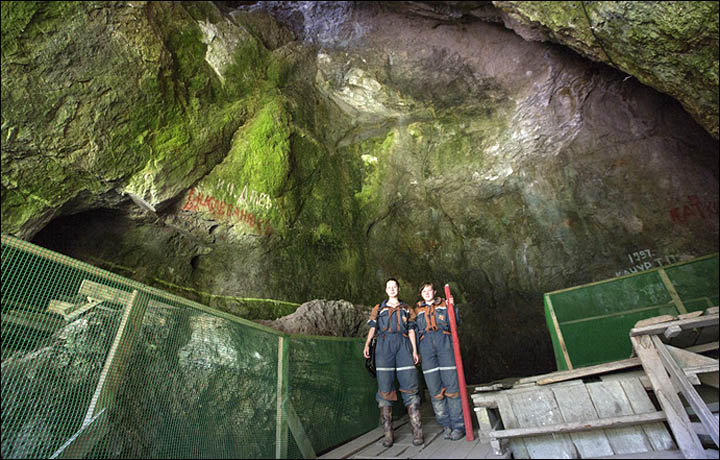
First glimpse inside the Siberian cave that holds the key to man's origins

The significance of the cave is immense, and the experts are convinced it has more secrets to give up on human origins. Picture: Vera Salnitskaya

These exclusive pictures show the world famous Denisova Cave in the Altai Mountains from which a series of stunning scientific discoveries on man's origins have been made in recent years.
More are expected as a result of a hive of archeological activity - overseen by the specialists from Novosibirsk State University -  underway at this unique site inhabited continuously from the deep past.
Scientist Maksim Kozlikin said: 'We are working with Oxford University in the UK, they help us with radiocarbon and other dating and also conduct studies of ancient DNA. Currently, we continue cooperation and there can be new joint scientific articles.' 
The significance of the cave is immense, and the experts are convinced it has more secrets to give up on human origins. Here in 2008 was discovered a finger bone fragment of 'X woman', a juvenile female who lived around 41,000 years ago, analysis of which indicated that she was genetically distinct from Neanderthals and modern humans.
This previously unknown and long extinct hominin species or subspecies was christened Denisovan after this cave. In 2010 analysis on an upper molar from a young adult, found in the cave ten years previously, was also from a Denisovan.
Read the rest of this article...

Fragments of new female figurine found at Hohle Fels


Archaeologists, Prof. Nicholas Conard and his team member Maria Malina, present the discovery of two fragments of a new female figurine in today's edition of the journal: Archäologische Ausgrabungen Baden-Württemberg. The figurine shows similarities with the well-known Venus from Hohle Fels that Prof. Conard published in 2009. 


Fragments of a female figurine from Hohle Fels in southwestern Germany  dating to the Aurignacian period roughly 40,000 years ago  [Credit: J. Lipták/University of Tübingen] 

The two pieces of carved mammoth ivory fit together to form a find with dimensions of 23 x 22 x 13 mm. The find does not appear to be part of a depiction of an animal or lionman, both frequent motifs from the caves of the Swabian Jura of southwestern Germany. 

Instead, the find shows strong affinities with the only other female figurine known from the region. The find will be exhibited as part of a small research exhibit at the Museum of Prehistory in Blaubeuren.

Read the rest of this article...

French student finds tooth dating back 560,000 years

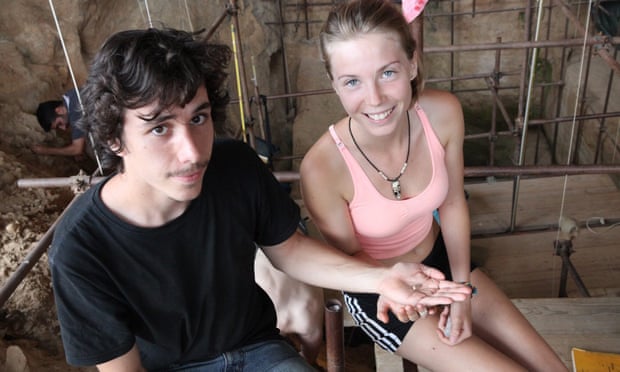
 Valentin Loescher, left, holding the tooth, and Camille Jacquey were working together on the dig. Photograph: Denis Dainat/EPA

A French student has found an adult tooth dating back around 560,000 years in south-western France, in what researchers are hailing as a major discovery.
Valentin Loescher, 20, was volunteering alongside Camille Jacquey, 16, on his first summer archaeological dig at the Arago cave near Tautavel, when he discovered the tooth.
The tooth could be the oldest human remains found in France. It predates by 100,000 years the famous Tautavel man, a 20-year-old prehistoric hunter and ancestor of Neanderthal man, who was discovered at the site in 1971 and whose remains dated back about 450,000 years.
Read the rest of this article...

5,000-year-old fort found in Monmouth


Archaeologists in Monmouth have discovered the remains of an ancient wooden building that dates back 5,000 years. 


An artist impression of what the fort looked like nearly 5,000 years ago  [Credit: Monmouth Archaeological Society] 

Steve Clarke, who two years ago uncovered the remains of a huge post-glacial lake at the Parc Glyndwr building site, said the timber remains found under the new Rockfield estate were once part of a crannog, an ancient fortified dwelling built into a lake. 

Part of the wooden building set into the bed of what was once Monmouth’s prehistoric lake, pre-dates the only other known crannog in England and Wales by 2,000 years. 

Read the rest of this article...
Tuesday, July 28, 2015

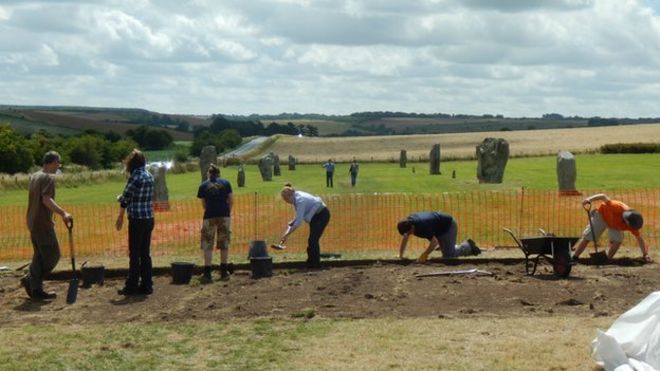
Neolithic house discovery at Avebury stone circle dig


Archaeologists believe they may have found the remains of a house where people who built Avebury stone circle may have lived.
The three-week Between the Monuments project is researching the daily lives of Neolithic and Bronze Age residents at the Wiltshire site.
The dig is being led by The National Trust and Southampton and Leicester University archaeologists.
The National Trust said if it is a house they will have "hit the jackpot".
Spokesman Dr Nick Snashall said: "I could count the number of middle Neolithic houses that have been found on the fingers of one hand.

Read the rest of this article...

Sunday, July 26, 2015

Ancient carriage way discovered near Athens


A 300-metre section of an ancient carriage way dated to the 4th century BC was discovered by archaeologists at the Megalo Kavouri beach in the southern suburb of Vouliagmeni, the ministry of Culture announced on Monday. 


Section of the ancient carriage road discovered in Vouliagmeni 
[Credit: Greek Ministry of Culture] 

The road, paved with small stones placed close to one another, varies in width from 1.90 metres to 6.10 metres. It is delineated by retaining walls on either side that also serve to keep the pavement stable, as the earth underneath is soft and sandy.

Read the rest of this article...

Bronze Age skeleton unearthed in Wiltshire


A 4,000-year-old Bronze Age skeleton, believed to be that of an adolescent child, has been unearthed by archaeologists.
The rare discovery was made by a team from the University of Reading, who are excavating Wilsford henge in the Vale of Pewsey, Wiltshire.
It is believed the skeleton will help shed light on the lives of those who lived and worshipped at nearby Stonehenge.
The body, around 1.5m in length, was found in a foetal position and was wearing an amber necklace. Efforts will now be made to determine the age and gender of the child and where they were from after the find was made on Tuesday.
The Vale of Pewsey, situated between Stonehenge and Avebury, is the subject of a three-year dig but over the last six weeks, archaeologists have focused on Marden henge and Wilsford henge.
Read the rest of this article...
Fortress older than the pyramids is uncovered in Monmouth


Archaeologists have unearthed a wooden island old enough to have been built by the Flintstones under a modern Barratt estate.
The fortified farmhouse on stilts in the middle of an ice age lake is so old it could have even been built before Stonehenge was created.
At 4,900 years old it's probably even older than the Pyramids and was probably built to provide a natural moat to protect the rich inhabitants from attackers in an area that is now on the Welsh borders.
It was around the time early man started to live communally and archaeologist Steve Clarke says it is only the second "crannog" to be found in England and Wales and much older than the first.
Read the rest of this article...

Irish motorway dig reveals finds dating back to 3500BC


A ‘mound’ used as a gathering point for rituals dating back to 3500 BC, evidence of medieval treasure-hunting and remains of Famine cottages are among the ancient finds along the M17 motorway. 


The excavation at Kilskeagh, which found, where a gathering point dating  back to 3500C was uncovered [Credit: Connacht Tribune] 

The finds at 26 excavated sites on the 30km stretch from Rathmorrissy (near Athenry) to Tuam have been recorded in a book entitled ‘Through the Lands of the Auteri and St Jarlath’, which will be launched next week. 

The book takes its title from the Auteri tribe which controlled large tracts of land in the second century AD in what is now Athenry, and 300 years later, where according to legend, St Jarlath founded Tuam.

Read the rest of this article...
Eine weitere Frauenstatuette aus dem Hohle Fels?


Ein neu entdecktes Elfenbeinfragment aus dem Hohle Fels in Baden-Württemberg gehört möglicherweise zu einer zweiten weiblichen Figurine. Der im letzten Jahr gemachte Fund aus der Altsteinzeit ist derzeit in einer Sonderpräsenation in Blaubeuren zu sehen.

Bei Ausgrabungen in der Höhle Hohle Fels auf der Schwäbischen Alb nahe Schelklingen hat das Team von Professor Nicholas Conard aus der Abteilung Urgeschichte und Quartärökologie der Universität Tübingen einen rätselhaften Fund gemacht: ein aus zwei Teilen zusammengesetztes Bruchstück aus Mammutelfenbein. Von Menschenhand bearbeitet, weist das Fragment deutliche, tief eingebrachte Rillen in musterhafter Anordnung auf.

Read the rest of this article...

Sunday, July 12, 2015

Archaeologists unearth golden enigma in Denmark


Archaeologists have discovered about 2,000 little gold spirals from the Bronze Age in a field near Boeslunde in Zealand.


Bronze Age gold spirals found in Boeslund, 900-700 BC  
[Credit: Morten Petersen/Zealand Museum]

The longest of the many spirals are around 3 cm in length and are all produced from thin and flat golden thread dating from 700-900 BC.

The find, in an area of Zealand considered one of northern Europe’s best places to find gold artefacts from the Bronze Age, remains as mysterious as it is sensational.

Read the rest of this article...
The boneyard of the bizarre that rewrites our Celtic past to include hybrid-animal monster myths

Cow with horse's legs among finds that throw light on the ancient mind

Ancient Mediterranean cultures thought nothing of splicing different animals together to form fantastical mythical beasts, such as the half-lion, half-goat chimera or the half-lion, half-eagle griffin.

Until now, however, ancient Britons were not credited with such imagination. That is all about to change following the discovery of a series of animal skeletons near Winterborne Kingston in Dorset, which raises the possibility that Britain’s ancient Celtic population had hybrid-animal monster myths similar to those of the ancient Greeks, Mesopotamians and Egyptians.

The bones, discovered in Dorset by archaeologists, appear to have been deliberately rearranged by Iron Age Britons in order to create hybrid beasts, half one creature and half another.

Read the rest of this article...

Human presence in Scotland earlier than thought


Archaeologists working on the National Trust for Scotland’s Mar Lodge Estate in Aberdeenshire have uncovered evidence that people were active in this mountainous landscape thousands of years earlier than previously thought. 


Excavations of an 8,000 year-old hunter-gatherer site in remote Glen Geldie,  on the National Trust for Scotland’s mountainous Mar Lodge Estate  [Credit: National Trust for Scotland] 

Archaeologists working on the National Trust for Scotland’s Mar Lodge Estate in Aberdeenshire have uncovered evidence that people were active in this mountainous landscape thousands of years earlier than previously thought. 

Excavations at sites deep in the Cairngorm glens have produced radiocarbon dates which demonstrate a human presence as far back as 8,100 BC, with some places being revisited over many thousands of years.

Read the rest of this article...
Wednesday, July 8, 2015

You(r) Archaeology – portraying the past


“You(r) Archaeology – portraying the past” - A European competition to express your view.

What is archaeology? An adventure? A pain in the neck? The appeal of the past, the magic of marvellous sites, the boredom of a dusty museum? Probably all of these together, and still more.

Up until July 31st 2015, all European citizens can answer the question and tell us about their idea of archaeology by entering a drawing, painting, photo or video in the European competition “You(r) Archaeology”.

Further details...

Monday, June 29, 2015

Polish farmer finds 2,500 year old gold bracelets


Gold items preliminarily dated to 1600-400 BC have been discovered by a farmer near Jasło in the Subcarpathia. The antique objects have been taken to the Sub-Carpathian Museum in Krosno. 


The three gold bracelets dating to between 1600 and 400 BC unearthed by a farmer in southeastern Poland [Credit: PAP © 2015/Darek Delmanowicz] 

During field work near Jasło, a farmer found three gold bracelets tied with golden wire. He then informed the archaeological service. 

Archaeologists now intend to study the place of discovery because the want to determine whether it was a discovery of a treasure, or perhaps the remains of a burial ground, as Jan Gancarski, director of the Sub-Carpathian Museum in Krosno said. 

Read the rest of this article...

Archaeologists find Bronze Age food at prehistoric settlement "comparable to the Mary Rose"

Archaeologists found food from between 800-1000 BC in a set of pots, textiles and other material at a Cambridgeshire settlement destroyed by fire during the Bronze Age
© Cambridge Archaeological Unit

An “extraordinary testimony” to the lives of prosperous people in Bronze Age Britain could lie under the soil of a 1,100-square metre site destroyed in a fire 3,000 years ago, say archaeologists who are about to start digging within a brick pit near Peterborough.

Must Farm – part of the Flag Fen Basin, and the site where nine pristine log boats were famously unearthed in 2011 – was protected by a ring of wooden posts before a dramatic fire at the end of the Bronze Age caused the dwelling to collapse into the river.

Its submergence preserved its contents, creating what experts are describing as a “time capsule” of “exceptional” decorated tiles made from lime tree bark.

Read the rest of this article...

Friday, June 19, 2015

“Globally unparalleled” evidence of prehistoric Welsh feasting practices unearthed by archaeologists


New research led by archaeologists at Cardiff University has showcased "globally unparalleled" evidence of a unique prehistoric pork-focused feasting practice in South Wales
After 10 years of excavation and research, analysis of animal bones deposited in a 'midden' or rubbish heap at a prehistoric feasting site in Llanmaes, Vale of Glamorgan, has revealed the novel custom of mass feasting focused specifically on pigs' right forequarters.
The research - a collaboration between the University's School of History, Archaeology and Religion and National Museum Wales - has provided extraordinary insights into the lives of Wales' prehistoric ancestors.
Read the rest of this article...

400,000-year-old dental tartar provides earliest evidence of manmade pollution


Most dentists recommend a proper teeth cleaning every six months to prevent, among other things, the implacable buildup of calculus or tartar -- hardened dental plaque. Routine calculus buildup can only be removed through the use of ultrasonic tools or dental hand instruments. But what of 400,000-year-old dental tartar?
Tel Aviv University researchers, in collaboration with scholars from Spain, the U.K. and Australia, have uncovered evidence of food and potential respiratory irritants entrapped in the dental calculus of 400,000-year-old teeth at Qesem Cave near Tel Aviv, the site of many major discoveries from the late Lower Paleolithic period. 
Read the rest of this article...

Le prince au torque d’or de Lavau


Exhumée par une équipe d’archéologues de l’Inrap, la tombe princière de Lavau, datée du début du Ve siècle avant notre ère, a révélé un mobilier funéraire exceptionnel : chaudron en bronze méditerranéen à têtes de lionnes et d’Acheloos (dieu-fleuve), oenochoé attique à figures noires, ciste, bassins en bronze etc. Dans le cadre des Journées nationales de l’archéologie (19-21 juin 2015), l’Inrap présente les derniers résultats de cette fouille achevée depuis quelques jours.

Read the rest of this article...

Friday, May 29, 2015

Modern humans migrated out of Africa via Egypt, suggests genetic study


How and when the first modern human populations emerged out of Africa to settle Europe and Asia has been at the center of a long-standing debate among researchers and scholars. The results of a new genetic study, however, suggests that modern humans made their first successful major migration out of Africa around 55,000 – 60,000 years ago through Egypt, and not from further south through Ethiopia, as suggested by another proposed theory.
Dr. Luca Pagani, of the Wellcome Trust Sanger Institute and the University of Cambridge in the UK, and his colleagues analyzed the genetic information from six modern Northeast African populations (100 Egyptians, and five Ethiopian populations each represented by 25 people).
Read the rest of this article...

New human ancestor species from Ethiopia lived alongside Lucy's species

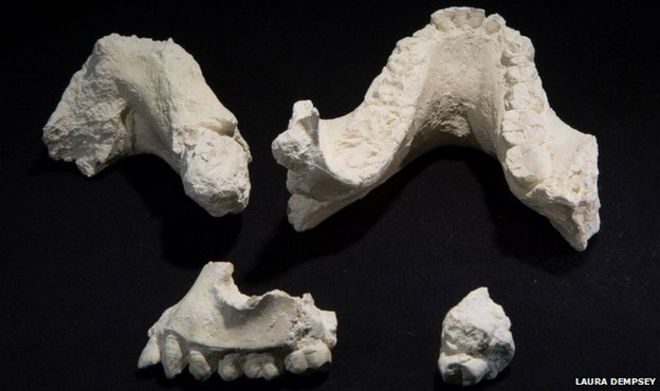
Holotype upper jaw of a new human ancestor species found on March 4, 2011. 
Credit: Yohannes Haile-Selassie, Cleveland Museum of Natural History

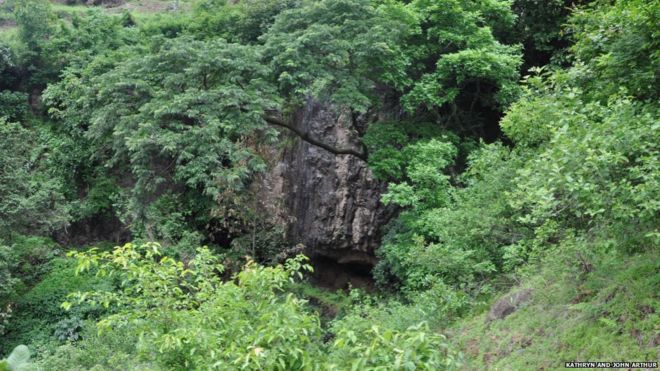
A new relative joins "Lucy" on the human family tree. An international team of scientists, led by Dr. Yohannes Haile-Selassie of The Cleveland Museum of Natural History, has discovered a 3.3 to 3.5 million-year-old new human ancestor species. Upper and lower jaw fossils recovered from the Woranso-Mille area of the Afar region of Ethiopia have been assigned to the new species Australopithecus deyiremeda. This hominin lived alongside the famous "Lucy's" species, Australopithecus afarensis. The species will be described in the May 28, 2015 issue of the international scientific journal Nature.

Lucy's species lived from 2.9 million years ago to 3.8 million years ago, overlapping in time with the new species Australopithecus deyiremeda. The new species is the most conclusive evidence for the contemporaneous presence of more than one closely related early human ancestor species prior to 3 million years ago. The species name "deyiremeda" (day-ihreme-dah) means "close relative" in the language spoken by the Afar people.

Australopithecus deyiremeda differs from Lucy's species in terms of the shape and size of its thick-enameled teeth and the robust architecture of its lower jaws. The anterior teeth are also relatively small indicating that it probably had a different diet.

Read the rest of this article...

New finds at Plassi, Marathon in Attica


This year’s excavations of the Prehistoric-Classical site of Plassi, Marathon in Attica, conducted by the University of Athens, have been completed last week. The survey of the site began last year. 


Buildings and pottery kiln of the Prehistoric era 
[Credit: National and  Kapodistrian University of Athens] 

The Plassi excavation has once again brought to light important finds showing that the site remained the most important settlement of the Marathon plain from the end of the Neolithic period (ca 3500 BC) until the Late Roman years (300 AD).

During this year’s excavation season the trial trenches of 1969 (made by archaeologists Sp. Marinatos and E. Mastrokosta) were revealed and cleaned and new ones were opened, in order to answer questions which had remained unanswered.

Read the rest of this article...

Brumath-Brocomagus, Civitas Capital of the Triboci


Brumath-Brocomagus, Civitas Capital of the Triboci

Exhibition at Musée Archéologique, Strasburg

until 31 December 2015

Occasioned by urban redevelopment projects involving housing schemes and business parks, the numerous successive archaeological excavations of recent decades in the town of Brumath and its surrounding area have helped to renew and considerably widen our knowledge of the antique city. Today, the wealth of discoveries prompts us to make an initial assessment of the settlement's development and the history of the territory of Brumath from Prehistory to the early Middle Ages. Central to the exhibition will be a review of the expansion of the Gallo-Roman city: urban topography, public and private buildings, aspects of daily life, production and trade, beliefs and religion, graveyards and funeral rites. The visitor will thus be offered an overall vision of the different aspects of Romanization and urban life in Alsace under Roman rule. 

Read the rest of this article...

Thursday, May 28, 2015

Il y a 35 000 ans, les Aurignaciens, premiers hommes modernes à occuper la grotte du Mas d’Azil


Une équipe d’archéologues et de géo-archéologues de l’Inrap et du laboratoire Traces (CNRS – université de Toulouse Jean Jaurès), intervient depuis 2011, sur prescription de l’État (Drac Midi-Pyrénées), dans la grotte-tunnel du Mas d’Azil en Ariège.

Ces recherches préventives et programmées s’intègrent dans un vaste projet de valorisation et de compréhension du site. Les multiples opérations préventives sont liées aux divers aménagements touristiques de la grotte (parcours, bâtiment d’accueil…) et à la mise en sécurité de la route départementale la traversant. Elles se doublent d’un programme complet d’étude archéologique et géologique sur le terrain : une étude méticuleuse centrée sur les occupations préhistoriques durant la dernière grande glaciation (entre -40 000 et -13 000). Mais la grotte joue aussi le rôle d’enregistreur climatique et témoigne des alternances entre des périodes très inhospitalières et des phases plus clémentes, pendant lesquelles les groupes préhistoriques accèdent à l’intérieur de la cavité.

Read the rest of this article...

Evidence of 430,000-year-old human violence found


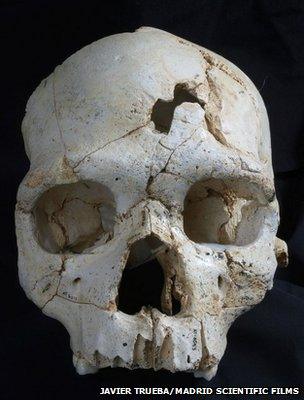
Human remains from a cave in northern Spain show evidence of a lethal attack 430,000 years ago, a study has shown.
Researchers examined one skull from a site called the Pit of Bones, which contains the remains of at least 28 people.
They concluded that two fractures on that skull were likely to have been caused by "multiple blows" and imply "an intention to kill".

Read the rest of this article...

'New species' of ancient human found

Researchers say the jaw bones and teeth are unlike any they have seen before

A new species of ancient human has been unearthed in the Afar region of Ethiopia, scientists report.
Researchers discovered jaw bones and teeth, which date to between 3.3m and 3.5m years old.
It means this new hominin was alive at the same time as several other early human species, suggesting our family tree is more complicated than was thought.
The new species has been called Australopithecus deyiremeda, which means "close relative" in the language spoken by the Afar people.

Read the rest of this article...

Tuesday, May 26, 2015

Danish Bronze Age girl may have been German


One of Denmark's proudest relics may not be Danish after all, researchers have found.

In a feat of laboratory sleuthing, scientists on Thursday provided a background to a mysterious Bronze Age teenager who died in modern-day Denmark 3,400 years ago.
 
The "Egtved Girl," uncovered at a village in the Jutland peninsula, was probably born in southwestern Germany and may have been married off to cement ties between powerful families, they said.
 
One of Denmark's proudest relics, the Egtved Girl was found in 1921 at a burial mound, inside an oak coffin that dates her interment to a summer's day in the year 1370 BC.

Read the rest of this article...

Our bond with dogs may go back more than 27,000 years


Dogs' special relationship to humans may go back 27,000 to 40,000 years, according to genomic analysis of an ancient Taimyr wolf bone reported in the Cell Press journal Current Biologyon May 21. Earlier genome-based estimates have suggested that the ancestors of modern-day dogs diverged from wolves no more than 16,000 years ago, after the last Ice Age.
The genome from this ancient specimen, which has been radiocarbon dated to 35,000 years ago, reveals that the Taimyr wolf represents the most recent common ancestor of modern wolves and dogs.
"Dogs may have been domesticated much earlier than is generally believed," says Love Dalén of the Swedish Museum of Natural History. "The only other explanation is that there was a major divergence between two wolf populations at that time, and one of these populations subsequently gave rise to all modern wolves." Dalén considers this second explanation less likely, since it would require that the second wolf population subsequently became extinct in the wild.
Read the rest of this article...

Thursday, May 21, 2015

Oldest stone tools pre-date earliest humans


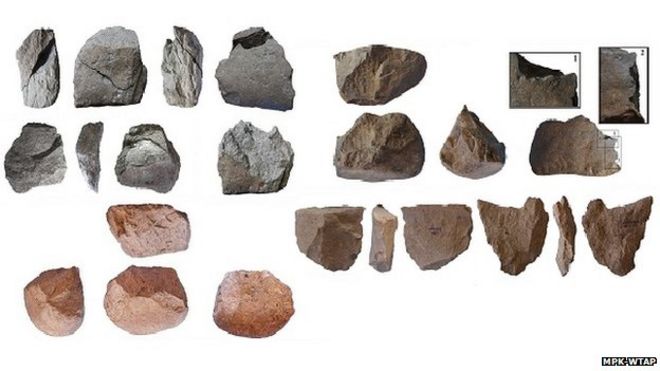
The tools includes sharp-edged flakes, hammers and anvils

The world's oldest stone tools have been discovered, scientists report.
They were unearthed from the shores of Lake Turkana in Kenya, and date to 3.3 million years ago.
They are 700,000 years older than any tools found before, even pre-dating the earliest humans in the Homo genus.
The find, reported in Nature, suggests that more ancient species, such asAustralopithecus afarensis or Kenyanthropus platyops, may have been more sophisticated than was thought.
"They are significantly earlier than anything that has been found previously," said Dr Nick Taylor, from the National Centre of Scientific Research (CNRS) in France and the University of Leiden in the Netherlands.

Read the rest of this article...

Tuesday, May 5, 2015

Prehistoric man with shield found after dig


An archeological dig in Pocklington has unearthed a prehistoric man buried with a shield.

The skeleton was found in one of the square barrows at the recently discovered Iron Age burial ground on Burnby Lane, which is where developer David Wilson Homes is planning to build 77 new houses.

MAP Archaeological Practice, the company which is carrying out the excavation work, says it has also discovered a man “of an impressive stature.”

The site has so far yielded more than 38 square barrows and in excess of 82 burials.

Read the rest of this article...

Neolithic fishing spear found in southern Denmark


At the archaeological investigations ahead of the construction of the future Fehmarn Belt Fixed Link, archaeologists from Museum Lolland-Falster have found an object that attracts particular attention. Jammed into the marine sediments was the head part of a fragmented fishing leister consisting of parts from both lateral prongs and a bone point slightly offset between them. It has long been presumed that there was a link between leister prongs and bone points, but this is probably the first time the connection has been documented in practice. The find thus confirms a theory that has been supported by archaeologists for decades, and which has been indicated by anthropological examples as well.


The Stone Age fishing leister, as it was found  [Credit: Museum Lolland-Falster]

"It is quite amazing that we have made a find that can help prove an old theory. So far, we have found a large number of individual leister prongs and bone points, but when we found them combined, it was quite remarkable. At last we are able to positively confirm the old theory because of this find," says Søren Anker Sørensen archaeologist at Museum Lolland-Falster.

Read the rest of this article...