Friday, October 18, 2013

5200 BC House Discovered in Romania


Recently , we shared with you some recent discoveries in Romania, from various periods. Apparently there is room for more, as the biggest house from the pre-Cucuteni period, 5200-5100 BC was just found in Baia, Suceava. Experts from the Cambridge University support this research, seeking to identify how the grain trade between China and Europe was made at that time.

The discovery is extremely important, as it confirms the existence of the pre-Cucuteni first phase. A similar archaeological discovery, from the same period, was made in 1951.

Emil Ursu, Bucovina’s Museum Director, said that the site will be dated using Carbon 14 into a laboratory in Germany.

Read the rest of this article...

Skull Find Could Change Picture of Early Human Evolutionary History


We may have to change some thinking about early human evolution in a major way, suggests researchers, after studying new fossil finds at the site of Dmanisi in the Republic of Georgia. What has previously been thought to be separate ancient human species - Homo erectus,Homo habilis, Homo rudolfensis, and Homo ergaster, for example, may actually be variations of one and the same species. This is the conclusion of a recent examination of fossil finds uncovered at this, the world's earliest known hominid site outside of Africa.

The new report describes the analysis of a complete, approximately 1.8-million-year-old cranium that was discovered in 2005 by scientists who, 5 years earlier, uncovered its corresponding mandible (jaw) at the same location. Combined, these fossils now constitute the most complete adult ancient human ancestor skull known to be identified with the Early Pleistocene genus of Homo (the genus of great apes that includes modern humans and species closely related to them). The Early Pleistocene time period ranged between 2.588 ± 0.005 Ma (million years ago) and 0.781 ± 0.005 Ma.
Read the rest of this article...

1.8M-year-old skull gives glimpse of our evolution, suggests early man was single species


In this photo taken Oct. 2, 2013, in Tbilisi, Georgia, David Lordkipanidze, director of the Georgia National Museum, holds a pre-human skull found in 2005 in the ground at the medieval village Dmanisi, Georgia.


The discovery of a 1.8-million-year-old skull of a human ancestor buried under a medieval Georgian village provides a vivid picture of early evolution and indicates our family tree may have fewer branches than some believe, scientists say.
The fossil is the most complete pre-human  uncovered. With other partial remains previously found at the rural site, it gives researchers the earliest evidence of human ancestors moving out of Africa and spreading north to the rest of the world, according to a study published Thursday in the journal Science.
The skull and other remains offer a glimpse of a population of pre-humans of various sizes living at the same time—something that scientists had not seen before for such an ancient era. This diversity bolsters one of two competing theories about the way our early ancestors evolved, spreading out more like a tree than a bush.
Read the rest of this article...

Archaeologists rediscover the lost home of the last Neanderthals


A record of Neanderthal archaeology, thought to be long lost, has been re-discovered by NERC-funded scientists working in the Channel island of Jersey.
The study, published today in the Journal of Quaternary Science, reveals that a key archaeological site has preserved geological deposits which were thought to have been lost through excavation 100 years ago.
The discovery was made when the team undertook fieldwork to stabilise and investigate a portion of the La Cotte de St Brelade cave, on Jersey's south eastern coastline.
A large portion of the site contains sediments dating to the last Ice Age, preserving 250,000 years of climate change and archaeological evidence.
Read the rest of this article...

Blow to multiple human species idea

The 1.8 million-year-old skull is the most complete hominid skull ever found

The idea that there were several different human species walking the Earth two million years ago has been dealt a blow.
Instead, scientists say early human fossils found in Africa and Eurasia may have been part of the same species.
Writing in the journal Science, the team says that Homo habilis, Homo rudolfensis and Homo erectus are all part of a single evolving lineage that led to modern humans.
But others in the field reject this.
A team looked at the most complete hominid skull ever found, which was uncovered in Dmanisi, Georgia.
Read the rest of this article...

Wednesday, October 16, 2013

Frogs' legs may have been English delicacy 8,000 years before France

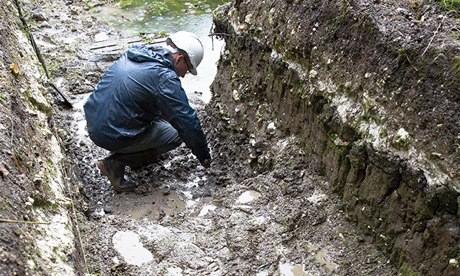
Blick Mead, near Stonehenge, where a charred toad's leg was found. Photograph: University of Buckingham/PA

If you're French, asseyez-vous, s'il vous plait. Archaeologists digging about a mile away from Stonehenge have made a discovery that appears to overturn centuries of received wisdom: frogs' legs were an English delicacy around eight millennia before becoming a French one.
The shock revelation was made public on Tuesday by a team which has been digging at a site known as Blick Mead, near Amesbury in Wiltshire. Team leader David Jacques said: "We were completely taken aback."
In April they discovered charred bones of a small animal, and, following assessment by the Natural History Museum, it has been confirmed that there is evidence the toad bones were cooked and eaten. "They would have definitely eaten the leg because it would have been quite big and juicy," said Jacques.
Read the rest of this article...

Tuesday, October 15, 2013

Bronze Age Europe – the first Industrial revolution


s part of a larger pan-European study investigating the Bronze Age of Europe, an archaeologist from the University of Gothenburg has provided the first evidence of long distance travel by an individual – probably from southern Sweden – into the territory of the Únětice culture of Silesia.

The doctoral thesis confirms evidence based on bioarchaeological data.

A traveller from Sweden

‘Over 3800 years ago, a young male, possibly born in Skåne, made a journey of over 900 kilometres south, to Wroclaw in Poland”. concludes Dalia Pokutta, author of the thesis. He met his end violently in Wroclaw, killed in the territory of the Úněticean farmers. His remains were discovered in association with two local females, who had been killed at the same time.

Read the rest of this article...

Amesbury dig 'could explain' Stonehenge history


A group of archaeologists is undertaking a major dig in Wiltshire, which it is hoped could explain why Stonehenge was built where it was. 

The team, which consists of leading experts in the Mesolithic period, also hopes to confirm Amesbury as the oldest continuous settlement in the UK. 

The site already boasts the biggest collection of flints and cooked animal bones in north-western Europe.

Read the rest of this article...

Iron Age camp unearthed at UK quarry


Archaeologists have unearthed an Iron Age enclosure while excavating land at the edge of a working quarry.

Iron Age camp unearthed at UK quarry
Archaeologists are excavating land close to Potgate Quarry [Credit: Steve Timms/BBC]
It is thought the encampment discovered at Potgate Quarry, near Ripon, was home to several families from as early as 130BC before being abandoned.

Dig leader Steve Timms said the site was later brought back into use in the early Roman period as a paddock.

Read the rest of this article...

Forscher enträtseln die Bevölkerungsentwicklung Europas in der Jungsteinzeit


Die bisher umfangreichste und detaillierteste genetische Studie zur Besiedlungsgeschichte Europas während des Neolithikums ergab deutliche Hinweise auf vier wesentliche Migrationsereignisse in der Zeit zwischen dem 6. und 2. Jahrtausend v. Chr. Für die heute in Science veröffentlichte Studie untersuchten Anthropologen aus Mainz und Adelaide in Kooperation mit Archäologen aus Halle (Saale) hunderte DNA-Proben von jungsteinzeitlichen Skelettfunden aus dem Mittelelbe-Saale-Gebiet.

Read the rest of this article...

Friday, October 11, 2013

European origins laid bare by DNA

DNA from ancient skeletons has revealed how a complex patchwork of prehistoric migrations fashioned the modern European gene pool.

The study appears to refute the picture of Europeans as a simple mixture of indigenous hunters and Near Eastern farmers who arrived 7,000 years ago.

The findings by an international team have beenpublished in Science journal.

DNA was analysed from 364 skeletons unearthed in Germany - an important crossroads for prehistoric cultures.

Read the rest of this article...


Link to Oetzi the Iceman found in living Austrians

Austrian scientists have found that 19 Tyrolean men alive today are related to Oetzi the Iceman, whose 5,300-year-old frozen body was found in the Alps.

Their relationship was established through DNA analysis by scientists from the Institute of Legal Medicine at Innsbruck Medical University.

The men have not been told about their connection to Oetzi. The DNA tests were taken from blood donors in Tyrol.

Read the rest of this article...


Monday, October 7, 2013

Shock Bronze Age find 'changes history'


Archaeologists in northern Sweden have located the remains of a farm from the Bronze Age, a find which challenges the established history of the area around Umeå and the province of Norrland.
 
"It is completely unique," Jan Heinerud at Västerbotten's Museum in Umeå told The Local on Friday. "We have never previously found a long house like this so far north."

The farm was discovered in the area between Backen and Klabböle in an area known as Klockaråkern and it is thought that the farm was in use for almost 600 years from around 1100 BC.


Read the rest of this article...

Monday, September 30, 2013

Stonehenge prepares to open visitor centre after decades of rows and delays


Construction of museum, cafe and shop 1.5 miles from stones follows series of scrapped plans and missed deadlines

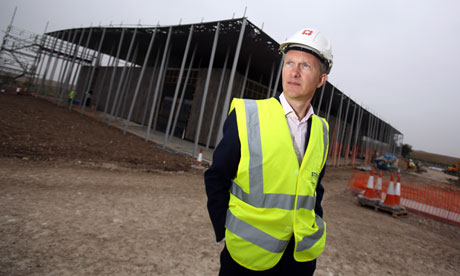
The English Heritage chief executive, Simon Thurley, outside the soon-to-be-completed Stonehenge visitor centre. Photograph: Matt Cardy/Getty Images
On 18 December, a mere 24 years after the parliamentary public accounts committee denounced the visitor facilities at one of the world's most famous ancient monuments as "a national disgrace", and 85 years after the idea was first mooted, a new £27m visitor centre will open atStonehenge.
For the first time there will be a museum-quality gallery interpreting the site and displaying original finds, as well as a cafe and shop. There was a distinct air of incredulity among many of the English Heritage staff, bruised and battered survivors of decades of debate, funding rows, public inquiries and planning consultations, sites identified and then abandoned, grandiose plans announced and promptly cancelled, landmark dates including the millennium and the Olympics missed, even as they stood in hard hats and hi-vis jackets in the shadow of the almost completed building.
Read the rest of this article...

Listen here: Our ancestors may have sounded like this


Recording studios were hard to find 6,500 years ago, but thanks to centuries of scholarship, we may now be able to get a sense of how our ancient ancestors sounded.

A linguist at the University of Kentucky has recorded a short story in Proto-Indo-European, or PIE, a language probably spoken across Europe and Asia from about 4,500 BCE to 2,500 BCE. Professor Andrew Byrd used Latin, Greek, and Sanskrit to deduce what PIE might have sounded like, the Huffington Post reports.

It's "a very educated approximation," Byrd says.

Read the rest of this article...

New Finds Uncovered at Ancient Greek Site of Argilos

With a team of 50 students and additional help from workmen, archaeologists have uncovered the remains of structures at the site of ancient Argilos on the coast of Macedonia, reporting that the finds will help open an additional window on the development and economy of one of the earliest Greek colonies in an area that was previously settled by the Thracians.

Among the discoveries was a large portico consisting of at least seven storerooms.
"The building is in a remarkable state of preservation, and five rooms have been partially excavated this year," report excavation co-directors Zizis Bonias of Greece's 18th Ephorate of Prehistoric and Classical Antiquities and Jacques Perreault of the University of Montreal. "In its early state, the building probably dates back to the 6th century BC."
Read the rest of this article...

Anthropologists confirm link between cranial anatomy and two-legged walking


Comparison of the skeletons of three bipedal mammals: 
an Egyptian jerboa, an eastern gray kangaroo and a human.


Anthropology researchers from The University of Texas at Austin have confirmed a direct link between upright two-legged (bipedal) walking and the position of the foramen magnum, a hole in the base of the skull that transmits the spinal cord.
The study, published in a forthcoming issue of the Journal of Human Evolution, confirms a controversial finding made by anatomist Raymond Dart, who discovered the first known two-legged walking (bipedal) human ancestor, Australopithecus africanus. Since Dart's discovery in 1925, physical anthropologists have continued to debate whether this feature of the cranial base can serve as a direct link to bipedal .
Chris Kirk, associate professor of anthropology and co-author of the study, says the findings validate foramen magnum position as a  for fossil research and sheds further insight into human evolution.
Read the rest of this article...

Sunday, September 29, 2013

Yorkshire Museum appeals to public to help save Iron Age jewellery of pre-Roman torc


Curators at The Yorkshire Museum are warning that a 2,000-year-old torc, described as having a rarer and more intricate style than its sister treasure, which was saved in 2012, could be sold at auction if they cannot raise £30,000 by October.

The precious bracelets became the first examples of Iron Age gold jewellery to have been found in the north of England when they were discovered by metal detectorists near Tadcaster in 2010 and 2011.

Despite being unearthed separately, curators say they were “almost certainly” buried together, having once belonged to a member of the ruling Brigantes whose extreme wealth could have indicated Royal status.


Read the rest of this article...

Ancient Greek site threatened amid celebration


Greece—While world leaders and top athletes lit the Olympic flame with pageantry drawn from antiquity, another important ancient site of athletic prowess sat overlooked and endangered.

Some 200 kilometers (125 miles) east of Ancient Olympia where the flame lighting for the 2014 Winter Games in Sochi went off without a hitch Sunday, the Nemea stadium and its humbler games are in danger of closing to the public because of crisis-hit Greece's harsh budget cuts, according to a renowned American archaeologist who led excavations there for decades.
Stephen G. Miller, professor emeritus of classical archaeology at the University of California, Berkeley, arrived at Nemea in 1973, when the ancient site still lay buried beneath a highway and vineyards used by raisin farmers. Excavations there unearthed the temple and stadium, one of the four major sites where Ancient Greek games were held: Olympia, Delphi, Isthmia and Nemea.
Read the rest of this article...

Bulgaria’s 2013 season draws to a close


The archaeology season for Bulgaria is winding down, with a number of dig teams announcing their findings in recent days. Although this summer has not yielded any treasure troves comparable to the one found at Sveshtari in 2012, there is still time – that particular find came in early November.

Bulgaria’s 2013 season draws to a close
The two-wheeled carriage and carcasses of the horses (foreground) were found in a Thracian tomb along with some decorations [Credit: Rex/Daily Mail]
At Sveshtari, near Razgrad, the team led by professor Diana Gergova has found the remains of a two-wheel chariot, buried with two horses still in their harness. Each horse was buried in its own sarcophagus.

Gergova described the find as unique for Bulgaria, the first physical evidence confirming some of the historical theories about Thracian culture. A mural of a two-wheel chariot has been previously found in a burial mound near Kazanluk, but the two chariots previously found by Bulgarian archaeologists both had four wheels, she said.


Read the rest of this article...

Saturday, September 28, 2013

2500-Year-Old Horse Remains in Bulgaria Suggest Creatures Were Buried Upright


Archaeologists have uncovered the remains of a Thracian carriage and two horses that appear to have been buried upright.

The chariot and horse skeletons are 2,500-years-old and were discovered in the village of Svestari in north-east Bulgaria.

The two-wheeled carriage and carcasses of the horses were found in a Thracian tomb along with some decorations.

Professor Diana Gergova of the National Archaeology Institute at the Bulgarian Academy of Sciences, who led the dig, said: 'The find is unique, it is not resembling any other carriage dating from the Thracian era ever uncovered in Bulgaria.'

Read the rest of this article...

Thursday, September 26, 2013

Fight hots up to keep Iron Age gold in Yorkshire

Natalie McCaul, curator of archaeology at the Yorkshire Museum, with the Iron Age torc, right, that the museum is hoping to buy to reunite it with one found metres from it at Towton, left, that is already in the collection

GOLD jewellery thought to be 2,000-years-old could leave North Yorkshire, if essential funds can not be raised.
The gold torcs, or bracelets, are currently on show at the Yorkshire Museum, and are the first items of Iron Age gold jewellery ever found in the north of England.
Read the rest of this article...

Bronze Age 'boat building' discovery in Monmouth

Reconstruction of the channels in the clay earth by Peter Bere
An artist's impression of how the channels could have been left in the ground at Monmouth

Archaeologists believe they have found the remains of a Bronze Age boat building community in Monmouth.
Excavations show 100ft-long (30m) channels in the clay along which experts think vessels were dragged into a long-gone prehistoric lake.
Monmouth Archaeological Society started to unearth new findings when work started on Parc Glyndwr housing estate two years ago.
The research is being published in a book called The Lost Lake.
Read the rest of this article...

Londonderry city walls archaeological dig extended


The Northern Ireland environment minister has announced a two-week extension to an archaeological dig in Derry that uncovered 13 skeletons last week.

Watch the video...

Derry dig team working in Bishop Street given more time to go back 4,000 years

The human remains found believed to be of a child aged between six and 10 years old

The archaeological dig that uncovered 13 skeletal remains from the early 17th century in Londonderry has now revealed evidence of life in the area 4,000 years ago.


New finds from the early Bronze Age mean the area has been settled for thousands of years more than previously thought.
The first artefact discovered was a flint tool known as a scraper, which would have been used to clean and prepare animal hides.
Read the rest of this article...

The First Great Human Population Explosion


It seems there is no end these days to what genetics might be telling us about our past. To add to the profusion of new findings are the conclusions of another study that suggest an early human population boom around 60,000 - 80,000 years ago, marking perhaps the first great population expansion of human history, or pre-history, as the case would be.

The prevailing theory is that, as humans transitioned to domesticating plants and animals around 10,000 years ago, they developed a more sedentary lifestyle, leading to settlements, the development of new agricultural techniques, and relatively rapid population expansion from 4-6 million people to 60-70 million by 4,000 B.C.
Read the rest of this article...

Archaeological dig seeks evidence of the very first islanders' arrival


ISLANDS perhaps better known for their Bronze Age relics are revealing traces of an earlier civilisation.
A settlement being unearthed on St Martin's represents "the most promising neolithic site in Scilly", according to Dr Duncan Garrow of Liverpool University, a specialist in the prehistory of North- West Europe.
  1. ​The dig site at St Martin's Old Quay, where 2m by 2m test pits have revealed a wealth of ancient material.
    The dig site at St Martin's Old Quay, where 2m by 2m test pits have revealed a wealth of ancient material.
Along with maritime archaeologist Dr Fraser Sturt of Southampton University and a ten-strong team, supplemented by locals, he is exploring how Neolithic man arrived on the islands some 5,000 to 6,000 years ago.

Read the rest of this article...

Alpine Archaeology Reveals High Life Through the Ages


An international team of archaeologists led by experts from the University of York has uncovered evidence of human activity in the high slopes of the French Alps dating back over 8000 years.

The 14-year study in the Parc National des Eìcrins in the southern Alps is one of the most detailed archaeological investigations carried out at high altitudes. It reveals a story of human occupation and activity in one of the world's most challenging environments from the Mesolithic to the Post-Medieval period.
The work included the excavation of a series of stone animal enclosures and human dwellings considered some of most complex high altitude Bronze Age structures found anywhere in the Alps.

Read the rest of this article...
A Bronze Age stone pathway that links stone circles has been uncovered for the first time since the 1930s.

Hurlers stone circles pathway uncovered
The dig was a community archaeological project with local people and
enthusiasts helping the experts [Credit: BBC]

Archaeologists were helped by local people to "re-discover" the feature, laid between two of the Hurlers stone circles on Bodmin Moor, Cornwall.

The 4,000-year-old pavement has been described as "unique" by archaeologists. They hope it will give a better understanding of early civilisations.


Read the rest of this article...

Tuesday, September 24, 2013

A VIRTUAL PREHISTORIC WORLD YOU CAN EXPLORE

Digital world. Image: Marcus Abbott

Imagine the possibilities as you explore a stunning visualisation of a 3D digital world generated from archaeological and paleo-environmental data. It already exists, but needs your help in order to make it freely available to the world.

A virtual prehistoric world

This project offers a visual representation of what is known about an ancient landscape, combining detailed archaeological and scientific data with cutting edge digital recording and visualisation techniques to produce a virtual world, but so real that the past and present become one.
The world you will enter is over 3500 years ago; the Bronze Age of East Anglia, UK  and focuses on an area known to be of great ritual significance during this period.

A liminal wetland environment

The landscape is a liminal wetland environment and what you will be able to explore has been generated entirely digitally. The archaeology has been painstakingly reconstructed from evidence found on sites in the area; round houses, wooden platforms, track ways, fences and even the great causeway structures of Flag Fen are all present.
Read the rest of this article...

Neolithic stone puts spotlight on Perthshire glen’s ancient history

The possible Neolithic quern stone found in Balnaguard Glen.

An ancient relic that shines a light on Neolithic life has been discovered on a picturesque reserve in Highland Perthshire.
The Scottish Wildlife Trust made the exciting archaeological discovery while repairing a wall in Balnaguard Glen. Volunteers were working on field walls on the hillside when they noticed one of the wall stones was shaped like a shallow basin.
It has since been identified as a possible Neolithic quern stone — potentially more than 6,000 years old — with its shape created by years of rubbing grain with a heavy stone to make flour.
Read the rest of this article...

How Complex Was Neanderthal Speech?


The challenge: Unlike pottery shards, arrowhead flints, and cave paintings, language does not leave an archaeological trace that can be uncovered by intrepid linguists bearing bullwhips.
That makes anything we say about early human speech and language very speculative. (As I've mentioned elsewhere, e.g., How did languages evolve?, it's been deemed so speculative that at one point, the Paris Linguistics Society banned discussion on the topic in the 19th century.)
And that makes what we say about Neanderthal speech doubly speculative because at least with humans, when we consider the evolution of speech for anatomically modern humans, we have living, breathing examples to look at, measure, experiment on, and observe. Everything about Neanderthals, we have to reconstruct from fossils and, now, DNA.
Read the rest of this article...

Cave Paintings Among the Oldest in Europe

Scientists find wall paintings in the Altxerri cave system in northern Spain pre-date most prehistoric paintings in Europe.

A team of scientists from the Universities of Cantabria and Burgos in Spain and Toulouse in France have dated prehistoric wall paintings in the Altxerri cave system in the Gipuzkoa province of northern Spain to about 39,000 years BPE, making them among the earliest known cave paintings produced by humans in Europe.

It was in 2011 when Cantabria University members Aitor Ruiz and César González began to explore the upper gallery of the cave, designated Altxerri B, with the objective of coming up with some reliable dates for the less-explored wall paintings in this part of the cave system. These paintings appeared to have been done independently of other paintings found in a lower gallery, paintings already with known dates that fell within the 29,000 - 35,000 BPE range. The paintings in this upper gallery were figurative representations of a bison (the most common element among the Altxerri cave system paintings) a feline, a possible animal's head, a bear and two groups of three finger marks, as well as other motifs. Ruiz and González also employed the help of Diego Garate, a specialist in Upper Paleolithic cave art from the University of Toulouse, to help them place and interpret the paintings and their findings within the context of current knowledge about Paleolithic art in Europe.
Read the rest of this article...

Mycenean Palace and Linear B Tablets Discovered in Sparta Area


A new excavation in the Xirokambi area of Aghios Vassilios west of Sparta, in the Peloponnese, Greece, has revealed a richness of Mycenean artefacts in the area, including the remains of a palace, Linear B tablets, fragments of wall paintings, and several bronze swords.
The excavation, led by emeritus ephor of antiquities Adamantia Vassilogrambrou, was presented publicly at the biennial Shanghai Archaeology Forum at the end of August as one of 11 sites showcased from different parts of the world.
The Aghios Vassilios excavation began in 2010, after Linear B tablets were found in the area in 2008, pointing to the existence of a powerful central authority and distribution system. The deciphered texts were devoted to perfume and cloth production, the trade of which was controlled by a palace administration in the Mycenean era.
Read the rest of this article...

UC Davis research finds Neandertals, not modern humans, made first specialized bone tools in Europe


One day in 2011, undergraduate student Naomi Martisius was sorting through tiny bone remnants in the University of California, Davis, paleoanthropology lab when she stumbled across a peculiar piece.
The bone fragment, from a French archaeological site, turned out to be a part of an early specialized bone tool used by a Neandertal before the first modern humans appeared in Europe.
"At the time, I had no idea about the impact of my discovery," said Martisius, who is now pursuing her doctoral degree in anthropology at UC Davis.
Martisius' opportunity was the result of a decade of excavation and research by two international teams. Their findings were published in the Proceedings of the National Academy of Science in August.
"Previously these types of bone tools have only been associated with modern humans," said Teresa E. Steele, associate professor of anthropology at UC Davis, who also served as a co-author on the article and adviser to Martisius at UC Davis and at archaeological excavations in France.
Read the rest of this article...

6,000 yr old wine discovered in eastern Macedonia


In the prehistoric settlement of Dikili Tash were discovered the oldest samples of wine that were ever recorded in Europe. The samples date back to 4200 BC and reverse existing data regarding the way of living during the Neolithic period.

6,000-year-old wine discovered in eastern Macedonia
Excavations at Dikili Tash [Credit: Ethnos]
The prehistoric site of Dikili Tash is located south east of Drama in Eastern Macedonia, Greece. It lies approximately 2 km from the ruins of the ancient city of Philippi and within the limits of the modern town of Krinides (Municipality of Kavala).

“It is an impressive and important discovery,” the archaeologist of the 17th Ephorate of Prehistoric and Classical Antiquities and co-director of the excavations at Dikili Tash Dimitra Malamidou told dimokratianews.gr. She explained that, “During the excavations that took place in a house on the archaeological site, called House 1, quantities of carbonized grape berries that had been pressed were discovered in pots, a fact which proves the extraction of juice from grapes.”


Read the rest of this article...

World's oldest bog body hints at violent past

A CT scan of Cashel Man showing the compressed state of the remains that are 500 years older than Tutankhamen

Cashel Man has had the weight of the world on his shoulders, quite literally, for 4,000 years.
Compressed by the peat that has preserved his remains, he looks like a squashed, dark leather holdall.
Apart, that is, from one forlorn arm that stretches out and upward and tells us something of the deliberate and extremely violent death that he suffered 500 years before Tutankhamen was born.

“Start Quote

As part of that decommissioning, their nipples are mutilated”
Eamonn KellyNational Museum of Ireland
Cashel Man is now being studied at the National Museum of Ireland's research base in Collins Barracks, Dublin. He was discovered in 2011 by a bog worker in Cashel bog in County Laois.
Read the rest of this article...

Monday, September 23, 2013

Skeleton of ancient prince reveals Roman life


Italian archaeologists have unearthed a 2,600-year-old intact Etruscan tomb that promises to reveal new depths of one of the ancient worlds most fascinating and mysterious cultures. (ROSSELLA LORENZI)

The skeletonized body of an Etruscan prince, possibly a relative to Tarquinius Priscus, the legendary fifth king of Rome from 616 to 579 B.C., has been brought to light in an extraordinary finding that promises to reveal new insights on one of the ancient world’s most fascinating cultures.

Found in Tarquinia, a hill town about 50 miles northwest of Rome, famous for its Etruscan art treasures, the 2,600 year old intact burial site came complete with a full array of precious grave goods.

“It’s a unique discovery, as it is extremely rare to find an inviolate Etruscan tomb of an upper-class individual. It opens up huge study opportunities on the Etruscans,” Alessandro Mandolesi, of the University of Turin, told Discovery News. Mandolesi is leading the excavation in collaboration with the Archaeological Superintendency of Southern Etruria.

Read the rest of this article...

Giant Prehistoric Elephant Slaughtered by Early Humans


Elephant tusks at Ebbsfleet. (Credit: University of Southampton)

Research by a University of Southampton archaeologist suggests that early humans, who lived thousands of years before Neanderthals, were able to work together in groups to hunt and slaughter animals as large as the prehistoric elephant.

Dr Francis Wenban-Smith discovered a site containing remains of an extinct straight-tusked elephant (Palaeoloxodon antiquus) in 2003, in an area of land at Ebbsfleet in Kent, during the construction of the High Speed 1 rail link from the Channel Tunnel to London.
Investigation of the area was carried out with independent heritage organisation Oxford Archaeology, with the support of HS1 Ltd.
Read the rest of this article...

Tuesday, September 17, 2013

Dating of Beads Sets New Timeline for Early Humans

Beads from the site of Ksar Akil (Lebanon) found closely associated with the skeleton of an early modern girl dating to between 39,000–41,000 years ago. The beads shown here are made of the shell of a small marine snail (Nassarius gibbosulus/circumcinctus). The large Glycymeris valve in the centre was not pierced, but its surface preserved bright red pigmentation. (Credit: Katerina Douka and Natural History Museum London)

An international team of researchers led by Oxford University have new dating evidence indicating when the earliest fully modern humans arrived in the Near East, the region known as the Middle East today. They have obtained the radiocarbon dates of marine shell beads found at Ksar Akil, a key archaeological site in Lebanon, which allowed them to calculate that the oldest human fossil from the same sequence of archaeological layers is 42,400-41,700 years old. This is significant because the age of the earliest fossils, directly and indirectly dated, of modern humans found in Europe is roughly similar. This latest discovery throws up intriguing new possibilities about the routes taken by the earliest modern humans out of Africa, says the study published online by the journal PLOS ONE.

Read the rest of this article...