Tuesday, December 22, 2015

Stonehenge tunnel survey reveals new sites, and mysteries


Archaeologists are mapping the area before road is replaced and teasing secrets from the ancient landscape


Some 3,400 years before the roaring torrent of the A303 road sliced theStonehenge landscape in half, some people cut a beautiful pit a metre deep into the chalk with no tools except picks made of red deer antlers. 
They may have had primitive tools, but there was nothing primitive about their skills: the bottom of the pit was so neatly levelled that you could balance a beaker of mead on it without spilling a drop.
As druids and tourists head towards Stonehenge for the winter solstice, which falls this year on 22 December, when the midwinter sun should set framed perfectly by the giant stones, Historic England archaeologists are hard at work teasing ancient secrets out of the landscape.
Read the rest of this article...

Wednesday, December 16, 2015

Dog has been man's best friend for 33,000 years, DNA study finds


First domesticated dogs came about 33,000 years ago and migrated to Europe from south east Asia, rather than descending from domesticated European wolves 10,000 years ago as had previously been thought


Man's best friend came about after generations of wolves scavenged alongside humans more than 33,000 years ago in south east Asia, according to new research.
Dogs became self-domesticated as they slowly evolved from wolves who joined humans in the hunt, according to the first study of dog genomes.
And it shows that the first domesticated dogs came about 33,000 years ago and migrated to Europe, rather than descending from domesticated European wolves 10,000 years ago as had previously been thought.
Scientists have long puzzled over how man's best friend came into existence but there is conflicting evidence on when and where wild wolves were first tamed.
Read the rest of this article...

Tuesday, December 15, 2015

Stonehenge was moved by glaciers - not our prehistoric ancestors


The famous rocks of Stonehenge were not dragged by pagans but moved by glaciers, according to a team of Welsh academics.
Previously, a team of experts from University College London (UCL) claimed to have resolved the archaeological enigma, confirming that the stones were excavated and transported from two sites in Pembrokeshire by our prehistoric ancestors.
The team of archaeologists and geologists said Carn Goedog and Craig Rhos-y-felin, both in the Preseli Hills, had definitely been quarried for the mysterious stones.
They believe that between 4,000 and 5,000 years ago, rocks were taken from the Welsh mountain range by people and dragged away to where they currently stand, in Wiltshire.
But in a recent conflicting report, scientists have refuted UCL’s findings.
Read the rest of this article...

Monday, December 14, 2015

Millet: The missing link in prehistoric humans' transition from hunter-gatherer to farmer


Professor Martin Jones is pictured with millet in north China.

New research shows a cereal familiar today as birdseed was carried across Eurasia by ancient shepherds and herders laying the foundation, in combination with the new crops they encountered, of 'multi-crop' agriculture and the rise of settled societies. Archaeologists say 'forgotten' millet has a role to play in modern crop diversity and today's food security debate.
The domestication of the small-seeded cereal millet in North China around 10,000 years ago created the perfect crop to bridge the gap between nomadic hunter-gathering and organised agriculture in Neolithic Eurasia, and may offer solutions to modern food security, according to new research.
Read the rest of this article...

Studies show early human hunters more advanced than previously thought


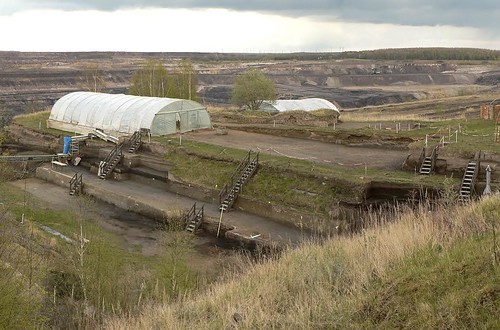
The Schöningen excavation site. Tangelnfoto, Wikimedia Commons 
The Paleolithic site of Schöningen in north-central Germany is best known for the earliest known, completely preserved wooden spears (at least 10 recovered) by archaeologists under the direction of Dr. Hartmut Thieme between 1994 and 1998 at an open-cast lignite mine. Deposited in organic sediments on an ancient lakeshore, they were found in combination with the remains of about 16,000 animal bones, including 20 to 25 butchered wild horses, whose bones featured numerous butchery marks, including one pelvis that still had a spear protruding from it. The finds are considered evidence that early humans were active hunters with specialized tool kits as early as 300,000 or more years ago.
Now, a series of detailed study reports on the Schöningen findings have been published online in the Journal of Human Evolution. Altogether, they present a picture of groups of prehistoric hunters who sojourned at sites in the Schöningen area about 300,000+ years ago and hunted and processed mammalian species such as wild horse and red deer using tools/weapons made of wood, stone and bone. The findings have changed the long-accepted paradigm of a more primitive early human hunting culture during this time period that featured primarily stone tools and weapons and a somewhat more limited subsistence strategy.
Read the rest of this article...

6,000-year-old skeletons in French pit came from victims of violence


CIRCLE OF DEATH  A circular pit excavated in France (left) contains the remains of eight people probably killed in a violent attack around 6,000 years ago. Seven severed left arms lay at the bottom of the pit. A diagram of the pit discoveries denotes bones of each individual in different colors.

A gruesome discovery in eastern France casts new light on violent conflicts that took lives — and sometimes just limbs — around 6,000 years ago.

Excavations of a 2-meter-deep circular pit in Bergheim revealed seven human skeletons plus a skull section from an infant strewn atop the remains of seven human arms, say anthropologist Fanny Chenal of Antea Archéologie in Habsheim, France, and her colleagues.

Two men, one woman and four children were killed, probably in a raid or other violent encounter, the researchers report in the December Antiquity. Their bodies were piled in a pit that already contained a collection of left arms hacked off by axes or other sharp implements. Scattered hand bones at the bottom of the pit suggest that hands from the severed limbs had been deliberately cut into pieces.

Read the rest of this article...

Unique Neolithic sculpture found at Czech site


Archaeologists in the east Moravian town of Přerov have discovered a unique statuette which they believe dates back to the early Neolithic period. The richly ornamented torso has been hidden under ground for over seven thousand years ago. 


The richly engraved torso of a Neolithic figurine was found at an archaeological  site in the Czech Republic [Credit: Zdeněk Schenk] 

The valuable finding was discovered during initial excavations of an archaeological site near Lipník nad Bečvou, a small town on the edge of the Moravian Gate valley. It is a torso of a body, or what the archaeologists call an anthropomorphic sculpture, richly engraved with geometric ornaments. It is about 76 millimetres tall and its head and arms have been broken off. 

According to the head of the archaeological research at the site Zdeněk Schenk, the statuette must be at least seven thousand years old, since it was found on the site of an early Neolithic settlement:

Read the rest of this article...

Dans les pas des mammouths de Montereau-sur-le-Jard (Seine-et-Marne)


Avant la construction, par Snecma, d’un nouveau bâtiment sur le site de Villaroche, à Montereau-sur-le-Jard (Seine-et-Marne), la Drac Île-de-France (service régional de l’Archéologie) a prescrit des recherches archéologiques menées par l’Inrap. 

Le diagnostic, préalable à la fouille, a montré une répartition des vestiges archéologiques sur une surface de 3 000 m². Seuls les


1 800 m² menacés par les travaux d’aménagement ont donné lieu à une fouille, de juin à juillet 2015. 
Les recherches ont démontré que le site a été occupé à plusieurs reprises au Paléolithique moyen (entre - 300 000 et - 40 000 avant notre ère). De nombreux outils en silex associés à des restes de mammouths datés de la dernière glaciation (autour de 100 000 ans avant notre ère) ont été mis au jour. Ces découvertes sont d’autant plus inédites qu’elles sont faites en contexte de plateau. Elles éclairent de façon singulière les comportements de subsistance des groupes humains à cette période. 


Read the rest of this article...
Wednesday, December 2, 2015

Did our ancient ancestors 'kill the cat'?

The European sabre-toothed cat was about the size of a modern tiger or lion

Our ancient human cousins may have fought off big cats with spears, according to archaeological evidence.
The sabre-toothed cat lived alongside early humans, and may have been a fearsome enemy, say scientists.
Several feline teeth - and a chunk of arm bone - were uncovered at a site in Germany known for the oldest discovery of human spears.
The 300,000-year-old animal fossils are described as "spectacular".
The sabre-toothed cat - once known as the sabre-toothed tiger - lived from about 55.8 million to 11,700 years ago.
Read the rest of this article...

Secrets unearthed at Boodie Cave: humankind just got a little older


Boodie Cave on Barrow Island is yielding an ancient secret of global significance: resourceful, well-fed humans were living in its limestone chambers more than 50,000 years ago, several thousand years earlier than archaeologists had ­estimated. 


UWA researcher and PhD student Kane Ditchfield excavating Boodie Cave,  on Barrow Island off Western Australia [Credit: Ingrid Ward] 

The startling evidence has been unearthed in surgically excavated pits on Barrow, Western Australia’s second largest island, 50km off the Pilbara coast. 

Thousands of tiny artefacts lie in sediment dated to 50,000 years old in an Oxford University laboratory, where 200 single sand grains were measured by optically stimulated luminescence.

Read the rest of this article...

Rice basket study rethinks roots of human culture

Although teaching is useful, it is not essential for cultural progress. 
Image courtesy of Shutterstock

A new study from the University of Exeter has found that teaching is not essential for people to learn to make effective tools.
The results counter established views about how human tools and technologies come to improve from generation to generation and point to an explanation for the extraordinary success of humans as a species. The study reveals that although teaching is useful, it is not essential for cultural progress because people can use reasoning and reverse engineering of existing items to work out how to make tools.
The capacity to improve the efficacy of tools and technologies from generation to generation, known as cumulative culture, is unique to humans and has driven our ecological success. It has enabled us to inhabit the coldest and most remote regions on Earth and even have a permanent base in space. The way in which our cumulative culture has boomed compared to other species however remains a mystery.
Read the rest of this article...

Human nature’s dark side helped us spread across the world


New research by an archaeologist at the University of York suggests that betrayals of trust were the missing link in understanding the rapid spread of our own species around the world.

Dr Penny Spikins, of the University’s Department of Archaeology, says that the speed and character of human dispersals changed significantly around 100,000 years ago.
Before then, movement of archaic humans were slow and largely governed by environmental events due to population increases or ecological changes. Afterwards populations spread with remarkable speed and across major environmental barriers.
Read the rest of this article...

Thursday, November 26, 2015

Gold jewellery unearthed at prehistoric site in Bulgaria


As gold jewellery goes, it could be considered to be quite modest, but a 6,600 year old pendant discovered at the site of one of Europe's oldest prehistoric towns may be the world's oldest bling. 


The newly found gold jewel from the Solnitsata prehistoric town near Bulgaria’s Provadiya
[Credit: Cherno More News Agency] 

The tiny two-gram pendant was discovered during excavations at the archaeological site of Solnitsata in the Varna region of Bulgaria. 

Archaeologists believe the area may have been part of an advanced prehistoric society that was among the first to work out how to process and produce gold goods. 

The necropolis at Solnitsata, which means 'Salt Pit', is situated just to the north of the Bulgarian city of Provadia. 

Read the rest of this article...

Paleolithic elephant butchering site found in Greece

Excavation with some of the elephant bones exposed.
Credit: Greek Ministry of Culture

A new Lower Paleolithic elephant butchering site, Marathousa 1, has been discovered in Megalopolis, Greece, by a joint team of researchers from the Ephorate of Paleoanthropology and Speleology (Greek Ministry of Culture) and the Paleoanthropology group, University of Tübingen.
Marathousa 1 is located in an open-cast coal mine, on what was once the shore of a shallow lake. It has yielded stratified stone artifacts in association with a nearly complete skeleton of Elephas antiquus, as well as the exceptionally well-preserved remains of fauna (rodents, birds, amphibians, reptiles, mollusks and insects) and plants (wood, seeds, fruit). The association of lithic artifacts with the elephant remains, as well as the discovery of cutmarks on elephant bones, indicate that Marathousa 1 is an elephant butchering site.
Read the rest of this article...

Tuesday, November 24, 2015

Genetic history of Europeans revealed


A study of ancient DNA has shed new light on European genetic history.
It confirms that farming spread across Europe due to the influx of ancient people from what is now eastern Turkey.
Many modern Europeans owe their taller stature to these early farmers - and a later influx of Bronze Age "horsemen" - say international researchers.
In the study, researchers mapped the genes of 273 ancient people who lived in West Europe and Asia from about 8,500 to 2,500 years ago.
Of these, 26 were part of a population that gave rise to Europe's first farmers.
Prof Ron Pinhasi of the School of Archaeology at University College Dublin, a lead researcher on the study, said: "We now have the first clear evidence that agriculture in Europe started with the first farmers coming from what is now Turkey.

Read the rest of this article...

Monday, November 16, 2015

Scientists discover the cause behind prehistoric climate change


Scientists now know why the climate underwent dramatic changes at the end of the last Ice Age.


The atmosphere plays an important role in the speed at which climate change can occur. During the last ice age, it meant that in some places on Earth temperatures increased by 10 degrees centigrade in a single decade. (Photo: Shutterstock)

Scientists have discovered the causes behind a period of dramatic climate change at the end of the last Ice Age, which will help predict how climate will change in the future.
Climate scientists are nervous about how man-made climate change may impact on the Gulf Stream--the ocean current that brings warm water from the tropics to the North Atlantic.
Changes to Gulf Stream, according to the new research, may not only result in a much colder Europe, but it might also lead to changes in ‘communication’ between the ocean and the atmosphere. Such changes could lead to the kinds of abrupt climate changes last seen at the end of the last Ice Age.
Read the rest of this article...

Thursday, November 12, 2015

Explore 4,500 British Museum artifacts with Google's help


The British Museum in London holds an array of beautiful and historically significant artifacts including the Rosetta Stone, which helped historians to understand the ancient hieroglyphics used in Egypt. Today, the organisation is teaming up with Google to bring its various collections online as part of the Google Cultural Institute. The search giant has been developing this resource for years by continually visiting and archiving exhibits around the world. With the British Museum, an extra 4,500 objects and artworks are being added to its collection, complete with detailed photos and descriptions.
The most important addition is arguably the Admonitions Scroll, a Chinese text which dates back to the 6th-century. The piece is incredibly fragile, so it's only visible in the museum for a few months each year. Through the Cultural Institute, you can take a peek whenever you like -- and because it's been captured at "gigapixel" resolution you can zoom in to see some extraordinary details. All of the objects are searchable on Google's site, along with a couple of curated collections about ancient Egypt and Celtic life in the British Iron Age.
Read the rest of this article...

Early farmers exploited beehive products at least 8,500 years ago


Humans have been exploiting bees as far back as the Stone Age, according to new research from the University of Bristol published in Nature today.

Previous evidence from prehistoric rock art is inferred to show honey hunters and Pharaonic Egyptian murals show early scenes of beekeeping. However, the close association between early farmers and the honeybee remained uncertain.
This study has gathered together evidence for the presence of beeswax in the pottery vessels of the first farmers of Europe by investigating chemical components trapped in the clay fabric of more than 6,000 potsherds from over 150 Old World archaeological sites.
Read the rest of this article...

Ancient hominids used wooden spears to fend off big cats


Human ancestors living in Central Europe between 320,000 and 300,000 years ago may have used wooden spears to fend off fearsome, meat-eating rivals — saber-toothed cats.
From 2011 to 2013, a team led by paleontologist Jordi Serangeli of the University of Tübingen in Germany found five teeth and a partial leg bone from two of these roughly 200-kilogram predators at a site where researchers previously discovered ancient wooden spears. Whatever hominid species made the spears must have needed them to defend against attacks by saber-toothed cats, the researchers propose online October 23 in the Journal of Human Evolution.  

Limited signs of wear on teeth from one saber-toothed cat, found about 100 meters from the spear excavation, indicate that the creature was relatively young. Pits, scrapes and other marks on the leg bone of an adult male, found in spear-bearing sediment, indicate that hominids used the bone as a hammer for making stone tools.

Read the rest of this article...

Neolithic tomb discovered on Irish hilltop


A hilltop tomb recently discovered close to the edge of Tievebaun mountain on the Sligo/Leitrim border may be more than 5,000 years old , according to the archaeologist who found it. 


The tomb at Tievebaun discovered by archaeologist Michael Gibbons  
[Credit: Michael Gibbons] 

Michael Gibbons said a series of discoveries in this area – including animal enclosures, field systems, and booley settlements – suggests that there are layers of history spanning the Neolithic period, the iron age, the bronze age and the post medieval period on these uplands. 

Mr Gibbons, who discovered other tombs in this area a decade ago, said that the hilltop tomb, which was a sacred site up to 3,500 BC, was probably not discovered before now because of its dramatic setting on the edge of the mountain. 

Read the rest of this article...