Wednesday, January 28, 2015

Anthropology: Ancient skull from Galilee cave offers clues to the first modern Europeans

Interior of the Manot Cave in Israel's Galilee, where a 55,000-year-old skull sheds new light on human migration patterns.

The discovery of a 55,000-year-old partial skull in Northern Israel provides new insights into the migration of modern humans out of Africa. The rare find is reported in the journal Nature this week by an international team of Israeli, North American and European researchers.

A key event in human evolution was the expansion of modern humans of African origin across Eurasia, replacing all other forms of hominin (humans and their predecessors), around 40,000-60,000 years ago. However, due to the scarcity of human fossils from this period, these ancestors of all present-day non-African modern populations have largely remained a mystery.
Now, researchers describe a partial skull that dates to around 55,000, which was found at Manot Cave in Israel's Western Galilee. 
Read the rest of this article...

Skull discovery suggests location where humans first had sex with Neanderthals

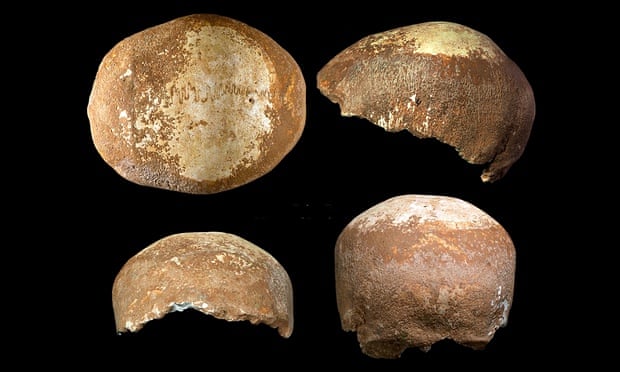
Views of the human skull, with missing jaw, found in western Galilee, northern Isreal and estimated at 55,000 years old. Photograph: Tel Aviv University and University of Vienna

An ancient skull found in a cave in northern Israel has cast light on the migration of modern humans out of Africa and the dawn of humanity’s colonisation of the world.
For most palaeontologists that might be enough for a single fossil, but the braincase has offered much more: a likely location where the first prehistoric trysts resulted in modern humans having sex with their heavy-browed Neanderthal cousins.
Discovered in a cave in western Galilee, the partial skull belonged to an individual, probably a woman, who lived and died in the region about 55,000 years ago, placing modern humans there and then for the first time ever.
Read the rest of this article...

Scan finds new tattoos on 5300-year-old Iceman


A new study has used advanced imaging techniques to identify previously unknown tattoos on the ribcage of the 5300-year old man known as Ötzi, bringing his total number of tattoos to 61.
But first, some context
In September of 1991 hikers in the Ötzal Alps along the border of Austria and Italy happened upon the mummified corpse who became an archaeological celebrity. After Ötzi died at the hands of unknown attackers one late spring or early summer around 3500 BC, his body and belongings were left in a small gully where they were entombed beneath an alpine glacier. A combination of glacial meltwater and extreme cold resulted in natural mummification of his body.
Read the rest of this article...

Friday, January 23, 2015

Maybe Early Humans Weren't The First To Get A Good Grip

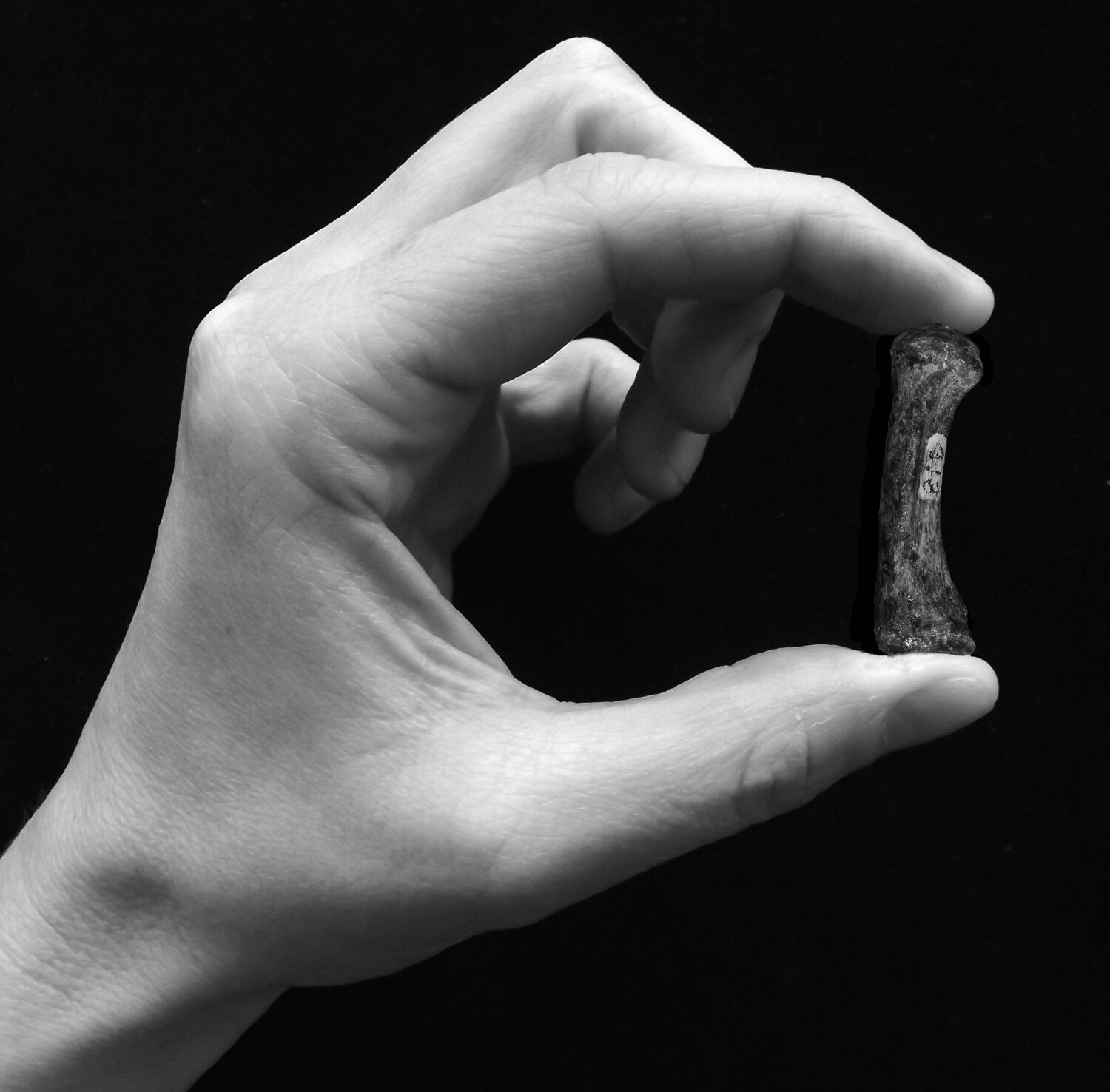
An example of a human precision grip — grasping a first metacarpal from the thumb of a specimen of Australopithecus africanus that's thought to be 2 to 3 million years old.

The special tool-wielding power of human hands may go back further in evolutionary history than scientists have thought.
That's according to a new study of hand bones from an early relative of humans calledAustralopithecus africanus. Researchers used a powerful X-ray technique to scan the interior of the bones, and they detected a telltale structure that's associated with a forceful precision grip.
"It's clear evidence that these australopiths were using their hands and using grips that are very consistent with what modern humans did and what our recent relatives like Neanderthals did," says Matthew Skinner, a paleoanthropologist at the University of Kent, in the United Kingdom. He was part of the team that published the new work online Thursday in Science.
Read the rest of this article...

Monday, January 19, 2015

Stone Age artefacts found in Norway's melting glaciers


Around 7,000 years ago the Earth was enjoying a warm climate. Now glaciers and patches of perennial ice in the high mountains of Southern Norway have started to melt again, revealing ancient layers. 


A small knife with a wooden handle, probably from the Iron Age, was one of the  treasures found by archaeologists at the glacier Lendbreen in Oppland County,  Norway during the 2014 summer season [Credit: Oppland County] 

“Actually we should be slowly approaching a new ice age. But in the past 20 years we have witnessed artefacts turning up in summer from increasingly deeper layers of the glaciers,” says Lars Pilø. 

He is an archaeologist working for Oppland County, and has for many years done fieldwork in glaciers and ice patches, finding things our ancestors discarded or lost.

Read the rest of this article...

Friday, January 16, 2015

Stone Age man wasn't necessarily more advanced than the Neanderthals


A multi-purpose bone tool dating from the Neanderthal era has been discovered by University of Montreal researchers, throwing into question our current understanding of the evolution of human behaviour. It was found at an archaeological site in France. "This is the first time a multi-purpose bone tool from this period has been discovered. It proves that Neanderthals were able to understand the mechanical properties of bone and knew how to use it to make tools, abilities usually attributed to our species, Homo sapiens," said Luc Doyon of the university's Department of Anthropology, who participated in the digs. Neanderthals lived in Europe and western Asia in the Middle Paleolithic between around 250,000 to 28,000 years ago. Homo sapiens is the scientific term for modern man.
The production of bone tools by Neanderthals is open to debate. For much of the twentieth century, prehistoric experts were reluctant to recognize the ability of this species to incorporate materials like bone into their technological know-how and likewise their ability to master the techniques needed to work bone. However, over the past two decades, many clues indicate the use of hard materials from animals by Neanderthals. "Our discovery is an additional indicator of bone work by Neanderthals and helps put into question the linear view of the evolution of human behaviour," Doyon said.
Read the rest of this article...

Recreating the ancient Greek drinking game Kottabos


Years before beer pong was invented, the ancient Greeks played kottabos to pass the time at symposia (drinking parties) where privileged men reclined on cushion couches and played the game that is found illustrated on ancient artworks. Women of fine society didn’t attend symposia but hetaires (courtesans) played the sloppy game where winners received all sorts of prizes, such as sweets and even sexual favours. 


Banqueter playing the kottabos game; kalos inscription in the name of Leagros.  Side A of the neck of an Attic red-figure neck-amphora, ca. 510 BC. From Vulci  [Credit: Marie-Lan Nguyen/WikiCommons] 

Assistant Art History Professor Heather Sharpe of West Chester University in Pennsylvania tried to recreate the game with her students. It wasn’t as easy as it appears “because we do have these illustrations of it, but they only show one part of the game – where individuals are about to flick some dregs at a target.”

Read the rest of this article...

Parasiteneier aus der Keltenzeit in Basel gefunden

Ei eines Spulwurms (Ascaris sp.) mit der typischen gewellten Membran. Foto: IPNA

In Proben aus der früheren keltischen Siedlung «Basel-Gasfabrik» sind Archäologen der Universität Basel bei Laboranalysen auf Eier von Darmparasiten gestossen – und schliessen damit auf eine mangelhafte Hygiene der damaligen Bevölkerung. Mittels spezieller Methoden der Geoarchäologie fanden sie drei verschiedene Parasitenarten, wie sie in der Fachzeitschrift «Journal of Archaeological Science» berichten.

Read the rest of this article...

Monday, January 12, 2015

THE BRONZE AGE SETTLEMENT OF AKROTIRI

THE BRONZE AGE SETTLEMENT OF AKROTIRI
ON THE ISLAND OF SANTORINI
a Lecture by
Michael Duigan
7.00 pm, Friday, 16th January

Activity Space 1, Clore Learning Centre
Museum of London, London Wall EC2Y 5HN

FREE TO EMAS MEMBERS . . . . . . £3:00 NON-MEMBERS

Would you be beautiful in the ancient world?


In ancient Greece the rules of beauty were all important. Things were good for men who were buff and glossy. And for women, fuller-figured redheads were in favour - but they had to contend with an ominous undercurrent, historian Bettany Hughes explains.
A full-lipped, cheek-chiselled man in Ancient Greece knew two things - that his beauty was a blessing (a gift of the gods no less) and that his perfect exterior hid an inner perfection. For the Greeks a beautiful body was considered direct evidence of a beautiful mind. They even had a word for it - kaloskagathos - which meant being gorgeous to look at, and hence being a good person.
Read the rest of this article...

Wednesday, December 17, 2014

4,000 year old skeleton was likely a 'warrior chief'


A Bronze Age skeleton found buried in West Sussex with one of the earliest bronze daggers in the UK was probably a high-ranking warrior chief who died in combat, experts have said. 


James Kenny, site excavator and planning archaeologist at Chichester District Council,  views the skeleton known as Racton Man at the Novium Museum in Chichester, West Sussex  [Credit: Chichester District Council] 

The virtually-complete skeleton dating back more than 4,000 years was found on farmland in the hamlet of Racton, near Chichester, in 1989. 

Its background has long been a source of intrigue to historians as the skeleton - nicknamed Racton Man - was found with an extremely rare and valuable dagger. 

Read the rest of this article...

Monday, December 8, 2014

Solid gold torc hidden in Celtic coin hoard


A Celtic coin hoard discovered on Jersey has been astounding archaeologists with a series of gold treasure finds. 


The Golden torc is bigger than any other ever found on Jersey  [Credit: © Jersey Heritage] 

For the past two weeks, Jersey Heritage's conservation team have been excavating an area known to contain gold jewellery. Late last week, one end of a solid gold torc was uncovered. 

The find comes after the discovery of two other solid gold torcs - one gold-plated and one of an unknown alloy - along with a silver brooch and a crushed sheet gold tube. But the latest artefact is considerably larger than anything previously unearthed on the island.

Read the rest of this article...

Une nécropole antique dans le quartier périphérique occidental de la ville de Saintes : plusieurs individus entravés, dont un enfant


De septembre à novembre 2014, une équipe d’archéologues de l’Inrap a mené, sur prescription de l’État (Drac Poitou-Charentes), une fouille préventive sur un terrain de 613 m2, dans le cadre de la construction d’une maison individuelle dans le quartier ouest de Saintes. Une première campagne de fouille réalisée en 2013 sur une parcelle contigüe avait mis en évidence la vocation funéraire de cet espace au cours de l’Antiquité. L’opération de cette année a permis la découverte d’une centaine de sépultures. 

Read the rest of this article...

Monday, December 1, 2014

EMAS Easter Study Tour to North Scotland and the Isle of Skye


EMAS Easter Study Tour to North Scotland 
and the Isle of Skye
2 - 8 April 2015

The 2015 EMAS Easter Study Tour is to the North of Scotland, including one day on the Isle of Skye.

We will travel from London Embankment by coach, staying overnight at Carlisle on the 2nd and 7th April.

We shall be based at a hotel in Inverness, which is a very good central point from which to explore the region.

The itinerary includes a wide range of prehistoric and medieval sites, including some of the famous Pictish symbol stones.


Limestone 'Venus' 23,000 years old dug up in France

A person points to a 23,000 year-old chalk statue of a woman called the "Venus of Renancourt" which was found at the paleolithic site of Renancourt, France, November 27, 2014

A limestone statuette of a shapely woman some 23,000 years old has been discovered in northern France in what archaeologists Thursday described as an "exceptional" find.
Archaeologists stumbled on the Paleolithic-era sculpture during a dig in the summer in Amiens, the first such find in half a century.
"The discovery of this masterpiece is exceptional and internationally significant," said Nicole Phoyu-Yedid, the head of cultural affairs in the area, on showing the find to the media.
"We were expecting to find classical vestiges such as tooled flint or bones," said archaeologist Clement Paris.
Read the rest of this article...

Secrets of a Celtic princess


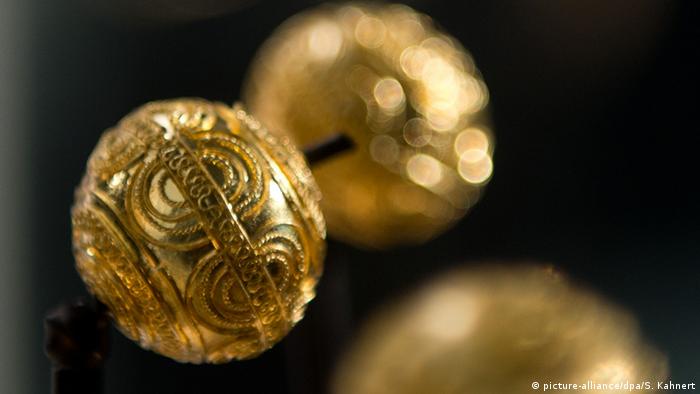
The burial chamber of the "Celtic Princess of the Danube" unearthed in 2010 remains one of the most important archeological finds of the past decades in Germany. A new exhibition in Stuttgart allows the public to contemplate the riches found in the 2,600-year old grave. Even in plain view, the princess holds on to many secrets which keep puzzling archeologists.

Read the rest of this article...
Archaeologists working for a mining company have uncovered an Iron Age settlement near Newcastle. 


Workmen at the dig [Credit: Banks Group] 

The five-hectare site at the Brenkley Lane Surface Mine has been excavated by Headland Archaeology on behalf of Banks Mining. 

The settlement, much of which is more than 2,000 years old, features the footprint of four roundhouses within an enclosure. 

Artefacts and a cemetery have also been unearthed at the site.

Read the rest of this article...

Friday, November 28, 2014

People ate mammoth; Dogs got reindeer

Artist's depiction of cave painting of primitive hunt (stock image).
Credit: © Nomad_Soul / Fotolia

Biogeologists have shown how Gravettian people shared their food 30,000 years ago.

Předmostí I is an exceptional prehistoric site located near Brno in the Czech Republic. Around 30,000 years ago it was inhabited by people of the pan-European Gravettian culture, who used the bones of more than 1000 mammoths to build their settlement and to ivory sculptures. Did prehistoric people collect this precious raw material from carcasses -- easy to spot on the big cold steppe -- or were they the direct result of hunting for food? This year-round settlement also yielded a large number of canids remains, some of them with characteristics of Palaeolithic dogs. Were these animals used to help hunt mammoths?

To answer these two questions, Tübingen researcher Hervé Bocherens and his international team carried out an analysis of carbon and nitrogen stable isotopes in human and animal fossil bones from the site. Working with researchers from Brno and Brussels, the researchers were able to test whether the Gravettian people of Předmostí ate mammoth meat and how the "palaeolithic dogs" fit into this subsistence picture.

Read the rest of this article...

Thursday, November 27, 2014

Woolly mammoth skeleton fetches £189,000 at auction


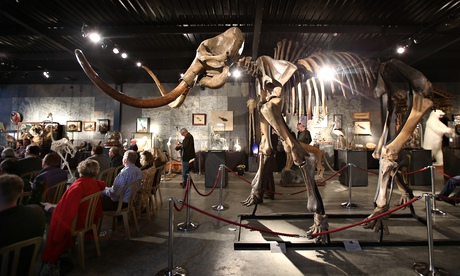
Monty the woolly mammoth skeleton is displayed at Summers Place Auctions in Billingshurst, West Sussex. Photograph: Peter Macdiarmid/Getty Images

A rare woolly mammoth skeleton has been sold for £189,000 at auction.
The skeleton, named Monty, is one of the most complete of the species and was bought by a private UK buyer at the sale by Summers Place Auctions in West Sussex.
It stands 3.5 metres tall and is 5.5 metres long (11ft tall by 18ft long), suggesting it may have been a male that weighed up to six tonnes. The skeleton, which is 30,000 to 50,000 years old, was estimated to command a price of between £150,000 and £250,000. It had been in a private eastern European collection for years and was only assembled, including tusks, for the first time when it came to the auction house.
Read the rest of this article...
Stone age axe found with wood handle


Archaeologists in Denmark have uncovered an incredibly rare find: a stone age axe held within its wooden handle.
The 5,500-year-old Neolithic axe was found during archaeological surveys ahead of a multi-billion euro tunnel project.
The axe seems to have been jammed into what was once the seabed, perhaps as part of a ritual offering.
The lack of oxygen in the clay ground helped preserve the wooden handle.
The find was made in Rodbyhavn on the Danish island of Lolland, which is to be connected to the German island of Fehmarn via the tunnel link.
Read the rest of this article...