Saturday, June 30, 2012

CSIC recovers part of the genome of 2 hunter-gatherer individuals from 7,000 years ago


A team of scientists, led by researcher Carles Lalueza-Fox from CSIC (Spanish National Research Council), has recovered - for the first time in history - part of the genome of two individuals living in the Mesolithic Period, 7000 years ago. Remains have been found at La Braña-Arintero site, located at Valdelugueros (León), Spain. The study results, published in the Current Biology magazine, indicate that current Iberian populations don't come from these groups genetically. 

The Mesolithic Period, framed between the Paleolithic and Neolithic Periods, is characterized by the advent of agriculture, coming from the Middle East. Therefore, the genome found is the oldest from Prehistory, and exceeds Ötzi, the Iceman, in 1700 years.

Researchers have also recovered the complete mitochondrial DNA of one of these individuals, through which they could determine that European populations from Mesolithic Period were very uniform genetically. Carles Lauleza-Fox, from the Institute of Evolutionary Biology (CSIC-UPF), states: "These hunters-gatherers shared nomadic habits and had a common origin. Despite their geographical distance, individuals from the regions corresponding to the current England, Germany, Lithuania, Poland, and Spain, shared the same mitochondrial lineage".

Cave in South Wales holds UK's oldest rock art


A reindeer engraved on the wall of a cave in South Wales has been found to date from at least 14,505 years ago – making it the oldest known rock art in the British Isles. 

This photo shows the main part of an engraving of a cervid found by Dr. George Nash of the University of Bristol, UK in Cathole Cave on the Gower Peninsula, South Wales. A new U-series date suggests it could be 14,505 years old -- making it the oldest known rock art in the British Isles [Credit: Dr. George Nash/University of Bristol]
The engraving was discovered in September 2010 by Dr George Nash from the University of Bristol's Department of Archaeology and Anthropology while he was exploring the rear section of Cathole Cave, a limestone cave on the eastern side of an inland valley on the Gower Peninsula, South Wales. 

Found to the rear of the cave on a small vertical limestone niche, the engraved cervid – probably a stylised reindeer – is shown side-on and measures approximately 15 x 11cm. It was carved using a sharp-pointed tool, probably made of flint, by an artist using his or her right hand. The animal's elongated torso has been infilled with irregular-spaced vertical and diagonal lines, whilst the legs and stylised antlers comprise simple lines.

Spanish site yields oldest bow in Europe


Archaeological research carried out at the Neolithic site of La Draga, near the lake of Banyoles, has yielded the discovery of an item which is unique in the western Mediterranean and Europe. The item is a bow which appeared in a context dating from the period between 5400-5200 BCE, corresponding to the earliest period of settlement. It is a unique item given that it is the first bow to be found in tact at the site. According to its date, it can be considered chronologically the most ancient bow of the Neolithic period found in Europe. The study will permit the analysis of aspects of the technology, survival strategies and social organisation of the first farming communities which settled in the Iberian Peninsula. The bow is 108 cm long and presents a plano-convex section. Worth mentioning is the fact that it is made out of yew wood (Taxus baccata) as were the majority of Neolithic bows in Europe. 

The complete bow discovered during this year's campaign [Credit: Universitat Autònoma de Barcelona]
In previous archaeological campaigns, fragments of two bows were found (in 2002 and 2005) also from the same time period, but since they are fragmented it is impossible to analyse the characteristics of these tools. The current discovery opens new perspectives in understanding how these farming communities lived and organised themselves. These bows could have served different purposes, such as hunting, although if one takes into account that this activity was not all that common in the La Draga area, it cannot be ruled out that the bows may have represented elements of prestige or been related to defensive or confrontational activities.

Thursday, June 28, 2012

Early human ancestor chewed bark


An early relative of humans chewed on bark and leaves, according to fossil evidence.

Analysis of food trapped in the teeth of the two-million-year-old "southern ape" suggests it existed on a unique diet of forest fruits and other woodland plants.

The study, in Nature, gives an insight into the evolution of what could have been a direct human ancestor.

Other early African contemporaries had a diet suggesting a grassland habitat.

Wednesday, June 27, 2012

Could one of the world's ancient cities be lost forever?


Pakistani officials say they are doing their best to save one of the most important archaeological sites in south Asia, Mohenjo Daro. But some experts fear the Bronze Age site could be lost unless radical steps are taken.

It is awe-inspiring to walk through a home built 4,500 years ago. 

Especially one still very much recognisable as a house today, with front and back entrances, interconnecting rooms, neat fired brick walls - even a basic toilet and sewage outlet.
Astonishingly, given its age, the home in question was also built on two storeys. 

But it is even more impressive to walk outside into a real Bronze Age street, and see all of the other homes lining it.

Monday, June 25, 2012

New deglaciation data suggests earlier migration opportunity for First Americans


A new study of  lake sediment cores from Sanak Island in the western Gulf of Alaska suggests that deglaciation there from the last Ice Age took place as much as 1,500 to 2,000 years earlier than previously thought, opening the door for earlier coastal migration models for the Americas.

The Sanak Island Biocomplexity Project, funded by the National Science Foundation, also concluded that the maximum thickness of the ice sheet in the Sanak Island region during the last glacial maximum was 70 meters – or about half that previously projected – suggesting that deglaciation could have happened more rapidly than earlier models predicted.

Results of the study were just published in the professional journal, Quaternary Science Reviews.
The study, led by Nicole Misarti of Oregon State University, is important because it suggests that the possible coastal migration of people from Asia into North America and South America – popularly known as “First Americans” studies – could have begun as much as two millennia earlier than the generally accepted date of ice retreat in this area, which was 15,000 years before present.

Saturday, June 23, 2012

Sheffield university helps to crack the mystery of Stonehenge - possibly


The famous circle may celebrate the end of Britain's forgotten east-west divide, long since replaced by the familiar one between north and south


Come together. Was it Britain's prehistoric equivalent of the UN building in New York? Photograph: Felix Clay
 
Sheffield academics are good at collaring national attention. Witness the anxious appeals by radio listeners in the 1930s for scientists in the city to halt an atomic experiment on the grounds that it might bring about the end of the world.

Not long before, a Sheffield University lecturer in electrical research, Dr T.F.Wall applied for a patent for a means of transmitting electrical energy without wires – according to journalists at the time:
an invention capable of destroying life, stopping airplanes in flight and bringing motor cars to a standstill.

More positively, he added, it could have beneficial applications in surgery and medicine. Not to mention, which he couldn't even though he was so ahead of his time, wifi and the internet which have brought you this.


What now? Sheffield has played a leading part in a ten year research project on Stonehenge whose discoveries and conclusions have been gradually released since 2002 and have now come together in a book. Don't for a minute think that the main conclusion can be proved beyond doubt or that the report will end the age-old mystery. But it is plausible and based on a heap of archaeological material.

Research finds Stonehenge was monument marking unification of Britain


After 10 years of archaeological investigations, researchers have concluded that Stonehenge was built as a monument to unify the peoples of Britain, after a long period of conflict and regional difference between eastern and western Britain.


Stonehenge Riverside Project team
 
Its stones are thought to have symbolized the ancestors of different groups of earliest farming communities in Britain, with some stones coming from southern England and others from west Wales.

The teams, from the universities of Sheffield, Manchester, Southampton, Bournemouth and University College London, all working on the Stonehenge Riverside Project (SRP), explored not just Stonehenge and its landscape but also the wider social and economic context of the monument’s main stages of construction around 3,000 BC and 2,500 BC.

“When Stonehenge was built”, said Professor Mike Parker Pearson of the University of Sheffield, “there was a growing island-wide culture – the same styles of houses, pottery and other material forms were used from Orkney to the south coast. This was very different to the regionalism of previous centuries. Stonehenge itself was a massive undertaking, requiring the labour of thousands to move stones from as far away as west Wales, shaping them and erecting them. Just the work itself, requiring everyone literally to pull together, would have been an act of unification.”

Stonehenge a 'symbol of unification' at centre of Ancient Britain


Stonehenge was the centre of ancient Britain, according to a study which claims the monument symbolised the unification of eastern and western communities. 

 Stonehenge was probably at the centre of the world for prehistoric Brits, archaeologists believe

Centuries of speculation have attributed countless functions to the famous Wiltshire landmark, describing it variously as a prehistoric observatory, a place of healing and a temple for ritual sacrifice.

But a new study by researchers from five British universities suggests Stonehenge may in fact have been built as a sign of peace between people from the east and west of the country after a period of conflict. 
The stones, which come from different locations as far afield as southern England and west Wales, may have been used to represent the ancestors of some of Britain's earliest farming communities, researchers suggest. 
Prof Mike Parker Pearson, of Sheffield University, said during Stonehenge's main period of construction from 3,000 to 2,500 BC there was a "growing island-wide culture" developin in Britain.

New deglaciation data suggests earlier migration opportunity for First Americans


A new study of  lake sediment cores from Sanak Island in the western Gulf of Alaska suggests that deglaciation there from the last Ice Age took place as much as 1,500 to 2,000 years earlier than previously thought, opening the door for earlier coastal migration models for the Americas.

The Sanak Island Biocomplexity Project, funded by the National Science Foundation, also concluded that the maximum thickness of the ice sheet in the Sanak Island region during the last glacial maximum was 70 meters – or about half that previously projected – suggesting that deglaciation could have happened more rapidly than earlier models predicted.

Results of the study were just published in the professional journal, Quaternary Science Reviews.

The study, led by Nicole Misarti of Oregon State University, is important because it suggests that the possible coastal migration of people from Asia into North America and South America – popularly known as “First Americans” studies – could have begun as much as two millennia earlier than the generally accepted date of ice retreat in this area, which was 15,000 years before present.

Virtual tour of Knowth to bring public closer to archaeological site after 50 years of excavations


50 years after the start of archaeological explorations into the ancient burial tombs at Knowth in the Boyne Valley, researchers at the site have confirmed that people will get to experience the site like never before via virtual tours.
The Irish Examiner reports on the rich history of the discoveries at Knowth in Co Meath and how they will be brought that much closer to the public in the near future.

The OPW hopes that the two burial chambers at Knowth, which are the longest in Ireland, will be accessible to the public virtually using high quality scans assembled by a UCD team. The chambers are otherwise inaccessible to the public.

Knowth is famous for its megalithic art, and the burial tombs at the site housed some 300 pieces. The art pieces that have been discovered date as far back as 3000 B.C.

Friday, June 22, 2012

Massive Gold Trove Sparks Archeological Dispute


A 3,300-year-old treasure trove of gold found in northern Germany has stumped German archeologists. One theory suggests that traders transported it thousands of miles from a mine in Central Asia, but other experts are skeptical.

Archeologists in Germany have an unlikely new hero: former Chancellor Gerhard Schröder. They have nothing but praise for the cigar-smoking veteran Social Democratic politician.

Why? Because it was Schröder who, together with Russian leader Vladimir Putin, pushed through a plan to pump Russian natural gas to Western Europe. For that purpose, an embankment 440 kilometers (275 miles) long and up to 30 meters (100 feet) wide had to be created from Lubmin, a coastal resort town in northeastern Germany, to Rehden in Lower Saxony near the northwestern city of Bremen. 

The result has been a veritable cornucopia of ancient discoveries. The most beautiful find was made in the Gessel district of Lower Saxony, where 117 pieces of gold were found stacked tightly together in a rotten linen cloth. The hidden treasure is about 3,300 years old. 

Spanish Cave paintings’ age questioned


Cave paintings in Spain need to be analyzed further before the works can be confirmed as the oldest known examples in the world, an archaeologist said, casting doubt over a paper published in the journal Science

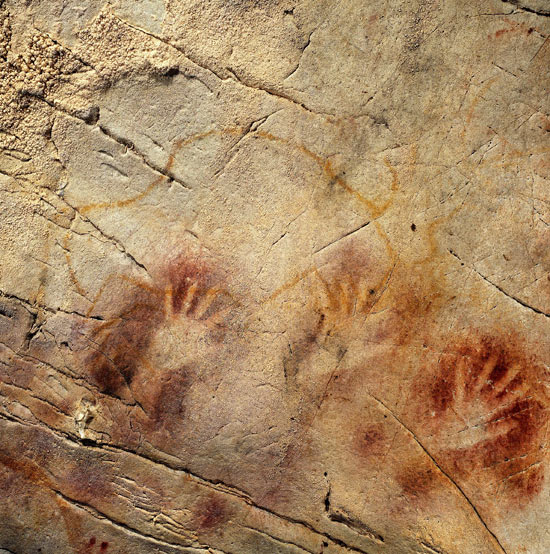
The Panel of Hands at El Castillo Cave in Spain. Researchers have now dated one of these hand stencils back to 37,300 years ago [Credit: Pedro Saura]
A team led by Alistair Pike of the University of Bristol in England said in the paper that paintings at El Castillo cave date back at least 40,800 years. That would make them about 4,000 years older than those at the Chauvet cave in France, meaning the Spanish works could be the only cave art ever found to have been painted by Neanderthals, according to Pike. 

The findings at El Castillo need further confirmation, Jean Clottes, who led the research team that appraised the Chauvet works in 1998, said in a telephone interview. Pike’s team used a method based on the radioactive decay of uranium to analyze calcium carbonate crusts formed on top of the paintings. This contrasts with radiocarbon dating employed at Chauvet. The two methods have arrived at conflicting dates in the past, according to Clottes.

Thursday, June 21, 2012

Mammoth field found at Serbia coal mine 'great find for Ice Age knowledge'


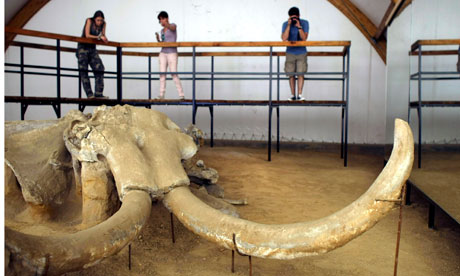
A mammoth recovered from the 'mass grave' at the Kostolac open-pit coal mine about 50 miles east of Belgrade. Photograph: Marko Drobnjakovic/AP

Archaeologists say bones of five woolly mammoths at Kostolac coal pit may reveal more about Balkans several millennia ago
 
FArchaeologists have unearthed at least five mammoths at a site in Serbia. The discovery last week at Kostolac coal mine, east of the Serbian capital of Belgrade, is the first of its kind in the region and could offer important insights into how the ice age affected the area now known as the Balkans. Miomir Korac, of Serbia's Archaeology Institute, said: "There are millions of mammoth fragments in the world, but they are rarely so accessible for exploration."

"A mammoth field can offer incredible information and shed light on what life looked like in these areas during the ice age." The remains were found during coal excavations about 20 metres below ground. Korac said the mammoth field stretched over nearly nine hectares (20 acres) of sandy terrain. In 2009 a well-preserved skeleton of a much older mammoth was found at the same site. The female skeleton, nicknamed Vika, is up to a million years old and belonged to the southern mammoth type which lacked dense fur.

Welsh people could be most ancient in UK, DNA suggests

A depiction of early man for The Story of Wales series

Welsh people could lay claim to be the most ancient Britons, according to scientists who have drawn up a genetic map of the British Isles.

Research suggests the Welsh are genetically distinct from the rest of mainland Britain.

Professor Peter Donnelly, of Oxford University, said the Welsh carry DNA which could be traced back to the last Ice Age, 10,000 years ago.

The project surveyed 2,000 people in rural areas across Britain.

Participants, as well as their parents and grandparents, had to be born in those areas to be included in the study.

Serbian archaeologists discover mammoth field containing at least five of the giant beasts


Miomir Korac, left, the director of the Viminacium archaeological park, and fellow archaeologists, work on a mammoth tusk at an open pit coal mine in Kostolac, 80 kilometers (50 miles) east of Belgrade, Serbia. Archaeologists in Serbia say they have discovered a rare mammoth field containing remains of at least five of the giant animals that lived here tens of thousands of years ago. AP Photo/ Marko Drobnjakovic. By: Marko Drobnjakovic, Associated Press KOSTOLAC, SERBIA (AP).- First there was one. Then another. And another. Archaeologists in Serbia say they have discovered a rare mammoth field containing the remains of at least five of the giant beasts that lived here tens of thousands of years ago. The discovery last week at the Kostolac coal mine, east of the Serbian capital of Belgrade, is the first of its kind in the region. It could offer important insight into the ice age in the Balkans, said Miomir Korac from Serbia's Archaeology Institute. "There are millions of mammoth fragments in the world, but they are rarely so accessible for exploration," he told The Associated Press. "A mammoth field can offer incredible information and shed light on what life looked like in these areas during the ice age."

More Information: http://www.artdaily.org/index.asp?int_sec=2&int_new=56063[/url]
Copyright © artdaily.org
Miomir Korac, left, the director of the Viminacium archaeological park, and fellow archaeologists, work on a mammoth tusk at an open pit coal mine in Kostolac, 80 kilometers (50 miles) east of Belgrade, Serbia. Archaeologists in Serbia say they have discovered a rare mammoth field containing remains of at least five of the giant animals that lived here tens of thousands of years ago. AP Photo/ Marko Drobnjakovic. By: Marko Drobnjakovic, Associated Press KOSTOLAC, SERBIA (AP).- First there was one. Then another. And another. Archaeologists in Serbia say they have discovered a rare mammoth field containing the remains of at least five of the giant beasts that lived here tens of thousands of years ago. The discovery last week at the Kostolac coal mine, east of the Serbian capital of Belgrade, is the first of its kind in the region. It could offer important insight into the ice age in the Balkans, said Miomir Korac from Serbia's Archaeology Institute. "There are millions of mammoth fragments in the world, but they are rarely so accessible for exploration," he told The Associated Press. "A mammoth field can offer incredible information and shed light on what life looked like in these areas during the ice age."

More Information: http://www.artdaily.org/index.asp?int_sec=2&int_new=56063[/url]
Copyright © artdaily.org


Miomir Korac, left, the director of the Viminacium archaeological park, and fellow archaeologists, work on a mammoth tusk at an open pit coal mine in Kostolac, 80 kilometers (50 miles) east of Belgrade, Serbia. Archaeologists in Serbia say they have discovered a rare mammoth field containing remains of at least five of the giant animals that lived here tens of thousands of years ago. AP Photo/ Marko Drobnjakovic.


Archaeologists in Serbia say they have discovered a rare mammoth field containing the remains of at least five of the giant beasts that lived here tens of thousands of years ago. 

The discovery last week at the Kostolac coal mine, east of the Serbian capital of Belgrade, is the first of its kind in the region. It could offer important insight into the ice age in the Balkans, said Miomir Korac from Serbia's Archaeology Institute. 

"There are millions of mammoth fragments in the world, but they are rarely so accessible for exploration," he told The Associated Press. 

"A mammoth field can offer incredible information and shed light on what life looked like in these areas during the ice age."
Archaeologists in Serbia say they have discovered a rare mammoth field containing the remains of at least five of the giant beasts that lived here tens of thousands of years ago. The discovery last week at the Kostolac coal mine, east of the Serbian capital of Belgrade, is the first of its kind in the region. It could offer important insight into the ice age in the Balkans, said Miomir Korac from Serbia's Archaeology Institute. "There are millions of mammoth fragments in the world, but they are rarely so accessible for exploration," he told The Associated Press. "A mammoth field can offer incredible information and shed light on what life looked like in these areas during the ice age."

More Information: http://www.artdaily.org/index.asp?int_sec=2&int_new=56063[/url]
Copyright © artdaily.org
Miomir Korac, left, the director of the Viminacium archaeological park, and fellow archaeologists, work on a mammoth tusk at an open pit coal mine in Kostolac, 80 kilometers (50 miles) east of Belgrade, Serbia. Archaeologists in Serbia say they have discovered a rare mammoth field containing remains of at least five of the giant animals that lived here tens of thousands of years ago. AP Photo/ Marko Drobnjakovic.

More Information: http://www.artdaily.org/index.asp?int_sec=2&int_new=56063[/url]
Copyright © artdaily.org


Read the rest of this article...

Sunday, June 17, 2012

Uranium-series dating reveals Iberian paintings are Europe's oldest cave art


The practice of cave art in Europe thus began up to 10,000 years earlier than previously thought, indicating the paintings were created either by the first anatomically modern humans in Europe or, perhaps, by Neanderthals. 

Fifty paintings in 11 caves in Northern Spain, including the UNESCO World Heritage sites of Altamira, El Castillo and Tito Bustillo, were dated by a team of UK, Spanish and Portuguese researchers led by Dr Alistair Pike of the University of Bristol, UK.

As traditional methods such as radiocarbon dating don't work where there is no organic pigment, the team dated the formation of tiny stalactites on top of the paintings using the radioactive decay of uranium. This gave a minimum age for the art. Where larger stalagmites had been painted, maximum ages were also obtained.

Hand stencils and disks made by blowing paint onto the wall in El Castillo cave were found to date back to at least 40,800 years, making them the oldest known cave art in Europe, 5-10,000 years older than previous examples from France.

Friday, June 15, 2012

Neanderthals may have been first human species to create cave paintings


Several times in the past 10 years scientists have had to rewrite the textbooks on Neanderthals, the latest species of human to go extinct. Once the archetype for primitive, uncivilised behaviour, the species, illuminated through fossil excavations and lately analysis of their genome, has emerged as being not too dissimilar from our own.

Contrary to their dim-witted image Neanderthals have been found to have used tools, to have worn jewellery, and, lastly, to have interbred with our Homo sapiens ancestors to such an extent that 4% of every modern European's genome is traceable to Neanderthal origins.

Now comes what could be the final nail in the coffin of the "unintelligent Neanderthals" myth: they might have been the first human species to paint in caves.

Natural History Museum – Evolution App


Introduction to the NHM Evolution App – brought to you by Authored Apps and the Natural History Museum London – The most extraordinary illustrated traveller’s guide to the past 600 million years on earth. http://www.nhm.ac.uk/business-centre/publishing/books/evolution/evolution-app/evolution-app.html

Red dot becomes 'oldest cave art'


Red dots, hand stencils and animal figures represent the oldest examples yet found of cave art in Europe.

The symbols on the walls at 11 Spanish locations, including the World Heritage sites of Altamira, El Castillo and Tito Bustillo have long been recognised for their antiquity.

But researchers have now used refined dating techniques to get a more accurate determination of their ages.

One motif - a large red dot - is said to be more than 40,000 years old.