Monday, September 30, 2013

Stonehenge prepares to open visitor centre after decades of rows and delays


Construction of museum, cafe and shop 1.5 miles from stones follows series of scrapped plans and missed deadlines
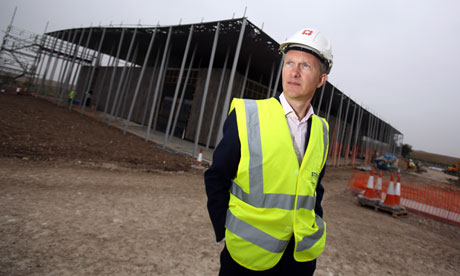
The English Heritage chief executive, Simon Thurley, outside the soon-to-be-completed Stonehenge visitor centre. Photograph: Matt Cardy/Getty Images
On 18 December, a mere 24 years after the parliamentary public accounts committee denounced the visitor facilities at one of the world's most famous ancient monuments as "a national disgrace", and 85 years after the idea was first mooted, a new £27m visitor centre will open atStonehenge.
For the first time there will be a museum-quality gallery interpreting the site and displaying original finds, as well as a cafe and shop. There was a distinct air of incredulity among many of the English Heritage staff, bruised and battered survivors of decades of debate, funding rows, public inquiries and planning consultations, sites identified and then abandoned, grandiose plans announced and promptly cancelled, landmark dates including the millennium and the Olympics missed, even as they stood in hard hats and hi-vis jackets in the shadow of the almost completed building.
Read the rest of this article...

Listen here: Our ancestors may have sounded like this


Recording studios were hard to find 6,500 years ago, but thanks to centuries of scholarship, we may now be able to get a sense of how our ancient ancestors sounded.

A linguist at the University of Kentucky has recorded a short story in Proto-Indo-European, or PIE, a language probably spoken across Europe and Asia from about 4,500 BCE to 2,500 BCE. Professor Andrew Byrd used Latin, Greek, and Sanskrit to deduce what PIE might have sounded like, the Huffington Post reports.

It's "a very educated approximation," Byrd says.

Read the rest of this article...

New Finds Uncovered at Ancient Greek Site of Argilos

With a team of 50 students and additional help from workmen, archaeologists have uncovered the remains of structures at the site of ancient Argilos on the coast of Macedonia, reporting that the finds will help open an additional window on the development and economy of one of the earliest Greek colonies in an area that was previously settled by the Thracians.

Among the discoveries was a large portico consisting of at least seven storerooms.
"The building is in a remarkable state of preservation, and five rooms have been partially excavated this year," report excavation co-directors Zizis Bonias of Greece's 18th Ephorate of Prehistoric and Classical Antiquities and Jacques Perreault of the University of Montreal. "In its early state, the building probably dates back to the 6th century BC."
Read the rest of this article...

Anthropologists confirm link between cranial anatomy and two-legged walking


Comparison of the skeletons of three bipedal mammals: 
an Egyptian jerboa, an eastern gray kangaroo and a human.


Anthropology researchers from The University of Texas at Austin have confirmed a direct link between upright two-legged (bipedal) walking and the position of the foramen magnum, a hole in the base of the skull that transmits the spinal cord.
The study, published in a forthcoming issue of the Journal of Human Evolution, confirms a controversial finding made by anatomist Raymond Dart, who discovered the first known two-legged walking (bipedal) human ancestor, Australopithecus africanus. Since Dart's discovery in 1925, physical anthropologists have continued to debate whether this feature of the cranial base can serve as a direct link to bipedal .
Chris Kirk, associate professor of anthropology and co-author of the study, says the findings validate foramen magnum position as a  for fossil research and sheds further insight into human evolution.
Read the rest of this article...

Sunday, September 29, 2013

Yorkshire Museum appeals to public to help save Iron Age jewellery of pre-Roman torc


Curators at The Yorkshire Museum are warning that a 2,000-year-old torc, described as having a rarer and more intricate style than its sister treasure, which was saved in 2012, could be sold at auction if they cannot raise £30,000 by October.

The precious bracelets became the first examples of Iron Age gold jewellery to have been found in the north of England when they were discovered by metal detectorists near Tadcaster in 2010 and 2011.

Despite being unearthed separately, curators say they were “almost certainly” buried together, having once belonged to a member of the ruling Brigantes whose extreme wealth could have indicated Royal status.


Read the rest of this article...

Ancient Greek site threatened amid celebration


Greece—While world leaders and top athletes lit the Olympic flame with pageantry drawn from antiquity, another important ancient site of athletic prowess sat overlooked and endangered.

Some 200 kilometers (125 miles) east of Ancient Olympia where the flame lighting for the 2014 Winter Games in Sochi went off without a hitch Sunday, the Nemea stadium and its humbler games are in danger of closing to the public because of crisis-hit Greece's harsh budget cuts, according to a renowned American archaeologist who led excavations there for decades.
Stephen G. Miller, professor emeritus of classical archaeology at the University of California, Berkeley, arrived at Nemea in 1973, when the ancient site still lay buried beneath a highway and vineyards used by raisin farmers. Excavations there unearthed the temple and stadium, one of the four major sites where Ancient Greek games were held: Olympia, Delphi, Isthmia and Nemea.
Read the rest of this article...

Bulgaria’s 2013 season draws to a close


The archaeology season for Bulgaria is winding down, with a number of dig teams announcing their findings in recent days. Although this summer has not yielded any treasure troves comparable to the one found at Sveshtari in 2012, there is still time – that particular find came in early November.

Bulgaria’s 2013 season draws to a close
The two-wheeled carriage and carcasses of the horses (foreground) were found in a Thracian tomb along with some decorations [Credit: Rex/Daily Mail]
At Sveshtari, near Razgrad, the team led by professor Diana Gergova has found the remains of a two-wheel chariot, buried with two horses still in their harness. Each horse was buried in its own sarcophagus.

Gergova described the find as unique for Bulgaria, the first physical evidence confirming some of the historical theories about Thracian culture. A mural of a two-wheel chariot has been previously found in a burial mound near Kazanluk, but the two chariots previously found by Bulgarian archaeologists both had four wheels, she said.


Read the rest of this article...

Saturday, September 28, 2013

2500-Year-Old Horse Remains in Bulgaria Suggest Creatures Were Buried Upright


Archaeologists have uncovered the remains of a Thracian carriage and two horses that appear to have been buried upright.

The chariot and horse skeletons are 2,500-years-old and were discovered in the village of Svestari in north-east Bulgaria.

The two-wheeled carriage and carcasses of the horses were found in a Thracian tomb along with some decorations.

Professor Diana Gergova of the National Archaeology Institute at the Bulgarian Academy of Sciences, who led the dig, said: 'The find is unique, it is not resembling any other carriage dating from the Thracian era ever uncovered in Bulgaria.'

Read the rest of this article...

Thursday, September 26, 2013

Fight hots up to keep Iron Age gold in Yorkshire

Natalie McCaul, curator of archaeology at the Yorkshire Museum, with the Iron Age torc, right, that the museum is hoping to buy to reunite it with one found metres from it at Towton, left, that is already in the collection

GOLD jewellery thought to be 2,000-years-old could leave North Yorkshire, if essential funds can not be raised.
The gold torcs, or bracelets, are currently on show at the Yorkshire Museum, and are the first items of Iron Age gold jewellery ever found in the north of England.
Read the rest of this article...

Bronze Age 'boat building' discovery in Monmouth

Reconstruction of the channels in the clay earth by Peter Bere
An artist's impression of how the channels could have been left in the ground at Monmouth

Archaeologists believe they have found the remains of a Bronze Age boat building community in Monmouth.
Excavations show 100ft-long (30m) channels in the clay along which experts think vessels were dragged into a long-gone prehistoric lake.
Monmouth Archaeological Society started to unearth new findings when work started on Parc Glyndwr housing estate two years ago.
The research is being published in a book called The Lost Lake.
Read the rest of this article...

Londonderry city walls archaeological dig extended


The Northern Ireland environment minister has announced a two-week extension to an archaeological dig in Derry that uncovered 13 skeletons last week.

Watch the video...

Derry dig team working in Bishop Street given more time to go back 4,000 years

The human remains found believed to be of a child aged between six and 10 years old

The archaeological dig that uncovered 13 skeletal remains from the early 17th century in Londonderry has now revealed evidence of life in the area 4,000 years ago.


New finds from the early Bronze Age mean the area has been settled for thousands of years more than previously thought.
The first artefact discovered was a flint tool known as a scraper, which would have been used to clean and prepare animal hides.
Read the rest of this article...

The First Great Human Population Explosion


It seems there is no end these days to what genetics might be telling us about our past. To add to the profusion of new findings are the conclusions of another study that suggest an early human population boom around 60,000 - 80,000 years ago, marking perhaps the first great population expansion of human history, or pre-history, as the case would be.

The prevailing theory is that, as humans transitioned to domesticating plants and animals around 10,000 years ago, they developed a more sedentary lifestyle, leading to settlements, the development of new agricultural techniques, and relatively rapid population expansion from 4-6 million people to 60-70 million by 4,000 B.C.
Read the rest of this article...

Archaeological dig seeks evidence of the very first islanders' arrival


ISLANDS perhaps better known for their Bronze Age relics are revealing traces of an earlier civilisation.
A settlement being unearthed on St Martin's represents "the most promising neolithic site in Scilly", according to Dr Duncan Garrow of Liverpool University, a specialist in the prehistory of North- West Europe.
  1. ​The dig site at St Martin's Old Quay, where 2m by 2m test pits have revealed a wealth of ancient material.
    The dig site at St Martin's Old Quay, where 2m by 2m test pits have revealed a wealth of ancient material.
Along with maritime archaeologist Dr Fraser Sturt of Southampton University and a ten-strong team, supplemented by locals, he is exploring how Neolithic man arrived on the islands some 5,000 to 6,000 years ago.

Read the rest of this article...

Alpine Archaeology Reveals High Life Through the Ages


An international team of archaeologists led by experts from the University of York has uncovered evidence of human activity in the high slopes of the French Alps dating back over 8000 years.

The 14-year study in the Parc National des Eìcrins in the southern Alps is one of the most detailed archaeological investigations carried out at high altitudes. It reveals a story of human occupation and activity in one of the world's most challenging environments from the Mesolithic to the Post-Medieval period.
The work included the excavation of a series of stone animal enclosures and human dwellings considered some of most complex high altitude Bronze Age structures found anywhere in the Alps.

Read the rest of this article...
A Bronze Age stone pathway that links stone circles has been uncovered for the first time since the 1930s.

Hurlers stone circles pathway uncovered
The dig was a community archaeological project with local people and
enthusiasts helping the experts [Credit: BBC]

Archaeologists were helped by local people to "re-discover" the feature, laid between two of the Hurlers stone circles on Bodmin Moor, Cornwall.

The 4,000-year-old pavement has been described as "unique" by archaeologists. They hope it will give a better understanding of early civilisations.


Read the rest of this article...

Tuesday, September 24, 2013

A VIRTUAL PREHISTORIC WORLD YOU CAN EXPLORE

Digital world. Image: Marcus Abbott

Imagine the possibilities as you explore a stunning visualisation of a 3D digital world generated from archaeological and paleo-environmental data. It already exists, but needs your help in order to make it freely available to the world.

A virtual prehistoric world

This project offers a visual representation of what is known about an ancient landscape, combining detailed archaeological and scientific data with cutting edge digital recording and visualisation techniques to produce a virtual world, but so real that the past and present become one.
The world you will enter is over 3500 years ago; the Bronze Age of East Anglia, UK  and focuses on an area known to be of great ritual significance during this period.

A liminal wetland environment

The landscape is a liminal wetland environment and what you will be able to explore has been generated entirely digitally. The archaeology has been painstakingly reconstructed from evidence found on sites in the area; round houses, wooden platforms, track ways, fences and even the great causeway structures of Flag Fen are all present.
Read the rest of this article...

Neolithic stone puts spotlight on Perthshire glen’s ancient history

The possible Neolithic quern stone found in Balnaguard Glen.

An ancient relic that shines a light on Neolithic life has been discovered on a picturesque reserve in Highland Perthshire.
The Scottish Wildlife Trust made the exciting archaeological discovery while repairing a wall in Balnaguard Glen. Volunteers were working on field walls on the hillside when they noticed one of the wall stones was shaped like a shallow basin.
It has since been identified as a possible Neolithic quern stone — potentially more than 6,000 years old — with its shape created by years of rubbing grain with a heavy stone to make flour.
Read the rest of this article...

How Complex Was Neanderthal Speech?


The challenge: Unlike pottery shards, arrowhead flints, and cave paintings, language does not leave an archaeological trace that can be uncovered by intrepid linguists bearing bullwhips.
That makes anything we say about early human speech and language very speculative. (As I've mentioned elsewhere, e.g., How did languages evolve?, it's been deemed so speculative that at one point, the Paris Linguistics Society banned discussion on the topic in the 19th century.)
And that makes what we say about Neanderthal speech doubly speculative because at least with humans, when we consider the evolution of speech for anatomically modern humans, we have living, breathing examples to look at, measure, experiment on, and observe. Everything about Neanderthals, we have to reconstruct from fossils and, now, DNA.
Read the rest of this article...

Cave Paintings Among the Oldest in Europe

Scientists find wall paintings in the Altxerri cave system in northern Spain pre-date most prehistoric paintings in Europe.

A team of scientists from the Universities of Cantabria and Burgos in Spain and Toulouse in France have dated prehistoric wall paintings in the Altxerri cave system in the Gipuzkoa province of northern Spain to about 39,000 years BPE, making them among the earliest known cave paintings produced by humans in Europe.

It was in 2011 when Cantabria University members Aitor Ruiz and César González began to explore the upper gallery of the cave, designated Altxerri B, with the objective of coming up with some reliable dates for the less-explored wall paintings in this part of the cave system. These paintings appeared to have been done independently of other paintings found in a lower gallery, paintings already with known dates that fell within the 29,000 - 35,000 BPE range. The paintings in this upper gallery were figurative representations of a bison (the most common element among the Altxerri cave system paintings) a feline, a possible animal's head, a bear and two groups of three finger marks, as well as other motifs. Ruiz and González also employed the help of Diego Garate, a specialist in Upper Paleolithic cave art from the University of Toulouse, to help them place and interpret the paintings and their findings within the context of current knowledge about Paleolithic art in Europe.
Read the rest of this article...