Monday, February 18, 2013

ARCHI The Archaeological Sites Index


ARCHI, the online searchable archaeological database, has added a new feature that allows users to add sites to their world-wide database.

The online form is easy to use and should prove to be an extremely useful addition to this site.

You can find the online form at:

http://www.digital-documents.co.uk/archi/archi_share.html

Ancient teeth bacteria record disease evolution


DNA preserved in calcified bacteria on the teeth of ancient human skeletons has shed light on the health consequences of the evolving diet and behaviour from the Stone Age to the modern day.

The ancient genetic record reveals the negative changes in oral bacteria brought about by the dietary shifts as humans became farmers, and later with the introduction of food manufacturing in the Industrial Revolution. An international team, led by the University of Adelaide's Centre for Ancient DNA (ACAD) where the research was performed, has published the results in Nature Genetics. Other team members include the Department of Archaeology at the University of Aberdeen and the Wellcome Trust Sanger Institute in Cambridge (UK)

Read the rest of this article...

'Amazing' treasures revealed in Dartmoor bronze age cist


A specialist at the Wiltshire Conservation Lab examines a prized amber bead


A rare and "amazing" burial discovery dating back 4,000 years has been described as the most significant find on Dartmoor and has given archaeologists a glimpse into the lives of the people who once lived there.
The discovery of a bronze age granite cist, or grave, in 2011 in a peat bog on White Horse Hill revealed the first organic remains found on the moor and a hoard of about 150 beads.
As the National Park's archaeologists levered off the lid they were shocked by what lay beneath.
The park's chief archaeologist, Jane Marchand, said: "Much to our surprise we actually found an intact cremation deposit [human bones] which is actually a burial alongside a number of grave goods.

Read the rest of this article...

Origins and Evolution of the Etruscans’ mtDNA


The Etruscan culture is documented in Etruria, Central Italy, from the 8th to the 1st century BC. For more than 2,000 years there has been disagreement on the Etruscans’ biological origins, whether local or in Anatolia. Genetic affinities with both Tuscan and Anatolian populations have been reported, but so far all attempts have failed to fit the Etruscans’ and modern populations in the same genealogy. We extracted and typed the hypervariable region of mitochondrial DNA of 14 individuals buried in two Etruscan necropoleis, analyzing them along with other Etruscan and Medieval samples, and 4,910 contemporary individuals from the Mediterranean basin. Comparing ancient (30 Etruscans, 27 Medieval individuals) and modern DNA sequences (370 Tuscans), with the results of millions of computer simulations, we show that the Etruscans can be considered ancestral, with a high degree of confidence, to the current inhabitants of Casentino and Volterra, but not to the general contemporary population of the former Etruscan homeland. By further considering two Anatolian samples (35 and 123 individuals) we could estimate that the genetic links between Tuscany and Anatolia date back to at least 5,000 years ago, strongly suggesting that the Etruscan culture developed locally, and not as an immediate consequence of immigration from the Eastern Mediterranean shores.

Read the rest of this article...

Sunday, February 17, 2013

Archaeology Summer Courses at Oxford


The Oxford Experience is offering a number of archaeology courses this summer.

Each course lasts for one week and participants stay in the 16th century college of Christ Church.

The courses offered are:

Cathedrals of Britain by James Bond
An Introduction to Archaeology by David Beard
The Black Death by Trevor Rowley (course full)
Bishop Odo and the Bayeux Tapestry by Trevor Rowley
Colleges of Oxford by Julian Munby
The Architecture and Archaeology of Medieval Churches by David Beard (course full)
Cotswold Towns by Trevor Rowley
Treasures of the British Museum by Michael Duigan (course full)
Churches of England by Kate Tiller
Treasures of the Ashmolean Museum by Gail Bent
The Age of Stonehenge by Scott McCracken
The World of the Vikings by David Beard

You can find further details here...

Skin Decoration Goes Way Back, Suggests Researcher


About 1.5 to 2 million years ago, early humans, according to the prevailing view of most paleoanthropologists and archaeologists, evolved into nearly hairless primates to more efficiently sweat away excess body heat. But later, according to Penn State anthropologist Nina Jablonski in a report to the annual meeting of the American Association for the Advancement of Science, humans may have begun to decorate skin to increase attractiveness to the opposite sex and to express, among other things, group identity.

Over thousands of years, humans used their skin as canvases of self-expression in a variety ways, including permanent methods such as tattooing and branding, as well as temporary, including cosmetics and body painting, according to Jablonski. But the determination of when this practice began to occur is somewhat more elusive than estimating the time when humans as primates actually began to lose their hair. "We find a lot of evidence of when humans began to lose hair based on molecular genetics," said Jablonski. But studying skin itself is difficult because it can be preserved only for a few thousand years, as opposed to bones, which fossilize and last millions of years. Nevertheless, while it is difficult to know when humans began to decorate their skin, some of the earliest preserved skin shows signs of tattooing, maintains Jablonski.
Read the rest of this article...

Dig provides glimpse into 9,000 years of village life


One of the special burials contained what is thought to be a woman and a stillborn baby [Credit: BBC]

When archaeologists began digging the fields in 2010 they knew it was a site of historical interest, but even they were surprised by the wealth of ancient finds their trowels unveiled.

Back in 1995, a hoard of 400 Roman coins was discovered west of Didcot in Oxfordshire, indicating the land had been lived on for centuries.

As plans progressed for 3,300 new homes, schools and shops on the 180-hectare site, archaeologists were called in to investigate.

It has taken them nearly three years to excavate 30 hectares, but they now know people have been living in Didcot for about 9,000 years - since the end of the last ice age.


Read the rest of this article...

Artificial finger tests evolutionary origin of prints


The artificial finger at Dartmouth College has a silicon pad with ridges impressed upon it


It seems intuitive that fingerprints should have something to do with grip, but showing this has not been easy.

Many experiments that have run human skin across various surfaces have found few if any friction benefits from the little lumps and bumps.

But new tests using an artificial finger may provide some fresh insight.

A Dartmouth College team took its mechanical digit into the field and ran it over natural materials like tree bark and found a big friction increase.


Read the rest of this article...

Saturday, February 16, 2013

EMAS Easter Study Tour to Yorkshire


There are still a few places available on the Easter archaeological study tour to Yorkshire.

The Study Tour is organized by EMAS, the University of London Extra-Mural Archaeological Society, and is open to any one.

You can find further details here...

Friday, February 15, 2013

Swiss dolmen reveals rituals of the Neolithic


The dolmen during the early stages of excavation with the massive capstone in situ. (Source: ADB)

Asensational archaeological discovery has been made in the region of  Bern, Switzerland, consisting of a communal dolmen grave dating back to over 5,000 years, containing 30 bodies and Neolithic artefacts. It represents the first intact burial chamber to be found north of the Alps.


Unexpected discovery

In October 2011, specialists from the Archaeological Service of the Canton of Bern began investigation of the large granite slab weighing in at 7 tonnes. The glacial erratic measured 3 metres long, 2 metres wide and was nearly 1 metre thick – what they did not realise at first was that it still covered a grave belonging to a Neolithic community.

The site was originally found when a farmer decided to try and remove the glacial boulder that he had to mow around when cutting grass in his field.

The boulder is from the last glacial maximum – some 20,000 years ago – and used by the early farmers during the 4th millennium BCE for burial purposes.


Read the rest of this article...

Didcot dig: A glimpse of 9,000 years of village life


The archaeological trenches can still be seen at the site where the builders are now working


When archaeologists began digging the fields in 2010 they knew it was a site of historical interest, but even they were surprised by the wealth of ancient finds their trowels unveiled.

Back in 1995, a hoard of 400 Roman coins was discovered west of Didcot in Oxfordshire, indicating the land had been lived on for centuries.

As plans progressed for 3,300 new homes, schools and shops on the 180-hectare site, archaeologists were called in to investigate.

It has taken them nearly three years to excavate 30 hectares, but they now know people have been living in Didcot for about 9,000 years - since the end of the last ice age.


Read the rest of this article...

Battered Skulls Reveal Violence Among Stone Age Women


Skulls from a forensic anthropology lab.
CREDIT: David Hunt, North Carolina State University                                             


  Stone Age farmers lived through routine violence, and women weren't spared from its toll, a new study finds.

The analysis discovered that up to 1 in 6 skulls exhumed in Scandinavia from the late Stone Age — between about 6,000 and 3,700 years ago — had nasty head injuries. And contrary to findings from mass gravesites of the period, women were equally likely to be victims of deadly blows, according to the study published in the February issue of the American Journal of Physical Anthropology.

Linda Fibiger, an archaeologist at the University of Edinburgh in Scotland, and her colleagues focused on the late Stone Age, when European hunter-gatherers had transitioned into farming or herding animals.


Read the rest of this article...

Friday, February 8, 2013

Early Humans in Southeast Europe Were of a Different Sort, Say Researchers


Newly conducted dating of a human mandible fossil discovered in 2008 in the Mala Balanica cave in southern Serbia has revealed that the human species to which it belonged featured a morphology (form and structure) that significantly departed from the pattern of features of early humans who inhabited what is today Western Europe during the same time period.
Considered a remain from what is now suggested to be the oldest hominin (human-related) species found in the Balkans of Eastern Europe, its age is now placed between 397,000 and 525,000 years old based on the application of electron spin resonance (ESR), uranium series isotoptic analysis and infrared/post infrared luminescence dating. These cutting-edge dating techniques are thought, used in combination in this instance, to provide a highly reliable date range for the fossil found. The new testing and study* was conducted by an international team of researchers that included William Jack Rink of McMaster University, Canada, DuÅ¡an Mihailović, University of Belgrade, Serbia, and Mirjana Roksandic, University of Winnipeg, Canada. Mihailović and Roksandic were both involved in the initial discovery of the ancient mandible (scientifically labeled "BH-1") in 2008. The new date range corresponds to a time when a human species called Homo heidelbergensis was present in Western Europe and an early stage in Neanderthal evolution. Homo heidelbergensis is suggested by many scientists to be a possible progenitor to Neanderthals or humans, or possibly a common ancestor.

Read the rest of this article...

Prehistoric rock art found in Scottish Highlands


One of the 28 stones on Swordale Hill which bear Bronze Age cupmarks [Credit: STV News]

An archaeologist has uncovered the biggest collection of ancient rock art in the Highlands. Douglas Scott, 64, of Tain, Ross-shire, discovered a circle of 28 carved rocks which date back 5000 years while combing a 200-metre hillside farm in Evanton.

Mr Scott reckons the stones, which have cup-marked shapes cut into them, represent one of the biggest collections of ancient rock art ever found in Scotland. He revealed he only visited the site, on Swordale Hill, Evanton, after one of his close friends died.

Mr Scott said: "I was first invited up the hill over 25 years ago by a friend of mine who was an archaeologist called Bob Gourlay.


Read the rest of this article...

Wednesday, February 6, 2013

Ice Age Art at the British Museum: 'Not even Leonardo surpassed this'


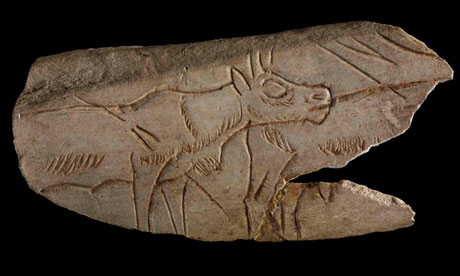
Human bodies in this show are overwhelmingly abstract, while animals are portrayed with gobsmacking accuracy … an image of a reindeer, carved into a reindeer bone, from Ice Age Art at the British Museum in London


I am looking at women with floppy breasts, massive hips and eyeless faces. Their bodies are deeply alien – disturbing in their total lack of what the modern world sees as desirable. Nearby, the British Museum has installed two nudes by Matisse, in one of many attempts in this exhibition to draw parallels between the earliest art and that of our own era. But this comparison just adds to the unease. To put it in language no archaeologist is likely to use: the curves of a Matisse woman are sexy; the bulges and blanknesses of these nudes, carved from ivory in central Europe 30,000 years ago, are not.
Then something catches my eye: a sculpture of a bison, created 21,000 years ago. It's so real, so alive, I can almost hear it snort and stamp. It has the same magical presence, the same thrilling realism, as cave paintings I've seen, also dating back to the ice age: images of mammoths, horses, bison. So why did the same artists choose to depict humans with such bizarre abstraction? It is one of the mysteries that make this show so eerie and thought-provoking.

Read the rest of this article...

Tuesday, February 5, 2013

Neanderthal extinction earlier than thought


Neanderthals may have become extinct in Europe some ten thousand years earlier than scientists currently think, a new radiocarbon dating study suggests.
Over the past 20 years, it has become widely accepted that the Iberian peninsula - modern day Spain and Portugal - served as a kind of refuge for the last remaining Neanderthals, who survived there five or ten thousand years longer than they did elsewhere in Europe.
Much of the evidence for this hypothesis came from radiocarbon dating of material found in caves associated with Neanderthal fossils or the particular kinds of stone tools, known to archaeologists as Mousterian, which are closely associated with the species.
North of the Ebro valley which crosses northern Spain, scientists previously found that evidence of Neanderthals disappeared around 42,000 years ago when anatomically modern humans arrived. South of that valley, it appeared, Neanderthals survived until 36,000 years ago with little evidence of modern humans.

Read the rest of this article...

Neanderthals 'unlikely to have interbred with human ancestors'


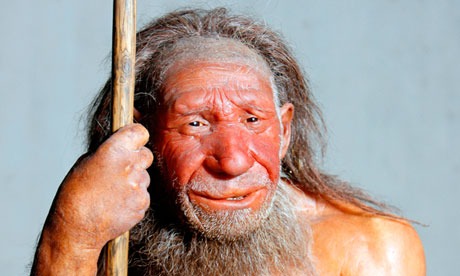
A model of a Neanderthal man from a museum in Mettmann, Germany. Traces of neanderthal DNA can be found in humans today. Photograph: Jochen Tack/Alamy


A new finding has cast doubt on the theory that ancestors of modern humans interbred with Neanderthals over thousands of years. Scientists have re-dated fossil bones from two sites in southern Spain and discovered they are much older than previously thought.
According to the new evidence, it is unlikely Neanderthals and modern humans ever lived together in the region. Researchers now think the Neanderthals had long gone before the arrival of the first Homo sapiens.
Since the 1990s experts have believed the last Neanderthals sought refuge in the Spanish peninsula and died out around 30,000 years ago. That would have provided easily enough time for the Neanderthals to mix their DNA with that of modern humans, who are believed to have colonised Spain more than 10,000 years earlier.

Read the rest of this article...

Australians shed new light on Neanderthals


A reconstructed Neanderthal skeleton, right, with a modern human skeleton. Photo: AP

Australian scientists have re-dated a collection of Neanderthal bones from southern Europe and found they are about 10,000 years older than first thought.

The new evidence means many of the region's Neanderthal specimens may be much older than previous studies suggest, and casts doubt on the date archaeologists believe the human subspecies became extinct.

Since the early 1990s several research groups have claimed to have radio-carbon dated some of the youngest Neanderthal bones, several just 32,000 years old, in a region known as Iberia, modern Spain and Portugal.
But the leader of the new research, Rachel Wood, said many archaeologists were not convinced of the specimens' ages.


Read the rest of this article...

Monday, February 4, 2013

Iron Age skull found at Scottish golf course


Police were called to this spot at Musselburgh Links Golf Course, on the race course where bones have been found [Credit: East Lothian News]

A skull unearthed during maintenance work at Musselburgh’s world famous Old Links is believed to be that of a young Iron Age woman.

Police were called to the historic nine-hole golf course last Tuesday after council workers dug up human remains while repairing a bunker at the fourth green, close to Mrs Forman’s pub.

The police investigation was halted after initial forensic tests confirmed that the skull had not been buried recently.

Subsequent tests by East Lothian Council’s archaeology officers showed the find to date back more than 2,000 years.


Read the rest of this article...

Saturday, February 2, 2013

Ice Age Lion Man is world’s earliest figurative sculpture


40,000 years old: Lion Man sculpture. Photo: Thomas Stephan, © Ulmer Museum


Work carved from mammoth ivory has been redated and 1,000 new fragments discovered—but it won’t make it to British Museum show
The star exhibit initially promised for the British Museum’s “Ice Age Art” show will not be coming—but for a good reason. New pieces of Ulm’s Lion Man sculpture have been discovered and it has been found to be much older than originally thought, at around 40,000 years. This makes it the world’s earliest figurative sculpture. At the London exhibition, which opens on 7 February, a replica from the Ulm Museum will instead go on display.

The story of the discovery of the Lion Man goes back to August 1939, when fragments of mammoth ivory were excavated at the back of the Stadel Cave in the Swabian Alps, south-west Germany. This was a few days before the outbreak of the Second World War. When it was eventually reassembled in 1970, it was regarded as a standing bear or big cat, but with human characteristics.


Read the rest of this article...