Tuesday, November 20, 2012

Archaeologists unearth Stone Age dwelling on the banks the of new Forth crossing

new forth crossing artists impression of the dwelling that archaeological excavation 
from the mesolithic period

THE remains of an ancient dwelling believed to be Scotland’s oldest house have been discovered on the banks of the River Forth.

Experts say the Stone Age timber structure – which may have resembled the wigwams constructed by North American Indians – was built more than 10,000 years ago, possibly as a winter retreat, in the ­period after the last ice age. 

It was discovered in a field outside the village of Echline, near South Queensferry, during routine archaeological excavations in advance of work on the new Forth Replacement Crossing over the Forth estuary and contained flint arrowheads used by the original ­occupants.

Dated from the mesolithic era, the remains consist of a large oval pit, seven metres long and half a metre deep, with a series of holes which would have held upright wooden posts. They would have supported walls possibly made from animals skins, ­although some experts believe there may have been a flatter turf roof.

Read the rest of this article...

Monday, November 19, 2012

Were Prehistoric Statues Pornographic?

The Venus of Hohle Fels
Photograph by Gerbil/Wikimedia Commons.

Our interpretations say more about modern sexism than life in the Paleolithic.

April Nowell is a Paleolithic archaeologist at the University of Victoria, British Columbia. The idea that curvaceous figurines are prehistoric pornography is an excuse to legitimize modern behavior as having ancient roots, she says. Her paper, "Pornography is in the eye of the beholder: Sex, sexuality and sexism in the study of Upper Paleolithic figurines," co-authored with Melanie Chang, will appear next year.

Jude Isabella: Which Paleolithic images and artifacts have been described as pornography?
April Nowell:
The Venus figurines of women, some with exaggerated anatomical features, and ancient rock art, like the image from the Abri Castanet site in France that is supposedly of female genitalia.

JI: You take issue with this interpretation. Who is responsible for spreading it, journalists or scientists?

AN:
People are fascinated by prehistory, and the media wants to write stories that attract readers—to use a cliché, sex sells. But when a New York Times headline reads "A Precursor to Playboy: Graphic Images in Rock," and Discover magazine asserts that man's obsession with pornography dates back to "Cro-Magnon days" based on "the famous 26,000-year-old Venus of Willendorf statuette ... [with] GG-cup breasts and a hippopotamal butt," I think a line is crossed. To be fair, archaeologists are partially responsible—we need to choose our words carefully.


Read the rest of this article...

Eastern valley shows off traces of Neolithic Age

The Levent Valley is home to thousands of large and small caves carved by the human hand, according to officials. There are still 20 villages in the village (L). AA photo 

Recent archaeological work in the Levent Valley in the eastern province of Malatya’s Akçadağ district has revealed traces of life from the Neolithic Age.

Levent İskenderoğlu, chairman of Malatya’s branch of the Conservation Implementation and Control Branch (KUDEB), said the 28-kilometer-long Levent Valley was a very attractive place thanks to its geological formations.

The valley is home to thousands of large and small caves carved by the human hand, he said. “One can see the traces of life in these caves with the naked eye.”

KUDEB has recently completed inventory work in the valley, he said. “The work, carried out by scientists – KUDEB’s technical staff including art historians and archaeologists – has revealed that life existed there until the Paleolithic age. We have seen traces of life from the Neolithic period in the valley caves.

There are also traces of the Hittite, Roman, Seljuk and Ottoman periods. Life is still continuing in villages. We can say that life has been continuing in the Levent Valley, which is a natural wonder, for 10,000 years. People have chosen this area to life in every age.” 


Read the rest of this article...

Stone age nomads settled down in Merseyside, flints and timber suggest

Lunt Meadow is close to Formby beach, where scores of trails of ancient human and animal footprints have been discovered preserved in the silty mud. Photograph: Colin Mcpherson/Corbis


It will come as no surprise to proud Merseysiders, but a recent discovery of worked flints and charred timber suggests that when stone age people reached Lunt Meadows, a beautiful site at Sefton, they liked it so much that instead of continuing as nomadic hunter-gatherers, they settled down and built permanent dwellings.

Archaeologists are still working on the site, discovered this summer during work for the Environment Agency, but preliminary carbon-dating results suggest that they are almost 8,000 years old, from the Mesolithic period, and come from at least three structures, suggesting family groups living together in a settlement which may have lasted for centuries.

As well as the worked flint, and large pebbles with a partly polished surface showing they were used as tools, the archaeologists have found quantities of chert stone which is not local, but must have been specially imported – the nearest site would be across the estuary, in what is now north Wales.

Archaeologist Ron Cowell called the discoveries "fascinating". He added: "It looks as if we have the remains of three houses, or structures, which were very substantial, up to six metres across. They fit an emerging body of recent evidence, challenging the traditional view of people of this period as constantly on the move. Our site suggests that they had permanent structures which at the least they repeatedly returned to for part of the year."

Read the rest of this article...

Mesolithic man find could rewrite Stone Age history


An archaeological find at Lunt Meadows in Sefton, Merseyside has unearthed evidence that Mesolithic man may have built settlements.

If proven, it could change the way historians think about how humans lived in the middle Stone Age period.

It was always thought that Mesolithic man was nomadic, yet this site presents the possibility that several families may have lived together in one place.

The discoveries have been dated back to the middle Stone Age (5,800 BC) and reveal a floor, timber stakes which would have been part of a wall, as well as flints and other utensils.

Watch the video...

Der Neandertaler in uns

Der Neandertaler in uns
 
(Deutschland, 2010, 52mn)
ZDF
Regie: Tamara Spitzing


A video over recent research into the Neandertal genome.

This video is available in either Gerrman or French.

Watch the video...

Scottish dig unearths '10,000-year-old home'


The remains of what is believed to be one of Scotland's earliest homes have been uncovered during construction works for the new Forth crossing. The site dates from the Mesolithic period, about 10,000 years ago.

Archaeological excavation works have been taking place in a field at Echline in South Queensferry in preparation for the Forth Replacement Crossing.

A large oval pit nearly 7m in length is all that remains of the dwelling, along with hearths, flint and arrowheads.

'First settlers'

Rod McCullagh, a senior archaeologist at Historic Scotland, said: "This discovery and, especially the information from the laboratory analyses adds valuable information to our understanding of a small but growing list of buildings erected by Scotland's first settlers after the last glaciation, 10,000 years ago.


Read the rest of this article...

Sunday, November 18, 2012

Summer Courses in Archaeology

Oxford Experience Archaeology Courses

The Oxford Experience Summer School offers weekly introductory courses in the Sciences and Humanities.  Participants stay in Christ Church, the largest and one of the most beautiful Oxford Colleges.


You can find out more about the Oxford Experience here...

Archaeologists unearth rare finds


Construction work on a new dual carriageway section of the A11 near Thetford has uncovered primitive flint tools dating back over 6,000 years.

An archaeological dig at the site has also uncovered evidence of settlements dating back to 1500 BC
For archaeologists the discovery at Eleveden is an opportunity to peak behind the curtain of time to catch glimpses of how our ancestors lived.

Items unearthed include fragments of vase, a Roman door latch and even flint cutting blades from around 2,000BC.

Watch the video...

Scythian warriors show genetic blending between Europeans and Asians


Evidence of the potential genetic blending between Europeans and Asians has been discovered by a team of researchers led by the Universitat Autònoma de Barcelona (UAB) within the remains of Scythian warriors living over 2,000 years ago in the Altai region of Mongolia.

Tracing the lineage routes

The Scythians were already documented as the first large Eurasian culture, but were believed to be the product of migration from Europe. The researchers now suggest that the genetic blending is actually a result of the expansion of Scythian culture over the mountains.

Studies on ancient mitochondrial DNA of this region suggest that the Altai Mountains played the role of a geographical barrier between West and East Eurasian lineages until the beginning of the Iron Age.
After the 7th century BC, coinciding with Scythian expansion across the Eurasian steppes, a gradual influx of East Eurasian sequences in Western steppes is detected. However, the underlying events behind the genetic admixture in Altai during the Iron Age are still unresolved: 1) whether it was a result of migratory events (eastward firstly, westward secondly), or 2) whether it was a result of a local demographic expansion in a ‘contact zone’ between European and East Asian people.

Read the rest of this article...

Scottish dig unearths '10,000-year-old home' at Echline


The remains of what is believed to be one of Scotland's earliest homes have been uncovered during construction works for the new Forth crossing.

The site dates from the Mesolithic period, about 10,000 years ago.

Archaeological excavation works have been taking place in a field at Echline in South Queensferry in preparation for the Forth Replacement Crossing.

A large oval pit nearly 7m in length is all that remains of the dwelling, along with hearths, flint and arrowheads.

Read the rest of this article...
Friday, November 16, 2012

Russia: Gone Fishing


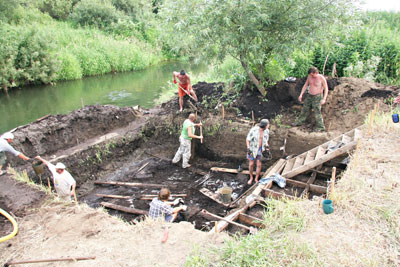
The discovery of 7,500-year-old fish traps in a Russian river valley has given new insight into prehistoric European settlement patterns.

The Mesolithic nomadic hunter-gatherers were believed to move with the seasons to follow food sources. Now excavation at a site in the Dubna river basin outside Moscow shows evidence of continuous year-round occupation.

The three-year investigation by an international team of archaeologists, led by the Spanish National Research Council (CSIC), found evidence that the inhabitants of Zamostje 2 adapted their diets according to the time of year but remained in the same place.

Project leader Ignacio Clemente said: ‘We think that fishing played a vital role in the economy of these societies, because it was a versatile product, easy to preserve, dry and smoke, as well as to store for later consumption.’

Read the rest of this article...

Unknown ancient city comes to light in Crete


An important archaeological excavation has just started at the “Koupos” site, by Krousona, not far from Herakleion (Crete). The site has been known since the early 20th century for the existence of an ancient city whose name remains unknown. 


The actual project is made possible by the collaboration between the 13th Ephorate of Prehistoric and Classical Antiquities and the Malevisi Municipality. Mayor Kostas Mamoulakis has taken in charge all expenses, while Athanasia Kanta, Director of the 13th EPCA, supervises the work. Furthermore, to facilitate the excavations, Malevizi Municipality has bought a big lot of land.

The site has been first investigated by the 13th EPCA back in the 1980s. A large settlement came to light, inhabited from the Late Minoan to the Hellenistic years (1200-100 BC). Many Archaic buildings had well built rooms. Inside the rooms were found the stone bases of the wooden columns that used to hold the roof. Pits carved in the rock contained ceramics and other findings that seem to have been offered for the house’s solid foundations.


Read the rest of this article...

Mysterious Elk-Shaped Structure Discovered in Russia


A huge geoglyph in the shape of an elk or deer discovered in Russia may predate Peru's famous Nazca Lines by thousands of years.  

The animal-shaped stone structure, located near Lake Zjuratkul in the Ural Mountains, north of Kazakhstan, has an elongated muzzle, four legs and two antlers. A historical Google Earth satellite image from 2007 shows what may be a tail, but this is less clear in more recent imagery.

Excluding the possible tail, the animal stretches for about 900 feet (275 meters) at its farthest points (northwest to southeast), the researchers estimate, equivalent to two American football fields. The figure faces north and would have been visible from a nearby ridge.

"The figure would initially have looked white and slightly shiny against the green grass background," write Stanislav Grigoriev, of the Russian Academy of Sciences Institute of History & Archaeology, and Nikolai Menshenin, of the State Centre for Monument Protection, in an article first detailing the discovery published last spring in the journal Antiquity. They note that it is now covered by a layer of soil.

Fieldwork carried out this past summer has shed more light on the glyph's composition and date, suggesting it may be the product of a "megalithic culture," researchers say. They note that hundreds of megalithic sites have been discovered in the Urals, with the most elaborate structures located on a freshwater island about 35 miles (60 km) northeast of the geoglyph. [See Photos of Russia's Nazca Lines]

Read the rest of this article...

Clubs Med: Neanderthals may have sailed to Mediterranean


Neanderthals or other extinct human lineages may have sailed to the Mediterranean Islands long before previously thought. Here, an excavation at Akrotiri Aetokremnos, a site in Cyprus dating back to about 10,000 B.C., where pygmy hippo fossils were found.


Neanderthals and other extinct human lineages might have been ancient mariners, venturing to the Mediterranean islands thousands of years earlier than previously thought. 

This prehistoric seafaring could shed light on the mental capabilities of these lost relatives of modern humans, researchers say. 

Scientists had thought the Mediterranean islands were first settled about 9,000 years ago by Neolithic or New Stone Age farmers and shepherds. 

"On a lot of Mediterranean islands, you have these amazing remains from classical antiquity to study, so for many years people didn't even look for older sites," said archaeologist Alan Simmons at the University of Nevada at Las Vegas.

Read the rest of this article...
Stone me! Spears show early human species was sharper than we thought


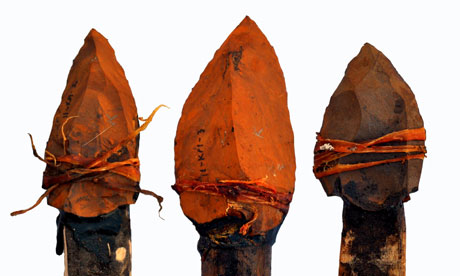
Cutting edge technology: early humans were lashing stone tips to wooden handles to make spears about 200,000 years earlier than we thought, research suggests. Photograph: Jayne Wilkins

Evidence of hunting with spears 500,000 years ago suggests common ancestor of humans and Neanderthals was 'very bright'


The ancestors of humans were hunting with stone-tipped spears 500,000 years ago, according to a new study – around 200,000 years earlier than previously thought. This means that the technology must have been developed by an earlier species of human, the last common ancestor of both modern humans and Neanderthals.

The invention of stone-tipped spears was a significant point in human evolution, allowing our ancestors to kill animals more efficiently and have more regular access to meat, which they would have needed to feed ever-growing brains. "It's a more effective strategy which would have allowed early humans to have more regular access to meat and high-quality foods, which is related to increases in brain size, which we do see in the archaeological record of this time," said Jayne Wilkins, an archaeologist at the University of Toronto who took part in the latest research.

The technique needed to make stone-tipped spears, called hafting, would also have required humans to think and plan ahead: hafting is a multi-step manufacturing process that requires many different materials and skill to put them together in the right way. "It's telling us they're able to collect the appropriate raw materials, they're able to manufacture the right type of stone weapons, they're able to collect wooden shafts, they're able to haft the stone tools to the wooden shaft as a composite technology," said Michael Petraglia, a professor of human evolution and prehistory at the University of Oxford who was not involved in the research. "This is telling us that we're dealing with an ancestor who is very bright."

Read the rest of this article...

Thursday, November 15, 2012

Airport x-ray scans reveal haul of new Bronze Age axeheads in pot found in Jersey field


An x-ray of the Bronze Age pot found in a Jersey field last month, carried out at the island’s airport, has found a further 21 axeheads in a discovery which could shed new light on the way people lived 3,000 years ago.

The original excavation, carried out after metal detectorist Ken Rive reported the find on a plot of land in Trinity, confirmed two socketed axeheads inside the damaged ancient pot.

Air pockets between the axes suggest that soil may have concealed the rest of the weapons as the pot gradually decayed.

“A trial x-ray fluorescence scan was carried out by staff from Cranfield University on the first two axes,” said a statement by Olga Finch, Jersey Heritage’s Curator of Archaeology, and Neil Mahrer, the Conservator for the group.

“This shows that they contain a very high lead content – almost 55 percent.


Read the rest of this article...
Archaeologists say Celtic relic found in Alps is a war horn


Trento, November 14 – Archaeologists in Trento announced Wednesday that an ancient Celtic artifact found some 60 years ago in this alpine region is, in fact, a Celtic war horn.

The horn was found in the Val di Non valley, an area more known for apples than for ancient artifacts.


While it was understood to be of Celtic origin, the use of the instrument - made of what appeared to be tubes and a bronze “leaf” - remained a mystery.


However, recently, archaeologists in Tintignac, France, uncovered a similar relic whose much better state allowed them to understand that it was, in fact, a horn.


Read the rest of this article...

Wednesday, November 14, 2012

Mongolia and the Altai Mountains: Origins of genetic blending between Europeans and Asians


A group of researchers led by the Universitat Autònoma de Barcelona (UAB) has discovered the first scientific evidence of genetic blending between Europeans and Asians in the remains of ancient Scythian warriors living over 2,000 years ago in the Altai region of Mongolia. Contrary to what was believed until now, the results published in PLoS ONE indicate that this blending was not due to an eastward migration of Europeans, but to a demographic expansion of local Central Asian populations, thanks to the technological improvements the Scythian culture brought with them. 

The Altai is a mountain range in Central Asia occupying territories of Russia and Kazakhstan to the west and of Mongolia and China to the east. Historically, the Central Asian steppes have been a corridor for Asian and European populations, resulting in the region's large diversity in population today. In ancient times however the Altai Mountains, located in the middle of the steppes, represented an important barrier for the coexistence and mixture of the populations living on each side. And so they lived isolated during millennia: Europeans on the western side and Asians on the eastern side. 

The research conducted by researchers from the UAB, the Institut Català de Paleontologia Miquel Crusafont and the Institute of Evolutionary Biology (UPF-CSIC) sheds new light on when and how this Eurasian genetic blending took place. 

At the UAB palaeogenetic laboratory researchers analysed mitochondrial DNA (inherited from the mother, it allows us to trace our ancestors) extracted from the bones and teeth of 19 skeletons from the Bronze Age (7th to 10th century BCE) and from the Iron Age (2nd to 7th century BCE) from the Mongolian Altai Mountains. The remains were extracted from the tombs discovered seven years ago, in which the skeletons of Scythian warriors were discovered and which represented the first scientific evidence of this culture in East Asia.

Read the rest of this article...

Tuesday, November 13, 2012

Civilisation is making humanity less intelligent, study claims

In a more civilised time the selection process which favoured the smartest of our ancestors
and weeded out the dullards is no longer in force
 Photo: ALAMY

Intelligence and the capacity for abstract thought evolved in our prehistoric ancestors living in Africa between 50,000 and 500,000 years ago, who relied on their wits to build shelters and hunt prey. 
But in more civilised times where we no longer need to fight to survive, the selection process which favoured the smartest of our ancestors and weeded out the dullards is no longer in force. 
Harmful mutations in our genes which reduce our "higher thinking" ability are therefore passed on through generations and allowed to accumulate, leading to a gradual dwindling of our intelligence as a species, a new study claims. 
Prof Gerald Crabtree, a developmental biologist at Stanford University, explained in the Trends in Genetics journal that a mutation in any one of 2,000 to 5,000 particular genes could lower our intellectual and emotional ability.

Read the rest of this article...

What is Google Earth Anomalies?


Discover the hidden archaeologist in you, on the Google Earth Anomalies website. As the name suggests, it is a website that is dedicated to discovering intriguing images from Google Earth. Recently, a group of archaeologists unearthed undiscovered pyramids and posted findings on the website. However, what has everyone gotten intrigued about is the unusual name of the website. The website states that the anomalies posted are derived from Google Earth satellite imagery programme. The site contains postings, satellite images from the anomaly collection of over 5,000 placemarks that consists of anomalous earthworks, unusual topography, geographical anomalies, scientific anomalies, mound sites, extraordinary sites, weird sites, unexplained features, mysterious landscape signs, unusual underwater formations/geography, and strange places seen with Google Earth.

Keisha Patel, a third-year geology student says that she finds the website extremely helpful for research projects. “Considering it is endorsed by Google, it has credibility and we can trust on findings. I found the project on underwater circular features in Greece extremely interesting. Even the quality and resolution of pictures is good. A lot of research had been going on for quite some time and these findings help us get a good hold of the subject,” explains Keisha.


Read the rest of this article...
You may also be interested in this Oxford summer school course about archaeology:

An Introductiuon to Archaeology

'Palaeo-porn': we've got it all wrong


See the evidence in our gallery: "The reality and the fantasy of 'palaeo-porn'"

The idea that curvaceous figurines are prehistoric pornography is an excuse to legitimise modern behaviour as having ancient roots, says archaeologist April Nowell

Which Palaeolithic images and artefacts have been described as pornography?
The Venus figurines of women, some with exaggerated anatomical features, and ancient rock art, like the image from the Abri Castanet site in France that is supposedly of female genitalia.

You take issue with this interpretation. Who is responsible for spreading it, journalists or scientists?

People are fascinated by prehistory, and the media want to write stories that attract readers - to use a cliché, sex sells. But when a New York Times headline reads "A Precursor to Playboy: Graphic Images in Rock", and Discover magazine asserts that man's obsession with pornography dates back to "Cro-Magnon days" based on "the famous 26,000-year-old Venus of Willendorf statuette...[with] GG-cup breasts and a hippopotamal butt", I think a line is crossed. To be fair, archaeologists are partially responsible - we need to choose our words carefully.

Read the rest of this article...

Monday, November 12, 2012

Golden treasure unearthed in Bulgaria


Bulgarian archaeologists have unearthed ancient golden artefacts during excavation works in the north of the country. 

The findings include golden rings, female figurines and 100 gold buttons. They are thought to date back to the late 4th or early 3rd century BC. 

James Kelly reports.

Watch the video...

Rare discoveries inspire archaeology on the beach


Mesolithic remains, an early Bronze Age cemetery and ancient peat beds are just some of the heritage wonders due to be excavated from the cliffs at Low Hauxley, thanks to a Heritage Lottery Fund (HLF) grant of £285,900.

The project ‘Rescued from the Sea’ run by the Northumberland Wildlife Trust, will engage a small army of volunteers to meticulously uncover the extremely rare and nationally important archaeological finds that are currently hidden within the cliff face. Local volunteers will be specially trained in the necessary skills to accurately record and preserve their findings. They will be trained in excavation skills, photography and small find recording amongst others.

The site is rapidly eroding with each high-tide, so the project has come to fruition just in time. According to the English Heritage funded North East Rapid Coastal Zone Assessment – the site is of high importance and extremely vulnerable. Mesolithic settlement sites, such as middens, hearths and structural remains, are very rare making these discoveries and this project all the more vital.

Read the rest of this article...

Neolithic houses unearthed in central Greece


The third field season of the Koutroulou Magoula Archaeology and Archaeological Ethnography project was completed a few days ago, bringing to light an important and extremely well preserved prehistoric site. 


The site of Koutroula Magoula, near the villages of Vardali and Neo Monastiri in Fthiotida is one of the largest tell sites in Greece covering of area of around 4 hectares, and rising 6,6 meters above the plan. 

It was occupied during the Middle Neolithic period (c. 5800-5300 BC) by a community of a few hundred people who constructed elaborate and architecturally sophisticated houses out of stone and mud-brick and with stone-paved under-floors.


Read the rest of this article...

Saturday, November 10, 2012

French mammoth may have been Neanderthal lunch


French archaeologists have uncovered a rare, near-complete skeleton of a mammoth in the countryside near Paris, alongside tiny fragments of flint tools suggesting the carcass may have been cut into by prehistoric hunters.

The archaeologists say that if that hypothesis is confirmed, their find would be the clearest ever evidence of interaction between mammoths and ancient cavemen in this part of Europe.

"Evidence this clear has never been found before, at least in France," said Gregory Bayle, chief archaeologist at the site.

"We're working on the theory that Neanderthal men came across the carcass and cut off bits of meat."
Archaeologists came across the giant bones by accident while they were excavating ancient Roman remains in a quarry near the town of Changis-sur-Marne, 30 km (19 miles) east of Paris.

Read the rest of this article...

Bounty Of Golden Artifacts Unearthed From 2,400-year-old Bulgarian Tomb


Bulgarian archeologists announced that they have unearthed a bounty of golden jewelry, sculptures, and other artifacts from a 2,400-year old tomb located in northern Bulgaria.

The artifacts were found in a wooden box that contained burnt bones and ritual items, which had been wrapped in a gold-weave cloth. The tomb belonged to the Getae, an ancient tribal people that were rivals with the ancient Greeks and part of a larger group of tribes called the Thracians. The Thracians inhabited an area west of the Black Sea for around 1,000 years, starting around the 5th century B.C.E.

Among the artifacts discovered were four bracelets with snake heads, a tiara with reliefs of lions and fantasy animals, a horse-head ornamental piece, a golden ring, 44 female figure depictions and 100 golden buttons.

“These are amazing findings from the apogee of the rule of the Getae,” lead researcher Diana Gergova, from the Sofia-based National Archaeology Institute, told The Guardian. “From what we see up to now, the tomb may be linked with the first known Getic ruler, Cothelas.”

Read the rest of this article...

Iceman was Central Europe native, new research finds


Otzi the Iceman, an astonishingly well-preserved Neolithic mummy found in the Italian Alps in 1991, was a native of Central Europe, not a first-generation émigré from Sardinia, new research shows. And genetically, he looked a lot like other Stone Age farmers throughout Europe. 

The new findings, reported Thursday here at the American Society of Human Genetics conference, support the theory that farmers, and not just the technology of farming, spread during prehistoric times from the Middle East all the way to Finland. 

"The idea is that the spread of farming and agriculture, right now we have good evidence that it was also associated with a movement of people and not only technology," said study co-author Martin Sikora, a geneticist at Stanford University.

In what may be the world's oldest cold case, Otzi was pierced by an arrow and bled to death on a glacier in the Alps between Austria and Italy more than 5,000 years ago. [ Album: A New Face for Otzi the Iceman ]

Read the rest of this article...

Archaeologists discover Thracian golden jewelry


Archaeologists say they have unearthed an almost 2,400-year-old golden hoard in an ancient Thracian tomb in northern Bulgaria.

he treasure was found on Thursday near the village of Sveshtari, 400 kilometers (250 miles) northeast of Sofia, team leader Diana Gergova said.

She said that among the artifacts, dating back to the end of the fourth or the beginning of the third century B.C., were gold jewelry and applications for horse trappings, a tiara with reliefs of lions and fantasy animals, as well as four bracelets and a ring.

The Thracians lived in what is now Bulgaria, and parts of modern Greece, Romania, Macedonia, and Turkey between 4,000 B.C. and the 7th century A.D., when they were assimilated by the invading Slavs.

Read the rest of this article...

Unique Thracian treasure found in Bulgaria


Bulgarian archaeologists have found a unique gold Thracian treasure in the famous Sveshtari tomb.

The team, led by one of the most prominent Bulgarian experts on Thracian archaeology, Prof. Diana Gergova, from the National Archaeology Institute at the Bulgarian Academy of Sciences, BAS, made the discovery during excavations at the so-called Omurtag mount.

The researchers found fragments of a wooden box, containing charred bones and ashes, along with a number of extremely well-preserved golden objects, dated from the end of the 4th and the beginning of the 3rd century B. C.. They include four spiral gold bracelets, and a number of intricate applications like one which shows the head of a female goddess adorned with beads, applications on horse riding gear and a forehead covering in the shape of a horse head with a base shaped like a lion head. The objects weigh 1.5 kg, but the excavations continue.

The precious find also contains a ring, buttons and beads. Gergova explains that it seemed the treasure was wrapped in a gold-woven cloth because a number of gold threads were discovered nearby.


Read the rest of this article...

Thursday, November 8, 2012

Oldest Arrowheads Hint at How Modern Humans Overtook Neandertals

Tiny stone blades from Pinnacle Point Cave 5-6 in South Africa that once tipped arrows or darts represent the oldest known projectile weapons. Image: Simen Oestmo

Archaeologists excavating a cave on the southern coast of South Africa have recovered remains of the oldest known projectile weapons. The tiny stone blades, which were probably affixed to wooden shafts for use as arrows, date to 71,000 years ago and represent a sophisticated technological tradition that endured for thousands of years. The discovery bears on an abiding question about when and how modern human cognition emerged, and suggests a way by which early modern Homo sapiens outcompeted Neandertals to eventually become the last human species standing.

Fossils show that humans who basically looked like us had evolved by around 200,000 years ago. Yet based on the cultural stuff they left behind, it looked as though anatomically modern humans didn’t begin thinking like us until much later. And when the creative spark did eventually ignite, the flame flickered only briefly before fizzling, only to spark and fade again and again as populations died out, taking their innovations to the grave. Projectile weapon technology, for example, seemed to make a brief first appearance sometime between 65,000 and 60,000 years ago and didn’t stick until after 40,000 years ago. But whether this flickering pattern in the archaeological record is real or merely an artifact of the small number of sites excavated has been unclear. The new South African finds, which come from a site called Pinnacle Point 5 – 6 (PP5-6), support the latter scenario.

Read the rest of this article...

Wednesday, November 7, 2012

Mammoth skeleton found in France


Archaeologists in France have unearthed a rather hairy fossil — a nearly complete skeleton of a mammoth.

The bones — thought to belong to a creature that roamed the earth between 200,000 and 50,000 years ago — were discovered by accident during the excavation of an ancient Roman site 30 miles (50 kilometers) east of Paris.

It may be only the third remains of a long-haired woolly mammoth discovered in France in the last 150 years. Such discoveries are more common in Siberia.

Archaeologists will try to establish the circumstances of the long tusked specimen's death: If it drowned in the River Marne or was hunted by Neanderthal Man.

Read the rest of this article...

Archeologists Examine One of the Oldest Hoards Found in Europe


Jewelry and female figurines from Belica, Serbia, to be exhibited for the first time at Tübingen University Museum.

Archeologists from the University of Tübingen's Institute of Prehistory are working with the Serbian Archeological Institute in Belgrade to analyze the most comprehensive Early Neolithic hoard ever found. Work on the nearly 8000 year old collection of jewelry and figurines is funded by the Thyssen Foundation.

The unique hoard is composed of some 80 objects made of stone, clay and bone. "This collection from Belica, in all its completeness, provides a unique glimpse into the symbols of the earliest farmers and herdsmen in Europe," says Tübingen archeologist Dr. Raiko Krauss, who heads the German side of the project.

The objects include stylized female figures, parts of the human body, as well as miniature axes and abstract figures. Much attention has been given to the rotund female figures of water-smoothed stone given human features by human hands. Were they idols, lucky charms or fertility symbols? Their purpose is unknown.

Read the rest of this article...

Tolkien estate bans reference to 'hobbits'


It was, perhaps, inevitable that Homo floresiensis, the one-metre-tall species of primitive human discovered on the Indonesian island of Flores, would come to be widely known as "hobbits". After all, like JRR Tolkien's creation, they were "a little people, about half our height". But a New Zealand scientist planning an event about the species has been banned from describing the ancient people as "hobbits" by representatives of the Tolkien estate.

Brent Alloway, associate professor at Victoria University, is planning a free lecture next month at which two of the archaeologists involved in the discovery of Homo floresiensis in 2003, Mike Morwood and Thomas Sutikna, will speak about the species. The talk is planned to coincide with the premiere of The Hobbit film, and Dr Alloway had planned to call the lecture "The Other Hobbit", as Homo floresiensis is commonly known.

But when he approached the Saul Zaentz Company/Middle-earth Enterprises, which owns certain rights in The Hobbit, he was told by their lawyer that "it is not possible for our client to allow generic use of the trade mark HOBBIT".


Read the rest of this article...

Tuesday, November 6, 2012

Archaeologists find prehistoric remains in Truro

A slate disc decorated on both sides is believed to date to the later Neolithic, found at the Truro site Credit: Cornwall Council

Archaeologists working at the site of the future Truro Eastern District Centre (TEDC) have discovered the fragmentary remains of a prehistoric enclosure likely to have been built around 5,500 years ago.

Initial findings from the excavations, led by Cornwall Council’s Historic Environment Service, suggest the eastern end of the site may have been a ‘causewayed enclosure’ dating from the early Neolithic period (3800BC to 3600BC).
Now the team will catalogue their findings, take samples and, in line with national guidance, carefully re-bury the site to protect it for future generations.
“While it is important that we take the opportunity to learn more about our findings now, best practice is for the site to be preserved for future generations of archaeologists who will have better technologies to understand it than we do today,” said Dan Ratcliffe from the Council’s Historic Environment Service. “Scientific analysis of evidence recovered during the excavations is expected to take some years after the sample excavation has concluded.”
Read the rest of this article...

Monday, November 5, 2012

Europe's oldest prehistoric town unearthed in Bulgaria


Archaeologists in Bulgaria say they have uncovered the oldest prehistoric town found to date in Europe.

The walled fortified settlement, near the modern town of Provadia, is thought to have been an important centre for salt production.

Its discovery in north-east Bulgaria may explain the huge gold hoard found nearby 40 years ago.

Archaeologists believe that the town was home to some 350 people and dates back to between 4700 and 4200 BC. 

That is about 1,500 years before the start of ancient Greek civilisation.

Read the rest of this article...
Prehistoric remains unearthed in Cornwall


Archaeologists working at the site of the future Truro Eastern District Centre (TEDC) have discovered the fragmentary remains of a prehistoric enclosure likely to have been built around 5,500 years ago.

Initial findings from the excavations, led by Cornwall Council’s Historic Environment Service, suggest the eastern end of the site may have been a ‘causewayed enclosure’ dating from the early Neolithic period (3800BC to 3600BC).

Now the team will catalogue their findings, take samples and, in line with national guidance, carefully re-bury the site to protect it for future generations.


Read the rest of this article...

Monday, October 22, 2012

Breakthrough in world's oldest undeciphered writing

Experts working on proto-Elamite hope they are on the point of 'a breakthrough'

The world's oldest undeciphered writing system, which has so far defied attempts to uncover its 5,000-year-old secrets, could be about to be decoded by Oxford University academics.

This international research project is already casting light on a lost bronze age middle eastern society where enslaved workers lived on rations close to the starvation level.

"I think we are finally on the point of making a breakthrough," says Jacob Dahl, fellow of Wolfson College, Oxford and director of the Ancient World Research Cluster.

Dr Dahl's secret weapon is being able to see this writing more clearly than ever before.

Read the rest of this article...

Core sample sends carbon clock farther back in time


The carbon clock is getting reset. Climate records from a Japanese lake are set to improve the accuracy of the dating technique, which could help to shed light on archaeological mysteries such as why Neanderthals became extinct.

Carbon dating is used to work out the age of organic material — in effect, any living thing. The technique hinges on carbon-14, a radioactive isotope of the element that, unlike other more stable forms of carbon, decays away at a steady rate. Organisms capture a certain amount of carbon-14 from the atmosphere when they are alive. By measuring the ratio of the radio isotope to non-radioactive carbon, the amount of carbon-14 decay can be worked out, thereby giving an age for the specimen in question.

But that assumes that the amount of carbon-14 in the atmosphere was constant — any variation would speed up or slow down the clock. The clock was initially calibrated by dating objects of known age such as Egyptian mummies and bread from Pompeii; work that won Willard Libby the 1960 Nobel Prize in Chemistry. But even he “realized that there probably would be variation”, says Christopher Bronk Ramsey, a geochronologist at the University of Oxford, UK, who led the latest work, published today in Science1. Various geologic, atmospheric and solar processes can influence atmospheric carbon-14 levels.

Read the rest of this article...

Ancient sundial found in northern Greece

The ancient sundial dating from the Greco-Roman period found in Polichrono in Chalkidiki [Credit: Greek Reporter]

One of the rarest sundials dating from the Greco-Roman period was found in Polichrono in Chalkidiki, northern Greece. This sundial is not a usual one as it shows the correct time at any given place.

It is noteworthy that in the Ancient Greek world, sundials consisted of a gnomon (indicator) in the form of a vertical post or peg set in a flat surface, upon which the shadow of the gnomon served to indicate the time.

This sundial has a surface which is separated in 12 parts representing 12 hours of the day. More particularly, the sundial consists of a hyperbola tracing the shadow’s path at the winter solstice, a second one for the summer solstice, and a straight east-west line in between marking the equinoctial shadows.


Read the rest of this article...