Thursday, October 29, 2015

ARCHAEOLOGISTS DISCOVER 10 GRAVES IN NECROPOLIS OF BRONZE AGE DANUBE RIVER CULTURE NEAR BULGARIA’S BALEY

The 2015 excavations of the necropolis of the settlement of the “Culture of the Encrusted Ceramics of the Lower Danube” took place in mid October 2015. Photo: Monitor daily

A total of 10 graves from the necropolis of a Late Bronze Age and Early Iron Age settlement located near the town of Baley, Vidin District, in Northwest Bulgaria, have been discovered and explored during the 2015 excavations of the site which belongs to the so called “Culture of the Encrusted Ceramics of the Lower Danube”.
In one of the ten newly found graves, the archaeologists have found a total of 16 ceramic vessels, some of which are funeral urns, reveals Nikolay Kazashki from the Vidin Regional Museum of History, who is the deputy head of the archaeological expedition in Baley.
The excavations are led by Assist. Prof. Georgi Ivanov, and consulted by Assoc. Prof. Stefan Alexandrov, both of whom are from the National Institute and Museum of Archaeology in Sofia.
The newly discovered artifacts from the Baley necropolis, which dates back to 1,600-1,100 BC, are from three distinct chronological stages of the Bronze Age culture, reports the Bulgarian dailyMonitor.
Read the rest of this article...

Wednesday, October 28, 2015

3,500-year-old warrior prince tomb is 'most exciting Ancient Greek find for decades'


Experts describe the discovery of tomb packed full of gold, silver and weapons, which sheds light on ancient Mycenaean and Minoan civilisations, as one of the most significant in decades

Flanked by a three-foot long bronze sword with an ivory handle and surrounded by a treasure trove of gold, silver and precious stones, he lay undisturbed for 3,500 years.
Now, the skeleton of an ancient Greek warrior, his tomb protected by a heavy stone slab, has been discovered by archaeologists in the Peloponnese.
Described as one of the most exciting discoveries in Greece for decades, the 30-35 year old man has been dubbed the “Griffin Warrior” after an ivory plaque depicting the half-lion, half-eagle mythical beast that was found alongside him.
Read the rest of this article...

Friday, October 23, 2015

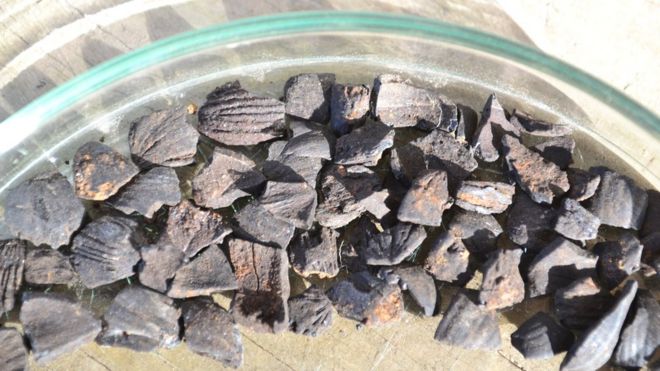
Hazelnut shells found at Skye Mesolithic site


The remains of hazelnuts eaten by some of Skye's earliest inhabitants were found at a dig on the island, archaeologists have revealed.
Hazelnuts were a favourite snack of Mesolithic hunter-gatherers, according to archaeologists at the University of the Highlands and Islands (UHI).
The shells found at an excavation above Staffin Bay could be 8,000-years-old.
UHI carried out the dig along with Staffin Community Trust, school children and volunteers.

Read the rest of this article...

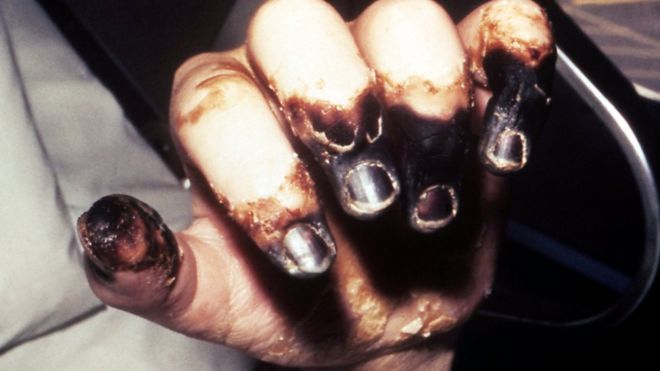
Plague traced back to Bronze Age


Plague has been a scourge on humanity for far longer than previously thought, ancient DNA shows.
Samples taken from the teeth of seven bodies contained traces of the bacterial infection in the Bronze Age.
They also showed it had, at the time, been unable to cause the bubonic form of plague or spread through fleas - abilities it evolved later.
The researchers, at the University of Copenhagen, say plague may have shaped early human populations.
Human history tells of three plague pandemics:

Read the rest of this article...

Monday, October 12, 2015

Oldest evidence of human activity found in Scotland


Archaeologists from the University of Reading have found the earliest dated evidence for human activity in Scotland - with a helping hand from a herd of pigs. 


Some of the tools found by the archaeologists  [Credit: University of Reading] 

The team made the remarkable discovery of a set of 12,000 year-old Ice Age stone tools while excavating Rubha Port an t-Seilich, on Islay in the Inner Hebrides in 2013. The tools include scrapers used for cleaning skins, sharp points likely used for hunting big game, such as reindeer, and much more. 

While the dig involved highly skilled archaeologists they have another team, or herd, to thank for the discovery. Pigs foraging along the Islay coastline uprooted Mesolithic objects in 2009 which ultimately led to the start of the excavation.

Read the rest of this article...

Digitising Yorkshire's savannah past


Ancient bones from a North Yorkshire cave, including the remains of rhinos, bears and hyenas, are to go on display in a "virtual museum" more than a century after they were excavated.
Some of the bones, found in Victoria Cave in the dales, date back more than one hundred thousand years.
At that time, such beasts were common in northern England.
A team of archaeologists from the organisation DigVentures has set out digitise the site's unique collection.
The cave was discovered in 1837 when a man noticed his dog disappear through an opening in the hill, and reappear through another.

Read the rest of this article...

Friday, October 9, 2015

First ancient African genome solves migration mystery


An ancient African genome has been sequenced for the first time.
Researchers extracted DNA from a 4,500-year-old skull that was discovered in the highlands of Ethiopia.
A comparison with genetic material from today's Africans reveals how our ancient ancestors mixed and moved around the continents.
The findings, published in the journal Science, suggests that about 3,000 years ago there was a huge wave of migration from Eurasia into Africa.
This has left a genetic legacy, and the scientists believe up to 25% of the DNA of modern Africans can be traced back to this event.
"Every single population for which we have data in Africa has a sizeable component of Eurasian ancestry," said Dr Andrea Manica, from the University of Cambridge, who carried out the research.

Read the rest of this article...

Saturday, October 3, 2015

Mummification was common in Bronze Age Britain


Ancient Britons may have intentionally mummified some of their dead during the Bronze Age, according to archaeologists at the University of Sheffield. 


Bronze Age skeleton from Neat's Court excavation, on Isle of Sheppey, Kent  
[Credit: Geoff Morley]

The study, published in the Antiquity Journal, is the first to provide indications that mummification may have been a wide-spread funerary practise in Britain. 

Working with colleagues from the University of Manchester and University College London, Dr Tom Booth analysed skeletons at several Bronze Age burial sites across the UK. The team from the University of Sheffield’s Department of Archaeology found that the remains of some ancient Britons are consistent with a prehistoric mummy from northern Yemen and a partially mummified body recovered from a sphagnum peat bog in County Roscommon, Ireland.

Read the rest of this article...
ARCHAEOLOGISTS UNCOVER BRONZE AGE ‘SAUNA HOUSE’ IN ORKNEY


Archaeologists in Orkney have uncovered the remains of over 30 buildings dating from around 4000 BC to 1000 BC, together with field systems, middens and cemeteries. The find includes a very rare Bronze Age building which experts believed could have been a sauna or steam house, which may have been built for ritual purposes. 

EASE Archaeology recently made the exciting discovery on the periphery of the prehistoric Links of Noltland, on the island of Westray in Orkney, next to where the famous ‘Westray Wife’ was found in 2009, which is believed to be the earliest depiction of a human face in Britain. 

The work is being funded by Historic Scotland, who are this week merging with the Royal Commission on Ancient and Historic Monuments of Scotland (RCAHMS) to form a new heritage body called Historic Environment Scotland. 

Work has been carried out at the Links of Noltland for several years now but the most recent discovery, and one of the most remarkable to date, is that of an almost complete and remarkably well-preserved, very rare Bronze Age building which experts believe had a very specialised function and was used by select groups for activities such as rites of passage or spiritual ceremonies.  It’s also possible that the building could have been used as a sweat house or sauna, for a number of activities ranging from basic healing and cleansing, or as a place where women could come to give birth, the sick and elderly could come to die, or where bodies were taken before burial.


Read the rest of this article...

Monday, September 21, 2015

5,000-Year-Old Throne Found in Turkey


The remains of a 5,000-year-old adobe basament of a possible “throne” have been unearthed during excavations in Turkey, revealing the origins of the secularization of power and one of the first evidence of the birth of the state system.
Discovered in Aslantepe in the eastern Turkish province of Malatya, the structure consists of an adobe platform, raised by three steps above the floor, on top of which burnt wooden pieces were found.
“The burnt wooden fragments are likely the remains of a chair or throne,” excavation director Marcella Frangipane of La Sapienza University in Rome, told Discovery News.
Read the rest of this article...

Steinzeitliche Miniaturräder aus Holz


Kinderspielzeug, Anschauungsmaterial für Wagenbauer oder rituelle Gegenstände?
Im Olzreuter Ried bei Bad Schussenried in Oberschwaben fanden Archäologen des des Landesamts für Denkmalpflege im Regierungspräsidium Stuttgart zwei gut erhaltene hölzerne Miniaturräder aus dem 3. Jahrtausend v.Chr. Die Funde zeigen, dass in der Jungsteinzeit zwei unterschiedliche Konstruktionsprinzipien für Fuhrwerke bekannt waren.
Read the rest of this article...

Monday, September 14, 2015

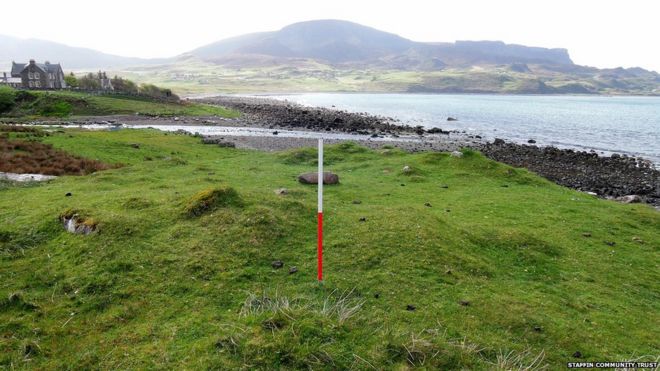
Mesolithic site on Skye to be investigated

Archaeologists have described the site as having "huge potential"

Excavations of a Mesolithic site on Skye could give new insights into the lives of some of the island's earliest residents.
Archaeologists believe the location above Staffin Bay has the remains of a house that could be 8,000 years old.
Mesolithic flints have previously been found in an area of eroded grazing land near the site.
Archaeologists will work with Staffin Community Trust and volunteers in making small excavations.
Read the rest of this article...
Neolithic skeleton reveals early history of rickets


Rickets has been identified in a Neolithic skeleton from the Scottish island of Tiree, making it the earliest case of the disease in the UK, according to research announced at the British Science Festival in Bradford.
This is particularly surprising as the disease – caused by Vitamin D deficiency linked to lack of sunlight – is more commonly associated with the urban slums of Victorian Britain than with rural, farming communities, as existed in Neolithic Scotland. The nature of the grave itself – a simple burial rather than a chambered tomb – has raised questions as to how the woman, physically deformed by the disease, may have been treated by her community.
Professor Ian Armit from the University of Bradford explains: “The earliest case of rickets in Britain until now dated from the Roman period, but this discovery takes it back more than 3,000 years. There have been a few possible cases in other parts of the world that are around the same time, but none as clear cut as this. While we can’t say for certain that this is the earliest case in the world, it is definitely very unusual.
Read the rest of this article...

DNA from Neandertal relative may shake up human family tree

FOSSIL SKULLS AND CHIMPANZEE/J.-J. HUBLIN; BONOBO/ROYAL MUSEUM FOR CENTRAL AFRICA, TERVUREN, BELGIUM

In a remarkable technical feat, researchers have sequenced DNA from fossils in Spain that are about 300,000 to 400,000 years old and have found an ancestor—or close relative—of Neandertals. The nuclear DNA, which is the oldest ever sequenced from a member of the human family, may push back the date for the origins of the distinct ancestors of Neandertals and modern humans, according to a presentation here yesterday at the fifth annual meeting of the European Society for the study of human evolution.

Ever since researchers first discovered thousands of bones and teeth from 28 individuals in the mid-1990s from Sima de los Huesos (“pit of bones”), a cave in the Atapuerca Mountains of Spain, they had noted that the fossils looked a lot like primitive Neandertals. The Sima people, who lived before Neandertals, were thought to have emerged in Europe. Yet their teeth, jaws, and large nasal cavities were among the traits that closely resembled those of Neandertals, according to a team led by paleontologist Juan-Luis Arsuaga of the Complutense University of Madrid. As a result, his team classified the fossils as members of Homo heidelbergensis, a species that lived about 600,000 to 250,000 years ago in Europe, Africa, and Asia. Many researchers have thought H. heidelbergensis gave rise to Neandertals and perhaps also to our species, H. sapiens, in the past 400,000 years or so.

Read the rest of this article...

Scientists identify a new ancient ancestor


An international team of scientists, including one from the University of Colorado Denver and another from the University of Colorado Anschutz Medical Campus in Aurora, announced the discovery of a new species of hominin, a small creature with a tiny brain that opens the door to a new way of thinking about our ancient ancestors. 


This photo provided by National Geographic from their October 2015 issue shows  a composite skeleton of Homo naledi surrounded by some of the hundreds of  other fossil elements recovered from the Rising Star cave in South Africa,  photographed at the Evolutionary Studies Institute of the University of  the Witwatersrand in Johannesburg, South Africa  [Credit: Robert Clark/National Geographic, Lee Berger/ University of the Witwatersrand via AP] 

The discovery of 15 individuals, consisting of 1,550 bones, represents the largest fossil hominin find on the African continent. 

“We found adults and children in the cave who are members of genus Homo but very different from modern humans,” said CU Denver Associate Professor of Anthropology Charles Musiba, PhD, who took part in a press conference Thursday near the discovery inside the Rising Star Cave in the Cradle of Humankind World Heritage Site outside Johannesburg, South Africa. “They are very petite and have the brain size of chimpanzees. The only thing similar we know of are the so-called ‘hobbits’ of Flores Island in Indonesia.”

Read the rest of this article...
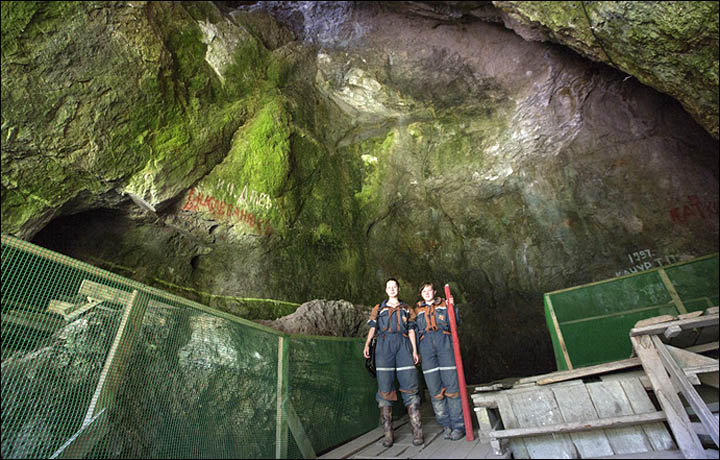
Friday, July 31, 2015

First glimpse inside the Siberian cave that holds the key to man's origins

The significance of the cave is immense, and the experts are convinced it has more secrets to give up on human origins. Picture: Vera Salnitskaya

These exclusive pictures show the world famous Denisova Cave in the Altai Mountains from which a series of stunning scientific discoveries on man's origins have been made in recent years.
More are expected as a result of a hive of archeological activity - overseen by the specialists from Novosibirsk State University -  underway at this unique site inhabited continuously from the deep past.
Scientist Maksim Kozlikin said: 'We are working with Oxford University in the UK, they help us with radiocarbon and other dating and also conduct studies of ancient DNA. Currently, we continue cooperation and there can be new joint scientific articles.' 
The significance of the cave is immense, and the experts are convinced it has more secrets to give up on human origins. Here in 2008 was discovered a finger bone fragment of 'X woman', a juvenile female who lived around 41,000 years ago, analysis of which indicated that she was genetically distinct from Neanderthals and modern humans.
This previously unknown and long extinct hominin species or subspecies was christened Denisovan after this cave. In 2010 analysis on an upper molar from a young adult, found in the cave ten years previously, was also from a Denisovan.
Read the rest of this article...

Fragments of new female figurine found at Hohle Fels


Archaeologists, Prof. Nicholas Conard and his team member Maria Malina, present the discovery of two fragments of a new female figurine in today's edition of the journal: Archäologische Ausgrabungen Baden-Württemberg. The figurine shows similarities with the well-known Venus from Hohle Fels that Prof. Conard published in 2009. 


Fragments of a female figurine from Hohle Fels in southwestern Germany  dating to the Aurignacian period roughly 40,000 years ago  [Credit: J. Lipták/University of Tübingen] 

The two pieces of carved mammoth ivory fit together to form a find with dimensions of 23 x 22 x 13 mm. The find does not appear to be part of a depiction of an animal or lionman, both frequent motifs from the caves of the Swabian Jura of southwestern Germany. 

Instead, the find shows strong affinities with the only other female figurine known from the region. The find will be exhibited as part of a small research exhibit at the Museum of Prehistory in Blaubeuren.

Read the rest of this article...
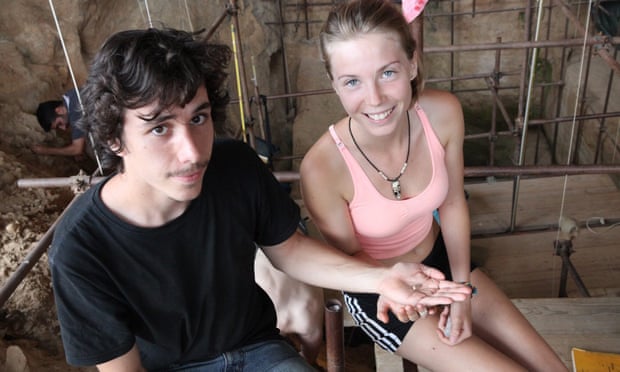
French student finds tooth dating back 560,000 years

 Valentin Loescher, left, holding the tooth, and Camille Jacquey were working together on the dig. Photograph: Denis Dainat/EPA

A French student has found an adult tooth dating back around 560,000 years in south-western France, in what researchers are hailing as a major discovery.
Valentin Loescher, 20, was volunteering alongside Camille Jacquey, 16, on his first summer archaeological dig at the Arago cave near Tautavel, when he discovered the tooth.
The tooth could be the oldest human remains found in France. It predates by 100,000 years the famous Tautavel man, a 20-year-old prehistoric hunter and ancestor of Neanderthal man, who was discovered at the site in 1971 and whose remains dated back about 450,000 years.
Read the rest of this article...

5,000-year-old fort found in Monmouth


Archaeologists in Monmouth have discovered the remains of an ancient wooden building that dates back 5,000 years. 


An artist impression of what the fort looked like nearly 5,000 years ago  [Credit: Monmouth Archaeological Society] 

Steve Clarke, who two years ago uncovered the remains of a huge post-glacial lake at the Parc Glyndwr building site, said the timber remains found under the new Rockfield estate were once part of a crannog, an ancient fortified dwelling built into a lake. 

Part of the wooden building set into the bed of what was once Monmouth’s prehistoric lake, pre-dates the only other known crannog in England and Wales by 2,000 years. 

Read the rest of this article...
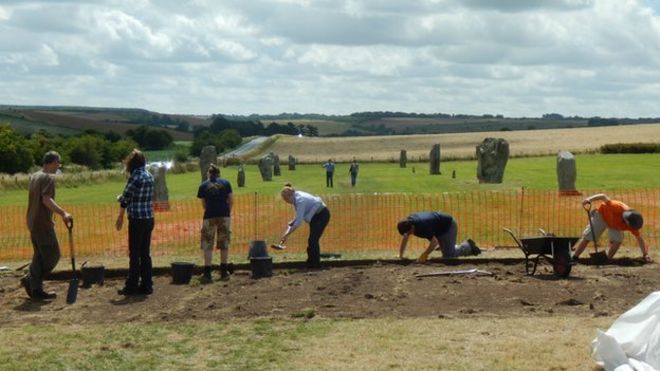
Tuesday, July 28, 2015

Neolithic house discovery at Avebury stone circle dig


Archaeologists believe they may have found the remains of a house where people who built Avebury stone circle may have lived.
The three-week Between the Monuments project is researching the daily lives of Neolithic and Bronze Age residents at the Wiltshire site.
The dig is being led by The National Trust and Southampton and Leicester University archaeologists.
The National Trust said if it is a house they will have "hit the jackpot".
Spokesman Dr Nick Snashall said: "I could count the number of middle Neolithic houses that have been found on the fingers of one hand.

Read the rest of this article...