Tuesday, November 26, 2013

Archaeologists looking for Stonehenge origins 'are digging in wrong place'

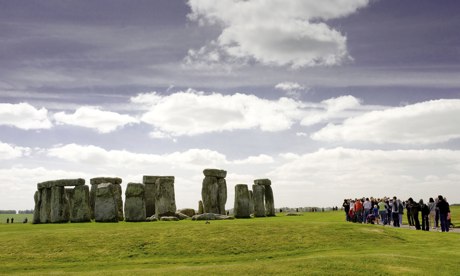
One of the mysteries of Stonehenge is how some of its stones were brought from Pembrokeshire in Wales to Wiltshire. Photograph: I Capture Photography/Alamy
For almost a century archaeologists have been braving the wind and rain on an exposed Welsh hillside in an attempt to solve one of the key mysteries of Stonehenge.
But new research about to be published suggests that over the decades they may have been chipping away at the wrong rocky outcrop on thePreseli Hills in Pembrokeshire.
The work in the hills is a crucial element in the understanding ofStonehenge because it is generally accepted that the bluestones that form part of the ancient Wiltshire monument came from this remote spot in south-west Wales. One of the many huge puzzles remains how the bluestone from Wales travelled 190 miles to the heart of south-west England.
Read the rest of this article...

NEOLITHIC DEATH RITUAL INCLUDES EARLIEST EVIDENCE FOR EUROPEAN BEER


Spanish excavations in Can Sadurní cave (Begues, Barcelona) have discovered four human skeletons dated to about 6,400 years ago. The skeletal remains of the individuals are particularly important as they are in a very good state of preservation.
An archaeological campaign carried out previously identified other individuals which were not so well preserved but belong to the same stratigraphic layer.
Archaeologists excavating  in 1999, also discovered within the cave, evidence for the earliest European beer, which may have been included as part of  the death ritual.
Excavations at Can Sadurní are carried out by Col·lectiu per la Investigació de la Prehistòria i l’Arqueologia del Garraf-Ordal (CIPAG), together with the Seminar of Studies and Prehistoric Research (SERP) of the University of Barcelona.

Read the rest of this article...

6,400 year-old burials found in Spanish cave


Excavations in Can Sadurní cave (Begues, Barcelona) have discovered four human skeletons dated at about 6,400 years ago which were buried following an unknown ritual in the Iberian Peninsula. Few caves have necropolis dated at such an ancient period: the beginning of Middle Neolithic.

6,400 year-old burials found in Spanish cave
In the case of the remains which have just been found, a light landslide from the outer part took place when corpses were quite complete or they had just began the decomposition process; it protected corpses, so they have remained in the position in which they were buried [Credit: University of Barcelona]
In addition, remains are particularly important as they are nearly complete. In fact, a campaign carried out previously identified some buried bodies, which were not so well preserved but belong to the same sepulchral layer, and the most ancient European remains of beer consumption. Excavations at Can Sadurní are carried out by Col·lectiu per la Investigació de la Prehistòria i l’Arqueologia del Garraf-Ordal (CIPAG), together with the Seminar of Studies and Prehistoric Research (SERP) of the UB.

Read the rest of this article...

Thursday, November 21, 2013

NEANDERTHAL STRING THEORY


In a further study of Neanderthal occupation at Abri du Maras, Ardèche in France, the evidence is stacking up to support the view that this group was behaviourally flexible and capable of creating a variety of sophisticated tools including projectile points and more importantly, cord and string.
Fibrous materials that can be used to create cords are difficult to find in the archaeological record and have usually rotted away, so the oldest known string dated back only 30,000 years.  However, perforations in small stone and tooth artefacts as well as shells from other Neanderthal sites in France suggested the pieces had once been threaded on string and worn as pendants.
Bruce Hardy at Kenyon College in Gambier, Ohio, explains that “The wear patterns provide circumstantial evidence of early use of string, but the evidence is not definitive.”  These items could also have been threaded onto animal sinew.

Read the rest of this article...

Another piece in Stonehenge rock source puzzle

The chances of Stonehenge's spotted dolerites not coming from Carn Goedog are 'infinitesimally small'

Research to be published this month may bring us a step closer to understanding how bluestones from Pembrokeshire ended up at Stonehenge.
Scientists from Aberystwyth University, University College London and National Museum of Wales have located the specific outcrop, Carn Goedog, in the Preseli Mountains.
This is where the distinctive spotted dolerites originated.
The findings are to be published in the Journal of Archaeological Science.
Geologist Herbert Henry Thomas first proposed in 1923 that the rocks which form the giant inner ring were specifically quarried for Stonehenge by Neolithic man around 5,000 years ago, and were hauled to Wiltshire via land and sea.
Read the rest of this article...

Deformed, Pointy Skull from Dark Ages Unearthed in France

A woman's deformed skull was found in one of the tombs, which dates to around 1,650 years ago.

The skeleton of an ancient aristocratic woman whose head was warped into a deformed, pointy shape has been unearthed in a necropolis in France.

The necropolis, found in the Alsace region of France, contains 38 tombs that span more than 4,000 years, from the Stone Age to the Dark Ages.

Rich valley

The Obernai region where the remains were found contains a river and rich, fertile soil, which has attracted people for thousands of years, Philippe Lefranc, an archaeologist who excavated the Stone Age burials, wrote in an email.

Read the rest of this article...

Saturday, November 16, 2013

DNA hint of European origin for dogs

Some dog-looking remains are more than 30,000 years old

The results of a DNA study suggest that dogs were domesticated in Europe.
No-one doubts that "man's best friend" is an evolutionary off-shoot of the grey wolf, but scientists have long argued over the precise timing and location for their emergence.
The new research, based on a genetic analysis of ancient and modern dog and wolf samples, points to a European origin at least 18,000 years ago.
Olaf Thalmann and colleagues report the investigation in Science magazine.
Read the rest of this article...

Wednesday, November 13, 2013

PREPARING FOR DEATH IN BRONZE AGE GALLOWAY


The discovery of 3 cists found within close proximity to one another has intrigued archaeologists. One of the cists contained the burial of a juvenile, while the other two were completely devoid of human remains.
The investigation began in April 2012 after a rectangular stone cist was accidentally damaged by ploughing at Blairbuy Farm in Dumfries and Galloway, southwest Scotland.   A team from GUARD Archaeology, led by Warren Bailie, was sent to investigate by Historic Scotland and it was during the excavation process that the other two cists were uncovered; one rectangular and one roughly oval in shape.

Juvenile burial

There were no artefacts present with the burial from cist 1 and no evidence of botanical offerings. The dead juvenile had been placed in a crouch position, facing north with its head resting on the left hand and the right hand placed near the pelvis.

Read the rest of this article...

Dig sheds light on prehistoric Cambridge


A huge archaeological dig on the edge of Cambridge has uncovered evidence of people living in the area in prehistoric times.

Dig sheds light on prehistoric Cambridge
Excavations at Countryside Properties Great Kneighton development on the southern fringe of Cambridge have uncovered prehistoric activity stretching back over 5,000 years [Credit: Cambridge News]
In what is described as the largest single excavation undertaken in the city, experts have uncovered traces of field systems, enclosures and settlements dating back to the Middle Bronze Age - 3,500 years ago.

Finds include pottery and metalwork, among them a bronze spearhead, and a variety of body parts, including human skulls.


Read the rest of this article...

Thursday, November 7, 2013

The Corrard gold torc – Bronze Age jewellery with a twist to the tale

The Corrard gold torc. © National Museums Northern Ireland: Collection Ulster Museum

Dr Greer Ramsey, Curator,
National Museums Northern Ireland
I am not sure if this happens to anyone else, but my work routine seems to revolve around how quickly I can get the computer turned on in the morning to view my inbox of emails. Then of course the ‘ping’ of incoming mail catches my eye at the bottom right hand corner of the screen. I know that I should not let it distract me from whatever I am doing but it inevitably does.
Such was the case when I received an attached image of an object to identify that was found at Corrard in County Fermanagh. With a click of the mouse the most intriguing artefact materialised on screen – a Bronze Age torc, quite simply the most fantastic single item of prehistoric gold jewellery ever found in Northern Ireland.
Read the rest of this article...

Monday, November 4, 2013

6,000 years of occupation revealed at French site


In advance of the construction of an industrial business park by the associated communes of Pays de Sainte Odile, Inrap has just finished a large excavation at Obernai, under the curation of the State (DRAC Alsace).

6,000 years of occupation revealed at French site
Deliberately distorted skull unearthed in a necropolis of the Late Empire
in Obernai (Bas-Rhin), 2013 [Credit: © Denis Gliksman, Inrap]
Across more than 7.5 hectares, Neolithic, Gallic, Gallo-Roman and Merovingian societies succeeded each other through time. The excavation of this site sheds new light on the cultural evolution and population movements over nearly 6 millennia, as well as on the territorial organisation of Alsace.

Around 6900 years ago: a Neolithic necropolis 

In the south-eastern part of the excavated area, the archaeologists uncovered a funerary sector containing around twenty graves. The oldest of them date from 4900 to 4750 BC. Another sector yielded around fifteen additional Neolithic graves. Most of the deceased were adorned with pendants and bracelets composed of small limestone or mother-of-pearl beads. One of them was wearing two stone ring-disks.


Read the rest of this article...

Resourceful Neanderthals in France


How "smart" were the Neanderthals, really? The question has been at the center of scholarly debate for decades. But the findings of recent research, including archaeological investigations at a site known as Abri du Maras, near Ardèche, southeastern France, have yielded clues that may expand the known repertoir of tools and behaviors that Neanderthals used to survive in the world that existed about 74,000 years ago. 

An international team of scientists from France, the U.S. and Spain recently conducted residue analysis and zooarchaeological analysis on stone tools and other materials, including otherwise perishable materials such as wood fragments, recovered from excavations at the archaeological site of Abri du Maras in France's Middle Rhône Valley.
What they found was enlightening. 
Read the rest of this article...

Sunday, October 20, 2013

The stomach-turning truth about what the Neanderthals ate?

New thinking suggests that Neanderthals may have eaten the contents of animals' stomachs – 'a consistency and a flavour that is not unlike cream cheese'. Photograph: Corbis

The idea of these early humans being plant-eating, self-medicating sophisticates has been brought into question by the findings of researchers at London's Natural History Museum.

It was the tell-tale tartar on the teeth that told the truth. Or at least, that is what it appeared to do. Researchers – after studying calcified plaque on Neanderthal fossil teeth found in El Sidrón cave in Spain – last year concluded that members of this extinct human species cooked vegetables and consumed bitter-tasting medicinal plants such as chamomile and yarrow.
These were not brainless carnivores, in other words. These were smart and sensitive people capable of providing themselves with balanced diets and of treating themselves with health-restoring herbs, concluded the researchers, led by Karen Hardy at the Catalan Institution for Research and Advanced Studies in Barcelona. Our vision of these long-extinct people needs adjusting, they argued.
Read the rest of this article...

Jersey's place in Neanderthal history revealed in study

A large portion of the site contains sediments dating to the last Ice Age

A study on a Jersey site that revealed a significant piece of late Neanderthal history has been published.
Scientists working on an archaeological dig in St Brelade said teeth found at La Cotte suggest Jersey was one of the last places Neanderthals lived.
The team of British archaeologists have unearthed items which show the presence of Stone Age hunters at the headland.
They said the finds were helping scientists understand more about the early relatives of modern humans.
Read the rest of this article...

Saturday, October 19, 2013

Neanderthals used toothpicks to alleviate gum disease


Removing food scraps trapped between the teeth one of the most common functions of using toothpicks, thus contributing to our oral hygiene. This habit is documented in the genus Homo, as early as Homo habilis, a species that lived between 1.9 and 1.6 million years ago.

Neanderthals used toothpicks to alleviate gum disease
In the left image, the arrow shows the interproximal groove of the upper Pm3. The right image is a groove detail view as seen with an Environmental Chamber Electron Microscope [Credit: Universitat Autònoma de Barcelona]
New research based on the Cova Foradà Neanderthal fossil shows that this hominid also used toothpicks to mitigate pain caused by oral diseases such as inflammation of the gums (periodontal disease). It is the oldest documented case of palliative treatment of dental disease done with this tool.

This research is based on toothpicking marks on the Neanderthal teeth related to periodontal disease. The chronology of the fossil is not clear, but the fossil remains were associated with a Neanderthal Mousterian lithic industry (about 150,000 to 50,000 years).


Read the rest of this article...

Friday, October 18, 2013

5200 BC House Discovered in Romania


Recently , we shared with you some recent discoveries in Romania, from various periods. Apparently there is room for more, as the biggest house from the pre-Cucuteni period, 5200-5100 BC was just found in Baia, Suceava. Experts from the Cambridge University support this research, seeking to identify how the grain trade between China and Europe was made at that time.

The discovery is extremely important, as it confirms the existence of the pre-Cucuteni first phase. A similar archaeological discovery, from the same period, was made in 1951.

Emil Ursu, Bucovina’s Museum Director, said that the site will be dated using Carbon 14 into a laboratory in Germany.

Read the rest of this article...

Skull Find Could Change Picture of Early Human Evolutionary History


We may have to change some thinking about early human evolution in a major way, suggests researchers, after studying new fossil finds at the site of Dmanisi in the Republic of Georgia. What has previously been thought to be separate ancient human species - Homo erectus,Homo habilisHomo rudolfensis, and Homo ergaster, for example, may actually be variations of one and the same species. This is the conclusion of a recent examination of fossil finds uncovered at this, the world's earliest known hominid site outside of Africa.

The new report describes the analysis of a complete, approximately 1.8-million-year-old cranium that was discovered in 2005 by scientists who, 5 years earlier, uncovered its corresponding mandible (jaw) at the same location. Combined, these fossils now constitute the most complete adult ancient human ancestor skull known to be identified with the Early Pleistocene genus of Homo (the genus of great apes that includes modern humans and species closely related to them). The Early Pleistocene time period ranged between 2.588 ± 0.005 Ma (million years ago) and 0.781 ± 0.005 Ma.
Read the rest of this article...

1.8M-year-old skull gives glimpse of our evolution, suggests early man was single species


In this photo taken Oct. 2, 2013, in Tbilisi, Georgia, David Lordkipanidze, director of the Georgia National Museum, holds a pre-human skull found in 2005 in the ground at the medieval village Dmanisi, Georgia.


The discovery of a 1.8-million-year-old skull of a human ancestor buried under a medieval Georgian village provides a vivid picture of early evolution and indicates our family tree may have fewer branches than some believe, scientists say.
The fossil is the most complete pre-human  uncovered. With other partial remains previously found at the rural site, it gives researchers the earliest evidence of human ancestors moving out of Africa and spreading north to the rest of the world, according to a study published Thursday in the journal Science.
The skull and other remains offer a glimpse of a population of pre-humans of various sizes living at the same time—something that scientists had not seen before for such an ancient era. This diversity bolsters one of two competing theories about the way our early ancestors evolved, spreading out more like a tree than a bush.
Read the rest of this article...

Archaeologists rediscover the lost home of the last Neanderthals


A record of Neanderthal archaeology, thought to be long lost, has been re-discovered by NERC-funded scientists working in the Channel island of Jersey.
The study, published today in the Journal of Quaternary Science, reveals that a key archaeological site has preserved geological deposits which were thought to have been lost through excavation 100 years ago.
The discovery was made when the team undertook fieldwork to stabilise and investigate a portion of the La Cotte de St Brelade cave, on Jersey's south eastern coastline.
A large portion of the site contains sediments dating to the last Ice Age, preserving 250,000 years of climate change and archaeological evidence.
Read the rest of this article...

Blow to multiple human species idea

The 1.8 million-year-old skull is the most complete hominid skull ever found

The idea that there were several different human species walking the Earth two million years ago has been dealt a blow.
Instead, scientists say early human fossils found in Africa and Eurasia may have been part of the same species.
Writing in the journal Science, the team says that Homo habilisHomo rudolfensis and Homo erectus are all part of a single evolving lineage that led to modern humans.
But others in the field reject this.
A team looked at the most complete hominid skull ever found, which was uncovered in Dmanisi, Georgia.
Read the rest of this article...