Monday, December 16, 2013

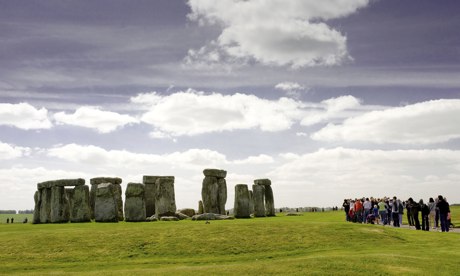
Stonehenge unveils trip back in time with new £27m visitor centre


It has been decades since visitors to Stonehenge were able to experience what Neolithic man did when he first set foot inside the gigantic stone circle.
With tourists and day-trippers barred since the late Seventies from entering the circle in order to protect the stones from damage, there has been a fierce and long-running debate on how the site should best be displayed.
But on Wednesday a new £27 million centre will open at Stonehengewith a 360 degree cinema at its heart where visitors can “experience” standing in the ancient circle.
Read the rest of this article...

Saturday, December 14, 2013

4.4 MILLION YEAR OLD HORSE HELPS UNDERSTAND HOMININ HABITAT


Two teams of researchers have announced the discovery of a new species of fossil horse from 4.4 million-year-old deposits in Ethiopia.

About the size of a small zebra, Eurygnathohippus woldegabrieli had three-toed hooves and grazed the grasslands and shrubby woods in the Afar Region, the scientists say. They report their findings in the November issue of Journal of Vertebrate Paleontology.

Very complex puzzle

The horse fills a gap in the evolutionary history of horses but is also important for documenting how old a fossil locality is and in reconstructing habitats of human forebears of the time, said Scott Simpson, professor of anatomy at Case Western Reserve’s School of Medicine, and co-author of the research. “This horse is one piece of a very complex puzzle that has many, many pieces.”
The researchers found the first E. woldegabrieli teeth and bones in 2001, in the Gona area of the Afar Region. This fossil horse was among the diverse array of animals that lived in the same areas as the ancient human ancestor Ardipithecus ramidus, commonly called Ardi.

Read the rest of this article...

Thursday, December 12, 2013

Nutrients in food vital to location of early human settlements


Research led by the University of Southampton has found that early humans were driven by a need for nutrient-rich food to select 'special places' in northern Europe as their main habitat. Evidence of their activity at these sites comes in the form of hundreds of stone tools, including handaxes.
A study led by physical geographer at Southampton Professor Tony Brown, in collaboration with archaeologist Dr Laura Basell at Queen's University Belfast, has found that sites popular with our , were abundant in foods containing nutrients vital for a balanced diet. The most important sites, dating between 500,000 to 100,000 years ago were based at the lower end of , providing ideal bases for early hominins - early humans who lived before Homo sapiens (us).
Professor Brown says: "Our research suggests that floodplain zones closer to the mouth of a river provided the ideal place for hominin activity, rather than forested slopes, plateaus or estuaries. The landscape in these locations tended to be richer in the nutrients critical for maintaining population health and maximising reproductive success."
Read the rest of this article...

Revealed: how prehistoric 'des res' gave Stone Age Brits a perfect diet

25-site survey shows that early humans chose predominantly to live on islands in the flood plains of major rivers

Stone Age Brits were past masters at choosing the perfect ‘des res’, according to new research carried out by archaeologists.

Their investigations have revealed that, 300,000 years before the emergence of anatomically modern humans, prehistoric Britons were selecting their domestic real estate with tremendous care.

Nutritional and security considerations appear to have been the main criteria, according to the new research carried out by scholars at the University of Southampton and Queen's University, Belfast.

A survey of 25 major British and north-west French sites dating from 500,000 to 200,000 years ago has revealed that early humans – members of the now long-extinct species Homo heidelbergensis – predominantly chose to live on islands in the flood plains of major rivers. They avoided  forests and hills – and the upper and middle reaches of river systems,  and their estuaries.
Read the rest of this article...

Sumatra coastal cave records stunning tsunami history

The cave retains the deposits washed ashore by huge waves over thousands of years

A cave on the northwestern coast of Sumatra holds a remarkable record of big tsunamis in the Indian Ocean.
The limestone opening, close to Banda Aceh, retains the sandy deposits washed ashore by huge, earthquake-induced waves over thousands of years.
Scientists are using the site to help determine the frequency of catastrophes like the event of 26 December 2004.
This is being done by dating the cave's tsunami-borne sediments, which are easy to see between layers of bat droppings.
Read the rest of this article...

Wednesday, December 11, 2013

Discovery of Partial Skeleton Suggests Ruggedly Built, Tree-Climbing Human Ancestor


A human ancestor characterized by "robust" jaw and skull bones was a muscular creature with a gorilla-like upper body and more adaptive to its environment than previously thought, scientists have discovered.

Researchers found a partial skeleton -- including arm, hand, leg and foot fragments -- dated to 1.34 million years old and belonging to Paranthropus boisei at the Olduvai Gorge World Heritage fossil site in Tanzania. The find, published in the latest edition of the scientific journal PLOS ONE, represents one of the most recent occurrences ofP. boisei before its extinction in East Africa.

Read the rest of this article...

Neolithic tridents discovered in northern England


Tullie House museum  in Carlisle, Northwest England, has been donated two very rare Neolithic wooden tridents by Cumbria County Council and is putting them on display for the public to give their theories onwhat they were used for.

Neolithic tridents discovered in northern England
Tridents on display. Image Tullie House Museum [Credit: © Tullie House
Museum and Art Gallery Trust]
The two tridents were discovered during the archaeological excavations prior to the construction of the Carlisle Northern Development Route (CNDR), and add to the mystery surrounding identical finds in Cumbria and Northern Ireland around 200 years ago.

Read the rest of this article...

Late Stone Age settlement unearthed on Cyprus


Artifacts found at an archaeological site in Cyprus support a new theory that humans occupied the tiny Mediterranean island about 1,000 years earlier than previously believed – a discovery that fills an important gap in Cypriot history.

Late Stone Age settlement unearthed on Cyprus
Archaeology Centre research fellow Sally Stewart holds replicas of stone tools and decorative
jewellery found on Cyprus dating back to the Late Stone Age [Credit: Jessica Lewis]
Excavations at Ayia Varvara-Asprokremnos (AVA) by archaeologists from the University of Toronto, Cornell University and the University of Cyprus have uncovered, among other objects, the earliest complete human figurine on the island. The site has been carbon-dated to between 8800-8600 BC, near the beginning of the Neolithic Period – also known as the Late Stone Age – when the transition from hunting to farming economies was occurring throughout the Middle East.

Read the rest of this article...

Tuesday, December 10, 2013

Serbian Archaeologist Finds 4,000-Year-Old Chariot


Pirot – During the protective archaeological works, carried out in parallel with the construction of Corridor 10, archaeologist Zoran Mitic found the remains of beautifully decorated chariot, assumed to be aged between 3,000 and 4,000 years and to have belonged to a Thracian from the elite of the time.

According to Mitic, this an unique and extremely important item, which he found near the village of Stanicenje.
“This is a chariot, drawn by two horses. My assumption is that the chariot belonged to a Thracian citizen,” Mitic told Tanjug.
He said that this is backed by the fact that, at the location where the chariot was found, was also found a tumulus – a tomb.
Read the rest of this article...

Thursday, December 5, 2013

Leg bone gives up oldest human DNA

The Pit of Bones has yielded one of the richest assemblages of human bones from this era

The discovery of DNA in a 400,000-year-old human thigh bone will open up a new frontier in the study of our ancestors.
That's the verdict cast by human evolution experts on an analysis in Nature journal of the oldest human genetic material ever sequenced.
The femur comes from the famed "Pit of Bones" site in Spain, which gave up the remains of at least 28 ancient people.
But the results are perplexing, raising more questions than answers about our increasingly complex family tree.
Read the rest of this article...

Building is underway at The new Wessex Gallery of Archaeology, The Salisbury Museum

Anglo-Saxon satchel mount c.700 AD. Gold and Silver foils with repoussé decoration. 
Found with the burial of an Anglo-Saxon ‘princess’ at Swallowcliffe, Salisbury.
Amesbury Archer Gold Hair Tresses - 2,300 BC. The oldest gold objects found in Britain, 
Copyright Ken Geiger/National Geographic.
Polished macehead made from gneiss found with a cremation burial at Stonehenge,  3,000 – 2,500 BC.

Building is underway at The new Wessex Gallery of Archaeology, 
The Salisbury Museum

Building has begun on the new Wessex Gallery at the Salisbury Museum, which will make it clear for the first time exactly why Salisbury and it’s nearby World Heritage Sites hold a unique place in British history.

The new gallery will be of international importance, telling the story of Salisbury and the surrounding area from prehistoric times to the Norman Conquest. Realm Projects, the Nottinghamshire based builders who worked on the Hepworth Wakefield and The Jewish Museum, have been contracted to complete the works.

“By Christmas this year the major construction work will be complete,” said museum director Adrian Green with a gleam in his eye. “In roughly seven months, the new Wessex Gallery will be ready.”

Read the rest of this article...

Sunday, December 1, 2013

Neolithic sink hole uncovered near Stonehenge


An archaeology team led by an academic from London's Kingston University has delved back into a Neolithic site at Damerham, Hampshire, and uncovered a sink hole of material that may hold vital information about the plant species that thrived there 6,000 years ago.

Neolithic sink hole uncovered near Stonehenge
An archaeology team led by a Kingston University academic has delved back into a Neolithic site at Damerham, Hampshire, and uncovered a sink hole of material that may hold vital information about the plant species thriving there 6,000 years ago [Credit: Kingston University]
Dr Helen Wickstead said the find was completely unexpected and had initially confused the team digging on the farmland. This is the sixth year of the project at Damerham, located about 15 miles from the iconic British monument Stonehenge, with four areas of a temple complex excavated during the summer. The surprise came in the largest of the openings, approximately 40 metres long, where careful extractions revealed a layer of uncharacteristic orange sand and clay. Typically the archaeological survey would involve mapping and cataloguing such finds as bone, pottery and tool-making waste fragments.

Read the rest of this article...

Tuesday, November 26, 2013

Archaeologists looking for Stonehenge origins 'are digging in wrong place'

One of the mysteries of Stonehenge is how some of its stones were brought from Pembrokeshire in Wales to Wiltshire. Photograph: I Capture Photography/Alamy
For almost a century archaeologists have been braving the wind and rain on an exposed Welsh hillside in an attempt to solve one of the key mysteries of Stonehenge.
But new research about to be published suggests that over the decades they may have been chipping away at the wrong rocky outcrop on thePreseli Hills in Pembrokeshire.
The work in the hills is a crucial element in the understanding ofStonehenge because it is generally accepted that the bluestones that form part of the ancient Wiltshire monument came from this remote spot in south-west Wales. One of the many huge puzzles remains how the bluestone from Wales travelled 190 miles to the heart of south-west England.
Read the rest of this article...

NEOLITHIC DEATH RITUAL INCLUDES EARLIEST EVIDENCE FOR EUROPEAN BEER


Spanish excavations in Can Sadurní cave (Begues, Barcelona) have discovered four human skeletons dated to about 6,400 years ago. The skeletal remains of the individuals are particularly important as they are in a very good state of preservation.
An archaeological campaign carried out previously identified other individuals which were not so well preserved but belong to the same stratigraphic layer.
Archaeologists excavating  in 1999, also discovered within the cave, evidence for the earliest European beer, which may have been included as part of  the death ritual.
Excavations at Can Sadurní are carried out by Col·lectiu per la Investigació de la Prehistòria i l’Arqueologia del Garraf-Ordal (CIPAG), together with the Seminar of Studies and Prehistoric Research (SERP) of the University of Barcelona.

Read the rest of this article...

6,400 year-old burials found in Spanish cave


Excavations in Can Sadurní cave (Begues, Barcelona) have discovered four human skeletons dated at about 6,400 years ago which were buried following an unknown ritual in the Iberian Peninsula. Few caves have necropolis dated at such an ancient period: the beginning of Middle Neolithic.

6,400 year-old burials found in Spanish cave
In the case of the remains which have just been found, a light landslide from the outer part took place when corpses were quite complete or they had just began the decomposition process; it protected corpses, so they have remained in the position in which they were buried [Credit: University of Barcelona]
In addition, remains are particularly important as they are nearly complete. In fact, a campaign carried out previously identified some buried bodies, which were not so well preserved but belong to the same sepulchral layer, and the most ancient European remains of beer consumption. Excavations at Can Sadurní are carried out by Col·lectiu per la Investigació de la Prehistòria i l’Arqueologia del Garraf-Ordal (CIPAG), together with the Seminar of Studies and Prehistoric Research (SERP) of the UB.

Read the rest of this article...

Thursday, November 21, 2013

NEANDERTHAL STRING THEORY


In a further study of Neanderthal occupation at Abri du Maras, Ardèche in France, the evidence is stacking up to support the view that this group was behaviourally flexible and capable of creating a variety of sophisticated tools including projectile points and more importantly, cord and string.
Fibrous materials that can be used to create cords are difficult to find in the archaeological record and have usually rotted away, so the oldest known string dated back only 30,000 years.  However, perforations in small stone and tooth artefacts as well as shells from other Neanderthal sites in France suggested the pieces had once been threaded on string and worn as pendants.
Bruce Hardy at Kenyon College in Gambier, Ohio, explains that “The wear patterns provide circumstantial evidence of early use of string, but the evidence is not definitive.”  These items could also have been threaded onto animal sinew.

Read the rest of this article...

Another piece in Stonehenge rock source puzzle

The chances of Stonehenge's spotted dolerites not coming from Carn Goedog are 'infinitesimally small'

Research to be published this month may bring us a step closer to understanding how bluestones from Pembrokeshire ended up at Stonehenge.
Scientists from Aberystwyth University, University College London and National Museum of Wales have located the specific outcrop, Carn Goedog, in the Preseli Mountains.
This is where the distinctive spotted dolerites originated.
The findings are to be published in the Journal of Archaeological Science.
Geologist Herbert Henry Thomas first proposed in 1923 that the rocks which form the giant inner ring were specifically quarried for Stonehenge by Neolithic man around 5,000 years ago, and were hauled to Wiltshire via land and sea.
Read the rest of this article...

Deformed, Pointy Skull from Dark Ages Unearthed in France

A woman's deformed skull was found in one of the tombs, which dates to around 1,650 years ago.

The skeleton of an ancient aristocratic woman whose head was warped into a deformed, pointy shape has been unearthed in a necropolis in France.

The necropolis, found in the Alsace region of France, contains 38 tombs that span more than 4,000 years, from the Stone Age to the Dark Ages.

Rich valley

The Obernai region where the remains were found contains a river and rich, fertile soil, which has attracted people for thousands of years, Philippe Lefranc, an archaeologist who excavated the Stone Age burials, wrote in an email.

Read the rest of this article...
Saturday, November 16, 2013

DNA hint of European origin for dogs

Some dog-looking remains are more than 30,000 years old

The results of a DNA study suggest that dogs were domesticated in Europe.
No-one doubts that "man's best friend" is an evolutionary off-shoot of the grey wolf, but scientists have long argued over the precise timing and location for their emergence.
The new research, based on a genetic analysis of ancient and modern dog and wolf samples, points to a European origin at least 18,000 years ago.
Olaf Thalmann and colleagues report the investigation in Science magazine.
Read the rest of this article...

Wednesday, November 13, 2013

PREPARING FOR DEATH IN BRONZE AGE GALLOWAY


The discovery of 3 cists found within close proximity to one another has intrigued archaeologists. One of the cists contained the burial of a juvenile, while the other two were completely devoid of human remains.
The investigation began in April 2012 after a rectangular stone cist was accidentally damaged by ploughing at Blairbuy Farm in Dumfries and Galloway, southwest Scotland.   A team from GUARD Archaeology, led by Warren Bailie, was sent to investigate by Historic Scotland and it was during the excavation process that the other two cists were uncovered; one rectangular and one roughly oval in shape.

Juvenile burial

There were no artefacts present with the burial from cist 1 and no evidence of botanical offerings. The dead juvenile had been placed in a crouch position, facing north with its head resting on the left hand and the right hand placed near the pelvis.

Read the rest of this article...