Friday, April 28, 2023

Neanderthals Built Boats And Sailed 100,000 Years Ago – Long Before Modern Humans


Jan Bartek - AncientPages.com - Maritime history dates back thousands of years, och there is no doubt many ancient civilizations had excellent knowledge of navigation and sailing. Once ancient civilizations understood the value of trading, many maritime routes were established, and spices, gold, silk, and many other items were bought and sold. There is archaeological evidence magnificent ancient ships crossed the oceans, and curious explorers set foot on new lands

Still, modern humans were not the ones who invented the boat. According to a study, the first seafarers were the Neanderthals, who lived from about 400,000 to 40,000 years ago. On islands in the Mediterranean Sea, scientists have examined several artifacts and stone tools uniquely associated with the Neanderthals.

"Archaeological data from the southern Ionian Islands show human habitation since Middle Palaeolithic going back to 110 ka BP yet bathymetry, sea-level changes and the Late Quaternary geology, show that Kefallinia and Zakynthos were insular at that time. Hence, human presence in these islands indicates inter island-mainland seafaring. Seafaring most likely started some time between 110 and 35 ka BP and the seafarers were the Neanderthals. Seafaring was encouraged by the coastal configuration, which offered the right conditions for developing seafaring skills according to the “voyaging nurseries” and “autocatalysis” concepts," the research team writes in a paper published in the Journal of Archaeological Science.

Read the rest of this article...

Archaeologists Discover Ancient Necropolis Near Parisian Train Station

Researchers uncovered 50 burials dated to roughly the second century C.E.
© Camille Colonna / INRAP

Residents of Lutetia buried their dead at Saint-Jacques between the first and fourth centuries C.E.

Little is known about the Parisii, the ancient Gallic tribe that dwelled on the banks of the Seine some 2,000 years ago. At the time, the French capital that now bears the Parisii’s name was called Lutetia.

Last week, archaeologists unearthed 50 burials that may shed light on funerary traditions in the ancient city that preceded Paris. Discovered just a few feet away from a bustling train station, the graves are believed to be part of the largest known Lutetian burial site, the Saint-Jacques necropolis.

Dominique Garcia, president of the French National Institute for Preventive Archaeological Research (INRAP), tells Agence France-Presse (AFP) that the finds open “a window into the world of Paris during antiquity.”

Read the rest of this article...

Sunday, April 23, 2023

Who Were the Neanderthals & Why Are They Important to Modern Humans?


Since their discovery in 1856, the Neanderthals have been stereotyped as brutish characters, devoid of the complexities that make modern humans so dynamic and successful. Over the past few decades, research has completely upturned this notion.

Contrary to popular belief, they were a complex and intelligent species that made use of intricate tools and were capable of a wide range of activities that required mental powers of deduction and reasoning that until recently were thought only to reside in our own species.

To the average person, the Neanderthals that lived and died so long ago are not important enough to warrant any meaningful thought. But their relevance today is far more salient than people would expect.

Read the rest of this article...

Monday, April 17, 2023

Archaeologists identify a Palaeolithic bone tool workshop in Spanish cave

Image Credit : Antiquity

A study of a partition made from rocks in the El Mirón Cave has led to archaeologists identifying it as a Palaeolithic bone tool workshop.

El Mirón Cave is a cave system in the upper Asón River valley, located in the Cantabria region of northern Spain.

The cave was first discovered in 1903, leading to a series of excavations over the century revealing evidence of Palaeolithic hunter-gatherer activity, and the discovery of the “Red Lady of El Mirón”, a skeleton from the Upper Palaeolithic which was found coated with ochre, a red iron-based pigment.

In a paper published in the journal Antiquity, researchers from the University of New Mexico (UNM) have suggested that a partition made from rocks in the rear of the cave was actually used for bone tool manufacturing around 20,000-years-ago.

Read the rest of this article...

Thursday, April 13, 2023

Bone fragment reveals humans wore leather clothes 39,000 years ago

This piece of bone from 39,600 years ago has multiple puncture marks on it that seem to have been made by puncturing leather

An analysis of a 39,600-year-old bone containing strange indentations claims it was used as a punch board for making holes in leather, revealing how Homo sapiens in Europe made clothes to help them survive cold climates at that time.

“We do not have much information about clothes because they’re perishable,” says Luc Doyon at the University of Bordeaux, France, who led the study. “They are an early technology we’re in the dark about.”

The bone, from the hip of a large mammal such as a horse or bison, was discovered at a site called Terrasses de la Riera dels Canyars near Barcelona, Spain. It has 28 puncture marks on its flat surface, including a linear sequence of 10 holes about 5 millimetres apart from each other, as well as other holes in more random positions.

Read the rest of this article...

People were using psychedelic drugs in Bronze Age Europe, study finds

Es Càrritx is a grotto on Minorca, an island off the coast of eastern Spain, that's home to a Bronze Age burial site. (Research Group in Mediterranean Social Archaeoecology/Autonomous University of Barcelona)

3,000-year-old human hair — possibly from a shaman — contains traces of mind-altering substances

People have been using mind-altering substances for a long, long time.

While archaeologists and historians have long suspected that people in Bronze Age Europe consumed psychoactive drugs, they now have hard scientific evidence to back it up.

And it's all thanks to several tiny strands of human hair found impeccably preserved in a 3,000-year-old burial site in Spain.

Those hairs, researchers have found, contain traces of three different alkaloid substances that are known to cause altered states of consciousness.

"It was amazing," Rafael Mico, a professor of archeological pre-history at the Autonomous University of Barcelona, told As It Happens host Nil Köksal. "It is the first direct evidence in Europe of the consumption [of psychedelic drugs]."

Read the rest of this article...

Who Was Ötzi the Iceman?

(Credit:Zigres/Shutterstock)

Ötzi the Iceman is the oldest mummy ever found. Learn what scientists now know about the famous ancient human.

In 1991, two German tourists were hiking in the Ötztal Alps — a mountain range shared by Austria and Italy — when they stumbled upon the frozen remains of a dead man. The ice preserved the man so well that his body, clothes and tools never decomposed.

Scientists dubbed him Ötzi the Iceman and began studying the naturally-preserved mummy. They’ve determined he lived more than 5,000 years ago, which makes Ötzi the Iceman the oldest mummy ever found.

Researchers are still studying the mountain mummy, and Ötzi the Iceman continues to unlock answers about what daily life was like thousands of years ago. 

Read the rest of this article...

The Antikythera Mechanism: the mysterious ancient machine that should not exist?


 The Antikythera mechanism is one of the most fascinating and enigmatic artifacts from ancient Greece.

This ancient machine, discovered in the wreckage of a Greek shipwreck, has puzzled historians, archaeologists, and scientists for over a century.

It's a device that is so advanced that it seems to belong in a much later period of human history, and its discovery has raised many questions about the sophistication of ancient Greek technology.

Here, we will explore the mysteries of the Antikythera mechanism, including its purpose, its creators, and the ways in which it has challenged our understanding of ancient technology. 

Read the rest of this article...

Wednesday, April 12, 2023

Evidence of drug use during Bronze Age ritual ceremonies has been discovered in Europe for the first time

View of the entrance of Es Càrritx (upper left); the deposit of Chamber 5 with the tubes containing the human hair placed at the center (upper right, courtesy of Consell Insular de Menorca); plan of the cave and section of the deposit found in chamber 5 (P. Arnau, J. L. Florit, J. Márquez & M. Márquez).

The researchers believe that these substances were likely used as part of ritual ceremonies, and that they may have been ingested orally or smoked. They also suggest that the use of these drugs may have been associated with shamanism or other forms of religious or spiritual practice.

This is the first direct evidence of drug use in Europe during the Bronze Age, and it provides new insights into the beliefs and practices of people during this time period. The study also suggests that the use of psychoactive drugs may have been more widespread in Europe than previously thought.

The researchers hope that their findings will lead to further research into the use of drugs in Bronze Age Europe, and that it will help to shed light on the cultural and religious beliefs of this time period.

Read the rest of this article...

Tuesday, March 7, 2023

Evidence for world’s first horse riders found in eastern Europe, dating back nearly 5,000 years

Grave of a horse rider discovered in Malomirovo, Bulgaria. Credit: Michał Podsiadło.

Using horses to get around was a critical juncture for development of human society.

Human skeletons found in 4,500-5,000-year-old burial mounds in Romania, Bulgaria, Hungary and Serbia show the six distinct signs that the people were horse riders.

Using horses was a critical juncture for development of human society.

The earthen burial mounds, called kurgans, belonged to the Yamnayan culture – migrants from the Pontic-Caspian steppes which stretch across from what is now Romania, Moldova and Ukraine in the west to western Kazakhstan and the lower Volga regions of Russia in the east.

Read the rest of this article...

Details Of Ice Age Hunter-gatherers Revealed


Prehistoric hunters and gatherers from various archaeological societies had their genomes studied.

The arrival of Ice Age hunter-gatherers in Western Europe over 30,000 years as they sought warmer climes has been revealed in “astonishing” detail for the first time.

Researchers analyzed the genomes of 356 prehistoric hunter-gatherers from different archaeological cultures – including new details of 116 individuals from 14 different European and Central Asian countries.

The team explained that modern humans began to spread across Eurasia around 45,000 years ago, but previous research showed that the first modern humans that arrived in Europe did not contribute to later populations.

Read the rest of this article...

Thursday, February 23, 2023

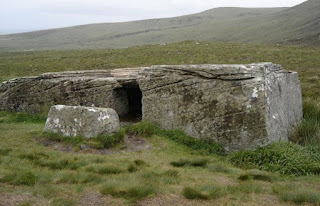
Dwarfie Stane: Mysterious 5,000-Year-Old Rock-Cut Tomb On Dark Enchanted Island Of Hoy, Scotland

The Dwarfie Stane with the entrance to the tomb. Credit: Grovel - CC BY 3.0

A. Sutherland- AncientPages.com - The "Dwarfie Stane" is a remarkable ancient and massive piece of red sandstone. This 5,000-year-old block is surrounded by mystery, which has not been solved until today.

There is no record of who, in what manner, and for what purpose or purposes, created this great tomb.

Known as the Dwarfie Stane, the curious stone lies in a steep-sided and remote valley between Quoys and Rackwick on the island of Hoy in Orkney, Scotland, and is believed to be Britain's only example of a rock-cut tomb.

The chamber was carved out between the Neolithic and the Early Bronze Age, probably around 3,000 BC. This estimation is based on similar tombs discovered in the region of the Mediterranean.

Read the rest of this article...

Modern Humans With Bows and Arrows Invaded France 54,000 Years Ago

Reproduced arrowheads made using the same flint and shot from a bow, to compare fracturing with the points found in Grotte Mandrin. Experiments by Laure Metz, Toomaï Boucherat, Christian Trubère and Ludovic Slimak show they were indeed arrowheads.Credit: Ludovic Slimak

But they didn’t stay long. New finds in southern France indicate protracted struggle: Neanderthals and humans replacing one another, more than once

Around 54,000 years ago, a group of anatomically modern humans forayed into southern France, intruding deep into the stamping ground of Neanderthals. And they came prepared, bearing the first bow and arrow technology to reach Europe – a good 10,000 years earlier than we assumed. Not that it helped them survive.

Read the rest of this article...

Grave of Elite Bronze Age Brothers With Mystery Disease Discovered

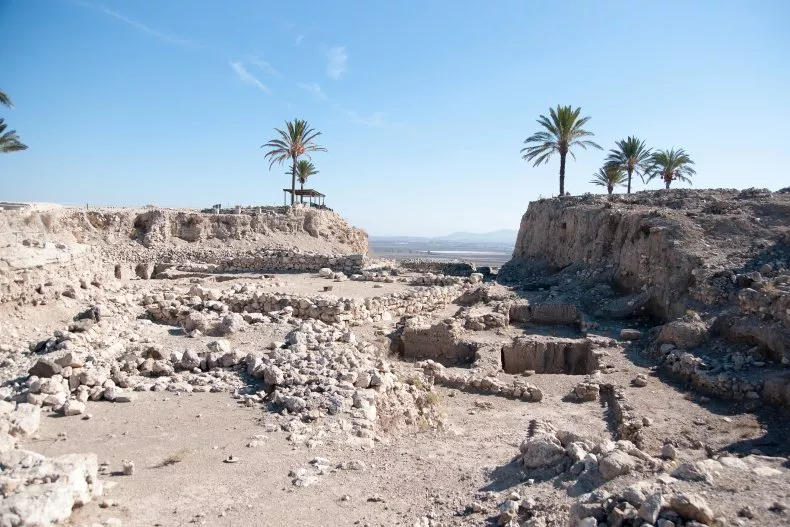
Photo of Tel Megiddo National Park in modern-day Israel. This was the site of the ancient city of Megiddo.  JAVAX/GETTY

The bodies of two Bronze Age brothers have been discovered in an ancient tomb in Israel, and they bear a mysterious disease that has left scientists puzzled.

The bones of the brothers—whose relation was confirmed by DNA analysis—both show signs of developmental abnormalities and extensive bone remodeling, characteristic of a chronic infectious disease. The identity of the disease, however, remains a mystery.

"There is no one infectious disease that seems to fit all of the lesion patterns perfectly," Rachel Kalisher, who led the study, told Newsweek. "Paleopathology is an extremely complex field of study that has to not only study modern clinical manifestations of a disease, but also think about how it could have manifested in the past."

Read the rest of this article...

54,000-Year-Old Stone Points Are Oldest Signs of Bow and Arrow Use in Europe

The site of Grotte Mandrin, in France

Artifacts discovered in a rock shelter suggest Homo sapiens was launching stone projectiles in Europe 40,000 years earlier than previously thought.

Hundreds of stone artifacts and 54,000-year-old human teeth have been found in a rock shelter in the south of France, pushing back evidence for Homo sapiens wielding the bow and arrow in Europe by 10,000 years.

The shelter—Grotte Mandrin, near the Rhône River valley—has yielded 852 artifacts, including cut stone points, blades, and flakes, which indicate to researchers that projectile weapons were being used by ancient humans there. The team’s study is published today in Science Advances, and it builds on a paper published last year that established the ancient human presence based on 54,000-year-old teeth.

Read the rest of this article...

This Man Underwent Brain Surgery 3,500 Years Ago

Two brothers’ remains were found buried together under the floorboards of their home. One had a hole in his skull consistent with surgery. Kalisher et al., 2023, PLOS One, CC-BY 4.0

While excavating a 3,500-year-old tomb in Tel Megiddo, Israel, scientists discovered a skull with a surprising feature: a square hole that’s clear evidence of an ancient brain surgery.

Nobody knows whose steady hands performed the operation, or what experience made the surgeon feel prepared to remove part of a living human’s cranium. Was the patient administered some anesthesia or a mind-altering substance? Or was he left to experience the operation in excruciating pain? And what desperate straits or last-ditch hopes led to such an extreme step?

“I can only hypothesize based off of the amount of pathological evidence that is on this individual that this was an intervention because of deteriorating conditions,” says Rachel Kalisher, a bioarchaeologist at Brown University. “But we don’t really have a clear answer.”

Read the rest of this article...

Centuries Before Stonehenge, This Settlement Housed the First European Stone Monument Builders


Whether its Stonehenge, the pyramids, or a myriad of other ancient places, we’ve long been fascinated by impressive monuments from the distant past. But more often than not, the stories of the people who built these ancient marvels are lost to the mists of time.

It’s rare to get a glimpse into the lives of the laborers whose handiwork still towers over landscapes today. But a newly-described site in France reveals the likely home base of some of Europe’s first stone monument builders, dating back to the Middle Neolithic period (4700-3700 BC).

Described this week in the journal Antiquity, researchers reconstructed a 6500-year-old settlement where a group of workers may have lived just a few kilometers from their job site. They pieced together the details of life at the settlement, including how it met a destructive fate.

Read the rest of this article...

Neanderthals spread diverse cultures across Eurasia (before we came along)

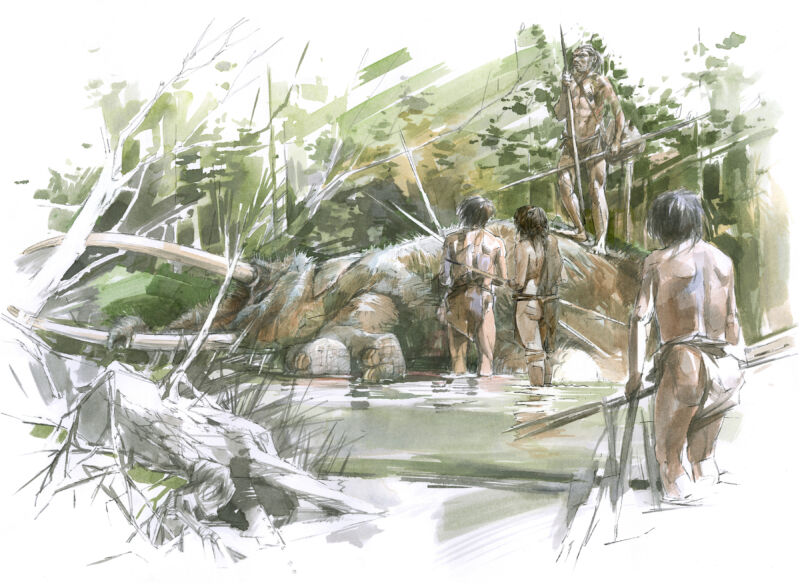
This artist's conception shows how Neanderthals might have faced down the mammoth task of butchering a freshly-killed elephant.

Two recent studies of Neanderthal archaeological sites (one on the coast of Portugal and one in central Germany) demonstrate yet again that our extinct cousins were smarter and more adaptable than we’ve often given them credit for. One study found that Neanderthals living on the coast of Portugal 90,000 years ago roasted brown crabs—a meal that’s still a delicacy on the Iberian coast today. The other showed that 125,000 years ago, large groups of Neanderthals came together to take down enormous Ice Age elephants in what’s now central Germany.

Individually, both discoveries are fascinating glimpses into the lives of a species that's hauntingly similar to our own. But to really understand the most important thing these Neanderthal diet discoveries tell us, we have to look at them together. Together, they show that Neanderthals in different parts of Europe had distinct cultures and ways of life—at least as diverse as the cultures that now occupy the same lands.

Read the rest of this article...

Thursday, February 16, 2023

Stunning reconstruction reveals 'lonely boy' with deformed skull who died in cave in Norway 8,300 years ago

Here we see a gif of a skull that gets muscles, eyes and finally hair and coloring added to it in 10 steps.It took Oscar Nilsson, a forensic artist based in Sweden, months to complete a reconstruction based on the boy's skull. (Image credit: Oscar Nilsson)

About 8,300 years ago, a teenage boy with an unusual skull and short stature may have scampered along the rocky coast of what is now Norway, pausing to regain his balance as he clutched a fishing rod. Now, a new full-body reconstruction of the Stone Age teenager — nicknamed Vistegutten, Norwegian for "the boy from Viste" — is on display at the Hå Gamle Prestegard museum in southern Norway.

The boy's reconstruction was a months-long project, but researchers have known about Vistegutten since 1907, when archaeologists found his remains in a Mesolithic, or Middle Stone Age, cave in Randaberg, along Norway's western coast. 

Read the rest of this article...

Monday, February 13, 2023

Never-Before-Seen Minoan Artifacts Exhibited in Oxford Museum

Minoan ladies women artifact Never-Before-See Minoan Artifacts Exhibited in Oxford’s Museum. Credit: ArchaiOptix / Wkimedia Commons CC BY-SA 4.0 

Over a hundred Minoan artifacts that have never left Crete and Greece before -including some which have never been displayed anywhere- launched on February 10 at Oxford’s Ashmolean Museum.

Labyrinth – Knossos, Myth and Reality is the first UK exhibition focusing on Knossos, the center of the Minoan civilization, which had been excavated by British archaeologist Sir Arthur Evans in the early 20th century.

The selection of Minoan artifacts, many of which were discovered after World War II, has been lent by the Archaeological Museum and the Ephorate of Antiquities of Heraklion, Crete, and will be exhibited until July 30, 2023, alongside discoveries from the Ashmolean’s Sir Arthur Evans Archive.

Read the rest of this article...