Tuesday, December 20, 2016

Europe's Earliest Humans Did Not Use Fire


New research conducted by scientists at the University of York and the Universitat Autonoma de Barcelona reveals for the first time that Europe's earliest humans did not use fire for cooking, but had a balanced diet of meat and plants - all eaten raw.


Studying dental plaque from a 1.2 million year old hominin (early human species), recovered by the Atapuerca Research Team in 2007 in Sima del Elefante in northern Spain, archaeologists extracted microfossils to find the earliest direct evidence of food eaten by early humans.

These microfossils included traces of raw animal tissue, uncooked starch granules indicating consumption of grasses, pollen grains from a species of pine, insect fragments and a possible fragment of a toothpick.

All detected fibres were uncharred, and there was also no evidence showing inhalation of microcharcoal - normally a clear indicator of proximity to fire.


Read the rest of this article...

Archäologen entdecken erste befestigte Flachland-Siedlung der Eisenzeit in Westfalen


Werne (lwl). Wo der Versandhandelsriese Amazon aktuell künftige Geschenke für das Weihnachtsfest lagert, deponierten die Menschen schon vor über 2.000 Jahren in Speichern und Gruben Lebensmittel und Ernten. Mit Siedlungsspuren aus dem ersten Jahrhundert vor Christi Geburt rechneten die Archäologen des Landschaftsverbandes Westfalen-Lippe (LWL) durchaus, als die Untersuchungen auf dem Gelände des neuen Logistikzentrums des Versandhändlers in Werne begannen. Dass zusätzlich eine gewaltige Befestigungsanlage bei den Bauarbeiten im neuen Gewerbegebiet Wahrbrink II zum Vorschein kam, war eine Überraschung. Die Archäologen dokumentierten hier die Spuren der ersten Siedlung der Eisenzeit in Westfalen abseits der Gebirgsregionen, die mit einem riesigen Graben gesichert war. 

Read the rest of this article...

Thursday, December 15, 2016

Neanderthals visited seaside cave in England for 180,000 years


SAINT HELIER, Jersey, Dec. 14 (UPI) -- Neanderthals may have taken vacations, or at least they liked the view from the granite cliffs of Jersey. New evidence suggests Neanderthals visited La Cotte de St Brelade, a prehistoric site on the island of Jersey, for at least 180,000 years.
Previous surveys of La Cotte de St Brelade have been limited in scope, focused mostly on concentrations of mammoth remains within the cave. The latest effort involved a wide-angle approach.
Researchers re-examined stone artifacts unearthed in the 1970s to better understand how they were made and where materials were sourced from. The survey helped archaeologists get a better sense of how visitors to La Cotte de St Brelade utilized local resources and the surrounding landscape. The analysis also revealed where Neanderthals were visiting from.
Read the rest of this article...

Wednesday, December 14, 2016

Sex of prehistoric hand-stencil artists can be determined forensic analysis


"This geometric approach is very powerful as it allows us to look at the palm and fingers independently," researcher Patrick Randolph-Quinney said.

Researchers built a model cave wall to test their ability to determine the sex of hand stencil artists in the lab. Photo by University of Liverpool

Attempts to determine the sex of prehistoric hand-stencil artists have turned up contradicting conclusions. Researchers in England and South Africa suggest focusing on hand size and finger length is unreliable.

To solve the problem, scientists adopted a forensics technique to yield more definitive results. Scientists believe the new analysis strategy can sex 40,000-year-old hand stencils with 90 percent accuracy.

"The problem with focussing on hand size and finger length is that two different shaped hands can have identical linear dimensions and ratios," Patrick Randolph-Quinney, a forensic anthropologist at the universities of Central Lancashire and Witwatersrand, said in a news release. "To capture shape, we applied geometric morphometrics, a technique used in forensic studies that had never been tested on hand stencils before."

Read the rest of this article...

Late Bronze Age Grave Of Yound Girl Wearing Elaborate Diadem Found In Northern Greece

The skeleton of the young girl as found during the discovery of the tomb [Credit: Ethnos]

The coronet was unearthed among a trove of other valuable personal items found in the grave of a young girl thought to be between 6-7 years of age.

The diadem, which is comprised of three rows of spherical bronze plates mounted on a perishable material (leather or, more likely, a fabric), was wrapped at least twice around the girl's head.

Archaeologist Konstantinos Noulas said the skeleton of the girl, found in a strongly contacted position in the grave, was adorned with numerous jewels and precious items. Among these was a necklace with glass and carnelian beads, a bracelet, three bronze rings, two bronze girdles or belts, while pottery surrounded the interior of the grave.

Read the rest of this article...

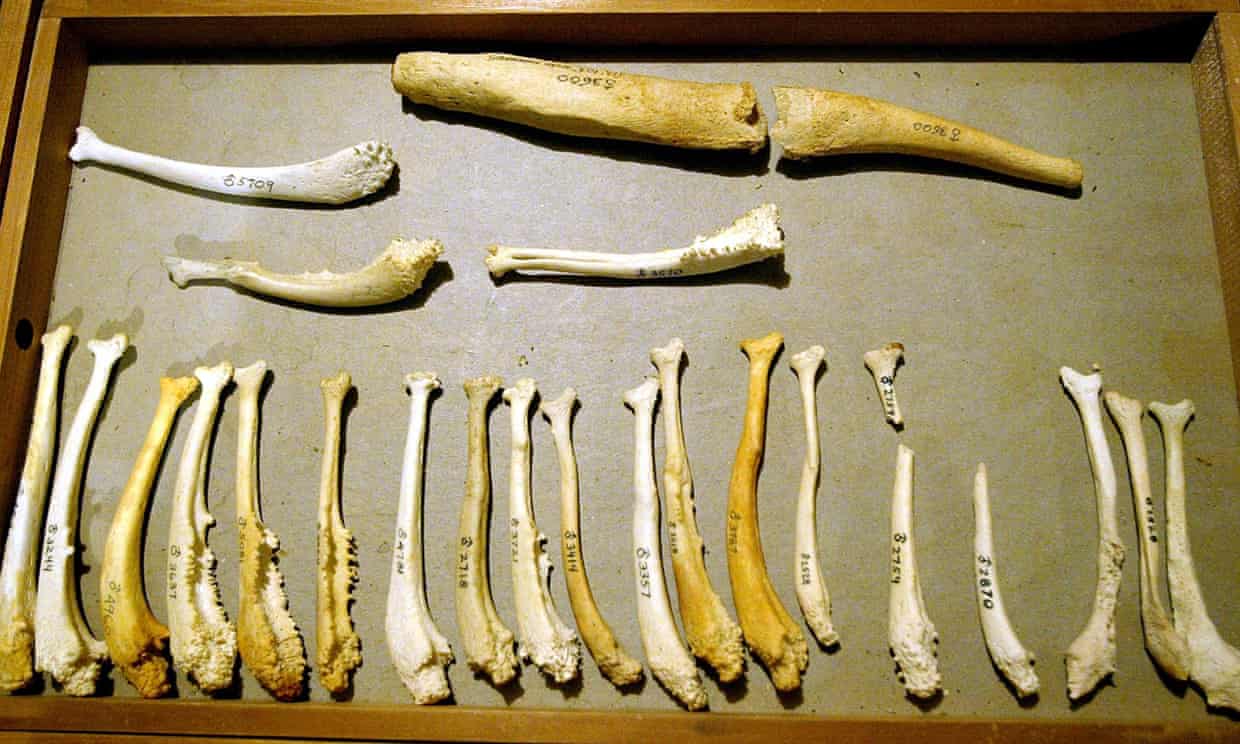
Why don't humans have a penis bone? Scientists may now know


Speed of human mating might be behind the lack of a baculum in humans, suggests study tracing bone’s evolution


It can be as long as a finger in a monkey. In the walrus, it can be two feet long. But the human male has lost it completely. And researchers are a little stumped.
Known as the baculum to scientists with an interest, the penis bone is a marvel of evolution. It pops up in mammals and primates around the world, but varies so much in terms of length and whether it is present at all, that it is described as the most diverse bone ever to exist.
Prompted by the extraordinary differences in penis bone length found in the animal kingdom, scientists set out to reconstruct the evolutionary story of the baculum, by tracing its appearance in mammals and primates throughout history.
Read the rest of this article...
Sunday, December 11, 2016

France to unveil stunning copy of landmark prehistoric art cave


More than 70 years after the original cave was discovered, France will unveil a stunning real-to-life copy of the 18,000 year-old Lascaux cave, which cost €66 million and took four years to create.
The last of four boys who discovered the Lascaux cave paintings, a stunning display of prehistoric art in southwest France, will visit a new replica of the site Saturday.
Simon Coencas, now 89, will join President Francois Hollande for the inauguration of the display at a visitors' centre in Montignac, a village at the foot of the hills where he discovered the cave as a teenager.
More than seven decades after he got his first look at the site, Coencas will -- health permitting -- revisit a complete copy of the caves.
Read the rest of this article...

Human blood, organs, and a surprising virus detected in ancient pottery

The vessels were interred in a burial mound near an Iron Age hillfort in Germany, known as the Heuneburg, reconstructed here.

Sometime between 600 and 450 B.C.E., a high-status individual in what is today Germany developed some disturbing symptoms: large bruises, bleeding from the nose and gums, and bloody diarrhea and urine. His fellow villagers, shocked—or perhaps intrigued—by his condition, stored his blood and organs in pottery vessels after he died, and interred them in a burial mound. Now, using a novel technique based on analyzing ancient proteins, archaeologists have reconstructed the contents of these vessels to conclude that the individual likely died from Crimean-Congo hemorrhagic fever virus (CCHFV), a severe tick-borne disease that still kills people across the world today.
"This is the first identification of CCHFV or any hemorrhagic fever virus in the archaeological record," says Conner Wiktorowicz, the study's lead researcher and a Ph.D. candidate in archaeology at Purdue University in West Lafayette, Indiana. It’s also the only known example of human blood and organs being buried in pottery vessels during this time in this region, raising the question of whether this was a more widespread practice, previously unknown to archaeologists.
The contents of ceramic vessels decay over time, leaving a film of residue containing proteins from any organic matter stored within. Archaeologists are exploring new ways to recover and analyze these proteins. In the new study, a team led by Wiktorowicz ground up a small portion of each of the pottery fragments (or sherds), used detergent and other chemicals to dislodge any proteins stuck to them, and isolated and analyzed the protein fragments using various techniques. The team then fed this information into a national protein database.
Read the rest of this article...

Wednesday, December 7, 2016

Archaeologists uncover clues to life of Iron Age man


Archaeologists have been able to provide insights into the life of a man whose remains were found at an Iron Age site on Orkney.
A human jaw with two teeth was discovered centrally placed in a large, carved whalebone vertebra within the ruins of a broch earlier this year.
Analysis, including radiocarbon dates, of the find on South Ronaldsay show the man died when he was 50 or older.
His diet also appears to have been unusually rich in fish.

Read the rest of this article...
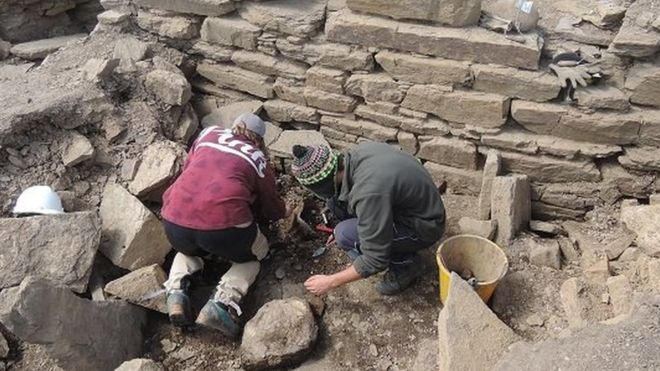
Anglesey dig discovers human remains at 'internationally important' neolithic site


Archaeologists have also unearthed a fourth house from the period at the Llanfaethlu dig.
CR Archeology have been working at the site since late 2014 and have called the discoveries made there "unparalleled".
More than 6,000 artefacts have been recovered which is the most of any Prehistoric site in North Wales and these include a massive range of pottery styles from both the neolithic and Bronze age.
The discovery of two partial sets of human remains could cause a "revolution" in how historians view the origins of North Wales agriculture, say CR Archeology, who have been working with Anglesey Council, Wynne Construction and Gwynedd Archaeological Planning Services.
Read the rest of this article...
Moderner als gedacht - Neandertaler passten ihre Überlebensstrategien aktiv an


Wissenschaftler des Senckenberg Center for Human Evolution and Palaeoenvironment an der Universität Tübingen haben herausgefunden, dass Neandertaler auch ohne äußere Einflüsse, wie Umwelt- oder Klimaveränderungen ihre Überlebensstrategien variierten. Mit einer neuen Methode zeigen sie anhand von Karbonatisotopie an fossilen Zähnen, dass die Vorfahren der heutigen Menschen vor 250.000 Jahren moderner in ihrer Entwicklung waren als bisher gedacht.

Read the rest of this article...

Tuesday, December 6, 2016

‘Bronze Age burial reveals its long held secret’


Archaeologists studying Neolithic and Early Bronze Age human remains in the Manx Museum collection for the ‘Round Mounds of the Isle of Man’ project have made an exciting discovery. 

Contained within a box of cremated bones excavated in 1947, osteologist Dr Michelle Gamble, discovered a collection of small bone objects that had not been noticed by the excavators. The bones had been buried almost 4000 years ago at Staarvey Farm in what is now German parish, Isle of Man. 

The site was excavated by Basil Megaw (1913-2002) who was director of the Manx Museum (1945-1957). Mr Megaw had been contacted by the farmer who had hit a large stone during ploughing. Excavations revealed a stone-built cist (a box made out of stone slabs) containing fragments of burnt bone, two flint tools, and two Collared Urns (Bronze Age pots) buried upside-down. But it is only now that the bones have been studied in detail.


Read the rest of this article...

Monday, November 28, 2016

5,000-Year-Old Hill Fort 'Damaged By Metal Detectors'


Cissbury Ring is the largest hill fort in Sussex [Credit: National Trust]

A 5,000-year-old hill fort is being damaged by the "illicit use of metal detectors", police say. The damage to Cissbury Ring, on the South Downs near Worthing, is irreversible, Sussex Police said.

The use of metal detectors on scheduled monuments is prohibited without a licence.

PCSO Daryl Holter said: "Illicit metal detecting is a shady unscrupulous act, and deliberate damage to this site is irreversible."

He said the site was protected by the Ancient Monuments and Archaeological Areas Act 1979 and managed by the National Trust.

Read the rest of this article...

Wednesday, November 23, 2016

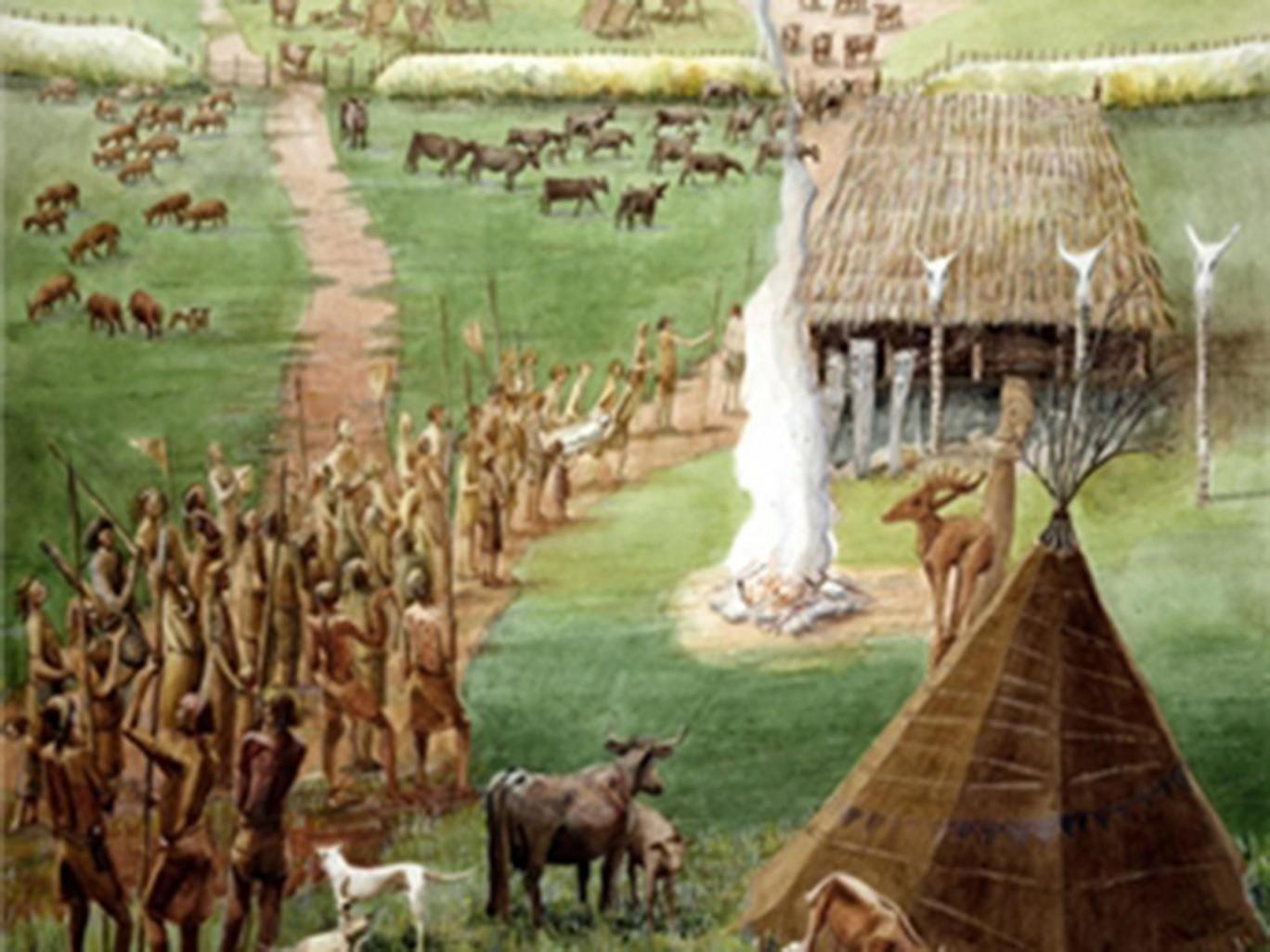
Vast 5,600-year-old religious centre discovered near Stonehenge


The centre was built more than 1,000 years before the stones of Stonehenge were erected

A reconstruction of part of a Neolithic causewayed enclosure at Windmill Hill, which would have been similar to the complex discovered near Stonehenge Historic England Archive/Judith Dobie

A huge, prehistoric religious and ceremonial complex has been discovered near Britain’s most famous prehistoric temple Stonehenge. 

Its discovery is likely to transform our understanding of the early development of Stonehenge’s ancient landscape.


Built about 5,650 years ago – more than 1,000 years before the great stones of Stonehenge were erected – the 200m-diameter complex is the first major early Neolithic monument to be discovered in the Stonehenge area for more than a century.

Read the rest of this article...
ARCHAEOLOGISTS FIND 2ND ANTIQUITY FORTRESS AT PREHISTORIC, THRACIAN ROCK SHRINE NEAR BULGARIA’S ANGEL VOYVODA

A second Antiquity fortress has been found at the ancient rock shrine Hasara near Bulgaria’s Mineralni Bani. Photo: Mineralni Bani Municipality

A second previously unknown Antiquity fortress has been found by archaeologists a prehistoric and later Ancient Thracian rock shrine in an area known as Hasara near the town of Angel Voyvoda, Mineralni Bani Municipality, Haskovo District, in Southern Bulgaria.

In May-June 2016, the team of archaeologists led by Assoc. Prof. Zdravko Dimitrov from the National Institute and Museum of Archaeology in Sofia announced the discovery of an Ancient Roman fortress with an Early Christian church at the ancient rock shrine near Bulgaria’s Angel Voyvoda.

The Ancient Thracians were found to have used the Hasara shrine at about the period of the Trojan War.

Read the rest of this article...

Archaeological finds on route of Inverness West Link

Burnt grains and timbers found while excavating a grain-drying kiln at Torvean

Prehistoric and Bronze Age finds have been made during work to construct the new Inverness West Link road.
Pottery fragments and the remains of kilns used for drying grain were among discoveries made at Torvean.
Archaeologists who have been monitoring the building of the West Link displayed some of the items at Lochardil Primary School last week.
The new road is being built for Highland Council to ease traffic flow through Inverness.
Read the rest of this article...

Friday, November 11, 2016

Prehistoric Greenlanders ate bowhead whales to survive 4,000 years ago

Bowhead whales in the Fram Strait between Svalbard and Greenlandfruchtzwerg's world/Flickr

The first humans to arrive at Greenland feasted on bowhead whales in order to survive, scientists believe. Through DNA analysis, researchers have reconstructed the diets of the first settlers, finding large marine mammals were a bigger part of their diet than previously believed.

How paleo-Eskimo cultures successfully migrated to Greenland is not entirely known. They first arrived around 4,500 years ago and there were several waves of settlement. However, most of our understanding of the culture is based on fossils analysed using traditional techniques. Because of this mostly consists of bones, a skewed picture of their diet emerges.

In a study published in Nature Communications, scientists from the University of Copenhagen looked at the DNA extracted from sediments that dated back to 2000BCE. Samples came from four well-described midden deposits and allowed the team to distinguish organic tissue, including fat, skin and microfossils. From this they could work out which species it belonged to.

Read the rest of this article...

Shackle-Bound Skeleton Found in Etruscan Burial


The gruesome find suggests the ancient people had a dark side.

Archaeologists digging in central Tuscany have brought to light a dark side of the Etruscan civilization, unearthing a 2,500-year-old skeleton still bound by shackles on his neck and ankles.

The finding appears to be the first case of an Etruscan burial containing a shackled individual.


The unusual grave was found in Populonia, a unique Etruscan settlement built directly on the sea. There, in a simple pit dug into the sandy soil near the beach of Baratti, the archaeologists found the complete skeleton of a male between 20 and 30 years of age.

tti
Read the rest of this article...

The Fate Of Neanderthal Genes


The Neanderthals disappeared about 30,000 years ago, but little pieces of them live on in the form of DNA sequences scattered through the modern human genome. A new study by geneticists at the University of California, Davis, shows why these traces of our closest relatives are slowly being removed by natural selection.


Modern humans and Neanderthals interbred tens of thousands of years ago. New work shows how the difference in  population size has led to genes that survived in Neanderthals being removed from the modern human genome 
[Credit: WikiCommons/DrMikeBaxter]

“On average, there has been weak but widespread selection against Neanderthal genes,” said Graham Coop, professor in the UC Davis Department of Evolution and Ecology and Center for Population Biology, and senior author on a paper describing the work published in the journal PLOS Genetics. That selection seems to be a consequence of a small population of Neanderthals mixing with a much larger population of modern humans.

Neanderthals split from our African ancestors over half a million years ago, and lived in Europe and Central Asia until a few tens of thousands of years ago. Archaeological discoveries have shown that they had quite a sophisticated culture, Coop said. Thanks to DNA samples retrieved from a number of fossils, we have enough data on the Neanderthal genome to identify their genes among ours.

When modern humans left Africa about 50,000 to 80,000 years ago and spread through Europe and Asia, they interbred with Neanderthals. The first hybrid offspring would have been, on average, a 50-50 mix of modern human and Neanderthal genes, and could then have themselves bred with modern humans, Neanderthals or other hybrids.

Read the rest of this article...

Monday, November 7, 2016

A 9,000-year-old axe sheds light on burial practices


Ireland’s earliest burial site gives up the secrets of our hunter-gatherer ancestors


Analysis of an axe that is more than 9,000 years old, found at Ireland’s earliest burial site, in Co Limerick, has shed light on the ancient burial practices of our hunter-gatherer ancestors.

Archaeologists believe the highly-polished stone axe, known as an adze, was made especially for the funeral of a very important person, whose remains were cremated and then buried at the site.

Microscopic analysis has revealed the shale tool, believed to be the earliest fully polished adze in Europe, was only used for a short time, and then deliberately blunted.

Situated on the banks of the river Shannon at Hermitage, Castleconnell, the burial site, dating back to between 7,530 and 7,320 BC, is twice as old as Newgrange.

Read the rest of this article...