Friday, April 12, 2013

Ötzi the Iceman Needed a Dentist


CT Scan of Otzi the Iceman's teeth
Otzi the iceman, an astonishingly preserved Neolithic mummy found in the Alps in 1991, shows evidence of severe gum disease and cavities (shown in red).
CREDIT: UZH

Ötzi the Iceman could have used a dentist. The amazingly preserved Neolithic mummy found in the Italian Alps had tooth decay, gum disease and dental trauma, new research suggests.

The new findings, published Tuesday (April 9) in the European Journal of Oral Sciences, suggest that theIceman mummy's grain-heavy diet took a toll on his dental health.
"It's surprising how bad condition he is in," said study co-author Frank Ruhli, a paleopathologist at the University of Zurich in Switzerland. "We have the whole range of disease pathologies you can imagine." [Album: What Otzi the Iceman Looked Like]


Read the rest of this article...

Pottery reveals Ice Age hunter-gatherers' taste for fish


Hunter-gatherers living in glacial conditions produced pots for cooking fish, according to the findings of a pioneering new study led by the University of York which reports the earliest direct evidence for the use of ceramic vessels.
Pottery reveals Ice Age hunter-gatherers' taste for fish
An Incipient Jomon pot from Kubodera-minami, Niigata Prefecture, Japan
ca. 15,000 years old [Credit: Tokamchi City Museum]
Scientists from the UK, the Netherlands, Sweden and Japan carried out chemical analysis of food residues in pottery up to 15,000 years old from the late glacial period, the oldest pottery so far investigated. It is the first study to directly address the often posed question "why humans made pots?" Theresearch is published in Nature.

The research team was able to determine the use of a range of hunter-gatherer "Jōmon" ceramic vessels through chemical analysis of organic compounds extracted from charred surface deposits. The samples analysed are some of the earliest found in Japan, a country recognised to be one of the first centres for ceramic innovation, and date to the end of the Late Pleistocene -- a time when humans were adjusting to changing climates and new environments.


Read the rest of this article...

Team reconstructs 'human ancestor'


Australopithecus sediba


The researchers were able reconstruct the species using bones from three different individuals

The most complete view yet of a possible human ancestor uncovered in South Africa has revealed an intriguing mix of human and ape traits.

The two-million-year-old remains of several partial skeletons belonging to a previously unknown humanlike species were found in 2008 near Johannesburg.

The new analysis shows this species -Australopithecus sediba - had a human-like pelvis, hands and teeth, and a chimpanzee-like foot.

The findings appear in Science journal.

In six separate research reports, scientists probed further into the anatomy of a juvenile male skeleton, commonly referred to as MH1, a female skeleton, known as MH2, and an isolated adult tibia or shinbone, known as MH4.

Sunday, April 7, 2013

Investigating Bronze Age stone ships on Gotland


Ship Stones in Gannarve, Gotland. Image: Jerzy Kociatkiewicz 
(Flickr, used under a CC BY-SA 3.0)


In the middle of the Bronze Age, around 1000 BCE, the quantity of metal artefacts traded in the Baltic Sea region increased dramatically. Around that same time, a new type of monument appeared along the coasts; stones set on edge and arranged in the form of ships, built by the maritime culture involved in that same metal trade.

A wide maritime network

These Bronze Age maritime groups were part of a network that extended across large parts of northern Europe and with links further to the south: a network maintained due to the increasing dependence on bronze and other important raw materials as a means of social status and cultural dependency.

Archaeologists have long assumed that bronze was imported to Scandinavia from the south, and recent analyses has now confirmed this hypothesis. However, the people who conducted the trade and formed the networks are rarely addressed, not to mention the locations of where they met.

‘One reason why the meeting places of the Bronze Age are not discussed very often is that we have been unable to find them. Which is in contrast to the trading centres of the [later] Viking Age, which have been easy to locate due to the wealth of archaeological material that was left behind,’ says the author of the thesis Joakim Wehlin from the University of Gothenburg and Gotland University.


Read the rest of this article...

Ancient monument 'damaged by cattle'


One of the Westcountry's most famous archaeological landmarks is being threatened by grazing cattle permitted by the Government's environment watchdog, campaigners have warned.

The Bronze Age stone monument, known as Men-an-Tol, has stood near Morvah, in West Cornwall, for up to 4,500 years.


It is listed as a scheduled monument with English Heritage describing it as "one of the most famous and mysterious" in Cornwall.

But campaigners fear it is now being damaged by cattle introduced onto the heathland under a Natural England agri-environmental scheme.


Read the rest of this article...

First Love Child of Human, Neanderthal Found


The skeletal remains of an individual living in northern Italy 40,000-30,000 years ago are believed to be that of a human/Neanderthal hybrid, according to a paper in PLoS ONE.

If further analysis proves the theory correct, the remains belonged to the first known such hybrid, providing direct evidence that humans and Neanderthals interbred. Prior genetic research determined the DNA of people with European and Asian ancestry is 1 to 4 percent Neanderthal.

The present study focuses on the individual’s jaw, which was unearthed at a rock-shelter called Riparo di Mezzena in the Monti Lessini region of Italy. Both Neanderthals and modern humans inhabited Europe at the time.


Read the rest of this article...

Bronze warship ram reveals secrets


Analysis of a bronze battering ram from a 2,000 year-old warship sheds light on how such an object would have been made in ancient times.

Known as the Belgammel Ram, the 20kg artefact was discovered by a group of British divers off the coast of Libya near Tobruk in 1964. The ram is from a small Greek or Roman warship – a “tesseraria”. These ships were equipped with massive bronze rams on the bow at the waterline and were used for ramming the side timbers of enemy ships. At 65cm long, the Belgammel Ram is smaller in size and would have been sited on the upper level on the bow. This second ram is known as a proembolion, which strengthened the bow and also served to break the oars of an enemy ship.

Leading marine archaeologist, Dr Nic Flemming a visiting fellow of the National Oceanography Centre, co-ordinated a team of specialists from five institutes to analyse the artefact before it was returned to the National Museum in Tripoli in May 2010. Their results have been published in the International Journal of Nautical Archaeology.

Dr Flemming said: “Casting a large alloy object weighing more than 20kg is not easy. To find out how it was done we needed specialists who could analyse the mix of metals in the alloys; experts who could study the internal crystal structure and the distribution of gas bubbles; and scholars who could examine the classical literature and other known examples of bronze castings.


Read the rest of this article...

Saturday, March 23, 2013

AFTERLIFE OF EARLY NEOLITHIC HOUSES IN THE POLISH LOWLANDS


First farmers on the Polish Lowland


The transition to farming on the Polish Lowland, which is a part of the North European Plain, was a complex process lasting over a millennium. This is partly due to the diversity of the landscapes (Figure 1) from the Pomerania Lakeland to the north with its rolling glacial hills and the south with the flat monotonous Great Poland Lowland Plain. The largest area is covered by a light sandy soil, however, in some regions heavy, fertile mollic gleysols formed over a clay subsoil can be found; comparable to the fertile loess-based soils prevailing in the uplands of southern Poland.


The Early Neolithic long house

The LBK long house is a rectangular post-built dwelling with a pitched roof structure, which rests its weight on three rows of posts along the its axis (Figure 2). The side walls are created by a row of more densely spaced external posts sunk to a shallower depth than the weight bearing posts. In the eastern part of the LBK distribution area, including Kuyavia, there is as yet no record of foundation trenches in the buildings, which is a more common feature to the west.
The length of these long houses varies from 12 to 40 plus metres, though the average is about 20 metres. The width is more standardised, ranging from between 5 to 8 metres.


Read the rest of this article...


Stone Ships Show Signs of Maritime Network in Baltic Sea Region 3,000 Years Ago


 In the middle of the Bronze Age, around 1000 BC, the amount of metal objects increased dramatically in the Baltic Sea region. Around the same time, a new type of stone monument, arranged in the form of ships, started to appear along the coasts. New research from the University of Gothenburg, Sweden shows that the stone ships were built by maritime groups.

The maritime groups were part of a network that extended across large parts of northern Europe. The network was maintained largely because of the strong dependence on bronze.
Archaeologists have long assumed that bronze was imported to Scandinavia from the south, and recent analyses have been able to confirm this notion. The distribution of bronze objects has been discussed frequently, with most analyses focusing on the links in the networks. The people behind the networks, however, are only rarely addressed, not to mention their meeting places.

Read the rest of this article...

'Out of Africa' Story Being Rewritten Again


Our early human ancestors may have left Africa more recently than thought, between 62,000 and 95,000 years ago, suggests a new analysis of genetic material from fossil skeletons.

The new findings are in line with earlier estimates, but contradict a more recent study that put humans' first exodus from Africa least 200,000 years ago.

The new results "agree with what we know from archaeology," said study co-author Alissa Mittnik, a biologist at University of Tübingen, in Germany.


Read the rest of this article...

Monday, March 18, 2013

How Beer Gave Us Civilization


HUMAN beings are social animals. But just as important, we are socially constrained as well.
We can probably thank the latter trait for keeping our fledgling species alive at the dawn of man. Five core social instincts, I haveargued, gave structure and strength to our primeval herds. They kept us safely codependent with our fellow clan members, assigned us a rank in the pecking order, made sure we all did our chores, discouraged us from offending others, and removed us from this social coil when we became a drag on shared resources.
Thus could our ancient forebears cooperate, prosper, multiply — and pass along their DNA to later generations.
But then, these same lifesaving social instincts didn’t readily lend themselves to exploration, artistic expression, romance, inventiveness and experimentation — the other human drives that make for a vibrant civilization.

Read the rest of this article...

Ancient Rock Art at Risk, Warn Experts


Chatton. Urgent action is needed to prevent ancient art disappearing, Newcastle University experts have warned. (Credit: Image courtesy of Newcastle University)


Researchers from the International Centre for Cultural and Heritage Studies (ICCHS)  and School of Civil Engineering and Geosciences (CEG) studied the physical underpinnings and condition of Neolithic and Bronze Age rock art panels in Northumberland. They conclude climate change could cause the art to vanish because new evidence suggests stones may deteriorate more rapidly in the future.
Writing in the Journal of Cultural and Heritage Studies, they say action is needed so the art can be preserved for future generations, but they also urge that a deeper understanding is needed of what causes rock art to deteriorate.
David Graham, Professor of Ecosystems Engineering (CEG) said: “We wanted to understand the scientific reasons why these stones may deteriorate. Our findings show that predicted changes to our broader environment  – such as more wind and warmer, wetter weather -  could have a devastating effect on these artworks. If we want to keep them, we need to start looking at how we can preserve them now.”

Read the rest of this article...

Friday, March 15, 2013

Failure to Hunt Rabbits Part of Neanderthals' Demise?


Neanderthals did not learn how to hunt small animals such as rabbits (pictured, a group of animals Portugal).


Rabbits are small, fast, and devilishly hard to catch. And that could have had dire consequences for Neanderthals.
A new study suggests that an inability to shift from hunting large mammals to wild rabbits and other small game may have contributed to the downfall of European Neanderthals during the Middle Paleolithic period, about 30,000 years ago.
"There have been some studies that examined the importance of rabbit meat to hominins"—or early human ancestors—"but we give it a new twist," said study lead author John Fa, a biologist at the United Kingdom's Durrell Wildlife Conservation Trust and Imperial College London.

Read the rest of this article...

Bronze Age settlement unearthed in SW England


Wick Barrow beakers [Credit: Somerset County Council]


Excavations at the Hinkley C site have revealed the remains of a 3,000-year-old Bronze Age settlement.

Archaeologists have also discovered the first Saxon grub hut to be found in Somerset, and a number of Roman features and artefacts, including a grain drier, quern stones, a stone anchor, fishing net weights, jewellery and graves.

The work was funded by EDF Energy as part of its site preparations and carried out by Somerset County Council.

Read the rest of this article...

Wednesday, March 13, 2013

Neanderthals' large eyes 'caused their demise'


The eyes have it: The Neanderthal skull (L) has larger eye sockets compared with a modern human skull (R). Consequently, the now extinct species used more of its brain to process visual information
A study of Neanderthal skulls suggests that they became extinct because they had larger eyes than our species.
As a result, more of their brains were devoted to seeing in the long, dark nights in Europe, at the expense of high-level processing.
By contrast, the larger frontal brain regions of Homo sapiens led to the fashioning of warmer clothes and the development larger social networks.
The study is published in Proceedings of the Royal Society B.

Read the rest of this article...

Ancient Reindeer Hunters Fished Ice Age Lakes


Archaeologists unearthed six fishhooks that date to 12,300 years ago, with one made from a 19,000-year-old mammoth tusk.  CREDIT: B. Gramsch 

Scientists have unearthed six fishhooks, the oldest of which was made from a 19,000-year-old mammoth tusk.  

Hunters of ice age reindeer around 12,300 years ago likely left the fishhooks, along with mammal and fish bones, in an open field in what is now Wustermark, Germany. The fishhooks, which are the oldest found in Europe, suggests humans developed fishing tools earlier than previously thought, probably to catch fast-moving fish that appeared in lakes as the climate warmed.

"These people had strong ideas to use the new resources of this changing environment," said Robert Sommer, a paleoecologist at the University of Kiel in Germany. The eel, perch and pike that entered lakes are too fast to snag with a harpoon or a spear, Sommer added.


Tuesday, March 12, 2013

Stonehenge started as graveyard, says new research


New research overturns the belief that Stonehenge was built as an astronomical calendar or observatory [Credit: Associated Press]

British researchers have proposed a new theory for the origins of Stonehenge: it may have started as a giant burial ground for elite families around 3000BC.

New studies of cremated human remains excavated from the site suggest that about 500 years before the Stonehenge we know today was built, a larger stone circle was erected at the same site as a community graveyard, according to researchers.

"These were men, women, children, so presumably family groups," University College London professor Mike Parker Pearson, who led the team, said at the weekend. "We'd thought that maybe it was a place where a dynasty of kings was buried, but this seemed to be much more of a community - a different kind of power structure."

Parker Pearson said archaeologists studied the cremated bones of 63 individuals, and believed that they were buried around 3000BC. The location of many of the cremated bodies was originally marked by bluestones, he said.


Read the rest of this article...
Saturday, March 9, 2013

Stonehenge may have been burial site for Stone Age elite, say archaeologists


Dating cremated bone fragments of men, women and children found at site puts origin of first circle back 500 years to 3,000 BC
Centuries before the first massive sarsen stone was hauled into place at Stonehenge, the world’s most famous prehistoric monument may have begun life as a giant burial ground, according to a theory disclosed on Saturday.
More than 50,000 cremated bone fragments, of 63 individuals buried at Stonehenge, have been excavated and studied for the first time by a team led by archaeologist Professor Mike Parker Pearson, who has been working at the site and on nearby monuments for decades. He now believes the earliest burials long predate the monument in its current form.

Read the rest of this article...

Tooth found in Cave of Orce named earliest human remain


A MILK tooth discovered in Granada has been declared the earliest known human remain ever found in Western Europe.
The infants tooth was unearthed in the Cave of Orce and is believed to be 1.4 million years old.
Archaeologists believe the tooth came from aHomo erectus or Homo habilis which correlates with another discovery in the cave.
In 1983, Catalan archaeologist Josep Gibert visited the cave and found a skull fragment belonging to what he dubbed the Orce Man.

Read the rest of this article...

Friday, March 8, 2013

BRONZE AGE BOAT TRIP – BY ROAD


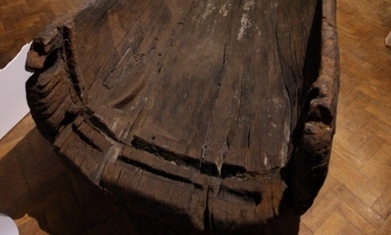
THE 3,000-year-old Carpow log boat is about to embark on another journey – not by river, but by road.
The waterlogged craft was discovered partially submerged in the mud, sand and gravel of Carpow Bank, at the head of the Tay Estuary, in 2001.
Carved from a single tree trunk, it was an example of one of the first known boats in existence and was radiocarbon dated to 1130-970 BC.

Read the rest of this article...