Archaeologists have found evidence of ancient human activity on Britain’s very own “Atlantis”.
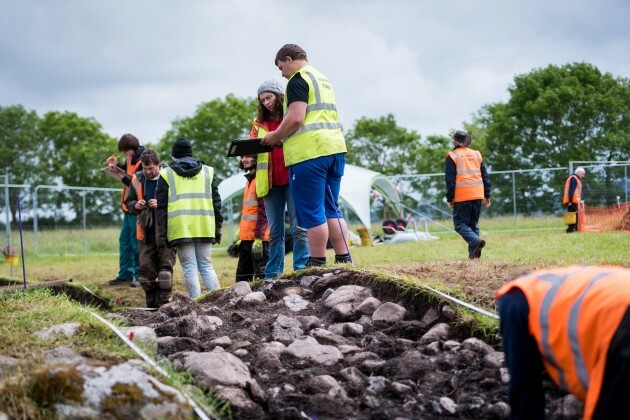
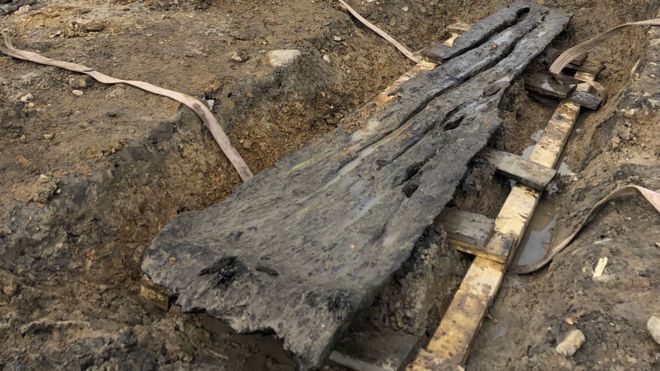
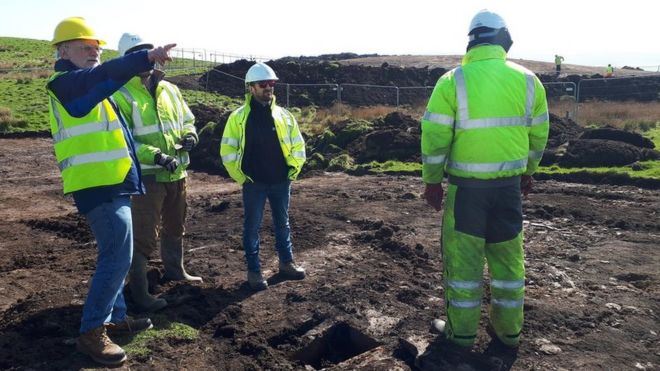
Scientists investigating a drowned Stone Age landscape at the bottom of the North Sea have discovered two potential prehistoric settlement sites on the banks of a long-vanished ancient river.
It is the first time that an archaeological expedition has ever found such evidence far offshore under the huge body of water.
In the past, prehistoric artefacts have on occasions been trawled up by fishermen and found by oil exploration teams – but the seabed contexts they came from were never archaeologically assessed.
This time, the discoveries are part of a systematic archaeological survey.
Read the rest of this article...
The Prehistoric Archaeology Blog is concerned with news reports featuring Prehistoric period archaeology. If you wish to see news reports for general European archaeology, please go to The Archaeology of Europe Weblog.
Monday, June 17, 2019
Anglesey archaeology: Bronze Age cairn dig at Bryn Celli Ddu
Bryn Celli Ddu burial chamber is aligned to the sun and is lit during the summer solstice
AERIAL-CAM
An excavation is under way on the site of a suspected 4,500-year-old burial cairn that lies next to one of Wales' most important prehistoric monuments.
Experts are hoping to learn more about it and its relationship to Bryn Celli Ddu burial chamber at Anglesey.
The 5,000-year-old "passage tomb" is aligned to coincide with the rising sun on the summer solstice.
Dr Ffion Reynolds said the cairn showed the site remained a "special location" centuries after the chamber was built.
Read the rest of this article...
Sunday, June 16, 2019
Archaeologists uncover megalithic monument thought to be unlike any found in Ireland to date
IT Sligo Archaeology students Jazmin Scally Koulak and Eugene Anderson sieving the soil at Carrowmore excavation
AN ARCHAEOLOGICAL EXCAVATION in Co Sligo has uncovered a megalithic monument thought to be unlike any found in Ireland to date.
Several prehistoric tools made from a hard stone called chert were discovered and are thought to have been used for activities such as working animal hides, cutting and preparing food, basket food, basket working and bone working.
The discovery was made by a team of archaeologists from IT Sligo during a two-week excavation of a prehistoric monument in the heart of the Carrowmore megalithic complex in Co Sligo.
Carrowmore in the largest cemetery of megalithic tombs in Ireland, with 5,500-year-old passage tombs dating from 3,600 BC.
Read the rest of this article...
Thursday, June 13, 2019
Artificial islands older than Stonehenge stump scientists
A diver holds a Neolithic (ca. 3,500 B.C) Ustan vessel found near a crannog (artificial island)
in Loch Arnish, Scotland. PHOTOGRAPH BY C. MURRAY
When it comes to studying Neolithic Britain (4,000-2,500 B.C.), a bit of archaeological mystery is to be expected. Since Neolithic farmers existed long before written language made its way to the British Isles, the only records of their lives are the things they left behind. And while they did leave us a lot of monuments that took, well, monumental effort to build—think Stonehenge or the stone circles of Orkney—the cultural practices and deeper intentions behind these sites are largely unknown.
Now it looks like there may potentially be a whole new type of Neolithic monument for archaeologists to scratch their heads over: crannogs.
Artificial islands commonly known as crannogs dot hundreds of Scottish and Irish lakes and waterways. Until now, researchers thought most were built when people in the Iron Age (800-43 B.C.) created stone causeways and dwellings in the middle of bodies of water. But a new paper published today in the journal Antiquity suggests that at least some of Scotland’s nearly 600 crannogs are much, much older—nearly three thousand years older—putting them firmly in the Neolithic era. What’s more, the artifacts that help push back the date of the crannogs into the far deeper past may also point to a kind of behavior not previously suspected in this prehistoric period.
Read the rest of this article...
Friday, June 7, 2019
DNA from 31,000-year-old milk teeth leads to discovery of new Ice Age population of big game hunters
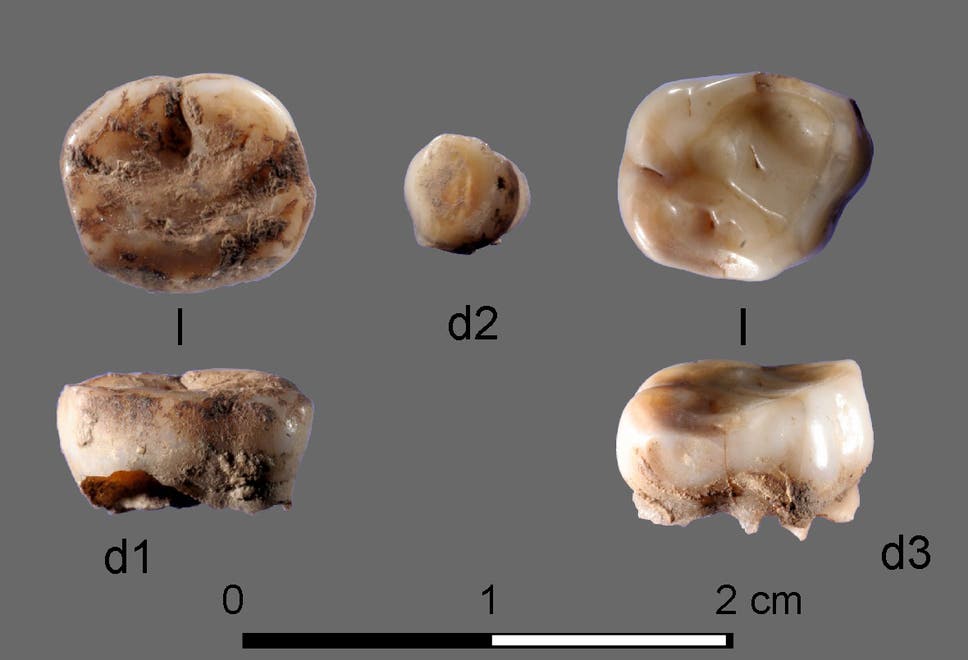
The DNA was recovered from the only human remains discovered during the era – two tiny milk teeth ( Russian Academy of Sciences )
A new Ice Age population of big game hunters that lived in the depths of Siberia has been discovered using DNA taken from 31,000-year-old human milk teeth.
Named the ‘Ancient North Siberians’ the hardy population would have hunted lions, wolves, woolly mammoths and bison, according to a study led by Cambridge University.
The find was one aspect of new research into the genetic composition of Native Americans who in part descended from these Siberian hunters.
The existence of this fierce population, who first evolved 38,000 years ago, forms “a significant part of human history”, according to lead researcher Professor Eske Willerslev.
He told The Independent: “These humans had adapted to an extremely harsh environment in terms of temperatures – it’s a part of the world that is almost completely dark all winter. There are basically no trees and they were living alongside lions, wolves, bison and rhinos.
Read the rest of this article...
Thursday, June 6, 2019
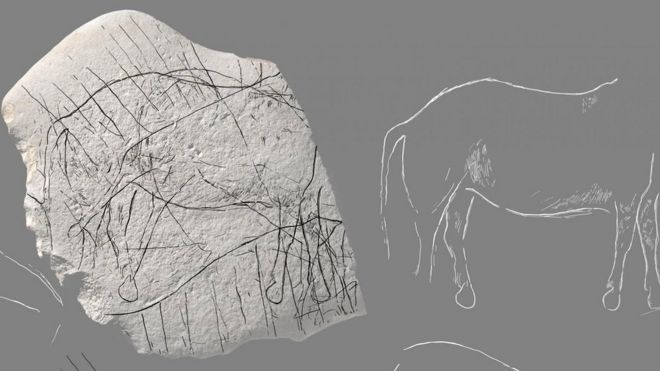
Prehistoric stone engraved with horses found in France
A generated image of the prehistoric sandstone plate and its engraving
DENIS GLIKSMAN/INRAP
A stone believed to be about 12,000 years old and engraved with what appears to be a horse and other animals has been discovered in France.
The prehistoric find by archaeologists excavating a site in the south-western Angoulême district, north of Bordeaux, has been described as "exceptional".
Markings appear on both sides of the sandstone, the National Archaeological Research Institute (Inrap) said.
It was found during work at an "ancient hunting site" near Angoulême station.
The Palaeolithic stone plate, which is said to be about 25cm long, 18cm wide and 3cm thick, "combines geometric and figurative motifs", Inrap said.
Read the rest of this article...
Wednesday, June 5, 2019
Africa’s first herders spread pastoralism by mating with foragers
INHERITING HERDING Ancient DNA indicates that early African herders started mating with hunter-gatherers more than 5,000 years ago. Here, modern herders in Tanzania watch over their goats.
Ancient sheep, goat and cattle herders made Africa their home by hooking up with the continent’s native hunter-gatherers, a study suggests.
DNA analysis shows that African herders and foragers mated with each other in two phases, says a team led by archaeologist Mary Prendergast of Saint Louis University in Madrid. After entering northeastern Africa from the Middle East around 8,000 years ago, herders swapped DNA with native foragers between roughly 6,000 and 5,000 years ago. Herders possessing some forager heritage then trekked about halfway down the continent and mated with eastern African foragers around 4,000 years ago, the scientists report online May 30 in Science.
Present-day herders, such as the Dinka in South Sudan, still live in eastern Africa. But how pastoralism spread into the region has been a mystery. In particular, it has been difficult to tell whether ancient African hunter-gatherers mated with early herders or simply adopted their livestock practices. The new study supports an emerging view from ancient DNA studies that human cultural evolution has often featured mating across groups with different traditions and lifestyles.
Read the rest of this article...
Monday, June 3, 2019
The Birdman of Siberia: sensational finds in the heart of Russia puzzle scientists
Two unique burials of the Odinov culture (early Bronze) were unearthed last year at the Ust-Tartas site in Novosibirsk region.
Inside one of them researches found several dozen long beaks and skulls of large birds assembled into something looking like a collar, a head dress, or armour.
‘Nothing of this kind was ever found as part of Odinov culture in all of Western Siberia’ said researcher Lilia Kobeleva from Novosibirsk Institute of Archeology and Ethnography.
‘Why do we think this was a part of clothing? The beaks were assembled at the back of the skull, along the neck, as if it was a collar that protected the owner when he lived here.’
Read the rest of this article...
17 amphorae from the 3rd century BC discovered off Cannes
Credit: Marc Langleur
A campaign of underwater archaeological excavations has uncovered 17 amphorae dating from the 3rd century BC at a depth of twenty metres, not far from the Lérins islands off the Bay of Cannes.
According to Anne Joncheray, archaeologist and director of the Saint-Raphaël Museum of Archaeology, the 2,300-year-old amphorae are remarkably well-preserved and were likely used to transport locally produced wine to the Greek trading posts of the Mediterranean.
Read the rest of this article...
Sunday, June 2, 2019
Whipworm eggs found in 8000-year-old human coprolites. Andrew Masterson reports.
Archaeologists carefully excavating the neolithic village.
SCOTT HADDOW
Researchers picking though 8000-year-old human faeces have identified the earliest evidence of intestinal parasite infection in the mainland Near East.
A team led by archaeologist Piers Mitchell of Cambridge University in the UK travelled to the well preserve remains of a prehistoric village called Çatalhöyük, in southern Anatolia.
The site was occupied from about 7500 to 5700 BCE, and is today a UNESCO World Heritage Site.
Apart from the extraordinarily good state of its survival, the village is of key interest because it was occupied around the period that populations in the region shifted from foraging to farming.
The change in both diet and lifestyle – particularly the emergence of permanent settlements – introduces the question of whether such a shift in living conditions also brought about a consequent change in disease profiles.
Monday, May 27, 2019
LATE BRONZE AGE SETTLEMENT DISCOVERED IN NORTHWEST BULGARIA IN TURKISH STREAM GAS PIPELINE RESCUE DIGS
A settlement originally dating back to the Late Bronze Age, which was also subsequently inhabited in the Thracian and Roman Antiquity, and the Middle Age, has been discovered by archaeologists near Rasovo in Northwest Bulgaria during rescue excavation on the projected route of the Turkish Stream natural gas transit pipeline.
A total of three archaeological sites have been found along the route of the proposed extension of the Turkish Stream gas pipeline (dubbed Turkish Stream – Northwest) that would potentially be transporting natural gas from Russian via the Black Sea, Turkey, and Bulgaria into Central Europe.
One of the three newly discovered sites is the settlement from the very end of the Bronze Age dating back to ca. 1,200 BC near today’s town of Rasovo, Medkovets Municipality, Montana District, in Northwest Bulgaria.
Because of the fact it was also inhabited during later historical periods, however, the archaeologists have described it as a “multilayer settlement".
Read the rest of this article...
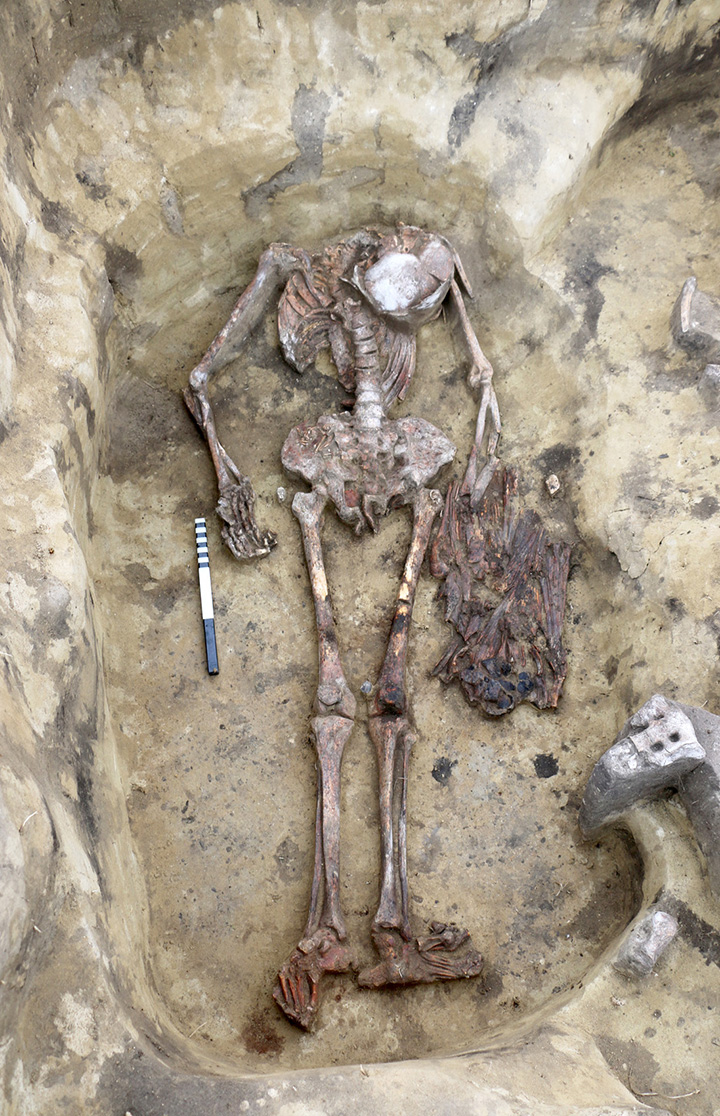
Roadworks uncover Bronze Age urn burial site in Saxony-Anhalt, Germany
Credit: ct-press
More than 100 cremation burials dating to around 800 BC have been found here, reports chief archaeologist Susanne Friederich, head of the department for the preservation of archaeological monuments at the State Office for Archaeology and Monument Conservation.
"The place obviously served as a 'cemetery' for several villages, whose remains were also found nearby", she said
"The deceased were burned on pyres. Their relatives placed their ashes and bone remains in urns, together with anything which had not been destroyed by fire, such as bronze clasps or jewellery made of metal," excavation leader Anette Schubert explains.
NOUVELLE FOUILLE DE LA TOMBE DE LA « DAME DE VIX »
Le site de Vix en Côte-d’Or est avant tout célèbre pour la tombe de « la Dame de Vix », dont la fouille, menée en 1953, a révélé un mobilier d’une incroyable richesse. Hormis la sépulture, le vaste monument funéraire qui l’abritait n’a jamais été réellement fouillé. D’août à novembre 2019, il fera l’objet, d’une importante fouille sous la direction de l’Inrap (Bastien Dubuis), en partenariat avec le Laboratoire ARTEHIS (CNRS/Université de Bourgogne) et avec le soutien de la DRAC Bourgogne-Franche-Comté et de la Communauté de Communes du Pays Châtillonnais. Les nouvelles approches et méthodes de l’archéologie devraient permettre une contextualisation et une compréhension plus fine de cette tombe emblématique du phénomène princier celtique.
Read the rest of this article...
Sunday, May 26, 2019
'Phenomenal' 2,300-year-old bark shield found in Leicestershire
The shield is made from green bark that has been stiffened with internal wooden laths.
An “astonishing and unparalleled” 2,300-year-old shield made of tree bark has been discovered in Leicestershire, the only example of its kind ever found in Europe.
Archaeologists say the discovery of the shield, made between 395 and 250BC, has completely overturned assumptions about the weapons used in the iron age, sparking breathless reactions among experts of the period.
“This is an absolutely phenomenal object, one of the most marvellous, internationally important finds that I have encountered in my career,” said Julia Farley, curator of British and European iron age collections at the British Museum.
“So often it is gold which grabs the headlines, but this bark shield is much rarer.”
Read the rest of this article...
Wednesday, May 22, 2019
New data platform illuminates history of humans' environmental impact
Animal bones on display.
Credit: © DedMityay / Adobe Stock
The human environmental footprint is not only deep, but old.
Ancient traces of this footprint can be found in animal bones, shells, scales and antlers at archaeological sites. Together, these specimens tell the millennia-long story of how humans have hunted, domesticated and transported animals, altered landscapes and responded to environmental changes such as shifting temperatures and sea levels.
Now, that story is available digitally through a new open-access data platform known as ZooArchNet, which links records of animals across biological and archaeological databases.
Making these specimen records accessible digitally helps provide a long-term perspective on current biodiversity crises, such as animal extinction and habitat loss, and could lead to more informed conservation policies, said Michelle LeFebvre, postdoctoral associate at the Florida Museum of Natural History and lead author of a study introducing ZooArchNet.
Read the rest of this article...
Sunday, May 19, 2019
Analysis of the Palaeolithic diet shows no social divisions in food consumption
Credit: University of Granada
The study of the human diet in Palaeolithic times is currently among the research areas generating the greatest advances in knowledge. Analysis of the Palaeolithic diet is conducted mainly on the basis of stable isotopes of carbon and nitrogen, which are present in the collagen of human bones. These isotopes indicate the types of food consumed by the individual in the years leading up to their death.
Researchers from the University of Granada (UGR) have analyzed the diets of past peoples from samples in the anthropological collections of the Megalithic necropolises of Panoria (Darro, Granada) and El Barranquete (Nijar, Almeria). They find that although Megalithic communities did vary their eating habits over time, there were no relevant social differences, either in the type of food or in the proportion of proteins consumed.
Read the rest of this article...
Friday, May 17, 2019
Chewing gums reveal the oldest Scandinavian human DNA
Masticate being examined
[Credit: Natalija Kashuba/Stockholm University]
[Credit: Natalija Kashuba/Stockholm University]
The first humans who settled in Scandinavia more than 10,000 years ago left their DNA behind in ancient chewing gums, which are masticated lumps made from birch bark pitch. This is shown in a new study conducted at Stockholm University and published in Communications Biology.
Ancient chewing gums are as of now an alternative source for human DNA and possibly a good proxy for human bones in archaeogenetic studies. The investigated pieces come from Huseby-Klev, an early Mesolithic hunter-fisher site on the Swedish west coast. The sites excavation was done in the early 1990's, but at this time it was not possible to analyse ancient human DNA at all, let alone from non-human tissue. The masticates were made out of birch bark tar and used as glue in tool production and other types of technology during the Stone Age.
Read the rest of this article...

Fossil teeth push the human-Neandertal split back to about 1 million years ago
CROWNING ROOTS An analysis of hominid tooth evolution, including specimens from Spanish Neandertals (top row), pushes back the age of a common Neandertal-human ancestor to more than 800,000 years ago. The bottom row shows Homo sapiens teeth.
People and Neandertals separated from a common ancestor more than 800,000 years ago — much earlier than many researchers had thought.
That conclusion, published online May 15 in Science Advances, stems from an analysis of early fossilized Neandertal teeth found at a Spanish site called Sima de los Huesos. During hominid evolution, tooth crowns changed in size and shape at a steady rate, says Aida Gómez-Robles, a paleoanthropologist at University College London. The Neandertal teeth, which date to around 430,000 years ago, could have evolved their distinctive shapes at a pace typical of other hominids only if Neandertals originated between 800,000 and 1.2 million years ago, she finds.
Gómez-Robles’ study indicates that, if a common ancestor of present-day humans and Neandertals existed after around 1 million years ago, “there wasn’t enough time for Neandertal teeth to change at the rate [teeth] do in other parts of the human family tree” in order to end up looking like the Spanish finds, says palaeoanthropologist Bernard Wood of George Washington University in Washington, D.C.
Read the rest of this article...
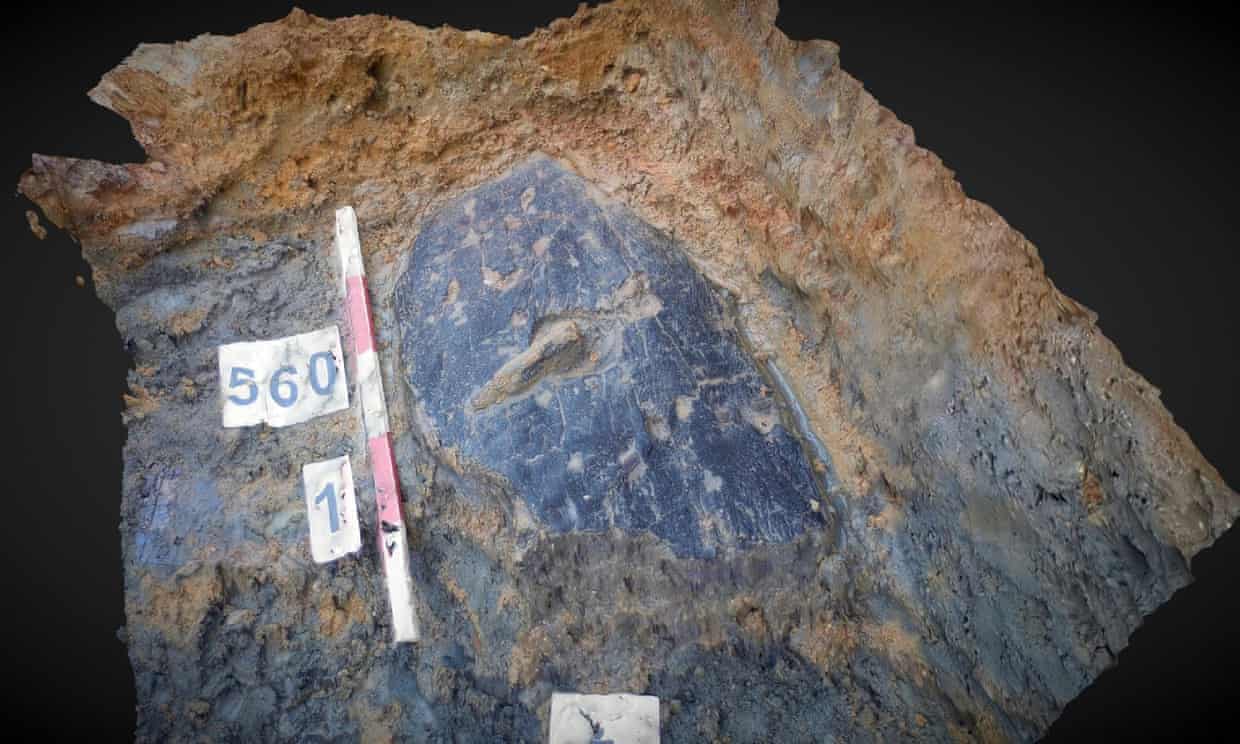
Bronze Age Caernarfon bypass find 'could be canoe'
If proven to be a canoe the timber would be a "rare find", according to experts
WELSH GOVERNMENT
Work on a bypass in Gwynedd has revealed the site of a Bronze Age mound which could contain an ancient canoe.
Archaeological excavation on the site of the Caernarfon-Bontnewydd bypass uncovered three troughs underneath a burnt mound dating back about 3,500 years.
Experts think one of the troughs may have been originally used as a dug-out canoe hollowed from an oak tree.
It would be the first prehistoric canoe ever found in north Wales if proven.
The timber has now been lifted from its discovery site and is being examined in more detail.
Bronze age burial uncovered at Orkney sub station site
The cist archaeologists have uncovered lies on top of a glacial mound
ORCA ARCHAEOLOGY
The stone lined box capped with a large flat stone was unearthed at Finstown, ahead of construction work by SSEN Transmission.
The pit - known as a cist - appears to be empty, though it would once have contained bones or cremated remains.
It's thought the burial dates back around 3,500 years.
The team from ORCA Archaeology based at Orkney College are exploring and recording the features and history of the site on behalf of the power firm.
Read the rest of this article...
Subscribe to:
Posts (Atom)