Friday, February 28, 2014

Prehistoric rock art found in Scottish Highlands


A rare example of prehistoric rock art has been uncovered in the Highlands. Archaeologists made the discovery while moving a boulder decorated with ancient cup and ring marks to a new location in Ross-shire. 


The rock decorated with cup and ring marks [Credit: BBC] 

When they turned the stone over they found the same impressions on the other side of the rock. It is one of only a few decorated stones of its kind. 

John Wombell, of North of Scotland Archaeological Society (NOSAS), said: "This is an amazing discovery."

Read the rest of this article...

Thursday, February 27, 2014

Jersey site that was last Neanderthal home studied


An ice age site said to be one of the last known places Neanderthals lived is being studied to assess storm damage. 


More Neanderthal artefacts have been found at La Cotte de St Brelade than in the rest of the British Isles [Credit: BBC] 

La Cotte in St Brelade, Jersey, was hit by south-westerly storms including winds of up to 100mph in February. A British archaeological team commissioned by the Societe Jersiaise will examine the storm damage. 

Dr Matt Pope, from the Institute of Archaeology, UCL, said it needed to consider the best solution for long-term preservation.

Read the rest of this article...

Monday, February 24, 2014

Didcot dig: MP Ed Vaizey supports history trail plans


Culture Minister Ed Vaizey is supporting a campaign for a history trail through a new housing estate.
Archaeologists discovered hunter-gatherers lived on the site of the Great Western Park development in Didcot, Oxfordshire, 9,000 years ago.
About 3,300 homes, schools and shops are being built on the 180-hectare site east of the town.
A petition in favour of installing a history trail has been signed by nearly 1,100 people.
The Didcot Dogmile group wants the archaeology found at the site marked and displayed through a trail with information boards and a reconstruction of an Iron Age roundhouse.

Read the rest of this article...

Sunday, February 23, 2014

Source of rocks used to build Stonehenge identified


A new study, published in the Journal of Archaeological Science, suggests that the site researchers had previously thought was the starting place of many of Stonehenge's rocks may not have been the source after all. Instead, it looks like the rocks actually come from a different site three kilometres away. 


Carn Goedog [Credit: Richard Bevins] 

The findings, bring into question the long-standing theory that people transported the rocks from Wales to Wiltshire in order to build the monument. 

The research focused on the smaller stones at Stonehenge, called bluestones. The chemistry of these rocks varies, but they all originate from the Preseli Hills in Wales and are thought to have been transported to the Stonehenge site over 4000 years ago. 

Read the rest of this article...

The Oldest Human Infectious Disease? MD Anderson Researcher Uncovers Some Ancient Mysteries Of Leprosy


New research at The University of Texas MD Anderson Cancer Center in Houston has unearthed some of the ancient mysteries behind leprosy, also known as Hansen’s disease, which has plagued mankind throughout history. The new research findings are published in the current edition of journal PLOS Neglected Tropical Diseases. According to this new hypothesis, leprosy disease may well be the oldest human-specific infection, with roots that likely stem back millions of years.

The PLOS NTG paper, entitled “On the Age of Leprosy” (doi/10.1371/journal.pntd.0002544) is co-authored bHanXYy Xiang Yang Han of the MD Anderson Center, and Francisco J. Silva of the Universitat de València’s Evolutionary Genetics Unit in Valencia, Spain.

Read the rest of this article...

Dozens of prehistoric burials found in West Pomerania


Dozens of prehistoric burials have been discovered by archaeologists during excavations in Nowy Łowicz in the biggest Polish military training area near Drawsko Pomorskie in West Pomerania. The study leaders were Dr. Adam Cieśliński of the Institute of Archaeology of the University of Warsaw and Andrzej Kasprzak of the Museum in Koszalin. 

Double grave of the Lusatian culture community [Credit: A. Cieślińsk/PAP] 

In the last three seasons, explored graves were mostly cremation graves of the Lusatian culture communities of the Bronze Age, from before 3 thousand years. Their number reaches 90. Last year, archaeologists found nearly 30 burials.

Read the rest of this article...

Sunday, February 16, 2014

ABBEY CRAIG: NOT JUST ANOTHER IRON-AGE HILLFORT


Scotland’s hillforts are amongst the most visible ancient monuments in the landscape; they are often large, in very prominent locations and are both physically and intellectually accessible. The majority of these hillforts are recognised to be of national significance, yet most of them remain under researched.

Murray Cook, Stirling Council’s Archaeology Officer is on a mission to raise their profile through key-hole excavation and community engagement. In September 2011, Murray, along with Claire Bird of the Stirling Council Rangers Service and the Cowane’s Hospital Trust undertook four days of excavation on the hillfort at Abbey Craig. The site is better known for the iconic 150 year old National Wallace Monument, which commemorates Sir William Wallace’s achievements at the Battle of Stirling Bridge (1297) and the Wars of Independence

Read the rest of this article...

Dating the Uluzzian


Researchers have securely dated a prehistoric human stone tool industry that is thought to have been used by early modern humans, or possibly late Neanderthals, around the time when early modern humans were beginning to emerge in Europe, arguably sometime between 40,000 to 50,000 years B.P. 
Scientists have long debated questions surrounding when the first modern humans entered Europe and what tools they first used upon entering. The Uluzzian, a prehistoric stone tool techno-tradition represented by lithic artifacts unearthed by archaeologists at cave locations primarily in Italy and Greece, has been a central contender as a possible "transitional" industry between the typical stone tool types (the Mousterian) used by late European Neanderthals and those (Aurignacian, Châtelperronian) of the earliest modern human newcomers to Europe. 
Read the rest of this article...

‘Active’ Bronze Age woman found in Highland woods


A BRONZE Age grave uncovered in the Highlands has revealed the remains of a woman in her forties who was suffering from toothache before she died 4,000 years ago.

Archaeologists from Glasgow-based Guard Archaeology were called in when a cist – a stone burial chest – was inadvertently disturbed by construction workers during landscaping of an access track through Cullaird Wood in West Torbreck, south-west of Inverness.

The team undertook a rescue excavation and found the human remains had been part of a burial.

Osteoarchaeologist Maureen Kilpatrick analysed the bones and discovered that they belonged to a woman aged between 40 and 44.

Read the rest of this article...

Archaeologists and chemists trace diets of ancient Britain


The change by our ancestors from hunter-gathers to farmers is one of the most intensively researched aspects of archaeology. Now a large-scale investigation of British archaeological sites dating from around 4,600 BC to 1,400 AD has examined millions of fragments of bone and analysed over 1,000 cooking pots. 


Early Neolithic Carinated Bowl from Knocknab, Dumfries & Galloway, one of several analyzed by researchers from the University of Bristol for a study which found that ancient Britons abandoned a fish diet for one based around milk and meat [Credit: © Alison Sheridan, National Museum of Scotland] 

The team, led by Professor Richard Evershed of the University of Bristol's School of Chemistry, developed new techniques in an effort to identify fish oils in the pots. Remarkably, they showed that more than 99 per cent of the earliest farmer's cooking pots lacked sea food residues. 

Read the rest of this article...

Bronze Age skeleton removed from school playground


THE SKELETON of a small Bronze Age man with worn-away teeth was today removed from his grave a metre beneath a primary school playground.

The 4000-year-old remains were found by archaeologists surveying Victoria Primary School in Newhaven, Edinburgh, ahead of a proposed school extension.

The archaeologists stumbled upon the well-preserved bones in late January while looking for evidence of the village’s medieval harbour.

The body was curled up in a foetal position common in the Bronze Age, and positioned alongside a pottery food or drink vessel to sustain them in the journey to the next world.

Read the rest of this article...

Tuesday, February 11, 2014

NEAR EAST CROSSROAD OF THE PALAEOLITHIC NOW QUESTIONED


The Out-of-Africa model currently holds that anatomically modern humans (AMH) evolved and dispersed from Africa into Asia from about 50,000 years ago, and then continued on later into Europe. For this reason, palaeoanthropological evidence from the Near East assumes great importance, but remains of these early modern humans are extremely scarce.

Doubt over Palaeolithic migration route

The study published in PLOSone in September 2013  suggests they may have arrived in the Near East much later than previously theorised with a concurrent knock on effect that this region was not the single crossroads through which all early humans passed on their way to colonising the Eurasian landmass.

Read the rest of this article...

A 'smoking gun' on the Ice Age megafauna extinctions


Gut content

It was climate that killed many of the large mammals after the latest Ice Age. But what more specifically was it with the climate that led to this mass extinction? The answer to this is hidden in a large number of sediment samples from around the Arctic and in the gut content from permafrozen woolly rhinos, mammoth and other extinct ice age mammals.

It is a bit of a shift in paradigme Willerslev and co-workers publish in this week's edition of the journal Nature. The common image of a light-brown grass-steppe dominating the northern hemisphere during the Ice Age does not hold any longer. The landscape was far more diverse and stable than today, and big animals like woolly rhino and mammoth fed on grasses and particularly on protein-rich forbs. But at the Last Glacial Maximum 25,000 – 15,000 years ago, at a time when the climate was at its coldest and driest, a major loss of plant diversity took place. The animals barely survived.

After the Ice Age ended about 10,000 years ago it became warmer again. After the large reduction of plant diversity during the Last Glacial Maximum another kind of vegetation now appeared. One of the key food sources of the large mammals– the protein-rich forbs – did not fully recover to their former abundance. This likely proved fatal for species like woolly rhino, mammoth, and horse in Asia and North America. Even though it became warmer again after the end of the Ice Age the old landscapes did not return.

Read the rest of this article...

Sunday, February 9, 2014

Earliest human footprints outside Africa found – in Norfolk


Archaeologists have found the earliest human footprints known outside Africa, at Happisburghon the Norfolk coast.
Dating back 800,000 years, the prints are thought to have been made by five individuals, including both adults and children.
They were identified by a team of scientists led by the British Museum, Natural History Museum, and Queen Mary University of London, after heavy seas removed beach sands to reveal a series of hollows in the silt at low tide.
Read the rest of this article...

900,000 year old footprints of earliest northern Europeans discovered


Footprints left behind by the earliest known human ancestors to live in northern Europe have been discovered after stormy seas swept sand off a beach in Norfolk

Footprints left behind by what may be one our first human ancestors to arrive in Britain have been discovered on a beach in Norfolk.
The preserved tracks, which consisted of 49 imprints in a soft sedimentary rock, are believed to be around 900,000 years old and could transform scientists understanding of how early humans moved around the world.
The footprints were found in what scientists have described as a "million to one" discovery last summer when heavy seas washed sand off the foreshore in Happisburgh, Norfolk.
Read the rest of this article...

Earliest footprints outside Africa discovered in Norfolk


Scientists have discovered the earliest evidence of human footprints outside of Africa, on the Norfolk Coast in the East of England.
The footprints are more than 800,000 years old and were found on the shores of Happisburgh.
They are direct evidence of the earliest known humans in northern Europe.
Details of the extraordinary markings have been published in thescience journal Plos One.
Read the rest of this article...

When was Britain first colonised by early humans?


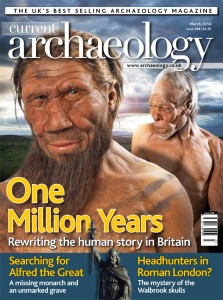
When was Britain first colonised by early humans? The famous Boxgrove bones, found in the 1990s, date back about 500,000 years, and are still the earliest hominin fossils yet found on these shores. Flints from the Cromer Forest Bed, Norfolk, though, are increasingly pointing to a much longer duration. We explore how the story of early human activity in Britain, currently the subject of a major Natural History Museum exhibition, has come to span almost one million years

Read the rest of this article...

Dartmoor tomb treasure hoard uncovered by archaeologists


Archaeologists from around the UK have been examining a hoard of treasures unearthed in a 4,000-year-old tomb on Dartmoor.
Prehistoric jewellery, animal pelts and beads made of amber were among the finds about two years ago in the burial chamber.
The chamber, known as a cist, was found on Whitehorse Hill, near Chagford.
Dartmoor National Park archaeologists have called it the most important ancient find on the moor.
When they levered off the chamber's lid they discovered an intact burial of cremated remains.
Read the rest of this article...

Thursday, February 6, 2014

Rabbits unearth a trove of New Stone Age treasure at Land's End


Burrowing bunnies have uncovered an 8,000-year old treasure trove buried near Land’s End.
The family of rabbits are believed to be responsible for unearthing the archaeological “gold mine” less than 200 yards from the Cornish landmark.

Archaeologists said that the animals had uncovered arrow heads, flint tools and hide scrapers dating back to the Neolithic Age.

Although a formal excavation of the 150-acre site hasn't started yet, the discovery suggests there could also be a large Neolithic – or New Stone Age -  cemetery, Bronze Age burial mounds and an Iron Age hill fort buried there.
Read the rest of this article...

Edinburgh Bronze Age bodies ‘part of burial sites’


Two Bronze Age bodies discovered beneath an Edinburgh primary school could be part of a nationally significant network of burial plots, archaeologists said. 


Janitor Robert Murray shows the area where prehistoric bones were uncovered [Credit: Phil Wilkinson] 

The discovery of the adult-sized figures, from about 4,000 years ago, has stunned local archaeologists. The dig was carried out as part of a routine survey ahead of the extension of Victoria Primary, in Newhaven. 

Dr Alison Sheridan, principal curator of early prehistory at the National Museums of Scotland, said: “It’s wonderful and very exciting. It’s not unique – in Merrilees Close, in Yardheads, in the 19th century, they found a cist stone box grave with two skeletons who were crouched like this. They were from around 1600BC.”


Read the rest of this article...